Does lightning strike twice in the same spot? Does Sierra Leone have the ridiculous luck of seeing two major global epidemics of life-threatening viruses within six years?
Sierra Leone is one of ten or so countries with the highest — or lowest -– rankings demographers measure. Mortality, life expectancy, literacy. Sierra Leone is again the country with an extreme. But this time that’s good. Very good.
As I write this (March 27), Sierra Leone doesn’t have a single confirmed case of COVID-19.
It’s one 10+ African countries (perhaps 20 globally) still with no confirmed COVID-19. Sierra Leone does have testing capability, in the capital and a couple cities where cases are most likely to first appear.
Sherbro Foundation just wired money this week for our Bumpeh Chiefdom friends’ COVID-19 prevention program. But first, here’s what’s happened leading up to this.
Quick response
I never thought I’d say Sierra Leone’s deadly Ebola experience was good for something. But Sierra Leone kicked into gear and, week by week, instituted early COVID-19 protective measures as they saw the rest of the world reel around them. The government and the people remember well the practical steps of managing Ebola and have responded quickly for the COVID-19 pandemic.
Air travel is the source of COVID-19 transmission for now, and Sierra Leone only has one international airport. Passengers on flights arriving from countries with 50 or more reported cases were put into automatic 14-day quarantine. This started in February 3 with passengers originating from China. Only a few airlines normally fly to Sierra Leone. Some European airlines started canceling flights in March.

As of March 23, the Sierra Leone government banned any flight from entering the country, and President Bio, above, declared a national state of emergency. 500 previous air travelers were still in quarantine.
During Ebola, the rest of the world isolated Sierra Leone and tried to keep its travelers out. Now the tables have turned. Sierra Leone is keeping the world out of its country.
With cases starting to grow in neighboring Liberia and Guinea, Sierra Leone’s land borders are closed as of March 27. Essential commodities can still pass through with strict supervision.
Ebola 2.0
So far, so good. Sierra Leone has a basic pandemic preparedness plan. Its health officials say strategies being used by coronavirus-affected countries emanated from their Ebola outbreak. And they have to be prepared for return of Ebola or Lassa Fever anytime.
The government has been working with WHO and other supporters to improve their health care capability since the Ebola epidemic, including developing three laboratories with virus testing capability. They have 370 COVID-19 test kits, and it’s stated they could get 20,000 more within 24 hours.
Sierra Leone is focusing on standard strategies to clamp down on early stages of epidemics: case management and preventive action.

President Bio washes his hands, left, before entering Lungi International airport terminal during a recent inspection visit. In a country with little running water, even in cities, buckets fitted with spigots introduced for handwashing during Ebola have now returned.
“We have one of the best contact tracing and surveillance [systems],” said the Deputy Health Minister. “Before Ebola, we had no epidemiologists. Now we have 176.” An isolation ward is ready in a military hospital, and more could quickly be set up. People who set up and ran MASH-style Ebola treatment centers around the country are still there.
All is critical in a country with few ICU units, let alone ventilators, and only in the capital.
Prevention in Bumpeh Chiefdom
When the dominoes started quickly falling in the US two weeks ago, Bumpeh Chiefdom leader Paramount Chief Charles Caulker called together his chiefdom council. Rural areas like Bumpeh Chiefdom must interpret and apply government guidance largely defined for urban areas. The chiefdom council quickly agreed to proactive steps that aren’t new for them. The next day they were in effect.
Chief Caulker fell back on their past Ebola program, with appropriate changes. Like us, they’re emphasizing social distancing and hand washing.
Per the government’s order:
> Religious services, sports events and other gatherings were closed.
> All schools close as of March 31, when current exams end. National exams for 9th and
12th grades are canceled until further notice. Same for colleges and vocational schools.
> Our partner CCET ends its education programs like after-school tutoring March 31.
Chief Caulker also set up chiefdom border controls to monitor for possible infected travelers, especially those coming from cities and larger towns. But it’s not as stringent as during Ebola when no traveler or returning resident could enter.
> Checkpoints with handwashing stations verify a traveler’s residency or business purpose at all places vehicles enter. Travelers must wash their hands before passing through.
> The old customary practice of “strangers” (nonresidents) reporting to the local chief was reinstated, including stating who their local hosts are.
Youth are being mobilized to educate villages on COVID19, going door to door and avoiding village meetings. Handwashing is emphasized, with washing stations set up in public places.
Bringing home delivery to Rotifunk
Social distancing at the big weekly market was the most problematic. Throngs of buyers and sellers crowd Rotifunk every Saturday.

It’s the town’s lifeblood, serving as the grocery, Walmart, Target and Ace Hardware for locals.
 Outside traders bring in fish, the main protein source for most.
Villagers sell their produce to outside traders who supply Freetown and other cities. Outside traders could bring in COVID-19, but closing the market would be devastating.
When solving a problem, Chief Caulker tries to maximize the solution’s benefits. Kill two birds with one stone. Or three or four birds, if possible.
He needs to get essential food safely into Rotifunk and area villages. But he didn’t want to close the market, just thin the crowds.
First, he told chiefdom residents to use the market seven days a week and bring their goods to sell any day in the usual daily market, below; not just on Saturday.

With business spread out over seven days, fewer outside traders come now. They can’t make as many sales on any one day so it’s not worth the long trip. Local villagers also get better prices for their wares with less competition.
But the biggest gain comes by taking the market to the people. Think of it as home delivery.
With Sherbro Foundation funding, Chief Caulker is expanding the Women’s Small Grant and Savings Program to add 40 more women traders. The women will use $100 grants to buy chiefdom fish or produce and sell them in designated neighborhoods, avoiding market crowds altogether. Creating job and income opportunities for the most impoverished local women is one of Chief’s ongoing priorities.
It’s a win-win all around. Outside traders who could be carrying in COVID-19 are reduced. Forty women are empowered to expand their trading businesses with capital and dedicated customers. Market customers and villagers who normally come to sell are protected by avoiding market crowds.
This solution will also keep more money in the local economy. Outside traders won’t take money outside the chiefdom. Rotifunk’s and the chiefdom’s overall economy will improve as the women traders succeed and use their increased purchasing power locally.
Pivoting for a compelling need
Sherbro Foundation is delighted to fund the 40 women traders with $100 grants.
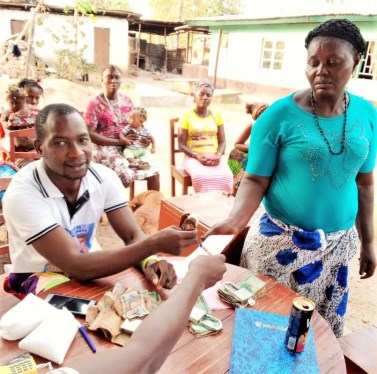 They also become part of the savings plan of the new Women’s Small Grant Program, where women deposit part of each week’s earnings, left.
At the end of the year, their total savings will be like getting a new grant.
Sherbro Foundation is also contributing to daily food stipends for the checkpoint volunteers.
Bumpeh Chiefdom and Sierra Leone are hardly out of the woods with COVID-19. But, like us, they’re buying time until therapeutic drugs or the ultimate vaccine are found.
Sherbro Foundation pivoted from other issues and helped Bumpeh Chiefdom fight Ebola in 2014-15. Being a small organization, we can respond quickly. As in 2014, within two weeks of my first phone call with Chief Caulker on their COVID-19 plan, they will have our funding in hand and start acting.
Next week, women traders will introduce food home delivery to the chiefdom. Who knows where this goes long term?
One more thing the whole dreadful Ebola experience taught me: I know we’ll get through COVID-19. On the upside, a whole new program with the potential to transform Bumpeh Chiefdom may blossom – strengthening struggling women as successful small entrepreneurs.
— Arlene Golembiewski, Executive Director
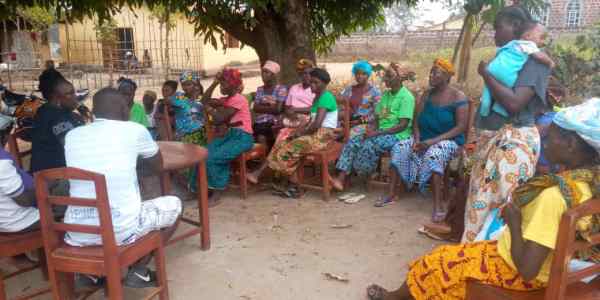


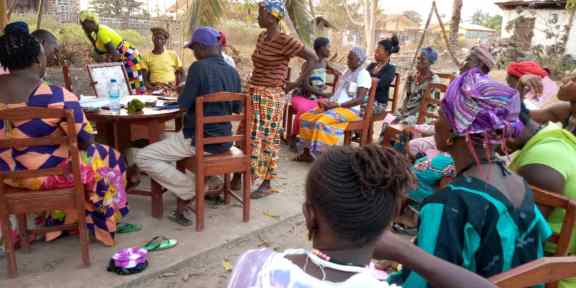
 Under the Small Grant and Savings Program, women should be able to increase the size of their trading business with their small grant and the resulting income they earn. And with required savings, they’ll have another windfall at the end of the year.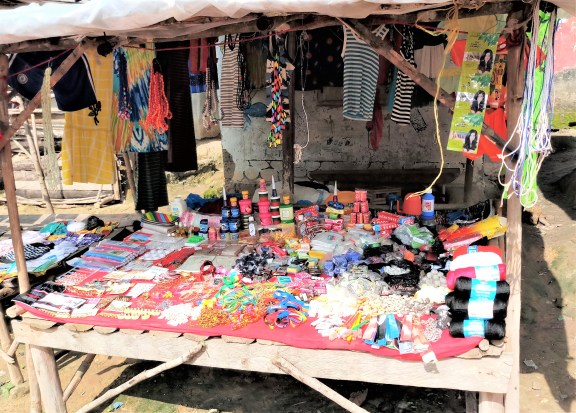
 With her remaining Le200,000 from the grant, Yeama bought cassava, a starchy tuber, and made foo foo, left, traditionally eaten on Saturday with a meat soup.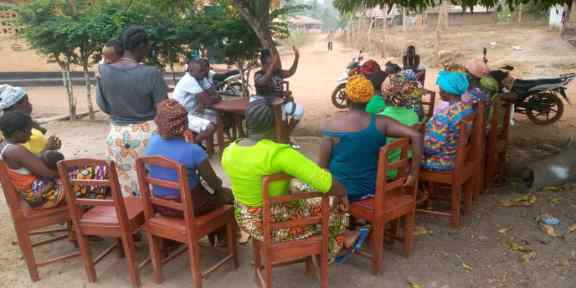


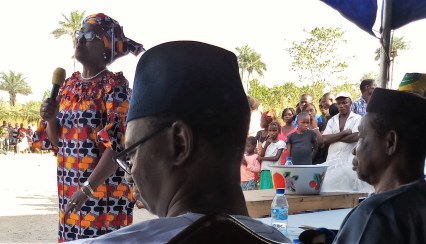 Ms. Conteh-Morgan, right, with Chief, far right, continued, “It’s not easy for someone to rule for 35 years without his people rising against him.”
 Amateur “devils” entertained the gathering crowds, as people found their seats under temporary shelters of bamboo and palm to escape the sweltering tropical sun.
 The conchama, above, took the lead. She is a special sub-chief in Bumpeh Chiefdom and one of the stalwart keepers of its oldest traditions. The conchama has been a female chief for as long as anyone can remember, and is unique among women. She was initiated into Poro and participates as a leader in the men’s society.
 The day was a mix of the traditional and the contemporary, just like the man himself.
 Some of the strongest praise came from the man who actively opposed Chief in that paramount chief election 35 years ago.
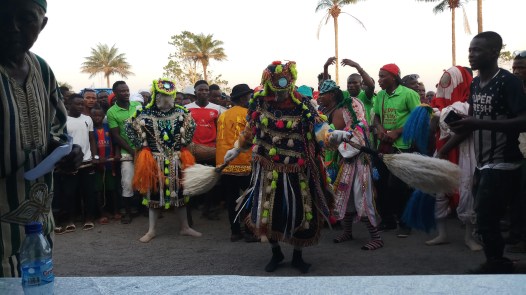

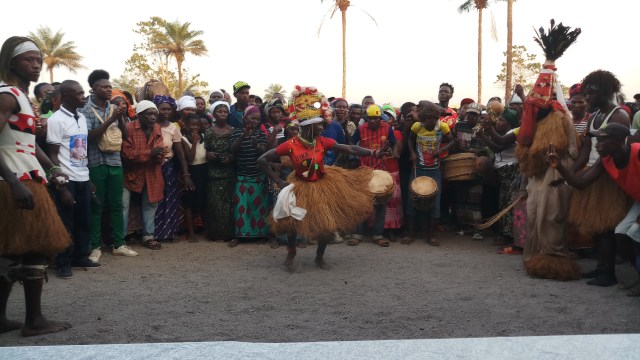

 Thirty-five years in service, but in no way is Chief Caulker retiring. He seems to just be picking up speed, with plans for the coming years pouring out.

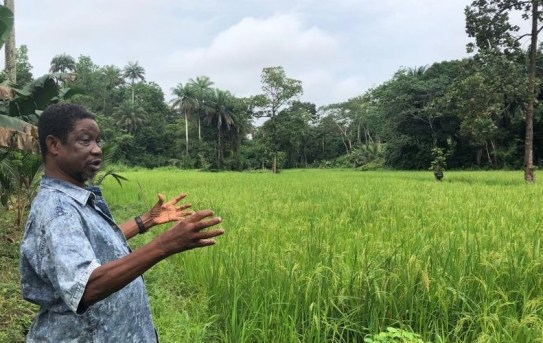

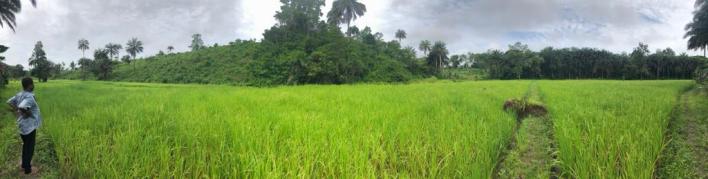
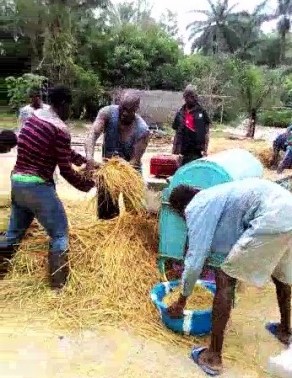 Seven acres of IVS rice, above, were just harvested in what proved to be a bumper crop.


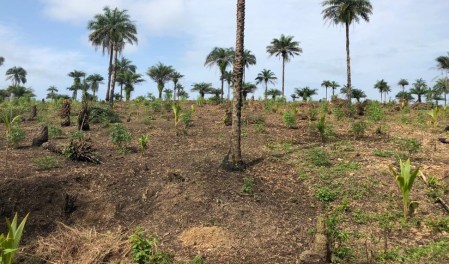 The third, most recent orchard was planted in June-July of this year
  Trees in the second orchard, left, planted in 2018 are strong, sprouting up with two rainy seasons of growth.
 The first orchard planted in 2017 is now in its third year.
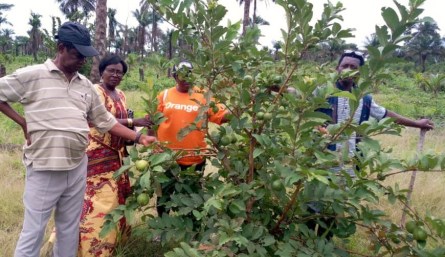 Guava and lime trees planted in 2017 in the first orchard are sporadically fruiting, and will yield a good harvest next year.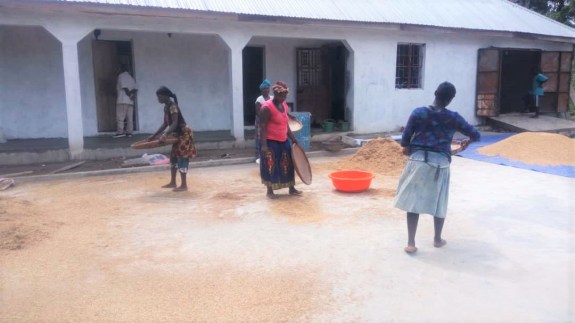


 The mini-truck, locally called a keke, is an easy and economical way to carry small loads the short distance from the project fields back into town. Here it’s being loaded with newly harvested rice sheaves.
 Loaded with rice and workers, Zainab carries all back from the fields to town.
 I always anxiously await seeing what happened to individual girls I’ve gotten to know. This picture of Fatmata proudly smiling in her senior high uniform made me smile, then left me teary thinking of her story.


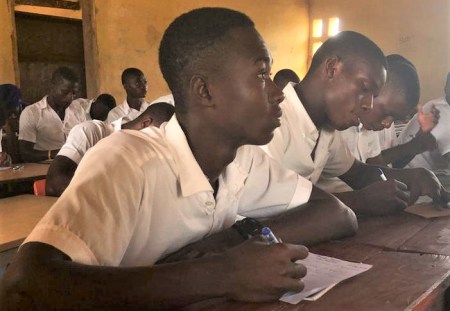 The fact is, they do. And with the scholarship program, the number of girls in Rotifunk secondary schools is catching up to their male peers.
 Student profiles show just how important it is to support boys as well as girls. Mustapha, left, is doing well now in 12th grade with his second scholarship.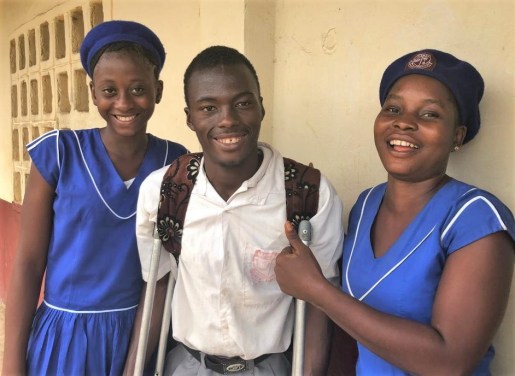

 Educating girls is one the highest impact things we can do to lift women and their communities out of poverty.
 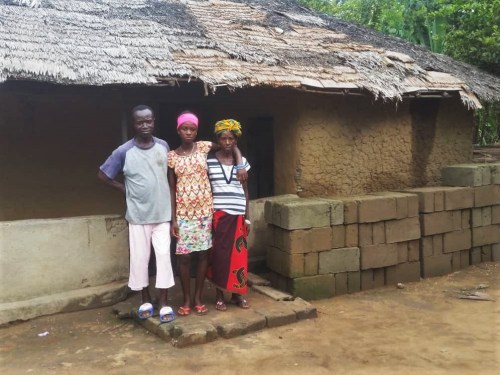 When I first saw Humu’s photo I thought, there’s a tall, slender, poised girl. A 16-year-old often shoots up in height, thin until she fills out. But I found there are other reasons why Humu is so slender.
 Humu attends our partner CCET-SL’s after-school tutoring program, left, also funded by Sherbro Foundation, that prepares girls for their senior high entrance exam.
 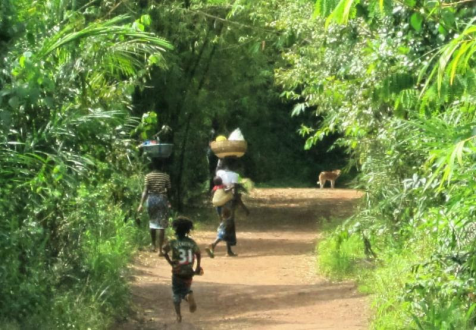 I was concerned for Humu’s safety walking this distance alone in the dark. I was relieved to hear she walks with several other Mokebbie village students.
  Humu wants to move out of the endless cycle of poverty that’s trapped her family for generations. Her grandparents care for ten children in their three-room mud brick house. With a total of sixteen in their household, it’s packed at night with children sleeping on straw floor mats. Subsistence farmers, her family grows most of what they eat and barters much of what’s left. That leaves little cash to pay school expenses. They sent their deep thanks for the scholarships that have enabled Humu to stay in school.
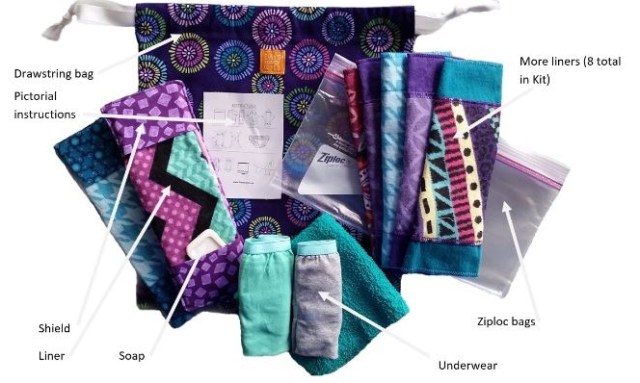 This year’s $30 scholarship package includes a wonderful addition to the school uniform and notebooks we supplied last year. All girls will get a
 Sherbro Foundation knows no one in Auburn, Maine. But someone there had hosted an exchange student from Sierra Leone. During the 2014 Ebola epidemic, they wanted to help at the grassroots level where they felt their money would be put to good use directly helping a rural Sierra Leone community. They found us on a Google search and have been giving ever since.
 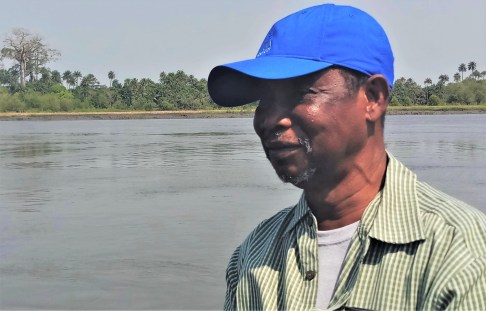 “If we could raise fruit trees on a big enough scale, we could grow our own community’s future.”
 700 coconut trees are flourishing in the first Rotary funded orchard, as well as lime, grapefruit, African plum, avocado, guava, soursop, oil palm and cassava. Most were grown in CCET’s tree nursery from local fruit seed.
 Chief Caulker, center, and Rosaline Kaimbay, CCET Managing Director, right, accept the Rotary Club of Ann Arbor flag from Mary Avrakotos. Dale Smith, Wilmington, NC Rotary Club, left, led fundraising for the medical care component of the grant.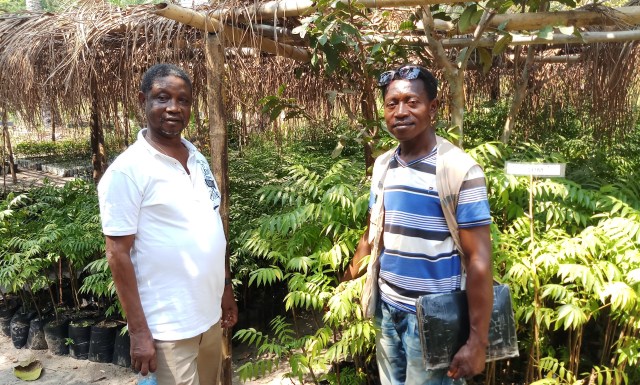
 Full-time orchard workers display their protective gear purchased from the Rotary grant: rain suits for working in the rainy season and thick rubber boots for protection against injury and snakes.
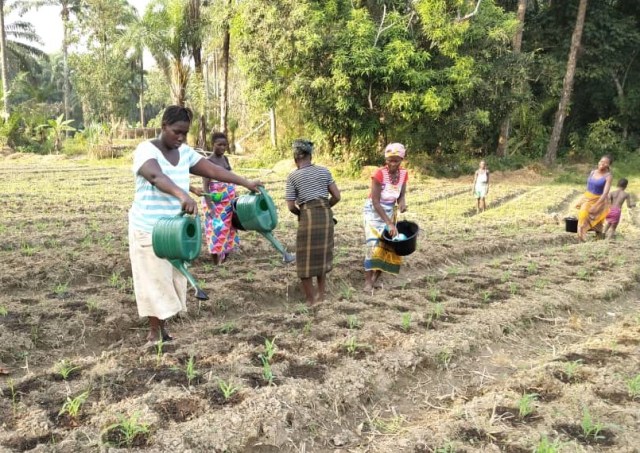
 Local women are hired as part-time workers where heavy labor is not needed. These are planting peanuts in an orchard to generate annual operating income. They’re paid wages equal to those of part-time male workers.
 School sports meets are a huge deal across Sierra Leone, but especially in rural towns like Rotifunk with little to entertain and amuse. Students march onto the sports field in brightly colored T-shirts for their house’s color, while a DJ blasts out music with massive speakers (thanks to a generator for power).
 Announcers calls out the competitors in their various track & field events and give the volleyball play-by-play account. Winners in individual events get certificates. Houses will parade around town with trophies boasting of their overall meet results.
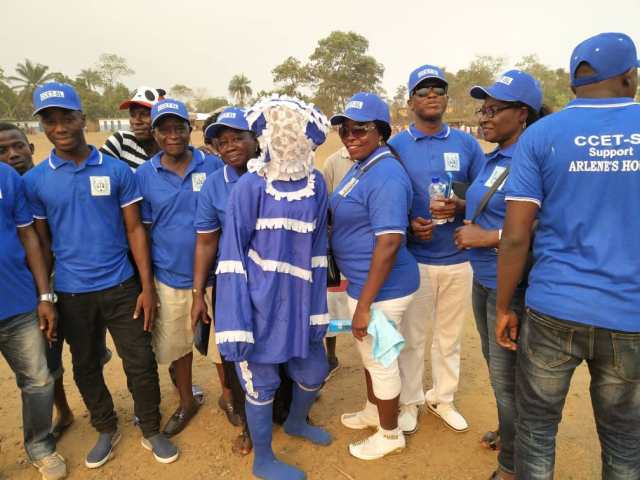 My colleagues from our partner CCET-SL turned out to support Arlene’s house. Each house comes with its own masked “devil,” a nod to their traditional societies. These devils compete in a wildly gyrating dance competition where spectators vote by tossing money in their basket.

 Our goal is for the orchards to produce annual income to run CCET’s education programs. In the meantime, we need annual crops to fund orchard operations until fruit trees mature and begin producing a few years from now.


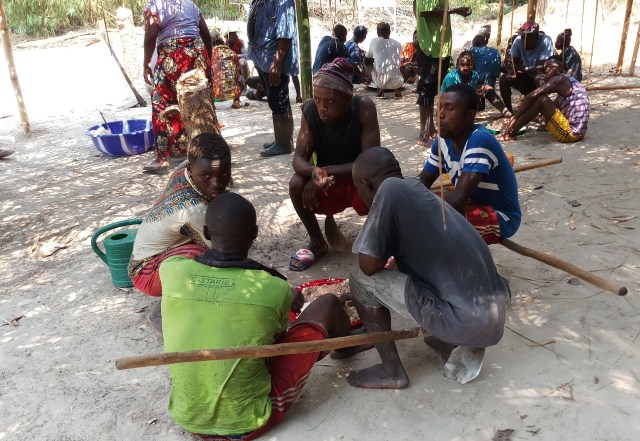

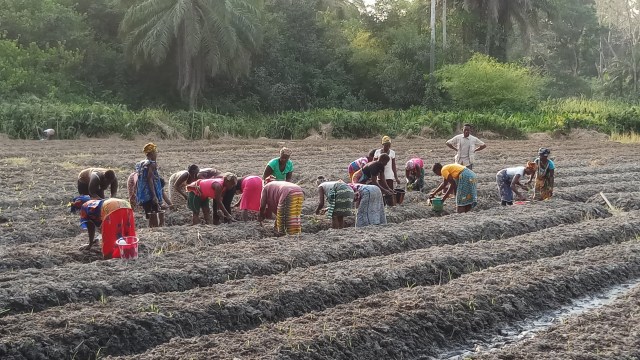

 The women were happy to receive wages for their labor.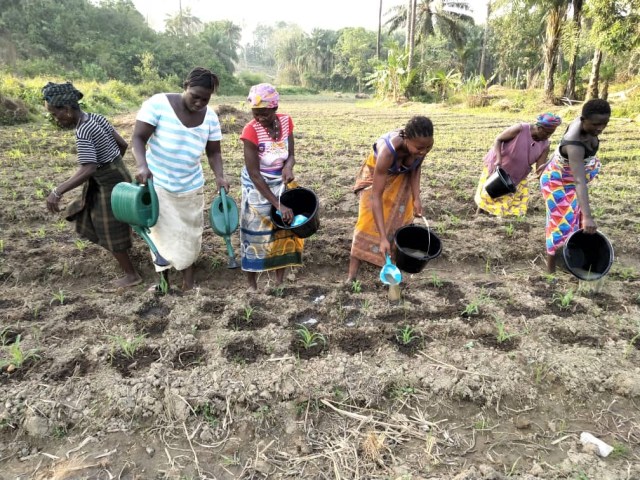


 Sherbro Foundation