$142,000 Rotary Clubs Grant Propels Bumpeh Chiefdom into Growing Its Own Future

Bumpeh Chiefdom leader Paramount Chief Charles Caulker long dreamed of developing his chiefdom using its own agriculture traditions. He wanted to grow fruit trees in his verdant tropical chiefdom that would produce income for community development for years to come.
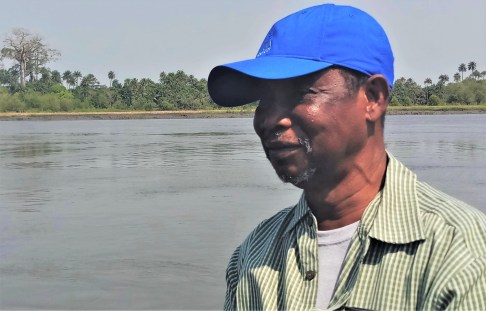
20190120_114736 (4)“If we could raise fruit trees on a big enough scale, we could grow our own community’s future.”

“We could move to eliminate poverty in the chiefdom ourselves and make people self-reliant,” he said.

But in Sierra Leone, too often it’s one step forward and two steps back. Barely had recovery from Sierra Leone’s brutal 11-year rebel war begun, when the Ebola epidemic hit in 2014. A three-year economic crisis followed with 40 percent devaluation of its currency. Just surviving was a struggle.

Now, a two-year $142,000 Rotary International Global Grant is changing that.

The Rotary Club of Ann Arbor worked collaboratively with Sherbro Foundation to secure the grant. Administered by the Center for Community Empowerment & Transformation, CCET, it funds community-led agriculture projects designed to create income for children’s education and resident medical care, and to help women subsistence farmers achieve self-reliance.

P1000710 (2)700 coconut trees are flourishing in the first Rotary funded orchard, as well as lime, grapefruit, African plum, avocado, guava, soursop, oil palm and cassava. Most were grown in CCET’s tree nursery from local fruit seed.

Nonprofit Social enterprise  The grant creates a chiefdom social enterprise, one where agriculture projects generate regular income for nonprofit purposes. Thanks to Rotary Clubs, CCET’s Orchards for Education project is expanding to plant thousands of fruit trees to fund chiefdom education. An orchard will also be planted to feed a benevolent fund paying local hospital care costs residents cannot afford. And, women farmers are being funded to grow peanuts to fully feed and educate their children.

The Rotary Club Global Grant, the second developed for CCET, was spearheaded by the Rotary Club of Ann Arbor, Mich., lead club sponsor. The Wilmington, NC Rotary Club and 17 other Rotary Clubs contributed to the grant. The Rotary International Foundation and two Rotary Districts provided matching funds. It will be overseen by the Rotary Club of Freetown, Sierra Leone and administered by CCET.
20190119_121158 (3)Chief Caulker, center, and Rosaline Kaimbay, CCET Managing Director, right, accept the Rotary Club of Ann Arbor flag from Mary Avrakotos. Dale Smith, Wilmington, NC Rotary Club, left, led fundraising for the medical care component of the grant.

Grant impact A total of 60 acres of orchards with 4000 fruit trees will be developed through the two Rotary grants, as well as a tree nursery, a watering system and storehouse. In three to five years, the orchards will provide long-term fruit income for education and hospital medical care for Bumpeh Chiefdom’s 40,000 mostly illiterate residents.20190125_124723 (2)
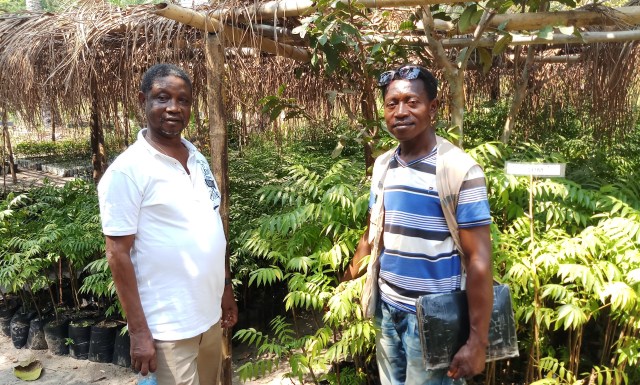


Chief Caulker and project agriculture manager Ibrahim Rogers, right, inspect African plum tree seedlings grown from seed for the project. They’ll be planted now in the June rains.

Some 260 subsistence-level women farmers can double their incomes by growing peanuts with supplies they receive from the project. How can something as seemingly small as $50 for a bale of peanut seed and a drying tarp impact the women? The spokeswoman for recent participants said it best, “Indeed, our lives have been transformed.”

Their peanut harvests act as reserves, to sell as they need cash to feed their children. When annual school expenses or unplanned health care costs come up, the women can fall back on their peanut harvest to pay for them. They no longer need to take out high interest moneylender loans.

Bigger ripple effect The Rotary funded projects are having a bigger ripple effect in this rural community. The projects create 20 full-time jobs in a subsistence farming area with virtually no wage paying jobs. One hundred part-time and seasonal workers are also hired. Families’ lives improve with a regular wage-earner.

IMG-20190602-WA0000 (2)Full-time orchard workers display their protective gear purchased from the Rotary grant: rain suits for working in the rainy season and thick rubber boots for protection against injury and snakes.

In addition to being paid, Chief Caulker explained the bigger effect these jobs have on his chiefdom. The workers are learning improved growing techniques and skills under the direction of CCET’s agriculture manager, he said. They’ll take this home and apply it to their own farms and gardens. They’ll teach neighbors how to get better yields, too.

Chief Caulker said he himself is working to act as a role model to teach people by example. He’s growing his own fruit trees in different parts of the chiefdom and annual crops like cassava. When people see they can earn more money with fast growing fruit trees like guava plus cassava and vegetables than in traditional rice growing, they start diversifying and growing more crops themselves.

Empowering women From the project’s initial work, Chief said he feels best about empowering women subsistence farmers. By supplying women to grow peanuts as a cash crop and hiring others to grow vegetables and peanuts for the project, we “have brought hope to ending the growing economic and gender inequalities in our country,” Chief said.

“Women, who before now were relegated to the kitchen, can confess of becoming breadwinners in their families, sometimes above their husbands.”

IMG-20190522-WA0006 (2)Local women are hired as part-time workers where heavy labor is not needed. These are planting peanuts in an orchard to generate annual operating income. They’re paid wages equal to those of part-time male workers.

With Rotary Clubs’ generous support, growing its own community’s future is becoming reality in Bumpeh Chiefdom.

It’s a future they can direct themselves and multiply like seed from a harvest.

This project definitely took a village to launch – an American village. So many contributed to raising funds for a $142,000 grant. We send huge THANKS to all.

  • 19 contributing Rotary Clubs – with special thanks to grant sponsor, the Rotary Club of Ann Arbor and supporting club, Wilmington, NC Rotary Club
  • Rotary Districts 6380 and 7730
  • Rotary International Foundation
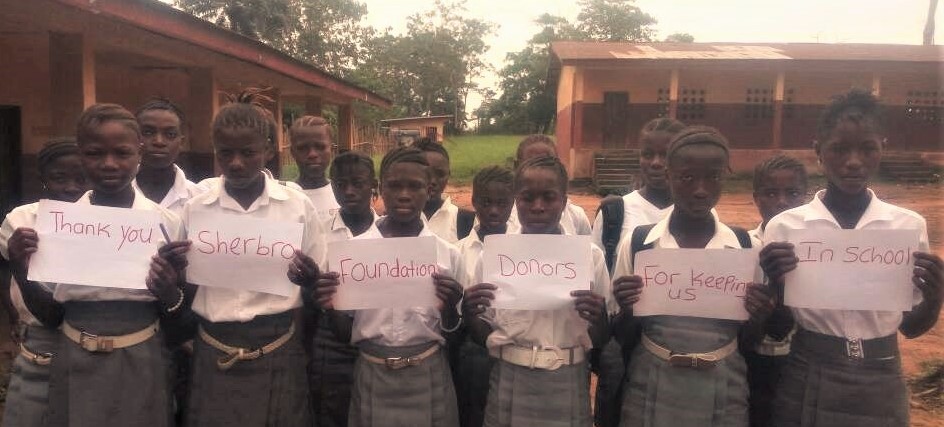
  • Fifty-five Sherbro Foundation donors – thank you!
  • Other private individual donors

How an Orchard Grows From a Swamp

“Grow vegetables in a swamp.”

That was the advice from our Sierra Leone partner CCET’s new agriculture manager. After one meeting, I quickly saw this was the voice of experience. Practical experience.

Ibrahim Rogers listened closely to our plan for expanding CCET’s Orchards for Education Program from 30 to 45 acres in 2019.

20190119_183930 (3)Our goal is for the orchards to produce annual income to run CCET’s education programs. In the meantime, we need annual crops to fund orchard operations until fruit trees mature and begin producing a few years from now.

“Vegetables will bring the most money in the shortest time,” Mr. Rogers said. “If you have water you can grow most anything and produce two and three crops a year.”

Mr. Rogers came to us from the Ministry of Agriculture in Moyamba District with more than 25 years of experience.

He’s a man who likes to be in the field. He’s passionate about growing things and using organic methods. We were soon talking about making our own compost (a four foot pit was quickly dug), and using neem as a natural pesticide. All music to my life-long gardener’s ears.

But first we had to prepare our Inland Valley Swamp, or IVS, and start vegetables. The growing season was in full swing when I was there in January – February, so we jumped in. With Mr. Rogers’ direction, the project broke ground on January 29, and in three days, the transformation was amazing.

Paramount Chief Charles Caulker, CCET board chairman, above left, stands in front of a three acre rice field with last year’s cut-back stalks.  Three days later, it was transformed into a sea of raised beds. Our Inland Valley Swamp was half the size of a football field and not yet finished.

20190129_105643_Moment(5)

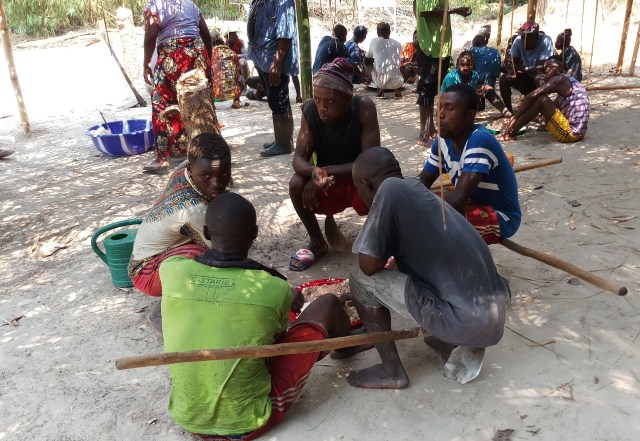
Thirty village men came, bringing mammoth hoes used make these raised beds. In an area with no mechanized farming, it’s an annual routine to manually turn over every field and the remains of the previous season’s harvest. They cut a swath of decaying plants with the hoe’s edge; then lift and pile it in front of them, making raised beds as they go.

Water pooled in the trenches they left. Even as the dry season progresses, the water table in the swamp is high and the beds stay moist. Later, a berm will surround the field and a small dam built to control the flow of water.

20190129_105412

This isn’t a stagnant swamp. It’s the flood plain of the small river snaking through Rotifunk that later enters the Bumpeh River. It’s black soil, fertile with silt carried as the river swells and floods in the rainy season. It’s further enriched by turning over the remains of many rice crops – all composting in place.

20190129_132001 (2)

I smiled to see men using their big hoes as stools to sit on while eating on break.

20190130_153446 (2) 20190130_154732
This rural area is strictly a cash economy, and the people illiterate. Almost none of the workers can sign their names.

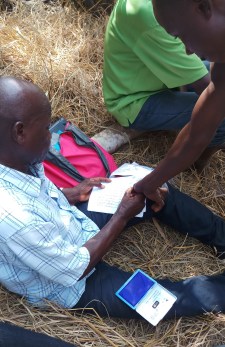
To keep project payment records, men “sign” to receive their wages at the worksite with thumbprints.


Now it was the women’s turn to take over. One of our standing objectives is to create employment for women in Bumpeh Chiefdom, especially for illiterate, unskilled women with no prospects for wage-earning jobs. 

20190211_171459

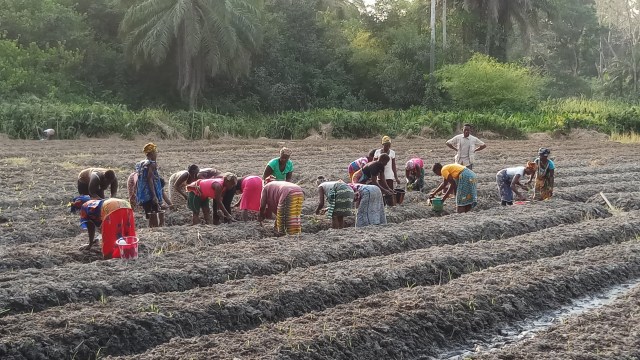
Women are the traditional vegetable growers. With patience and an eye for details, they’re the ones to transplant and care for tender young vegetable seedlings. Twenty women were brought in for the IVS project.

20190211_171143

First, they worked compost into the beds in circular “pots” to receive seedlings. We started with peppers, a high yielding and profitable vegetable crop. Mr. Rogers had the women transplant young pepper seedlings at 4 pm in the afternoon to avoid the hot sun. They watered in each seedling from buckets of water collected at shallow pit wells that quickly fill up in this swampy field.

20190211_170919 (2)The women were happy to receive wages for their labor.
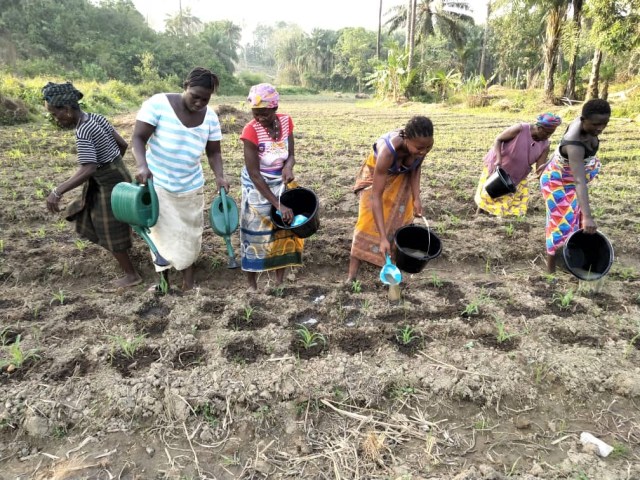
When they came to collect their pay, they were overheard laughing, “We never went to school, and now we’re being paid, like government workers.”

It’s hard to fathom that in 2019, Sierra Leone is a country where rural areas still have almost no wage-paying jobs.


Peppers 3-6-19 (2)

Women will continue to water and weed the Inland Valley Swamp, and then harvest the vegetables. Okra and onions have now been added. Peppers and okra can be picked more than once from the same plant. Next year, we’ll start earlier and harvest at least two crops.

By May, the first rains start. One hundred thirty inches of monsoon rain will fall here between June and November, beating down and washing out the raised beds just made. That’s the rice growing time, and the IVS will revert to a rice swamp again.

Come December, it will be time to prepare new raised beds again for vegetable growing. That’s the cycle of life in Bumpeh Chiefdom.

And now, the cycle of growing an orchard from a swamp has begun. Combined, the long term income to educate Bumpeh Chiefdom children is also on its way.

— Arlene Golembiewski, Executive Director


Come celebrate our 6th anniversary

Come celebrate our 6th anniversary

This week is Sherbro Foundation’s sixth anniversary!

I’m just back from five weeks in Sierra Leone. One program in 2013 has grown to six today, and they’re expanding.

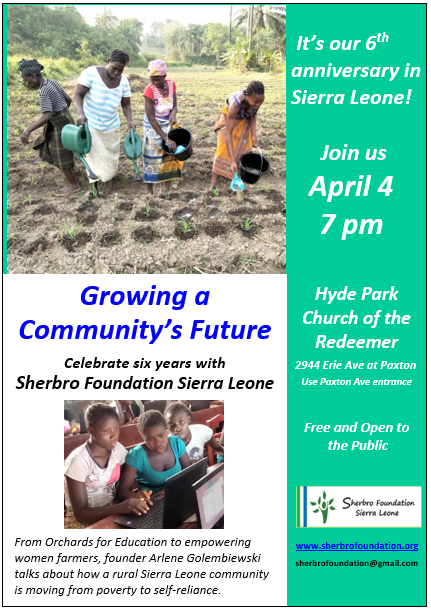
Join us April 4 at 7 pm in Cincinnati to hear all we’ve accomplished with our Sierra Leone partner CCET – and where we’re going next.

This isn’t a fundraiser. We just want to share all our good news with you. Pass this on and feel free to bring friends. Hope to see you there.

—– Arlene Golembiewski

Screenshot (29)

Our Lives Have Been Transformed: Women Vegetables Growers


“We are sure and proud that what is happening in Bumpeh Chiefdom is not happening in any other chiefdom.”

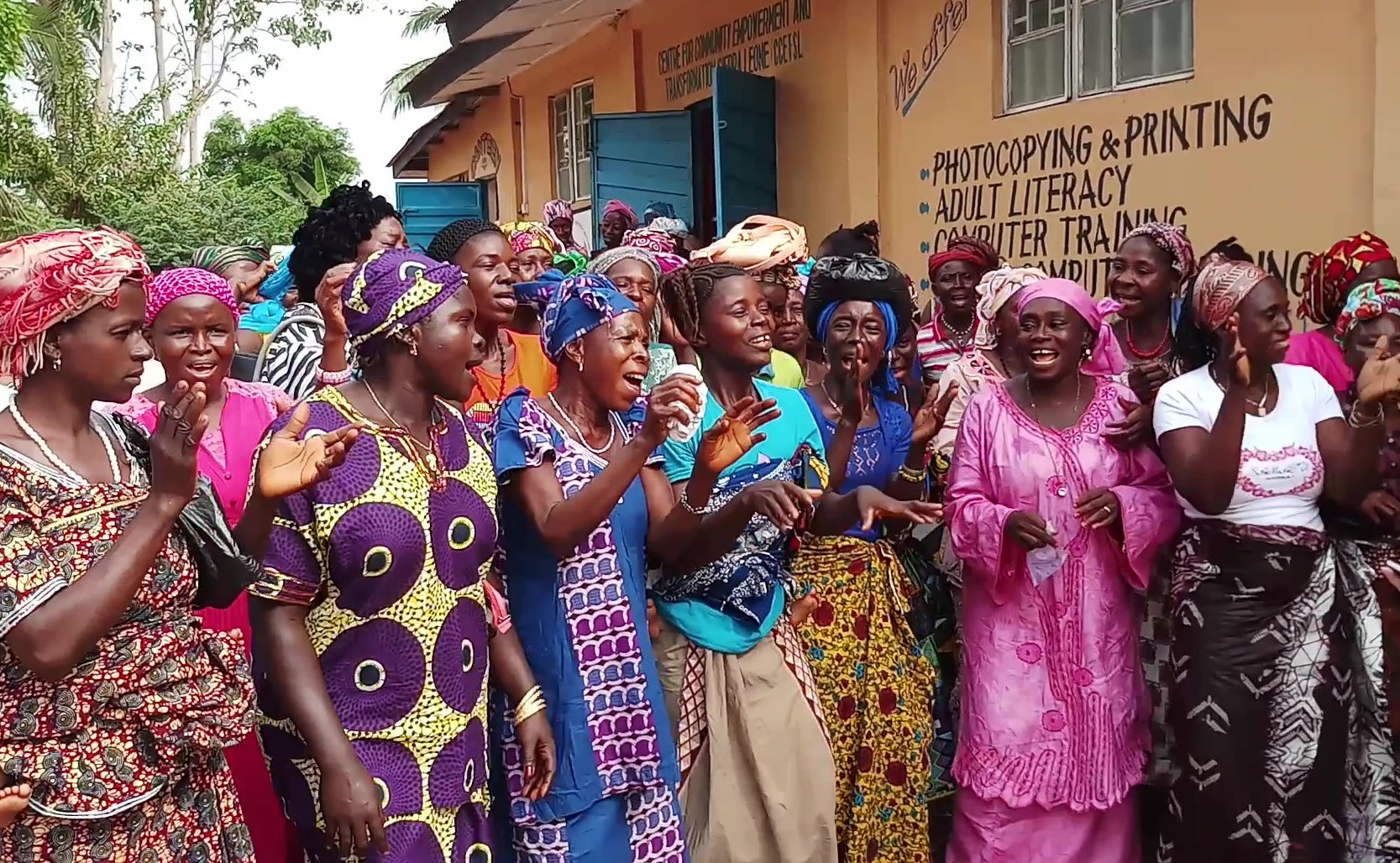
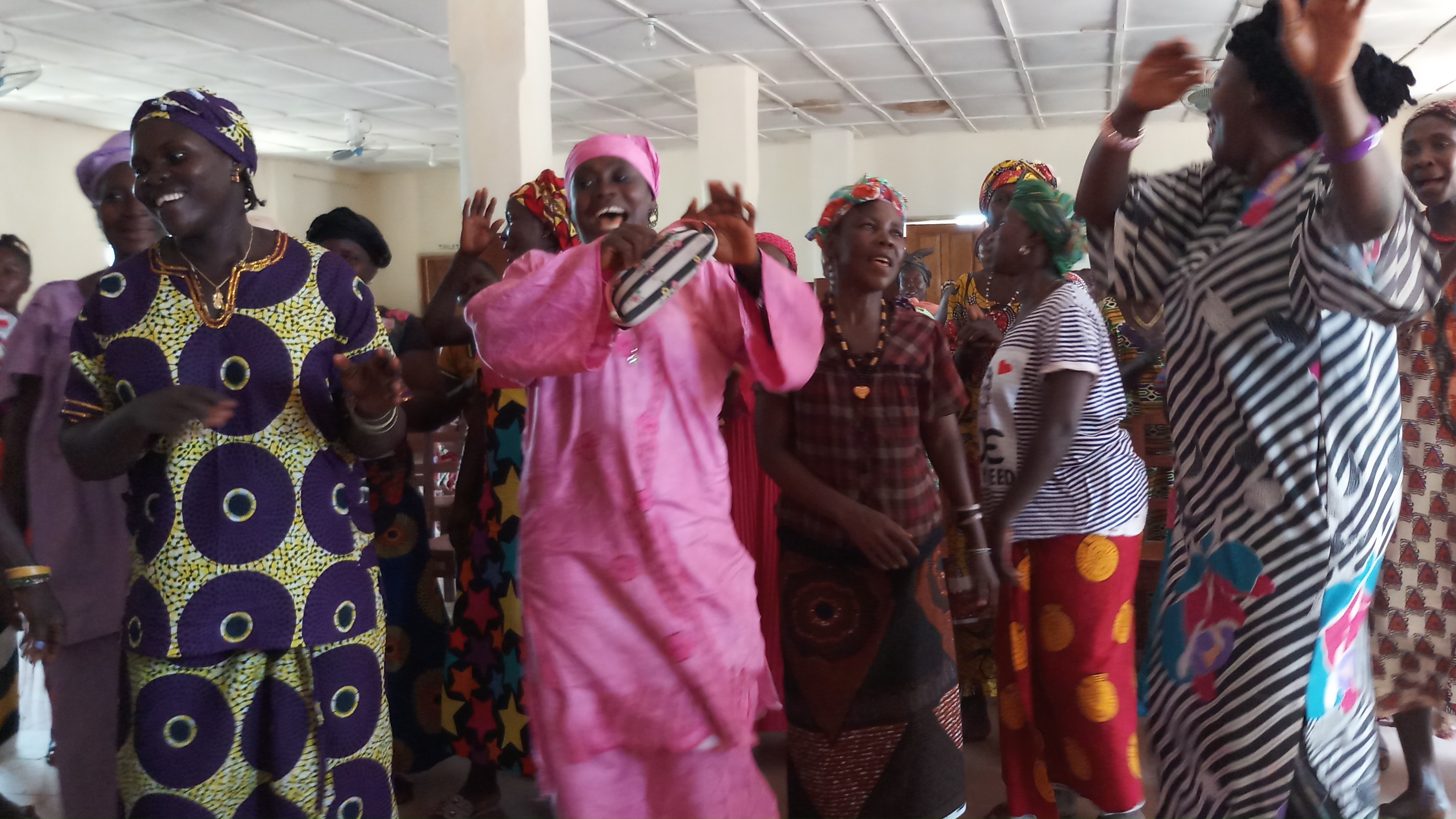
Before we reached the CCET Center to meet women from the Women’s Vegetable Growing project, we could hear them. Bumpeh Chiefdom women greet visitors with a welcome done in song. See video. (It may take a moment to load.) Their distinctive style with voices in harmony sounds like a minor key. They’re singing as one with syncopated clapping. You feel embraced by their warmth.

As we took our seats inside, the hall was thundering with the women’s song and clapping.

Their welcome song is one they sing among themselves while working as teams in each other’s gardens. They sang that if they are united and help each other, together, they will all individually benefit. There’s a Sherbro word for unity and working together: Lomthibul.

They gathered to thank us for helping them grow groundnuts (peanuts) in a project they say is not found in any other chiefdom.  

Started in 2015 as an Ebola relief effort, Women’s Vegetable Growing is now entering its fifth year. Sherbro Foundation funded it for three years, with Rotary Clubs stepping in last year.

The women are proud to be part of the program, as they should be. They receive a modest grant of two bushels of groundnut seed, a drying tarpaulin and a 100 lb. bag of rice. With that, they grow enough groundnuts to sell for income and keep seed for another harvest. For once, they have their own discretionary income they use to feed and care for their families.

In 2018, the program started supporting women for two harvests to give them a strong enough base to then keep planting and gain self-reliance.

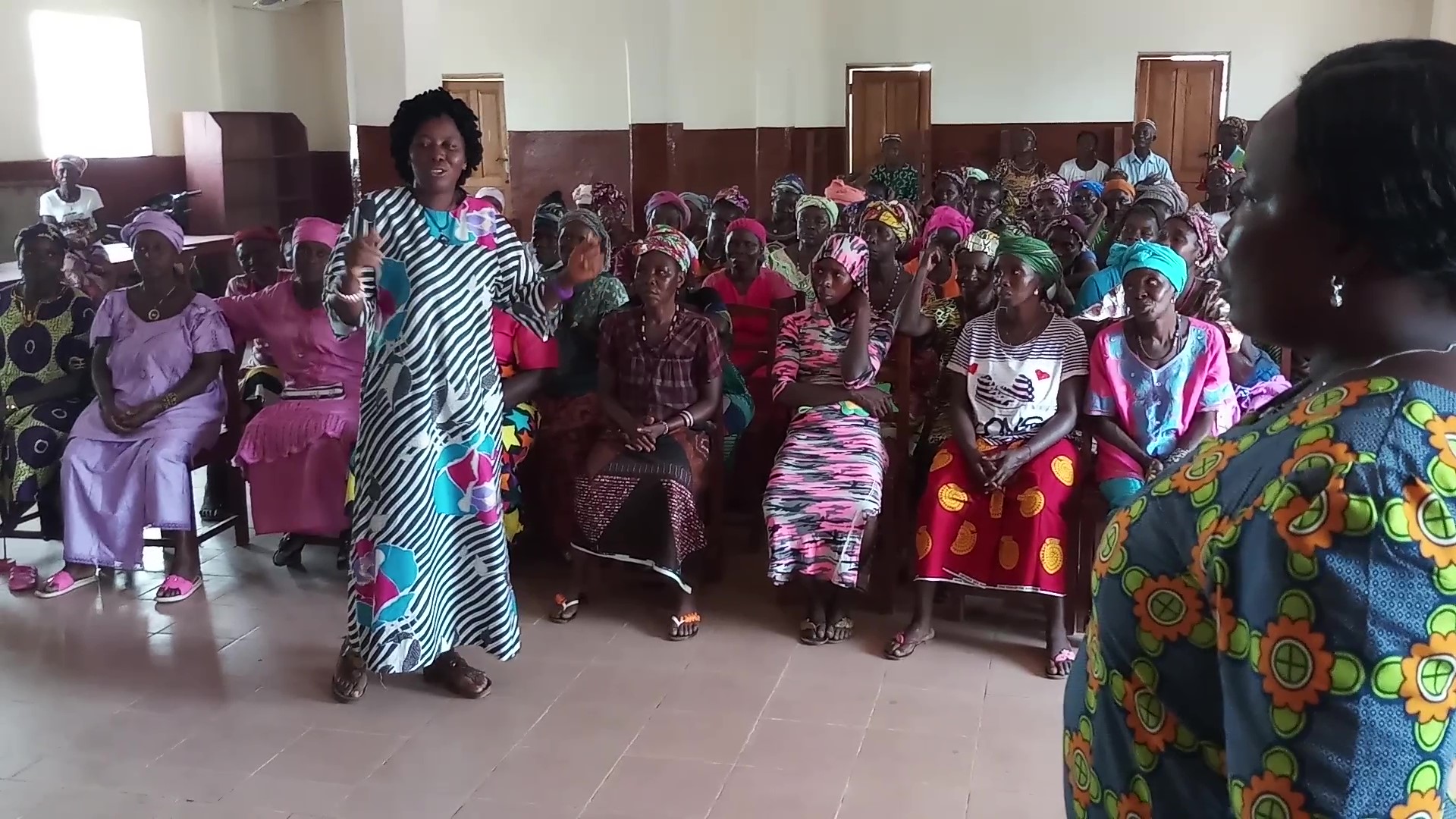
As we sat together, their spokesperson Hawanatu Sesay (above) explained, income in this rural area is dependent on agriculture. “Our only means of survival is though agriculture.”

These were representatives of the last group of 106 women selected for the project because they’re mature and vulnerable. “Most of us are widows. Some lost their husbands, and other men are not able to work now; they’re too old. Some [don’t take] responsibility for our welfare.” Hawanatu herself is a widow. She has more education than most, dropping out of junior secondary school to marry when she became pregnant. Her husband died and left her with two young children. She depends on her garden for income to feed her children.

When women first join the project, Rosaline Kaimbay, director of CCET-SL (the Center for Community Empowerment & Transformation) (above, right), explains the goal is to help them transform their own lives. They’re being helped with funding from Sherbro Foundation and now Rotary Clubs.

Today, the women told us, “Indeed, it’s a reality. Our lives have been transformed and we’re happy!”

They no longer need to rely on men to feed their families. “When we don’t have money, we take a few groundnuts [we grew] and sell them in the market and buy what we need to cook.”

“Before this time, ” Hawanatu continued, “our children were forced into early marriage because we don’t have much to give them. They go to school hungry. Because of this, they’re prone to getting boyfriends who give them money [and get them pregnant]. Now, we’re able to feed our children and they don’t get into early marriage.”

The women are also grateful to be beneficiaries of other CCET-SL programs. “You’ve given our children [in the girls scholarship program] uniforms and books. Through your help, some of our children are now at university with the college scholarships you’ve given them.”

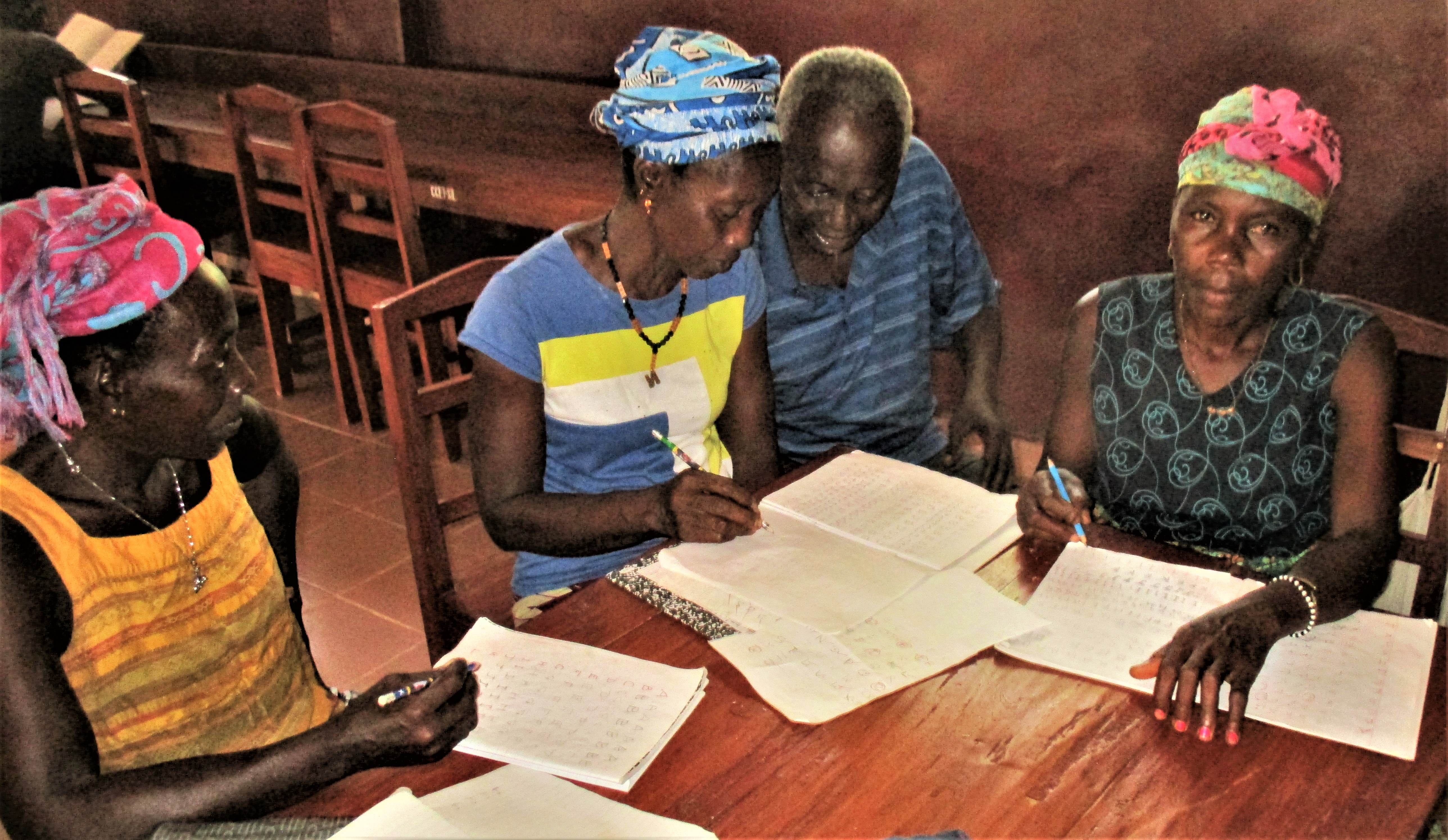
“Through the efforts of CCET-SL and the Adult Literacy program (above), most of us are now able to sign our names. Before, we were unable to read the [school] results of our children. Now we can look at their [report card] and see whether they passed their exams or not.”

The women also appreciate their 9th grade children could participate in the after-school tutoring program preparing for them for the senior high entrance exam, the BECE. They saw their children being fed three times a day in the intensive study camp before the exam – while they only have money to feed once or twice a day. “Because you did this, most of our children passed their BECE exam and we’re grateful.” All these things “are a big lesson to us.”

By now, tears were rolling down my face as I recalled the dark days in early 2015 when Ebola was nearly over, but a 3-year economic crisis just starting. We asked Bumpeh Chiefdom’s Paramount Chief Charles Caulker what Sherbro Foundation could do to help. Fund women to grow vegetables as a quick way for them to earn income, he said. The women today rightfully said Chief Caulker is “the brains behind this program.”

Women’s Vegetable Growing has grown from the first group of 30 to 106 women last year. By investing in them with several programs, CCET-SL enables the women to focus on growing groundnuts and maximize the seed they save to grow another and larger next crop. Nearly 400 women in total have been supported to move towards self-reliance. With families of five and more, the community impact is significant.

The women are proud to also contribute to the success of the program. It’s become a tradition spontaneously started by the first group of grateful women growers that they donate some seed back to help the next group.

“Because we are united, that is why the groundnuts you’ve given us we’re able to reproduce them and help other women. We’re happy and proud to help other women.

When starting a new program, you hope it will be embraced by the community and beneficiaries helped in a measurable way. It’s a priceless reward to now hear these women as a group say their lives have been transformed.

Let me thank all who have supported Women’s Vegetable Growing over the years. I hope you, too, now feel rewarded by your generosity.

We hope to expand Women’s Vegetable Growing with new funding to help the most successful of these women entrepreneurs develop their gardens into small businesses. They can then hire workers, creating local wage-paying employment.

Women farmers have great potential to become a driver of local economic development. As they said, they are united.

—- Arlene Golembiewski, Executive Director

Sending Children to School with Fruit

So many things to show from my Sierra Leone trip last month. Where to start? Here’s where we started our Orchards for Education work with Mike’s Orchard – the first one we planted in 2016 for our dear Peace Corps friend we lost a few years ago.

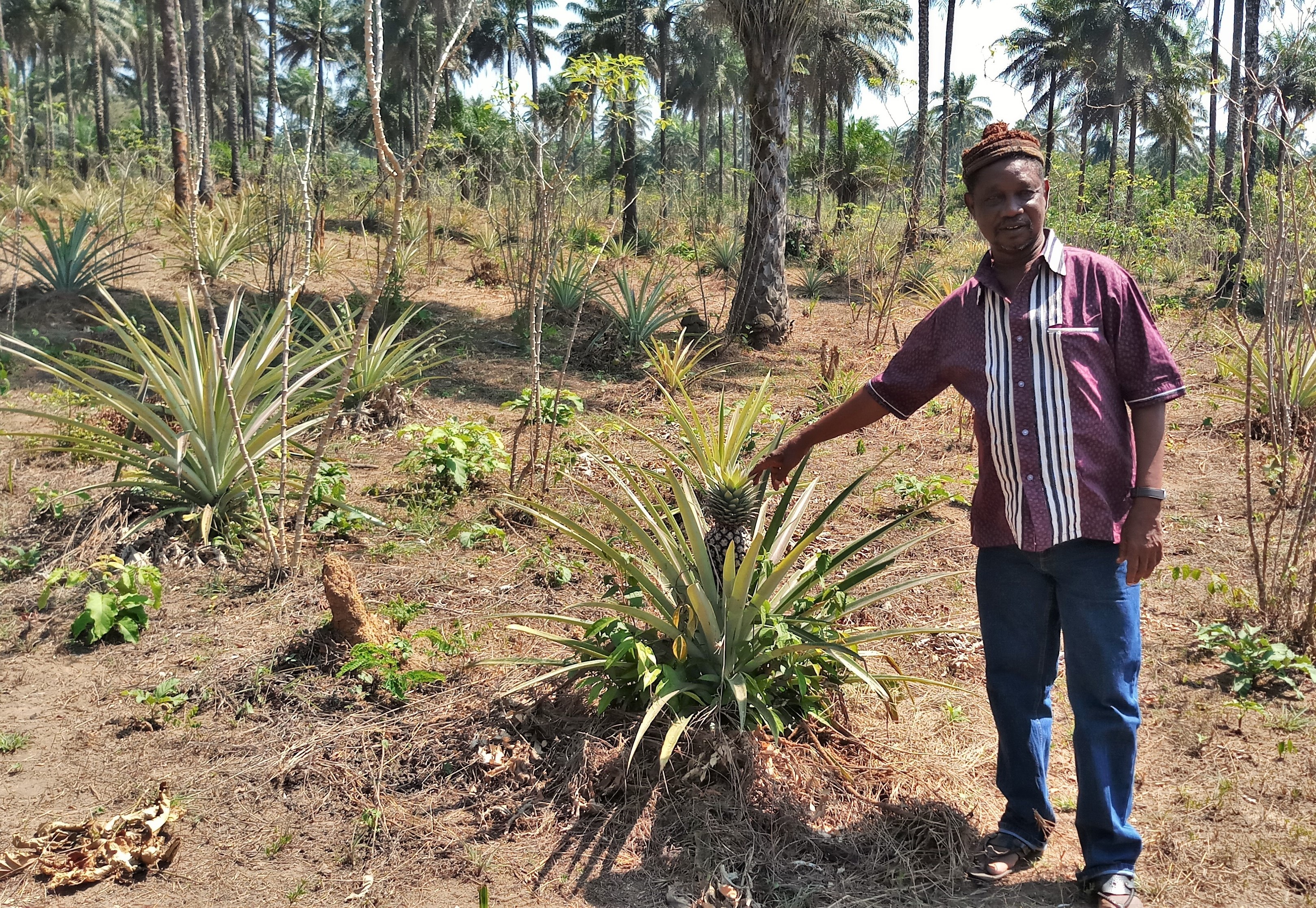
Bumpeh Chiefdom Paramount Chief Caulker, above, shows one of over 1000 pineapples planted in the rains of July 2016 that are doing well and starting to sporadically fruit.

It was in 2016 we decided with our Sierra Leone partner CCET-SL to start planting fruit orchards as a means of creating sustainable income to run their education programs for Bumpeh Chiefdom. Chief Caulker doesn’t want to keep asking donors to pay for scholarships for girls to go to secondary school, and now to college. We want to keep running the new Tutoring program that prepares students for their senior high and college entrance exams without hand-out’s.

As a rural agricultural area, starting fruit orchards became our plan. It’s a long-term strategy and requires work to carve them out of wild bush and get fruit trees established. But then they reliably produce fruit and income for years to come. We’ve added short term crops to fill in between trees, like pineapple, cassava, peanuts and corn.

The Sherbro Foundation Board stepped in to start the Mike Orchard ourselves, in recognition of our Peace Corps friend Mike and all he did for Sierra Leone over 35 years during and after he left the Peace Corps. You must clear land and plant in Sierra Leone in synch with the rainy season. Or wait another year. So we decided in short order in 2016 to just get started with eleven acres Chief provided near his family farm.

Since then, Orchards for Education is blossoming into another 45 acres, all planted for children’s education in Bumpeh Chiefdom. More on that later.

For now, our first effort is bearing fruit. Literally. Not enough to earn real income this year, but we’re on our way. Watch over us, Mike. The next year should be a good year.

Jane Goodall visit puts spotlight on Sierra Leone’s chimpanzee population

Jane Goodall’s Sierra Leone visit this week focused world attention on preserving the country’s chimpanzee population. Ten percent of the world’s estimated 55,000 wild chimpanzee live in Sierra Leone forests.

Goodall returned to the Tacugama Chimp Sanctuary outside Freetown, a reserve she had a hand in starting that gives a home to abandoned and rescued chimp babies and juveniles. She was able to view the sanctuary’s 89 chimps and meet with staff.


Sierra Leone President Maada Bio awarded the primatologist the Order of Rokel, the country’s highest honor.  Sierra Leone is on a quest to rebrand itself as a tourist destination. Goodall’s visit draws attention to Sierra Leone as a haven for ecotourism, where people can see the some of West Africa’s unique wildlife and scenic beauty.


Eat. Pray. Learn.

Eat. Pray. Learn.

Come January, 63 girls will be starting on a path few Bumpeh Chiefdom girls ever reach. They’ll eagerly begin senior high school.

IMG-20180724-WA0006 (2)Girls in CCET’s tutoring program waiting to start their senior-high entrance exam.

Last January, our partner CCET started their first after-school tutoring program for 9th grade girls. Extra classes fill learning gaps schools can’t provide and help girls successfully pass their senior-high entrance exams — and be well prepared for senior-high learning.

Eighty-one girls from four local schools started the program, coming to 4 pm classes three days a week, including their first computer training. Seventy-five continued for 7 months, finishing in July just before the national exam.

img-20180722-wa0002.jpgWhy the title Eat. Pray. Learn?

Tutoring ended with a 3-week study “camp”, where girls lived 24/7 at CCET’s education center. They had intensive review, drilling on practice test questions, study time and generally got pumped up to take the exam together.  Students, left, in study camp evening classes.

Thanks to funding from the Beaman Family Fund, we were able to feed these young scholars three meals a day during the camp. Below, students take a lunch break outside.

img-20180723-wa0003.jpg


img-20180722-wa0003-2-e1544378321317.jpgAnd prayer in all faiths, left, is part of the camp day. At day’s end, tables were pushed to the side and girls spread out on the floor to sleep dormitory style.

The experience of living and studying together in a focused environment with the support of their teachers and peers – and good nourishment — helped push girls over the finish line for the exam.

We weren’t sure what to expect from the new Sierra Leone government on this year’s exam. The nature of the questions didn’t change, but they applied more rigorous exam monitoring and scoring. They are emphasizing improving education and eliminating corruption at all levels, including on national school exams. Exam results were reported in November.

Sixty-three passes among girls completing the tutoring program is very good. For perspective, only 120 girls in total were enrolled in all grades of senior high last year. So, these 63 girls will be a strong group of new 10th graders, prepared to thrive in senior high.

20180710_171640-2.jpg


On average, the girls in the tutoring program outperformed local schools as whole.

They also did better on average in math and science scores, areas targeted in tutoring classes, left.


img-20180606-wa0003-3.jpgWe especially want to congratulate Bumpeh Academy who had the highest exam results (all students, boys and girls) among schools in 3 adjoining chiefdoms.

Some of their classrooms lack four walls, yet they deliver good results.

Girls from the tutoring program, left, made up about half the school’s students taking the exam.

Girls from the tutoring program were also among the top positions for all local 9th graders taking the exam — both boys and girls. Congratulations to Hellen Bangura for coming in first of any Bumpeh Chiefdom student. Adama Mansaray of Walter Schutz Memorial Secondary School and Isatu Conteh of Bumpeh Academy were among those in second and third positions. You make us proud.

The tutoring program is one example of the education programs our partner CCET provides for the benefit of the whole community. Led by a former school principal and staffed with teachers, they do a great job of identifying needs and designing practical, low-cost solutions that maximize use of limited resources for students in all local schools.

Sherbro Foundation is helping CCET create a sustainable solution to keeping the girls scholarship and tutoring programs funded and improving into the future. Orchards for Education plants fruit trees, long-term income from fruit sales for CCET’s education programs.

Please consider an end-of-the-year gift and see it grow by 50%, matched through a Rotary Club grant! Help plant fruit trees and you’ll keep sending girls to school for years to come. Gifting by December 25 will help us meet Rotary’s deadline for the grant request.

Many thanks to all of you for supporting Bumpeh Chiefdom programs and making 2018 a blessed year. We’re grateful for your generosity and outpouring of support!

Wishing you and yours a wonderful holiday season,

— Arlene Golembiewski and the Sherbro Foundation Board of Directors: Chris Golembiewski, Cheryl Farmer and Steve Papelian


Plant a Tree and Send Girls to School

Plant a Tree and Send Girls to School


Paramount Chief Charles Caulker has a vision in which every child in Bumpeh Chiefdom gets a secondary school education. We’ve made big strides with Sherbro Foundation’s Girls’ Scholarship Program.

Now Chief and his community nonprofit CCET are creating the chiefdom’s own sustainable source of income for education from fruit trees. Thousands have been planted. Thousands more are needed.

With Sherbro Foundation’s help, the Rotary Club of Ann Arbor is mobilizing Rotary Clubs and individuals through a Rotary International Foundation grant to plant another 15-acre orchard with 1500 fruit trees.

Sherbro Foundation is striving to raise $10,000 toward a $95,000 Rotary grant that will make Chief Caulker’s plan come to life.

We need your help. Plant a tree. It will fruit for years to come, creating income to keep sending girls to school year after year.  

And the Rotary International Foundation will match your gift by 50% !

Adding to orchards planted in 2017-18, the Rotary grant will result in a total of 45 acres of orchards with over 3000 fruit trees. As they start fruiting in 3 – 5 years, the trees will create a steady stream of income for education for 20 years or more. Give here to plant trees.

Growing trees yields big dividends in fruit income, providing students with these essentials every year:

$35 plants one tree (lime, guava, orange, grapefruit or avocado) that will pay secondary school fee scholarships for 2 girls, or a school uniform and notebooks for 1 student.

$70 plants 2 dwarf coconuts that will pay the monthly stipend for a computer instructor.

$100 plants 3 dwarf coconuts that will pay monthly wages for a lead teacher in after-school tutoring that prepares girls for senior high entrance exams.

$250 plants 8 lime trees that will pay living expenses for a community health nursing student who will return to serve in an area rural health clinic.

$600 plants 17 African plum trees and provides the tuition and living expenses for one year of girl’s college scholarship.

You’ll be doing more than planting a tree. Your gift will first help:

  • Clear 15 acres of wild bush – all with manual labor.
  • Grow 15,000 tree seedlings with seed collected from locally purchased fruit.
  • Plant 1500 tree seedlings (Others will be donated to chiefdom families or sold.)
  • Keep all 45 acres of orchards weeded and watered for 2 years.
  • Create 19 full-time jobs for local villagers where no wage-paying jobs now exist.
  • Grow annual crops for short-term income to maintain orchards as fruit trees mature.

The plan will do much more to ensure the orchard’s long term success.

It will dig a well and install a watering system to keep young seedlings watered; build a storehouse and concrete drying floor to handle all the produce; hire an experienced Agriculture Manager to run the program; buy tools and fund operating a truck. Another goal is to expand the successful Women’s Vegetable Growing project, helping eager women farmers grow peanuts and double their incomes.

This sustainable plan will have major impact on chiefdom families.

By 2023, we conservatively estimate the combined orchards will generate $50,000 a year in income for education. And orchard income will keep growing as trees continue to mature.

Added bonus 45 acres of fruit trees will help fight climate change. Tropical trees mature quickly and absorb large quantities of carbon dioxide and other greenhouse gases.

How you can help

Donate now Give here to plant trees.
100% of your gift goes directly to the project – no overhead expenses.

Checks can be made payable to:
Ann Arbor Rotary Foundation (a 501c3 nonprofit)
PO Box 131217
Ann Arbor, Michigan 48113-1217
Include “Sierra Leone Global Grant” in the memo line.

Give a Holiday Gift – Wouldn’t many on your gift list appreciate planting a tree for them that will educate girls year after year? Donate a $35 gift in their name and we’ll send a gift card describing the impact a tree has for the future of Sierra Leone girls. It’s a gift that truly keeps on giving. Add giftee name and address to the instructions line of your online donation above. For multiple gifts, or donating by check, email giftee info to sherbrofoundation@gmail.com

Ask a Rotary Club to contribute – Are you a Rotarian or do you know one? Many Rotary Clubs are interested in supporting worthwhile international development projects. Contact your local Rotary Club and ask if they would consider this project. We can supply more information.

Questions? Contact: Arlene Golembiewski – sherbrofoundation@gmail.com or Mary Avarkotos, Rotary Club of Ann Arbor – mavarkotos@me.com

Sherbro Foundation will personally thank you for your gift. We’ll direct your gift to the Ann Arbor Rotary Foundation who will coordinate with Rotary International. You’ll receive your tax receipt from the Ann Arbor Rotary Foundation in January.

Plant a Tree. Educate girls. Help the planet. Give a gift.

Where else would $35 accomplish so much?!

And — Rotary International will match your gift 50%! $50 becomes $75. $100 will be $150.

Thank you for investing in the future of Sierra Leone’s Bumpeh Chiefdom children!

— Arlene Golembiewski, Executive Director

P.S. Help us more. Pass this on to a friend.

Can $25 Be Life Changing? Send a Sierra Leone Girl to School.

Can $25 Be Life Changing? Send a Sierra Leone Girl to School.

Every girl in Sherbro Foundation’s Girls’ Scholarship Program — now more than 600 — has a story to tell. But even in this program for the neediest, Fatmata’s story is heart-wrenching.

We’re kicking off the 2018-19 Girls Scholarship drive, our sixth, with the story of one our first scholarship recipients and how $25 scholarships have changed her life.

Fatmata has received SFSL scholarships for four years, allowing her to finish the 9th grade at Bumpeh Academy. Soft spoken, Fatmata (white headscarf below) enthusiastically attends our partner CCET’s after-school tutoring program, prepping 9th graders for their national junior high completion exams. She breaks into smiles as she joins her classmates, all eager to prepare for senior high. Advancing girls to senior high is one our main objectives.

20180713_171554 (3)

Sherbro Foundation’s scholarship program gives priority to girls who are orphans or with single parents and from low-income families, even by local standards. Many from villages must leave their families to board in town to attend secondary school — another costly expense. Too many drop out after junior high without funds to continue.

20180712_184638 (3)Fatmata’s not sure how old she is. We estimate she’s 17. Her family was typical of many in Bumpeh Chiefdom. Her mother was the first of her father’s three wives. As the senior wife, she took the youngest wife’s child to raise with her own, a tradition. The child went missing and was found dead with no explanation.

Fatmata’s mother was held responsible and put in prison. Pregnant at the time, she delivered in prison and was released when the baby was a year-and-a-half. Fatmata had completed primary school, but her angry father gave no support for her mother or her children. Fatmata couldn’t start secondary school.

The Ebola epidemic hit when her father was home in adjoining Ribbi chiefdom. He was quarantined in a village with the virus, contracted Ebola and died. Fatmata’s mother now widowed with five children became involved with another man. While pregnant again, she had an uncontrolled infection. She and the baby died.

Fatmata’s father’s family wanted her to live with them in Ribbi Chiefdom. She resisted, “I was afraid in Ribbi I wouldn’t be able to go to school.” Another stepmother had enrolled her in junior high in Rotifunk where she received a SFSL scholarship and a uniform. Ribbi has no scholarship program.

20180712_184459 (2)“She made a good choice to stay here,” said our local partner CCET’s Managing Director Rosaline Kaimbay. “She’s determined to learn. We need to motivate her. I love the girl. So bold. I will follow her progress.”

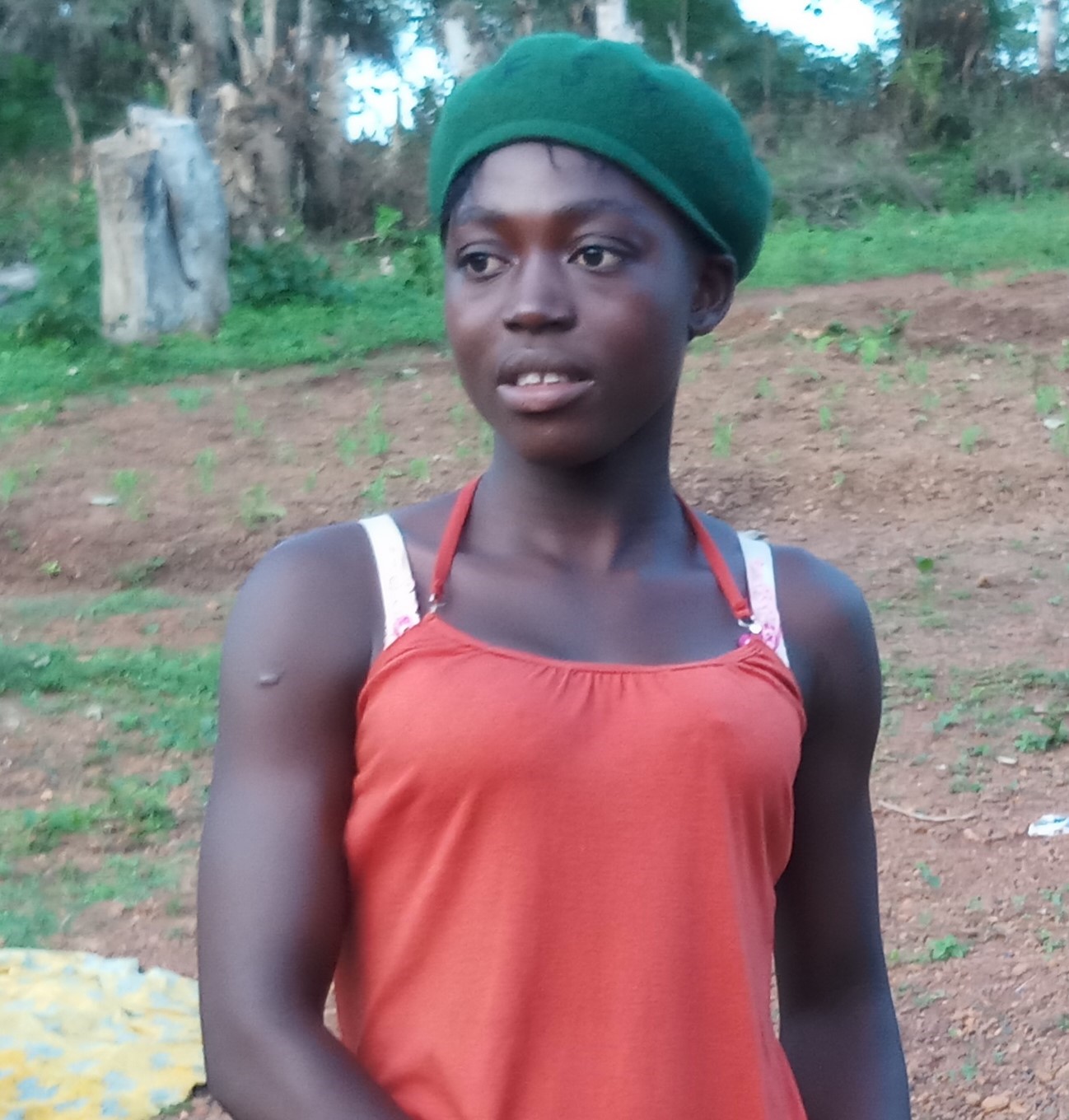
Fatmata (green beret, left with Mrs. Kaimbay) and her two younger sisters (also left) live with their maternal uncle and grandmother in Rotifunk. I counted at least ten in their small house. Her uncle is very supportive of his three nieces. I never met her hard-working grandmother, always out in her small peanut farm.

20180715_171915 (2)During that tumultuous time, Fatmata had to repeat her first year of junior high. She’s continued to advance to the 9th grade with four SFSL scholarships.
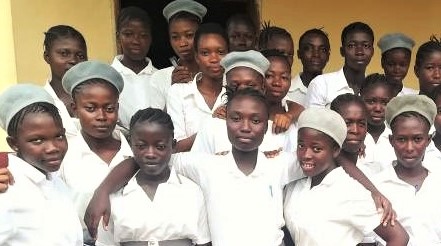
Fatmata, left, at her home’s outdoor kitchen where they cook on a wood fire sheltered from sun and rain.

In two weeks, she’ll take her national 9th grade exams and has a very good chance of moving on to senior high. She’ll be part of a small elite group of rural girls working for high school diplomas.

Fatmata is the kind of success story we work hard to support with our scholarship program.

IMG-20180606-WA0004 (3)Many other bright girls are eager to keep learning, often after interruptions in their educations. 
Girls like Fatmata are the future of the country. A number of men and women alike have told me they support girls going to school: “When you educate a girl, you educate the country.  A boy just looks after himself.”

After telling me her story, Fatmata asked, “After school, who will take care of me?” We’ve helped her this far, but then what? She has no role models to follow.

I paused for a moment, and then told her, “You’ll finish school, go to college and get a good job. You’ll be able to take care of yourself and help your family, just as Mrs. Kaimbay and I have done ourselves.” 

Your $25 scholarship will keep Fatmata and girls like her in school and out of early marriage and teenage pregnancy. It will give them the chance to gain independence after graduating by getting a wage-paying job or entering vocational school or college. Teaching, nursing and the police force are traditional jobs. But we want to encourage girls to go into growing fields with jobs like accountants, IT support, lab technicians, floor tilers and electricians. 

We’re also proud to have started our first college scholarship program in 2017-18 for girls meeting college entrance requirements.

In just five years, you’ve made the Girls’ Scholarship Program a great success with over 600 girls getting the help they need to attend secondary school — and keep advancing. What’s happened to last year’s cover story girls?

IMG-20180529-WA0001 (3)Isatu, an orphan in senior high, just completed 12th grade. She’s awaiting the next national senior high completion exam. She could be a candidate for our new college scholarship program.
Alima, (2nd from left) a motherless girl, walked five miles each way to school from her aunt’s house. Now in the 9th grade and living with a Rotifunk relative, she gets CCET tutoring for her junior high completion exam and is in the computer training class, too. One of her school’s brightest, she was one of two students to represent the school in a local interschool quiz competition.

Our goal for this year is to at least match last year’s results and again award 460 scholarships to deserving girls. We continue to emphasize advancement into senior high. Your support has doubled the number of girls in senior high over the last four years!

We have great news from the newly elected Sierra Leone government. They will be paying school fees for all secondary students as part of their program to improve education.  

Sherbro Foundation’s $25 scholarship award this year will consist of a uniform and notebooks for each awardee. These supplies actually cost more than school fees and are a formidable barrier for most Bumpeh Chiefdom students. Uniforms hand sewn by local Rotifunk tailors help keep costs down.

We hope you’ll help send Sierra Leone girls back to school in September. Yes, $25 can be life changing for so many girls like Fatmata.  Please donate here: I’ll send a girl to school. 

We’ll double your impact. The first $5000 in gifts will be matched!

Thank you! 

— Arlene Golembiewski, Executive Director


Aminata goes to University

Sherbro Foundation was thrilled to offer our first college scholarship in 2017-18 for a girl graduating in Rotifunk. We’re now delighted seeing how awardee Aminata Kamara’s first year is shaping up at University of Sierra Leone’s Institute of Public Administration & Management where she’s studying Banking and Finance.

Aminata is the youngest of 18 children of now aged parents who no longer work. She was an exceptional high school student, receiving the highest results for a female student on the national completion exam among Moyamba District’s 40 secondary schools.

IMG-20180224-WA0002 (2)

Moving from a quiet, rural village to the demanding urban environment of the capital Freetown, Aminata has quickly adapted. She shows, given the opportunity, intelligent, eager young people can catch up and perform well. Here’s our recent WhatsApp chat.

Arlene G.: What classes did you take in your first year? How did they go?

Aminata K.: In each year we have two semesters, each with six modules. First semester I took:

  1. Mathematics
  2. English
  3. Elements of Banking
  4. Principals of Accounting
  5. Information and Communication Technology [computer science]
  6. Human Resource Management

In second semester, there are new subjects. The classes are great. I’m doing fine.

AG: I’m glad to see you get an integrated approach with classes with like Human Resources Management from Year One. What are your biggest challenges in starting college?

IMG-20180608-WA0003AK: The high cost of transportation and high Internet cost. I can’t afford a computer laptop and a modem to do the required research.

I had to go to [an internet] café, left, to do some of those things and I pay a huge amount. Most of the tutors just give us topics and ask us to do our own research through Internet.


AG: Did you find anything surprisingly easy?

AK: I met new friends who are very hospitable. Some that are staying within the central area allowed me to stay with them during examination week so that we can study as a group, since I am staying in the far east end of Freetown where we experience a lot of traffic. I sometimes have to come down out of the [public transport] vehicle and hurry up on foot for me not to miss my lectures.


IMG-20180608-WA0007 (2)

AG: Tell us about the teaching staff at U of Sierra Leone.

AK: We have good lecturers and they teach well. When I started taking lectures, I found it difficult to understand the way of teaching because it is a different way of teaching [lecture and take your own notes] to that of high school [teacher writes notes on board that students copy]. But I am okay with it now as I have just sat to my first semester exams. I am now enjoying the lectures.

AG: Are professors responsive to students and help you succeed?

AK: They will see that the students understand whatever they are teaching and if you do not, they will repeat it again. They counsel students about their education.

AG: I know you lost about a month with classes shut down during the recent presidential election in March-April. How do you catch up?

AK: In the second semester we have only three months. That is why they give us some topics to research on our own. [Over the summer break, I will] keep studying and doing some research.

10371915_383754195116702_1689531377752587635_nAG: You have a change of government, with the new president making education his first priority. What are you students hoping to see change with the new administration?
AK: The change in government has not affected us in any way. We are just hoping to see the President fulfill his promise and we want the government to reduce the fees for us.

AG: Any new thoughts about the major you selected? Do you plan to continue with Banking and Finance?

AK: Yes, I want to continue if I am given the opportunity.

AG: What do you like about living in Freetown? Or dislike? It’s a big change from small town Rotifunk.

AK: I dislike the traffic. The thing I like about it is you can get good quality education here in Freetown.

AG: What message do you have for the people in the US who helped you go to college?

AK: On behalf of my old father and my blind mother, please help me extend my heartfelt thanks and appreciation to all those who in diverse ways made it possible for me to be in the university. I am so grateful to the donors and to CCET-SL for letting my dreams come true and putting a smile on my face and that of my parents.

AG: We are so proud of you and excited to see you doing so well in your first year! Best of luck on your exams.

What’s New for our 2018 Girls’ Scholarship Program

What’s New for our 2018 Girls’ Scholarship Program

Education in Sierra Leone is on an exciting new track and we’re expanding our 2018 scholarship program, too. Before our annual scholarship campaign kicks off in July, here’s a preview of the changes.

New government, education changes

First, the new Sierra Leone president sworn in April 2018 has made education his first priority. He is doubling the portion of the government’s budget going to education from 10% to 20%.

President Maada Bio’s first big initiative is to make school free for primary and secondary school students.

He also plans to work on teacher standards, training and pay to improve quality of education.

Our scholarship program will still be needed as much as ever. School uniforms cost more than school fees and that expense is another barrier to girls attending school.

IMG-20171205-WA0002

Last year with your strong response to the scholarship campaign, we supplied uniforms to two-thirds of girls receiving scholarships.

All girls also received exercise books to take class notes — essential for schools with no textbooks.

For 2018-19, a scholarship will consist of a uniform and exercise books. This will actually cost 40% to 50% more than the past school fee only scholarship – or $25 to $30 for junior and senior high girls. Uniforms will again be sewn by local Rotifunk tailors to keep costs down, as Sierra Leone’s high inflation drives prices up year by year.

We made a major increase in scholarships last year. We’ll target for the same number of scholarships for 2018-19 – but at higher value. Sending 410 girls in one rural community to school is exceptional. Senior-high girls will get priority.

With your help, we’d love to send even more girls to school or add additional supplies for each girl. Or do both!

Time to help disadvantaged boys

We’ve gotten a lot of local feedback for several years about why boys never get scholarships. Following Bumpeh Chiefdom Paramount Chief Caulker’s lead, we’ve focused to date on scholarships for girls as a means of achieving parity between girls and boys attending school.

IMG_2705 (3)

Enrollment for junior-high girls is approaching that of boys. And there are many disadvantaged boys who experience the same barriers to education as girls.

So, this year we will offer 10% additional scholarships for boys. It’s important for boys to succeed, too. Boys who struggle to go to school need to feel someone is behind them, offering encouragement and support.

Sending two girls to college on scholarship

You made sure we reached our goal of adding a second college scholarship for another graduate in 2018-19!   

Big thanks go out to all who responded to our request in March-April to fund college scholarships for two deserving girls.

Aminata Kamara, left, recipient of our first college scholarship is in her first year at the University of Sierra Leone’s Institute for Public Administration and Management in Freetown.

We especially want to thank the former Peace Corps volunteer who stepped up with a matching grant to pay for half of a $1,700 scholarship if we could find new donors for the other half.

We did, and this generous anonymous donor upped his match by another $250 for donations by Cincinnati area Peace Corps people.  They responded donating more than double that amount.

So, collectively, the Peace Corps community  is sending one girl to college in full! They know the crucial value of education in developing countries.

This means we can maintain the outstanding young woman who started at the University of Sierra Leone for 2017-18 for another year AND start a second student in her college career. The scholarships cover tuition, fees and a living stipend.

We began five years ago with the modest goal of sending some girls to one secondary school. Your response has been tremendous. The lives of over 600 girls in four schools have been changed by the opportunity to go to school on your scholarships.

And now, two young women will have the opportunity to reach their full potential by attending college.

It definitely took a village to support these girls’ educations — an American “village”.

We’re indebted to all our American villagers for making the dreams of so many girls come true.


IMG-20180224-WA0000


Five Years of Sending Girls to School   – By the Numbers

Five Years of Sending Girls to School – By the Numbers

We’ll soon kick off the campaign for our sixth year of the Girls Scholarship Program for Bumpeh Chiefdom. We thought you’d like to see what’s been accomplished in the first five years —  by the numbers.

Sherbro Foundation was founded in March 2013. We immediately funded scholarships for 67 junior-high girls in the 2012-13 school year already in progress. The numbers have been steadily increasing:

1250             Total number scholarships awarded

Over 600     Number of girls receiving scholarships, some for more than one year

  4                  Number schools participating — 2 Jr/Sr Highs and 2 Jr High only      

6X                 Increase in scholarships given annually — from 67 in 2013 to 410 in 2017

2X                 Increase in scholarship value in 2017 by adding uniforms for 2/3 of girls         

2X                 Increase in number of girls attending Senior High — from 58 to 120 in 2017

100               Percent of girls wanting to attend Sr. High in 2017 who received scholarships

 18                Number of 12th-grade awardees taking National exam (1st in 2016)

  3                 Number 12th-grade awardees meeting college entry requirements

  1                 College scholarship added in 2017

Here’s our five-year trend in scholarships:


5 yr scholarship data2 (2)

Only one in three Bumpeh Chiefdom teens have been able to attend secondary school. We started by ensuring more girls made the transition from primary school to junior high.

We focus on the most disadvantaged girls at risk of dropping out of school — orphans or with single parents, low-income families, and students who must leave home villages to attend secondary school in town. Often, a girl meets all the criteria.

The drop-out rate from junior to senior high is typically 50%. Our goal is to advance more girls to senior high and help them graduate. So, we expanded senior-high scholarships, while continuing to increase junior-high enrollment.

The short-term dip in 2015-16 came after the seven-month Ebola crisis, when many students from villages, especially senior high girls, returned to school late or not at all.

With your strong support, we doubled scholarships and the value of the awards (scholarship plus uniform) in each of the last two years.

In 2016, the first three scholarship recipients graduated from senior high.

And in 2017, we reached the ultimate goal by awarding the first college scholarship to one of first girls to meet college entrance requirements.

Now in January 2018, we added extra tutoring classes to help ensure 9th and 12th graders pass their junior and senior high national completion exams and advance to their next level of education. We’ll continue this program for the 2018-19 academic year.

Step by step, we’re reaching the goal we set of girls completing secondary school. And now we’re reaching beyond, to help girls advance to college and become leaders in their community and their country.


Preparing Sierra Leone Girls for Success

Preparing Sierra Leone Girls for Success

Girls can’t go to college or get jobs if they don’t successfully graduate from high school. And they won’t complete high school if they don’t first learn what they should in junior high.

75 Bumpeh Chiefdom 9th grade girls are completing a new tutoring program designed to help them pass their junior high completion exam. In its first five months, it’s exceeding our initial expectations.     

IMG-20180409-WA0003 (2)

The chiefdom’s drop-out rate from junior to senior high has typically been 50%. It’s a combination of inability to continue paying for school and not being well prepared academically for senior high. Many families just can’t pay beyond junior high. If students don’t pass their junior high exam, it’s that much harder for parents to pay for them to repeat a grade. Even if they pass, they may still struggle with senior high subjects.

With your support for the Girls Scholarship Program, Sherbro Foundation has been addressing the cost problem.  We want to remove inability to pay as a barrier to girls continuing into senior high.

Now we’re tackling the knowledge deficiency problem.

The tutoring program is the brainchild of Rosaline Kaimbay, Executive Director of our Sierra Leone partner, CCET, the Center for Community Empowerment & Transformation. She’s using the same technique she used as the highly successful founding principal of a secondary school.

IMG-20180409-WA0002 (2)She’s brought the most qualified local teachers together to provide evening classes that complete and intensively review the school curriculum. 9th graders in schools without qualified teachers now get the chance to be fully prepared for their national proficiency exam.
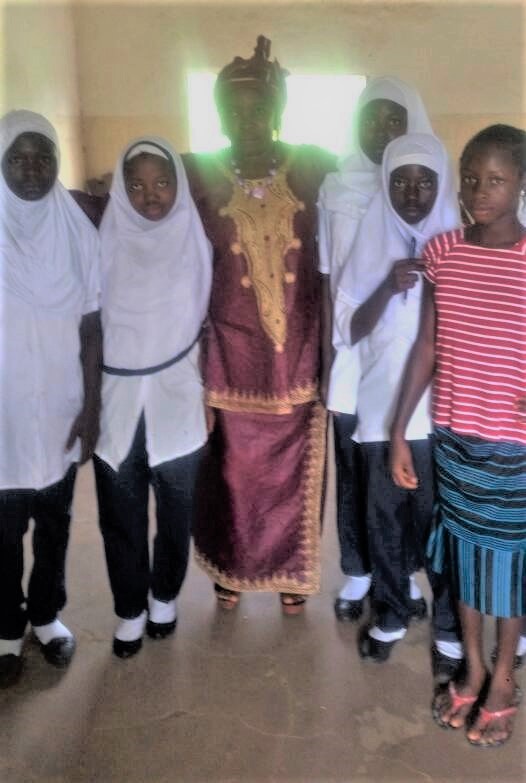
75 of the 80 9th graders who started evening classes in January have continued and will soon be taking their national proficiency exam in late June. They also received computer training as part of the program. Gibril Bendu, above, an award winning local science teacher, has been leading the program.

The first group of nine 12th grade girls received four months of remedial classes before their final proficiency exam in April. CCET immediately engaged 11th graders to start the tutoring program. They plan to continue classes over the summer holiday.

Boys are invited and starting to join girls in the program. They need the chance to succeed, too.

IMG-20170927-WA0000 (4)Mrs. Kaimbay is focused on the success of the chiefdom’s teens.

Left, she finds the most disadvantaged girls like the one on the right, and tells them, come to school. If you can’t pay for a uniform, we will help you.

“I want to get results.”

That’s Mrs. Kaimbay, referring to the students passing the national exams. “And then I will be proud.”

Proud she should be. The tutoring program is among the best spent money in our organization’s five years, in terms of impact and number of students affected.

Since its January start, over 100 kids are getting help to assure their success at the most critical junctures in their education – making the transition to senior high and to higher education.

At about $50 per child, including computer training, this is high value. And it’s an investment that will continue to pay back through their future success and their impact on the chiefdom.

Mrs. Kaimbay is now ready to “camp” the 75 9th grade girls by turning the CCET building into a dormitory / classroom for 3 weeks before and during their proficiency exam.

IMG-20180305-WA0002 (3)

The girls will live and sleep there 24/7, getting intensive prepping with sample test questions and keeping them focused & energized for their exam. All tutoring teachers participate. Mrs. Kaimbay will sleep there herself – on the concrete floor – as chaperone, coach and to supervise cooking to feed the students three meals a day.

With this technique, she got 100% of her former students passing the exam three years running. These girls are coming from other schools with more of an academic deficit. After 5 months of evening classes and with this last boost, Mrs. Kaimbay hopes to get 80% to 90% passes.

The diligence shown by everyone in the tutoring program has been impressive. It’s free to students and teachers get modest stipends. But I wondered if the commitment and enthusiasm for extra evening classes would be flagging now five months into the program.

It hasn’t. These girls are focused on succeeding and advancing their education. Their tutors look at the girls’ success as their own success.

Huge thanks go out to the Beaman Family for funding the tutoring program’s first 10 months and now stepping up to cover cost of feeding the girls for the three-week review camp.

We also send our deep thanks to everyone contributing to the scholarship program. It’s your support that brought them this far and gave them the opportunity to succeed.

I’m confident the girls will do us all proud. I can’t wait to see the next incoming senior high class in September filled with girls ready to continue learning.

Why 2017 was such a great year – in pictures

Why 2017 was such a great year – in pictures

2017 was a banner year for our projects in Sierra Leone. Our hats off once again to our local Sierra Leone partner, CCET-SL, for all their work making this happen. Here’s what made the year so great – in pictures.     —– Arlene Golembiewski, Executive Director

IMG_4972

January:  Five years in the making, CCET-SL’s new Education & Computer Center was open and buzzing with activity. Three levels of Adult Literacy classes filled the main hall, followed by evening computer training. My favorite group is first level literacy, or the ABC group, where women start by learning the alphabet and how to add. One typical student, Jeriatu, thinks she’s about 35 and is the mother of 12 children, one on her back in class. She grows peanuts and wants to be literate to improve her small business, by counting change correctly and figuring her profit.

MVI_2603_Moment   IMG_2532

February: Visiting small villages participating in our projects, like Village Orchards, is always a trip highlight. Villages have received hundreds of fruit tree seedlings to plant as community orchards. Income will go to children’s education and development projects. I asked Nyandahun village chief, Madam Bendu, above left, how her village would use income from their village orchard. She immediately said, we’ll send our children to school.

vlcsnap-error358 (2)March – We started our 3rd group of Women Vegetable Growers, where another 75 women can double their incomes in a few months growing peanuts and vegetables. Emma, above, was in last year’s program. She tells me and Paramount Chief Caulker that with her peanut harvest she paid her children’s school fees and didn’t have to take out a high interest loan. She kept some peanuts as seed to plant this year, too. A success for her, and one of our most successful projects.

Roponga orchard planting groundnuts 5-11-17 8 (4)

April – With a global Rotary Club grant, CCET-SL developed a 15 acre “baby orchard” that will fund children’s education savings accounts. Seven Rotary clubs led by the Ann Arbor club joined the Rotary International Foundation and a Rotary District in a grant that paid to clear overgrown bush and plant over 1100 fruit trees. CCET-SL raised all trees locally from seed, including 450 coconuts and 480 citrus. While the trees mature, annual crops of rice, peanuts, corn and couscous were inter-planted, producing income to pay workers. The $49,500 grant paid for the orchard and several other projects.

IMG_4919 (3)  IMG_4989 (2)

May –  SFSL won a $12,235 Procter & Gamble Alumni grant, enabling CCET-SL to complete equipping their Education & Computer Center. The Center’s first color printer arrived in May, giving CCET-SL an income generating service with the only public color document and photo printing within a 2-3 hour drive. Students can now get computer training on 17 new laptop computers up-to-date with Windows 10 also funded by the grant.

IMG-20170722-WA0007 (2)

June – JulyCCET-SL updated their chiefdom Birth Registration program that records newborn babies at the small village level. Government registrars can’t reach rural areas, jeopardizing children’s proof of citizenship and birthrights to family land, medical care and other services. The Rotary grant funded training for new chiefdom birth recorders and bicycles to cover their assigned villages. CCET-SL grows their own fruit trees from seed, and gives newborn parents three fruit trees to raise for their child’s welfare and education. The mothers above collected their fruit trees with their babies carried on their backs. See the little feet around their waists.

IMG-20170831-WA0022 (8)

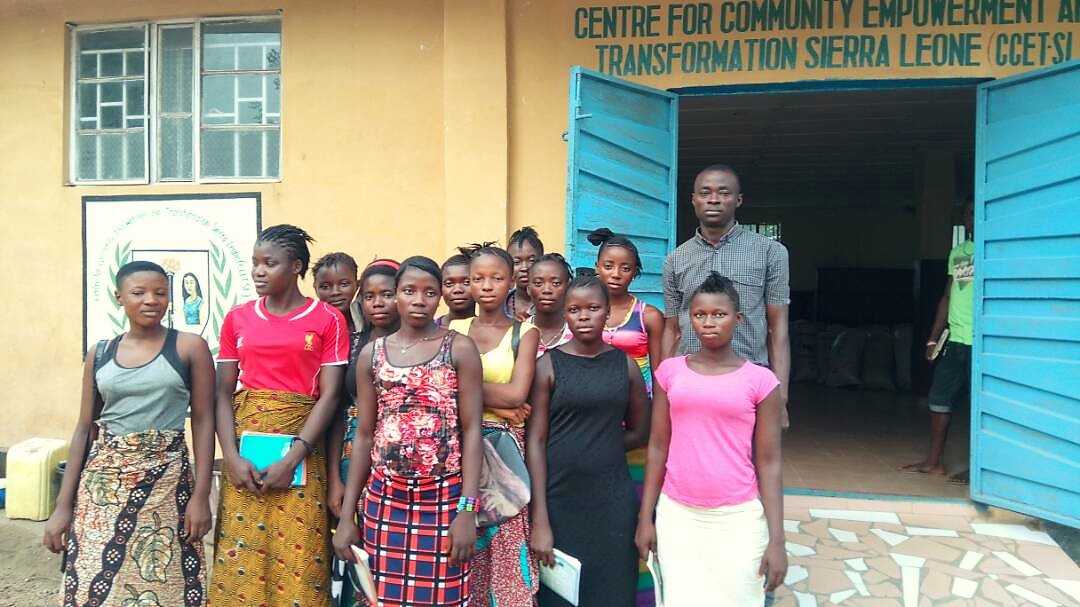
AugustA second group of Women Vegetable Growers got the opportunity to raise peanuts as a cash crop. Subsistence farmers, they use most everything they normally grow to feed their families and barter locally for other needs. They can’t afford a $30 bale of peanut seed to expand their farms and earn more money. This group of 85 women was funded under the Rotary Club grant. They happily line up above with Rosaline Kaimbay of CCET-SL, right, to collect peanut seed, a drying tarp and 100 lb. of rice to feed families before their harvest – worth $80 in all. Within five months they’ll be harvesting. We’ve reached 300 women to date.

IMG-20171124-WA0024 (2)

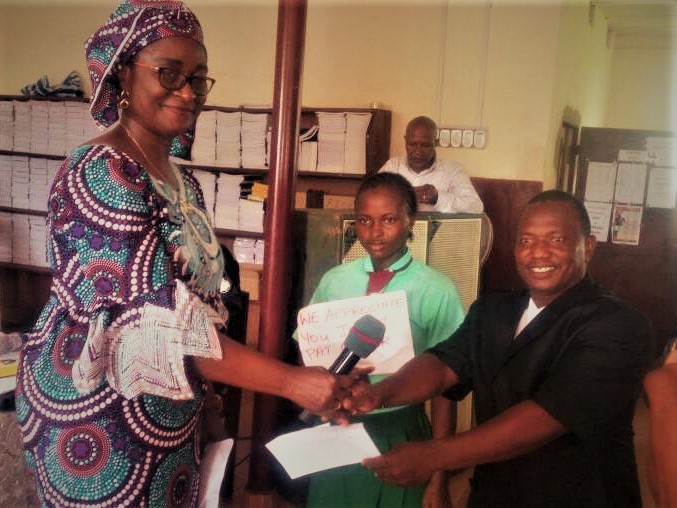
September460 girls returned to school with school fee scholarships from Sherbro Foundation. A $17 scholarship keeps them in school for a full year, avoiding early marriage and early pregnancy – and makes for brighter, more productive futures for every year of education they get. Compassionate donors funded uniforms for all 120 senior high and 290 junior high girls, as well. For the first time, 100 girls can study at night with solar study lanterns, and we awarded the first college scholarship. It’s very impressive. I’ve never seen any organization giving so many awards and paying for so many things,” said Alice Conteh Morgan, managing director of Reliance Insurance Co. in Freetown and Rotifunk native. Above, she presents scholarship awards to Bumpeh Academy principal Rashid Conteh.


Octoberrice planted in the Baby Orchard was ready to harvest by October. The orchard is really a working plantation with supplies, tree seedlings and acres of harvests to be transported throughout the year. Now a necessity, the SFSL Board made the gift of a used truck, one built to withstand unpaved rural roads. The rice had to be threshed by hand by beating the sheaves to loosen rice grains – using the chief’s palaver house, above, as a workspace. Year by year we’ll make improvements as we can pay for them.

IMG-20171120-WA0001

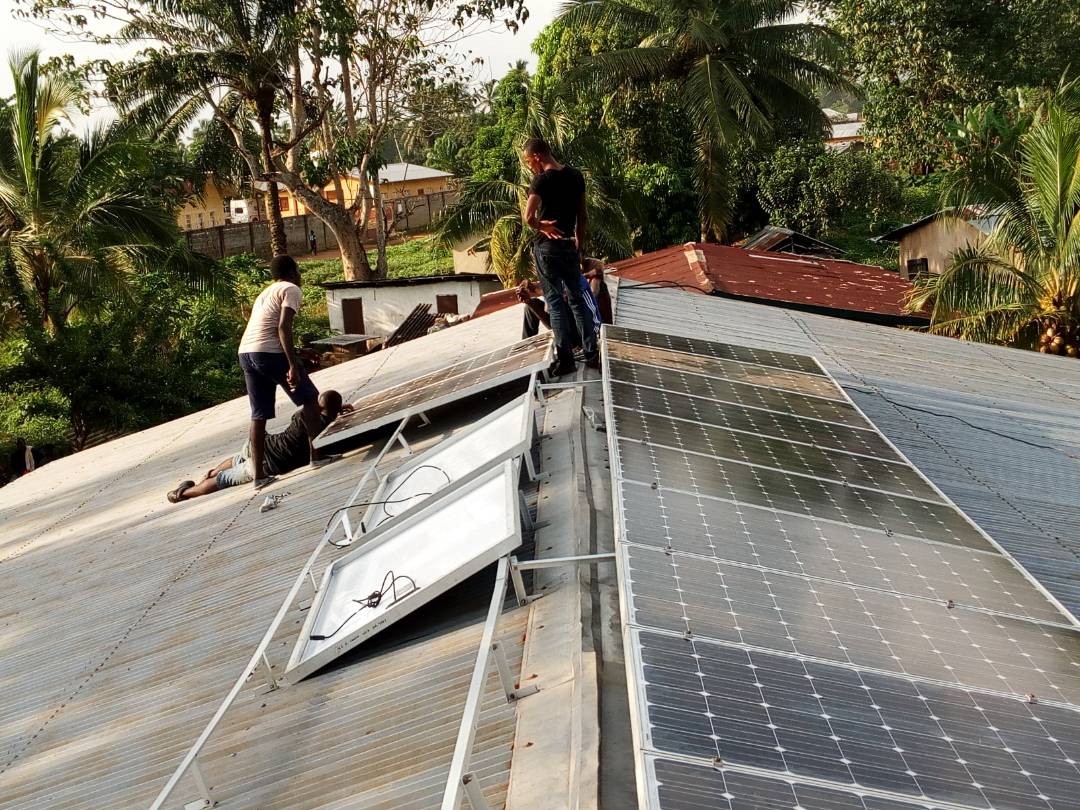
November – Reliable power for CCET-SL’s Center had become a major problem, interrupting classes and jeopardizing income generating services like printing that fund the center operations. Our prayers were answered when the Beaman Family funded a complete 6000 Watt solar power system for the Center.  Printing, charging computers and evening classes and meeting space are now available whenever needed. Thank you, Beaman Family!

IMG_2190December – Planning for 2018 is underway. CCET-SL’s Tree Nursery is central to several projects. 12,000 tree seedlings, all started this year from seed, are nearing transplanting stage. They’ll go to planting the next baby orchard, supplying “baby trees” for 2018’s newborns and their parents, and for sale to generate income to keep propagating more trees. 2018 will also be the start of a new local forest reserve system, a first of its kind at the chiefdom level to protect mature forests and sources of village drinking water.

Hundreds of Girls Scholarships Thrill Bumpeh Chiefdom

We thought this year’s Girls Scholarship Campaign was highly successful. More than doubling donations over the previous year is definitely a success.

How do the 460 scholarship students and their community see it? They are thrilled.

IMG-20171205-WA0013 (3)

After the recent Bumpeh Chiefdom scholarship awards ceremony, “parents were singing and dancing with happiness because their girls can stay in school,” reported Rosaline Kaimbay, managing director of our local partner, The Center for Community Empowerment and Transformation – Sierra Leone.

IMG-20171124-WA0010 (3)And special guests repeatedly said they’ve never heard of a larger – or more complete – scholarship program anywhere in the country. Ibrahim Coker, left, area supervisor of schools for the Sierra Leone Ministry of Education said: “I’ve never seen such a number of scholarships together with a total package including uniforms, exercise books and solar study lights.”
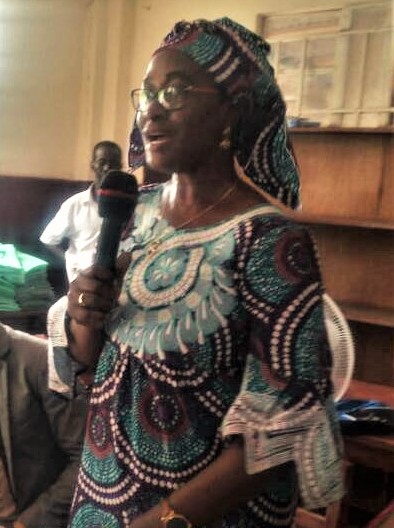
With $US17,900 from Sherbro Foundation donors, CCET was able to provide 460 school fee scholarships to young women in four secondary schools. And this year, we added 310 uniforms for girls entering junior high and all 120 senior high students.

PLUS, for the first time, 100 students studying for 9th or 12th grade graduation exams received portable solar lights – never seen before – so they can study in Africa’s long dark evenings. AND, we started the first college scholarship.

Scholarship awards CCET bldg 2 (3)“It’s very impressive. I’ve never seen any organization giving so many awards and paying for so many things,” said Alice Conteh Morgan, left, managing director of Reliance Insurance Risk Co. in Freetown. Conteh Morgan, a Rotifunk native, attended to encourage the girls: “With your educations, you can achieve everything.”
In comparison, Plan International, a large UK-based charity, awards fewer than 50 scholarships annually in Bumpeh Chiefdom for girls already enrolled in an older program. Most of our awardees don’t qualify. That’s why Sherbro Foundation’s work is so appreciated.

Scholarship money, like any school fee, goes into the schools’ operations and to make school improvements.

“CCET-SL has paid for all (160) girls in our school. We appreciate it so much. May god richly bless you and all the donors,” was the message from Daniel Koroma, vice principal of Bumpeh Academy Secondary School. The school immediately began applying scholarship funds to build classrooms, since many of its classes are held in partial structures with no walls.

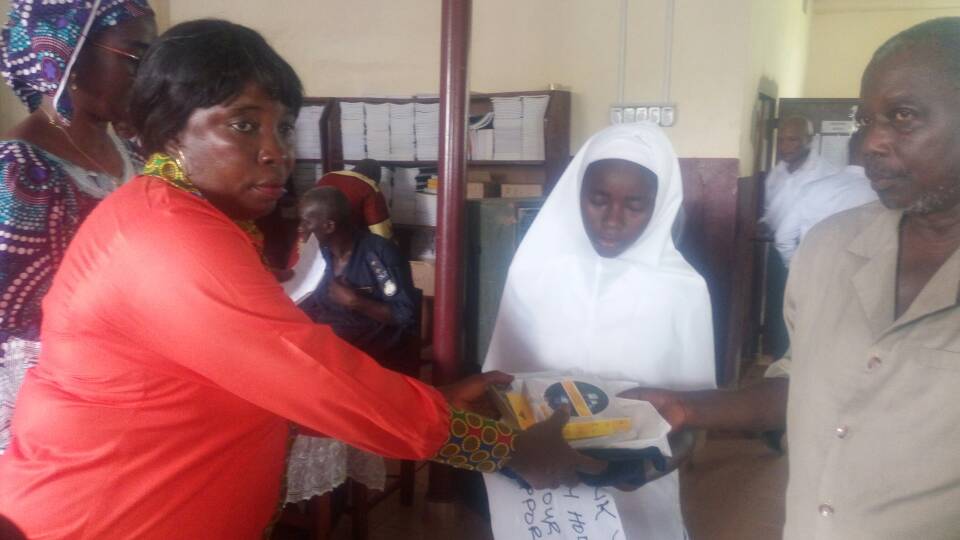
IMG-20171127-WA0000The awards ceremony was covered by the Sierra Leone Broadcasting Co., the country’s only TV station and a regional radio station. Paramount Chief Charles Caulker said he continues to receive phone calls congratulating him on Bumpeh Chiefdom’s big news.

Likewise, Rosaline Kaimbay’s phone kept ringing. “It made me so proud to hear from friends around the country saying they saw news of our impressive program.” Above, she presents an Ahmadiyya Islamic school student with her uniform, exercise books and solar study light, together with school principal Mr. Tarawallie.