After All the Eating and Shopping ….It’s Time to Give Back

10730891_746250242120351_4711102638509785596_n


logo-segoe printGive to help Sierra Leone emerge from the Ebola Crisis and build a brighter future.

 www.SherbroFoundation.org/donate  

Your donation is now DOUBLED with 1:1 matching.

Help Sierra Leone more. Pass this on to a friend.


P.C. Caulker interviewed on role of chiefs in Ebola crisis

Paramount Chief Caulker of Bumpeh Chiefdom talks about being a chief and their role during the Ebola crisis. As leader of the National Council of Paramount Chiefs in Sierra Leone, Chief Caulker was interviewed by Radio France Internationale.  Read the transcript here. 

Paramount Chief Charles Caulker

Paramount Chief Charles Caulker

Most Westerners don’t understand paramount chiefs are distinct from the Sierra Leone government.  They’re a separate form of governance that represents every Sierra Leone resident in every part of the country, and pre-dates colonial rule. They deal with local affairs and are the first level of action in addressing resident safety, including in time of disasters.  In a rural country with difficult roads and many remote villages, paramount chiefs are the first and often the only authority figure their residents will encounter.  Their role is critical for something like the current Ebola crisis.

Chiefdoms enact byelaws to document the customs and practices of the area. Two sets of byelaws on the paramount chief’s role in addressing the Ebola crisis were defined in recent months.  President Koroma has been admonishing paramount chiefs of late to fulfill their role in breaking the chain of Ebola transmission, as defined in the byelaws.  Chief Caulker discusses in the interview the need for adequate resources if chiefs are to deliver this role.

Peace Corps Volunteer’s Africa Book Honored at Smithsonian

Fellow former Sierra Leone Peace Corps Volunteer Monica Edinger was honored yesterday at the Smithsonian for her children’s book – Africa is my Home: Child of the Amistad.  It tells the story of a child captured into slavery on the Amistad ship and her eventual return to Sierra Leone.

edinger coverThe Smithsonian’s National Museum of African Art (NMAA) held their  22nd annual Children’s Africana Book Awards (CABA) in Washington, DC.  CABA was created by Africa Access and the Outreach Council of the African Studies Association to honor authors and illustrators who have produced exceptional books on Africa for young people.

Four books were honored in this category for young people, including a book authored by Desmond Tutu. Not bad company to keep, Monica.  Congradulations!

I introduced her book on the blog last September. Check it out.  Looking for an Xmas gift for a child in your life?  This would make a great one. Beautifully illustrated to tell a compelling story.

Read her own account of her November 10 trip to Washington, DC to collect the award.


It’s working – No More Ebola Cases in Bumpeh Chiefdom!

December 8th Update:  55 Days & counting  –  No new Ebola Cases!

Chiefdom Ebola Task Force is doing a fantastic job – but they need our continued support.

There are no more Ebola cases in Bumpeh Chiefdom since they embarked on their Breaking-the-Chain-of-Transmission program  October 22nd. Even though they earlier lost 21 people to Ebola and the epidemic rages around them.

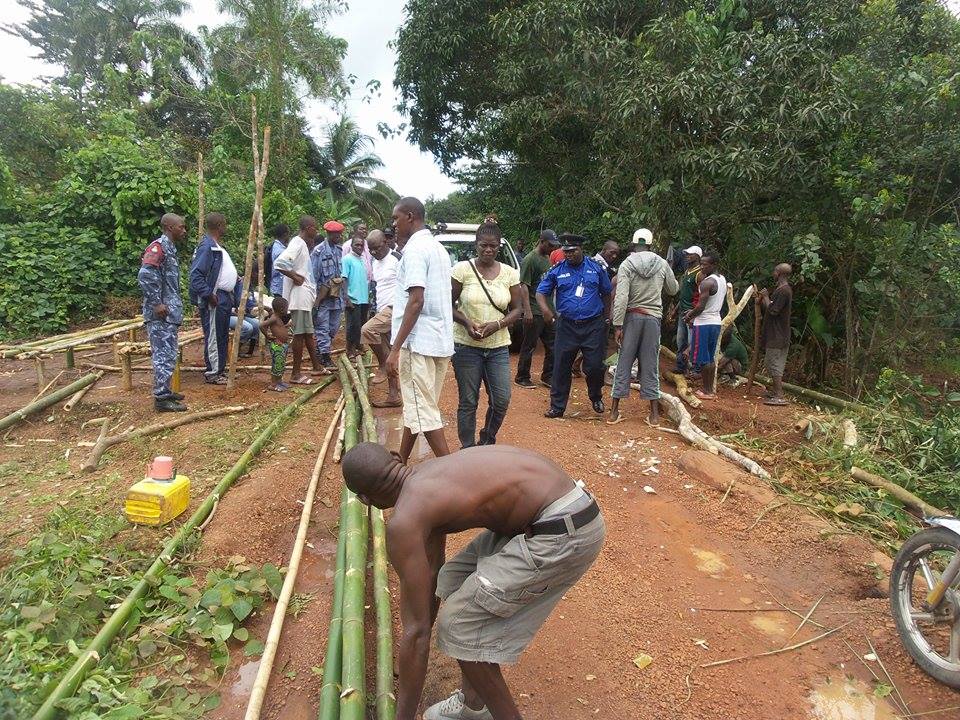
Setting up check point.

Setting up check point.

What’s changed? The single biggest intervention is rigorously managed checkpoints at the main roads to stop “strangers” from entering the chiefdom and carrying Ebola with them.  Village chiefs are the next level of defense going door to door daily to verify no one has taken ill and there are no unexpected visitors.  Reporting is real time with cell phones.

Imagine if every chiefdom in Sierra Leone mounted this kind of systematic offensive to identify and isolate Ebola cases for even 21 days.  It would literally break the chain of Ebola transmission and the outbreak would be on its way out.   Read the whole story here.

Sherbro Foundation continues to support Bumpeh Chiefdom in their Breaking-the-Chain-of- Ebola-Transmission program.  Without our donations, they could not have launched this comprehensive effort.

You can make a difference and help eliminate Ebola, too.  Join us and donate at www.sherbrofoundation.org/donate. We need your help to keep this effort going for the coming months.

You’ll know exactly where your money goes, and that it’s actually working to stop the spread of Ebola.

Bonus: 100% goes directly to the chiefdom Ebola program. Every penny. We’re an all-volunteer organization and our small administrative costs are paid by a separate donation.

2nd Bonus: It’s tax deductible for US residents. Sherbro Foundation is a 501(c)(3) tax exempt organization.

Help us even more – forward this to a friend.

It’s Working – No More Ebola Cases in Bumpeh Chiefdom

November 19 update – Ebola-free 32 days and counting

“Things are better, relatively speaking.” Rosaline Kaimbay emphasized the “relatively speaking” when I called yesterday for an update on Bumpeh Chiefdom. But it was the first positive news in some weeks. There are no more Ebola cases in the chiefdom since they embarked on their Breaking-the-Chain-of-Transmission program two weeks ago.

Yet Ebola is raging in Waterloo, a large town on the main highway and the source of recent Ebola cases in Bumpeh Chiefdom. There are reports of over 700 dead of Ebola in the Western Rural area in the last 5-6 weeks, most coming from Waterloo. Ebola “refugees” have been fleeing places like Waterloo and carrying Ebola to rural villages. Places like Bumpeh Chiefdom in close proximity.

Setting up check point.

Setting up a check point.

But today there’s no Ebola cases in Rotifunk or the rest of Bumpeh Chiefdom. Why? The single biggest intervention is rigorously managed checkpoints at the main roads to stop “strangers” from entering the chiefdom and possibly carrying Ebola with them.  There are also checkpoints on the Bumpeh River that traverses the chiefdom and is the main traffic route for many of its 208 villages “downriver” as they say.

Young chiefdom men volunteered to supplement government security forces at checkpoints and monitor all traffic in and out of the chiefdom. They’re the ones rigorously enforcing, keeping chiefdom borders tight, and ensuring outsiders are turned away. They’re the ones sitting up for all night vigils with nothing to protect them from mosquitos except a camp fire. They take turns for naps in a 3-sided palm branch lean-to on hard benches of split bamboo – their improvised shelter.

Rosaline Kaimbay interviewed at chiefdom meeting.

Rosaline Kaimbay interviewed at chiefdom meeting.

Rosaline visits the checkpoints daily to be sure all is going well and lend support. She is Executive Director of Sherbro Foundation’s partner organization, the Center for Community Empowerment and Transformation, CCET, and principal of Prosperity Girls High School. And now, she’s part of the chiefdom’s Ebola task force. Rosaline is a do-er. If you need something done, get Rosaline. If it’s important to Bumpeh Chiefdom, you won’t need to look for her. She’ll be there.

Rosaline said she goes to the checkpoints daily for at least 30 minutes, maybe an hour, to personally assess. She heads out each day with the CCET motorcycle and a driver, the only practical way to get around these days. Maybe the only way.

We have six chiefdom men assigned to each checkpoint, Rosaline said. They rotate through, with five days on and two days off. I talk with people, bring them drinks, something to boost morale.

And the checkpoints are working. I asked what they do if someone tries to enter the chiefdom who doesn’t live there. They send them back where they came from, she said, the way they came in.

Chiefs like Mr. Kamara monitor village families.

Chiefs like Mr. Kamara monitor village families.

It sounds rather medieval. But much of the country is under similar isolation orders, trying to isolate districts, and chiefdoms within districts, that have surges in new Ebola cases. This is Public Health 101 to isolate disease cases and keep them from spreading. It works.

Village chiefs are the next level of defense in the Breaking-the-Chain-of-Transmission program. Bumpeh Chiefdom chiefs are going door to door daily to verify no one has taken ill with Ebola-like symptoms, and there are no new visitors.  Reports are by cell phone real time, wherever possible.  Section Chiefs are responsible to report their village results to the Chiefdom task force.

Imagine if every chiefdom in the country mounted this kind of offensive to fight Ebola for even 21 days – the upper range for Ebola incubation. It would literally break the chain of Ebola transmission and the outbreak would be on its decline.

Identify – Isolate – Treat. If all three legs of the infectious disease control stool were reliably there, Ebola would come under control. Actively engaging and supporting traditional leaders to identify and isolate cases in their chiefdoms is the key. They play a role in getting cases promptly sent for treatment. No one else can do this systematically with cooperation of the people. No one else is already in place in every corner of the country.

There’s still a long uphill battle to eliminate Ebola. But for the first time in a long while, you get a sense the runaway train is starting to be controlled and slowing down.

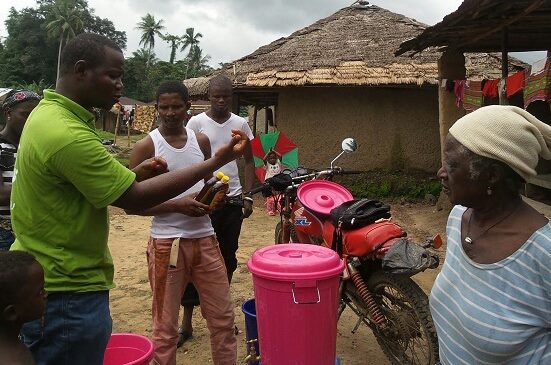
Sherbro Foundation will continue to support Bumpeh Chiefdom in their Breaking-the-Chain-of- Transmission program. Our donations go to support the checkpoints teams with small weekly per diems, transportation costs and cell phone coverage. Village chiefs receive a $5 honorarium to recognize their service for three months of house to house checks. With gas at $5/gallon, transportation costs are high. Our support enables the Chiefdom task force to get around and ensure work gets done. We continue to supply villages with hand washing stations and disinfectant for public places.

You can make a difference and help eliminate Ebola, too.  Join us and donate at www.sherbrofoundation.org/donate

You’ll know exactly where your money goes, and that it’s actually working to stop the spread of Ebola.

Bonus: 100% goes directly to the chiefdom Ebola program. Every penny. We’re an all-volunteer organization and our small administrative costs are paid by a separate donation.

2nd Bonus: It’s tax deductible for US residents. Sherbro Foundation is a 501(c)(3) tax exempt organization.

Help us even more – forward this to a friend.

Ebola – All We Need to Do

All we need to do to make this work is restrict movement (into the chiefdom) and don’t touch.

Setting up checkpoint at chiefdom border.

Setting up checkpoint at chiefdom border.

These were Chief Caulker’s words to me two days after he launched his “break-the-chain-of-transmission” program to stop Ebola in Bumpeh Chiefdom. He spent the previous evening at one of the key checkpoints set up to control anyone trying to enter or leave the chiefdom on a drivable road. Additional checkpoints are being set up at strategic points for river traffic and frequented footpaths.

Chief was there until nearly midnight to personally observe checkpoint activity. And I need to boost morale, he said, so I stayed there late into the night.

Chief Caulker (blue sports suit) inspecting checkpoint.

Chief Caulker (blue sports suit) inspecting checkpoint.

The chiefdom has been under a government isolation order for a month with no traffic in or out except those with an authorized pass. Waterloo and Moyamba Junction are both market towns on the main highway now decimated by Ebola. Many there have family and personal connections in Bumpeh Chiefdom. You turn off the highway at either of these points to reach the chiefdom. Both towns have been the source of three cases of Ebola infected people fleeing quarantine there to chiefdom villages. Each incident was isolated and contained, but Bumpeh Chiefdom’s proximity puts it at risk of a bigger outbreak.

Army or police manned checkpoints on roads are supposed to stop all traffic without authorized passes, including any vehicle, motorbike or foot traffic. But borders are “porous,” as they say. “Lots of compromising going on,” Chief said. These are nice ways of saying people can pay or otherwise talk their way through.

Checkpoint night watch.

Checkpoint night watch.

This is why Chief Caulker has added his own chiefdom volunteers. Young men committed to their chiefdom and willing to sit up all night in a palm lean-to with a camp fire, and actually stop traffic without an official pass. Four trucks per day are allowed to bring supplies to Rotifunk.

A week later Chief Caulker said, the checkpoints are being very effective. The presence of checkpoint volunteers is making the army or police personnel do their jobs.  Traffic is finally being halted and turned away. Volunteers call in reports on cell phones.

The only problem, chief said, is that the police and army personnel are asking for food and ”incentives.” In the local vernacular, this means money and things like cigarettes, because they’re not being paid by the government, or payments are skipped. I’m not using donations the chiefdom received to fight Ebola to pay staff the government is responsible for, Chief said.

I’ve come to better understand all the petty corruption from police, army and other government employees, trying to extract small bribes from local people. When they don’t get paid, they still need to eat and support their families. They’re in effect imposing their own tax. If that’s all that’s at stake it’s one thing. But allowing Ebola infected people to pass through checkpoints during this crisis in inexcusable.

On the no touch side, one of the biggest sources of new Ebola infections have been traditional burials – now considered unsafe. People now understand (at least in Bumpeh Chiefdom) the need to report all deaths to first check for Ebola.

We’re having a good response on our side on reporting, Chief said. I got five cases of natural deaths reported to me last week I wouldn’t normally get. We need to know cause of death in each case. Swabs are taken for Ebola testing  by the community health officer.  There’s been a better response now on testing requests.

Local chiefdom burial teams have been organized and started doing burials under the supervision of official burial teams from the district capital, Moyamba. This includes proper use of personal protective equipment they received a few days ago that’s WHO funded. Teams have to undress and throw the PPE into the grave, chief said, so the supply won’t last for long. The first few burials will be supervised; then local teams are on their own. Bodies won’t be waiting two, three or more days for burial. Or be thrown in the river, as was recently done.

Let’s hope the chiefdom program to stop Ebola results in few Ebola burials to come, and new protective equipment isn’t in demand. So far, so good.

Sherbro Foundation is proud to be supporting Bumpeh Chiefdom in their program to break the chain of Ebola transmission with helping fund the checkpoint teams.

Good News Among All the Bad

There is good news among all the bad news we hear daily on Ebola. It’s important to know there is hope for the future.  Here’s some things I read today.

Treatment – the Cure
To date, there’s not been any Ebola treatment that can be called a specific cure.  Patients can only be treated symptomatically, replacing lost fluids and electrolytes and treating secondary infections.  The body has to develop natural antibodies and fight the Ebola virus on its own.

The World Health Organization, WHO, indicates serum extracted from the blood of Ebola victims who survived the virus could be made available to patients in Liberia in the coming weeks.  Blood serum with its antibodies taken from Ebola survivors has been given to newly infected patients in recent weeks out of desperation and trying possible cures.  Results are now only anecdotal, without enough cases to demonstrate efficacy.  But they’re promising.

Success remains to be seen and can only be proven with greater use.  Blood serum from survivors was used with some success in previous Ebola outbreaks.  With more and more Ebola survivors now, it’s a treatment course that’s definitely feasible to try and may prove to work. Even if it proves to only be partially effective, that could make all the difference for some patients trying to climb their way back to health.  http://www.theweek.co.uk/world-news/ebola/57952/ebola-blood-serum-leads-the-global-race-to-find-a-cure

Prevention
Major drug companies race to produce a vaccine for Ebola and have large quantities of doses ready for humans in 2015.  Johnson & Johnson is said to be leading the pack.  This video is encouraging in hearing J&J Chief Scientific Officer discuss not only J&J’s work, but how drug companies are in communication with each other to ensure their collective work is fast  tracked.  http://www.bloomberg.com/news/2014-10-22/j-j-says-250-000-ebola-vaccine-doses-to-be-ready-by-may.html

This work won’t help people currently infected with Ebola. But it definitely offers hope for the future for millions of at risk Africans.

Surviving Ebola today

msf 1000th survivor

1000th survivor – from MSF

It’s important to remember that people are surviving Ebola today with supportive care.

Doctors Without Borders celebrated their 1000th survivor in the current Ebola outbreak this week.
http://www.npr.org/blogs/goatsandsoda/2014/10/21/357810605/my-son-is-doctors-without-borders-thousandth-ebola-survivor

The Hastings Treatment Center just outside Freetown is a new one, only opening September 19 and staffed with Sierra Leonean doctors and nurses.  130 patients have been released after successful treatment there. Amidst all the headlines on insufficient numbers of treatment centers and inadequate centers, it’s important to remember many people are being treated and surviving.

Kargboro Chiefdom receives Ebola Prevention Supplies via Sherbro Foundation

Rev Williams load his motorcycle to carry supplies to Shenge

Rev Williams loads his motorcycle to carry Ebola prevention supplies to Shenge

Sherbro Foundation was happy to help former Shenge Peace Corps Volunteer, Ginny Fornillo send Ebola  aid to Kargboro Chiefdom, Moyamba District.  Ginny’s donation allowed Reverend Hubert Williams of Gomer Memorial Church, Shenge, buy hand washing stations to set up in chiefdom public places, as well as disinfectant and soap.

Frequent hand washing with basic soap and water remains an effective first line of defense to prevent Ebola and other diseases like cholera and dysentery.

Reverend Williams loaded up his motorcycle in Freetown to carry supplies back to Shenge.  Shenge is a coastal village at the end of one the worst dirt roads in Sierra Leone. Motorcycles are one of the only means of transportation to still get to Shenge.

Kargboro Chiefdom Ebola Committee ready to distribute hand washing stations

Kargboro Chiefdom Ebola Committee ready to distribute hand washing stations

Kargboro Chiefdom Ebola Committee members distributed hand washing stations and soap to public places in Shenge and surrounding villages.

Kargboro Paramount Chief, Madam Doris Lenga Koroma, sent her thanks and appreciation on behalf of chiefdom residents.

Reverend Williams had to again travel to a place where he could email back a message  with pictures to show that he successfully delivered supplies in Shenge:

” D figures of contacts 4 EBOLA is everyday increasing. I heard of a case few miles 2 Bambuibu, so I have 2 go back immediately 2 go and take care of my family. D entire country we are in a complete confusion and worries.

As 4 request 4 HELP, I am ALWAYS in need at every moment. D people of KARGBORO are also asking 4 more assistance.”

Ebola victims are now fleeing infected cities and towns to the care of family and friends in rural villages.  Family connections run deep, and even remote places like Kargboro Chiefdom are no longer safe from the Ebola virus.

Thanks again to Ginny Fornillo for coming to the aid of Kargboro Chiefdom with supplies to help prevent transmission of the Ebola virus.


Ebola – how life is unnecessarily lost

Oct 4  Sad update to this story: everyone, save three small children, in the three quarantined houses have contracted Ebola and passed away. 14 adults and the 17-yr old girl pictured here. The 3 children have reached the 21 day point with no symptoms, and are being released.
****************************************************************************************************************************

I was shocked to hear that all of Moyamba District was put under an Ebola isolation order last week, and Bumpeh Chiefdom was further isolated within the district. And worried about the welfare of my friends in Bumpeh Chiefdom where Sherbro Foundation does our work.

I soon learned more that shocked me, more than four months into the second and more rapidly growing wave of Ebola in Sierra Leone. My heart aches for these people so far away, and there’s so little we can do from here. But one important action is helping.

After a three-day national shutdown to try to contain Ebola cases, it may have seemed that the cities were starting to get a grip on the deadly virus, which is spread by contact with bodily fluids.

But there’s still no full logistical plan nor Ebola-equipped health care in rural areas –the majority of the country — to manage cases in new Ebola hot spots. What are the practical next steps, when there are so few resources, when there are so many obstacles in a subsistence society?

17-yr old gives birth aloneIsolation and quarantine are the government orders. But with no further plan and coordination of services, avoidable Ebola cases can happen — and more unnecessary deaths.

This 17-year old girl is another kind of Ebola victim.

Pregnant with her first baby and quarantined in a village just outside Rotifunk, she got no prenatal care in her last weeks. When the baby came, she was left to deliver on her own. Even her own mother was afraid to come to assist. The baby was stillborn. The young mother got no assistance to ensure the placenta was fully removed and she had no complications. She remains untended in quarantine.

“If there had been the opportunity of suing the state to court, I should have been the first person to do that,” Rotifunk Ebola task force team leader Ben Alpha’n Mansaray said via Facebook.

“Once you are quarantine, you are sentenced to death. They need care! They need hope!”

About 1.2 million people in the country are now under isolation orders in the Sierra Leone government’s efforts to stop the spread of the disease. Isolation means a cluster of new Ebola cases occurred, requiring a more drastic measure.  People can move around within the isolated area, but no one can come in or go out. Individual homes are quarantined to further isolate new cases.
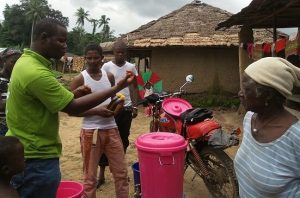
Alpha Mansaray delivers hand washing stations and Ebola prevention message to villagers.

Alpha Mansaray delivers hand washing stations and Ebola prevention message to villagers.

Quick action by Bumpeh Chiefdom’s Paramount Chief Charles Caulker to quarantine contacts of the first Ebola case in early September has kept the disease contained to a small village on the outskirts of Rotifunk. Rotifunk itself, seat of the chiefdom of 40,000, remains safe.

Ten days ago, the dreaded virus emerged in new cases among the quarantined people. Eight people total have died, and two early cases made it to a treatment center.

Quarantine sounds like a straight-forward measure. You restrict people to their house who may have been exposed, and wait through the 21-day incubation period to see if they develop the disease. But in an impoverished rural area like Rotifunk, the logistics are anything but simple.

They are nightmarish.

  • There’s no local holding center to isolate new Ebola cases from those not sick until they can be carried to a treatment center. In close quarters of a quarantined house, the sick can quickly infect those not sick.
  • The few Ebola treatment centers (only in far-off cities) and ambulance service are beyond overloaded. Rotifunk made repeated calls for five days and got no response. With no Ebola-equipped local health care, the sick are left on their own. No one comes near. The sick only got sicker.  Three died waiting for an ambulance to arrive.  Three others made it to the district capital holding center — two hours to go only 17 miles on a pothole ridden dirt road  — but died waiting for a bed opening up in a treatment center.
  • Inexperienced ambulance teams that did finally appear are fearful even with some protective equipment, and wouldn’t assist Ebola patients into the ambulance. If sick patients could drag themselves 25 feet and climb in on their own, they were taken to a holding center. If not, they were left to die at the quarantine house.  One man died the following day.
  • People in quarantine have great difficulty getting adequate food or daily clean water. These are people who rely on their daily labor to buy their daily food. Some are lucky when family or friends send food. Others are at the mercy of generous local residents.
  • Water is especially important to keep the sick hydrated. When a water container is used in quarantine, it must be considered contaminated. Disposables are unheard of. If the quarantined are near a river, they can collect their own water. If not, they wait for a Good Samaritan to bring water and pour it into their container left outside.
  • Other medical emergencies like malaria, typhoid, maternity cases or increasingly common chronic conditions like hypertension get no care in quarantine – resulting in unnecessary complications or deaths.

When new Ebola cases appear in a quarantined house, the 21-day quarantine clock starts again for those showing no Ebola symptoms.  They could end up in quarantine for five, six or more weeks. When left in the same infected house, their likelihood of getting Ebola only grows.

The central government Health Service orders there be no movement of people under quarantine. Security (army or police) are stationed to enforce this. No safe houses have been provided despite repeated reports of Rotifunk’s situation. Some well people, like this pregnant girl, moved to an outdoor bathhouse (just concrete) in an effort to protect themselves while waiting out the remainder of their quarantine.

Bumpeh Chiefdom’s  isolation order came last week without notice, separating parent from children, farmer from fields needing planting, family from breadwinner who went to market and has the only money or food to feed the others.

When I read of whole villages being decimated by Ebola, I can now better understand why. Quarantine can lead to the sick quickly infecting those not sick with nowhere to go. Villages may self-impose quarantine to isolate the sick. With sick people and no indoor plumbing or easy to access water, houses quickly become filthy. Disease spreads. Mothers delivering babies and small children with malaria get no medical care.

How can this awful situation be improved?  One simple solution is to build temporary makeshift huts and pit latrines as local Ebola holding centers, to separate those becoming sick until they can be moved for treatment. With very minimal funding, these could be locally built. But they’re not forthcoming. Ambulance service calls need to be coordinated, and drivers trained and held accountable for delivering patients.

There is something important we in other countries can do: Help to buy simple hand-washing stations for Bumpeh ChiefdomSherbro Foundation paid for 200 such plastic stations and disinfectant in August. Forty stations were set up in public places around Rotifunk in one week.  160 more followed for chiefdom villages in August.  Chief Caulker said, “These have been very, very effective. You see them constantly in use with people washing their hands throughout the day.”

Chief Caulker would like 200 more hand-washing stations to supply remaining villages. Villagers get Ebola sensitization training and weekly reminders from Rotifunk volunteers on the importance of frequent washing to prevent Ebola and other diseases like cholera, typhoid and dysentery. Behaviors on personal hygiene and sanitation are changing.

Sherbro Foundation works directly with the Bumpeh Chiefdom Ebola task force to quickly send all donated dollars so they can buy these life-saving supplies. Please consider donating right now!  $20 buys one hand-washing station and two bottles of disinfectant.  Donate online here.

Nothing is easy about managing the Ebola outbreak in Sierra Leone. But coordination and common-sense local solutions could help. When coordination between the central Sierra Leone government and rural traditional leaders during emergencies is missing, key opportunities are lost.

Innocent people are the losers when critical decisions aren’t made quickly. It means unnecessary and tragic loss of life.

Paramount Chiefs Now Authorized to Enforce Community Ebola Practices

A systematic way to enforce community Ebola procedures has been missing in Sierra Leone’s Ebola outbreak, enabling the disease to spread around the country. Paramount Chiefs are now authorized by the Sierra Leone government to do this.

The National Council of Paramount Chiefs developed a national template for individual chiefdom byelaws on managing Ebola at the community level.

The “Byelaws on the Prevention of Ebola and other Diseases” were approved by the Honorable Minister of Local Government and Rural Development and made pursuant to the Public Health Emergency declared by the President of the Republic of Sierra Leone and approved by Parliament on Friday 8th August 2014 under section 29 of the Constitution of Sierra Leone Act No. 6 of 1991.

Paramount Chiefs are now expected to adopt these byelaws into their chiefdom byelaws and enforce the provisions.  Beyond imposing fines, chiefdom authorities have the right to pursue legal action in the Local Courts or courts of higher jurisdiction, for flagrant violations of these byelaws.

The Sierra Leone Government had identified many community practices and procedures necessary to stop the spread of Ebola.  But they did not have the ability to uniformly enforce them in all corners of the country, especially once you leave the few provincial cities.

???????????????????????????????Paramount chiefs are a long standing country institution that ensures basic law and order, management of local land rights and maintaining traditional practices. There are 149 chiefdoms that cover every part of the country, with cascading chiefdom authorities down to the village level. But they are an institution separate from the Sierra Leone Government, and were not directly authorized to enforce Ebola practices established by the government.

P.C. Charles Caulker, chair of the National Council of Paramount Chiefs, worked with the NCPC to harmonize byelaws some chiefdoms had started initiating on Ebola. They worked with the Honorable Minister of Local Government and Rural Development to finalize a national document , have it accepted by the Government Cabinet, and then approved by Parliament on August 8.

Paramount chiefs are now expected to introduce and enforce these provisions as chiefdom byelaws.  They include nineteen provisions and authorize chiefs to impose fines of up to Five Hundred Thousand Leones (Le.500, 000) and/or a term of Six (6) months imprisonment for any breach of these provisions.

The provisions include Communication of Ebola, where no one can harbor a person suspected of having contracted Ebola and all strangers arriving in any residential area shall be immediately reported by their host, guest house or hotel to the competent chiefdom authorities.

They continue to Treatment of Ebola  where only personnel part of recognized facilities for the treatment of these diseases can be involved in treatment of any Ebola patient. Provisions for quarantine and receiving recovered Ebola patients back into their communities are given.

Provisions for Death and Burial are defined. Miscellaneous provisions temporarily prohibit public gatherings, including Luma markets and Secret Society activities, and the hunting and selling bush meat. Public places, including those of worship, are encouraged to have hand washing buckets with chlorinated water.

Any chief, including paramount chiefs, found negligent in the application and enforcement of the Bye-laws is liable to a fine of Five Hundred Thousand Leones (Le.500,000) and / or summary suspension from office.

Directly engaging paramount chiefs and authorizing them to enforce community Ebola practices will go a long way to controlling the current outbreak.  This hopefully also represents a new level of working relationship between the government and the country’s traditional leaders.

Rotifunk’s Computer Center: building their future

Rotifunk’s Computer Center: building their future

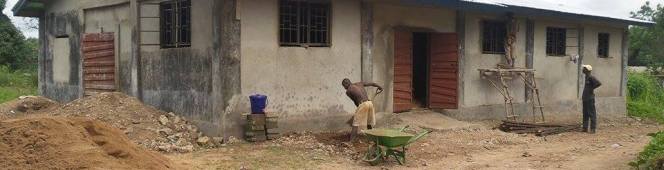
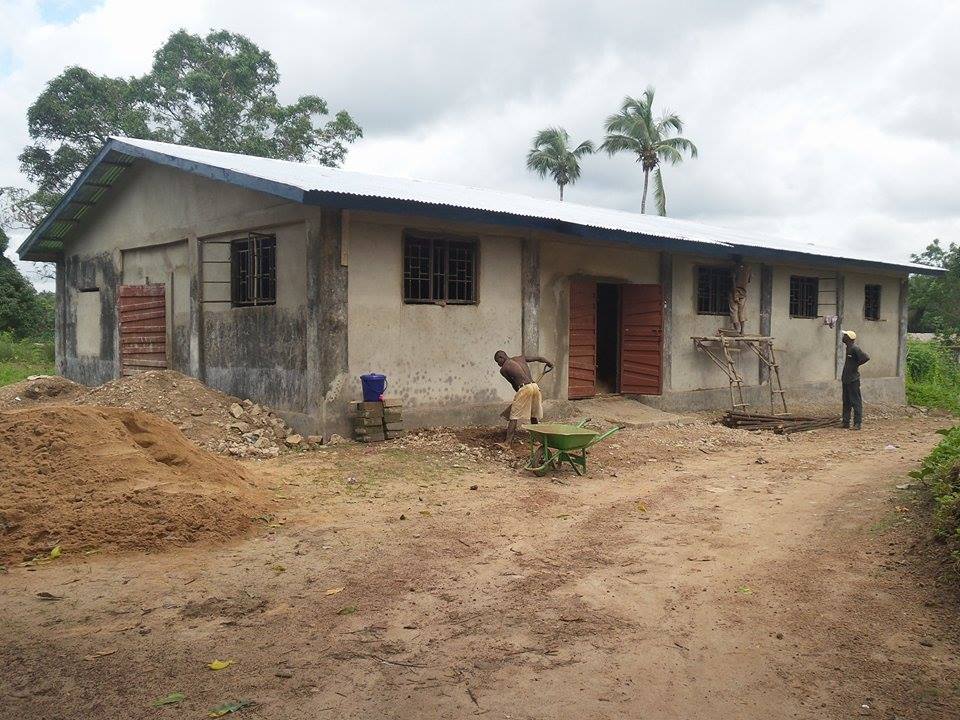
Rotifunk’s Community Computer Center structure is now completely up.  Latest pictures are below.  See more of the full construction story here and read about plans for the computing center here.

September 16: The building’s exterior is finished with window frames in place. Ready to paint.

computer ctr sept 16 4     computer ctr sept 16


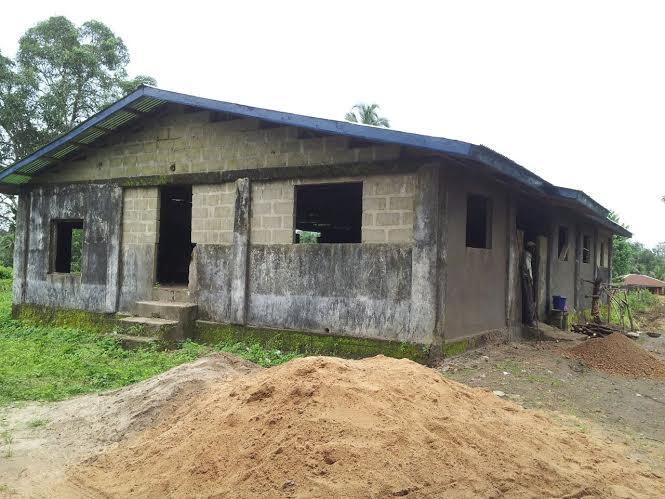
computer ctr sept 16 3Work on the interior now proceeds.  We did a quick lighting and computer use plan 2 weeks ago to devise the electrical wiring plan. An electrician got to work on wiring so the interior finishing with wall plastering can proceed.  The drop ceiling is now in.


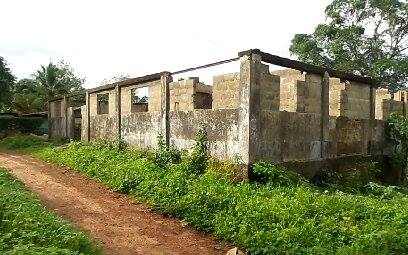
Compare with these pictures taken  June 24 a week after work initially started on from a burned out building shell.Computer Lab 2

Computer Lab 3


September 1: Rotifunk’s first Ebola cases appear in town.  Five deaths and 35 quarantined in five houses.  But the computer center construction proceeds on schedule.

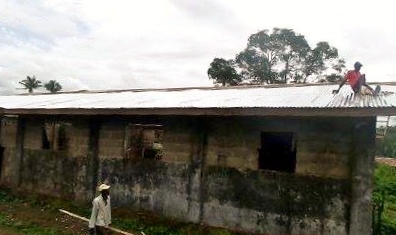
August 25:  The roof is up on Rotifunk’s community computing center.  Ebola is not slowing down work on this center full of hope for the future.

10634313_720411201361353_1073541016_nThis (now) ugly baby will be beautiful as they plaster the walls and add a coat of paint.

Work has gone on in spite of August being the peak of the rain season. Remember 2011 when here in Cincinnati we got 73″ rain for the year and called it an all time record year. The average rainfall for the month of August alone  in Sierra Leone is 42″.  Throw in July and there’s 73″.

The next stage is raising funds for a solar energy system so the computing center can operate into the evening with classes and community computer access. They’ll offer small business services, too, like typing and copying for those without computers or printers.

unnamed 5

unnamed 2

10637736_720409494694857_1289394485_n


Nine year-old Caitlin raises money for Ebola prevention

“Just because you can’t do everything doesn’t mean you can’t do something.” Olga Murray, founder of the Nepal Youth Foundation.  Nine year-old Caitlin found something she could do to help fight Ebola in Sierra Leone.

caitlinCaitlin came to me Friday with $18 she earned by making bracelets and selling them in a neighborhood business area.  She kept going until she collected $18 – the cost of one portable hand washing station being used to prevent Ebola transfer in Sierra Leone.

She set up her box of colorful rubber bands in a prominent place in the shopping district and proceeded to braid them into stretchy bracelets for sale. She was selling them for twenty five and fifty cents. When people saw her hand made sign saying she’s selling to help prevent Ebola, some people gave her a dollar.

"All funds go to help build hand sanitizing stations in Sierra Leone."

“All funds go to help build hand sanitizing stations in Sierra Leone.”

When I asked her why she decided to do this, she said she wanted to give kids in Sierra Leone a good place to wash their hands and not get Ebola.  I was touched beyond words.

I stole the above quote from friend Karen. It says so well what we’re doing with Sherbro Foundation. We can’t save the world, but we can do something to help one Sierra Leone community get through the Ebola crisis.

Frequent hand washing is one proven way to stop spread of the Ebola virus. The money we’re sending now goes for public hand washing stations in  Bumpeh Chiefdom in rural Sierra Leone where there is no running water.

Thanks to Caitlin for joining our effort to fight Ebola in Sierra Leone.  Thanks to many others who also joined in with their donations this month. These helped us place one hundred forty public hand washing stations in Bumpeh Chiefdom in the last two weeks.  They’re already being used.

Villagers are also getting an important personalized education on the importance of sanitation and hand washing in preventing disease.  The leader of our Bumpeh Chiefdom partner organization, Rosaline Kaimbay, told me, These hand washing stations are protecting against more than Ebola. It’s raining now. This is the cholera season, too.

The Ebola outbreak is unfortunately growing at the moment.  We will have to maintain these hand washing stations with chlorine bleach or disinfectant for months to come.  You can help.  Click here to donate.

Fighting Ebola with buckets and bleach

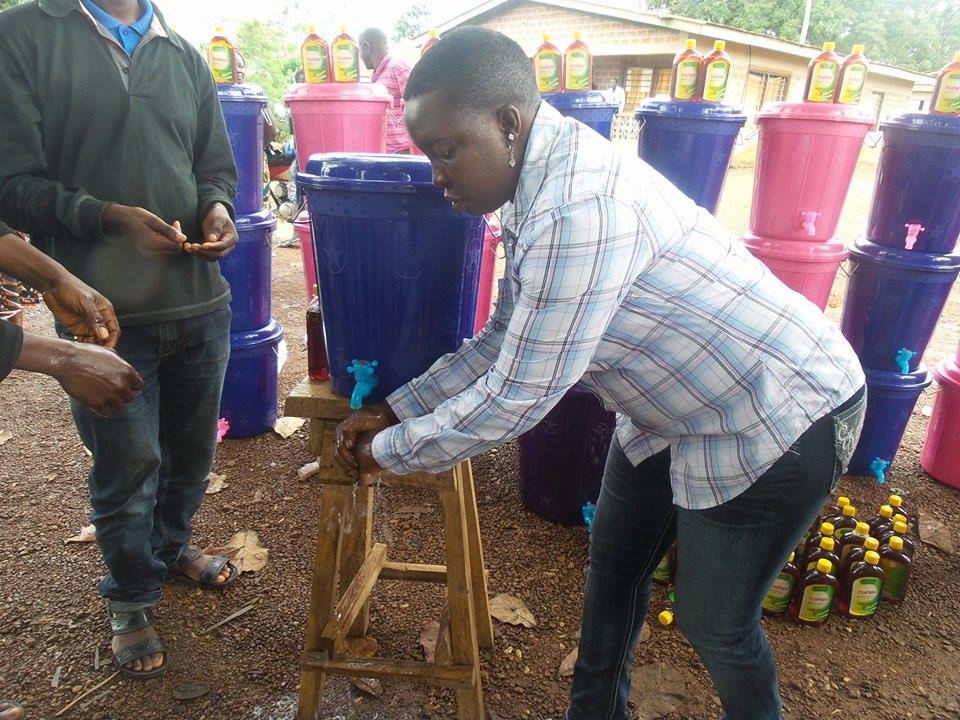
Buckets and bleach.  This is the most basic – and an effective – method to prevent Ebola.  Frequent hand washing is one necessary step in stopping the spread of Ebola.  Here’s the latest pictures on the community-led Ebola prevention work in Rotifunk and Bumpeh Chiefdom by the Center for Community Empowerment & Transformation (CCET).

Chief Caulker & CCET Exec Dir, Rosaline Kaimbay show buckets ready to distribute for hand washing

Chief Caulker & CCET Exec Dir, Rosaline Kaimbay show buckets ready to distribute for public hand washing

Hand washing stations are needed in public places to make it easy for people to frequently wash. In the cities in Sierra Leone, it’s become standard practice that you must wash your hands at a portable washing station (aka bucket with spigot) before entering a business or restaurant.  Business owners set these up at the front door and position someone to monitor they’re used.

But rural places with tiny local economies have no money to do this.  Public places like town markets, mosques, churches and public health clinics have not been equipped and are at risk.

Forty public hand washing stations were set up last week  in Rotifunk, seat of Bumpeh Chiefdom with Sherbro Foundation funding. With a second SF donation, CCET is out today in Bumpeh Chiefdom distributing another one hundred buckets and bottles of disinfectant to treat the water used.

2nd batch of 100 buckets for Bumpeh Chiefdom Ebola prevention.

2nd batch of 100 buckets for Bumpeh Chiefdom Ebola prevention.

I caught Paramount Chief Caulker today by phone as he was on the road to deliver the buckets to small villages in the chiefdom.  CCET picked up money Wednesday  in a second wire transfer Sherbro Foundation sent to the capital, Freetown.  They purchased the additional hundred buckets and disinfectant, and Chief Caulker drove them down to Rotifunk on Saturday.

Some were handed out there to complete Rotifunk coverage.  The rest were being driven and personally distributed to villages today, Sunday, by Chief and CCET volunteers. He’ll pick up a boat along the way to deliver buckets to the farther flung small villages along the Bumpeh River that transects his chiefdom.

This is how Chief Caulker and CCET get work done.  They do simple projects that can quickly be implemented and have immediate benefit for poorest people in the chiefdom. They collaborate closely and are personally leading the effort. And it’s finished and having the intended effect – quickly.

10565041_719734634762343_5707628134744572684_nThey are reaching small villages down narrow dirt roads that government designated Ebola “sensitization” trainers and NGO’s never get to.  But these village people travel to town markets to sell their farm goods. They have family and friends that travel down to see them, perhaps now to feel they are escaping the Ebola plague. It’s frequent travel that’s been the vector to spread this ebola outbreak compared to past outbreaks.

Bellantine town chief Ali Kamara is getting a hand washing station as he receives many visitors at this house.

Bellantine town chief Ali Kamara is getting a hand washing station as he receives many visitors at this house.

These villages need preventive  hand washing, too.  I asked Chief where he put buckets in a small village like this one.  At the public health clinic, the mosque and the town chief’s house, he said, the places where people congregate.

Chief Caulker and CCET are educating people as they go on how Ebola is transmitted and how to prevent transfer, like frequent hand washing. Then they get the hand washing station from Chief or one of their local leaders, and it’s all reinforced for them.

We talked today about the Ebola epidemic resulting in one silver lining with the country-wide blitz training on personal hygiene and spread of disease. Yes, Chief said, it’s a whole new orientation for people.

It’s also energizing people with positive action they can take to fight Ebola. To not feel like victims. They feel their Chief and their country are supporting them when they visibly see action taken they can understand – like a bucket and bleach. When a trusted chief personally explains it and puts it in their hands, it’s more accepted and likely to be used.

I could feel the energy in Chief’s voice today. It was a far cry from our conversation two weeks ago when we first talked of the need to provide preventive action, but none was there.

In recent weeks, Chief Caulker’s been contributing to a number of district level and national strategies to fight Ebola. Today he was doing what he does best; personally inspiring and leading people to action.  He was clearly being energized, too, to continue the Ebola fight.

This Ebola fight will probably go on for six months. We have work in front of us to keep these hand washing stations equipped with disinfectant. You can help by donating to Sherbro Foundation’s Ebola prevention effort.


Rotifunk Leads Unique Community Ebola Prevention Effort

Rotifunk Leads Unique Community Ebola Prevention Effort

Dear Friends,

I thought I would be writing now to ask your support for Sherbro Foundation Sierra Leone’s girls scholarship fund. With the Ebola outbreak in Sierra Leone, school is indefinitely suspended. Instead, I’m asking for your help on getting Ebola prevention supplies to the rural Sierra Leone area we work with.

CCET Exec. Director Rosaline Kaimbay demonstrates the hand washing station.

CCET Executive Dir. Rosaline Kaimbay demonstrates portable hand washing station filled with disinfectant solution.

In the last two weeks, SFSL has had to shift our focus from education to helping Rotifunk and surrounding villages fight the Ebola epidemic.  A second and bigger wave of Ebola is now moving through Sierra Leone.  Neither the Sierra Leone government nor any NGO’s have reached rural areas beyond the outbreak epicenter with Ebola prevention supplies.  Yet, it’s in these kinds of rural places the Ebola outbreak started.

The majority of Ebola cases continue to be in two areas in eastern Sierra Leone. A national state of emergency was declared last week, and these two areas have been blockaded. Everyone is effectively quarantined in place for 21 days, the Ebola incubation period. Only food, water and essential supplies are allowed in.

This is a necessary public health step to control the Ebola outbreak. But the disease had already started spreading around the country.  People who became sick in the hot spot areas feared they would get Ebola if they went to a hospital. Before the blockades went up, sick people ran to the care of relatives in other districts. Some of these sick people had Ebola and transferred it to other parts of the country, including Moyamba district where Rotifunk is.  This district now has four confirmed cases and fifty being tested.  This is how epidemics spread.  A frontline Scots aid worker describes the many direct and indirect effects the epidemic is having on an already fragile country.

10336595_716185338450606_6438555027606916424_n

CCET, our local partner, prepares to deliver hand sanitizing stations.

There’s a misconception that the Ebola outbreak is being managed for the whole country by large nonprofit organizations like Doctors WIthout Borders (MSF). MSF is heroically fighting the battle to save people’s lives already ill with Ebola in the two epicenters, and tracing their contacts for quarantine there. But they are not involved in prevention activities to stop the spread of Ebola in the rest of country. The Sierra Leone Government’s actions have been limited to reactive steps and mainly within their fragile health care system; not preventive steps across the country.

Sherbro Foundation is equipping Rotifunk and surrounding villages with portable hand sanitizing stations.  This deadly disease can surprisingly be killed with soap and water and hand sanitizers.  People are being trained to frequently wash their hands, especially when in public places like markets, churches, mosques and health clinics.

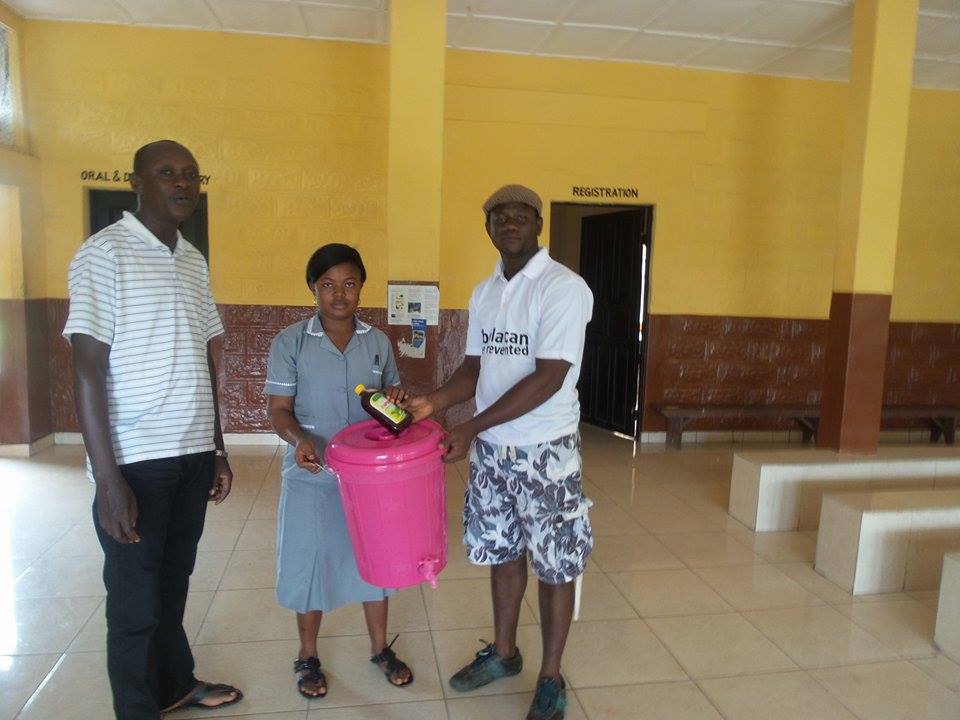
Hand washing station delivered to the health clinic waiting area.

Hand washing station delivered to health clinic waiting area.

Rotifunk, like most of the country, has no running water.  There is nowhere to wash hands.  Preventive steps like hand sanitizing stations in public places are not set up in rural towns and villages outside the two Ebola hot spots.

SFSL sent money last week to set up over forty hand sanitizing stations like this one and a supply of disinfectant. Our Rotifunk local partner, the Center for Community Empowerment & Transformation (CCET)informed us today they need to reach more villages and have more disinfectant to go around. Prices on buying these portable sanitizing stations have gone up 50% in the last week, as goods are in short supply.

CCET Executive Director, Rosaline Kaimbay informed me today they are being seen as unique in Sierra Leone with this kind of grass roots community-led effort on Ebola prevention.  While towns across Sierra Leone are still waiting for Government and NGO assistance, they are taking charge on the fight against Ebola.

It’s understandable that limited resources are first going to the epicenters of the emergency.  But unless towns in the rest of Sierra Leone like Rotifunk are equipped for preventive actions to fight Ebola, the epidemic can continue to spread across the country – and beyond.  More lives will be lost.

Time is of the essence. Can you help stop this tragic epidemic for the cost of a dinner out or one concert ticket? To donate online, just click here: Donate   We accept all major world currencies. To send checks, contact us at sherbrofoundation@gmail.com.

You can help even more by passing this on to a friend.

Thank you!

Arlene Golembiewski
Founder & Executive Director

Good News from Sierra Leone – Computer Center Construction Progress

The entire country of Sierra Leone may be living in the grip of fear of Ebola.  But life does go on beyond the two epicenters of the epidemic. We need good news to share right now.  Here’s some. Construction on the Rotifunk community Computer Center is on track for its November debut.

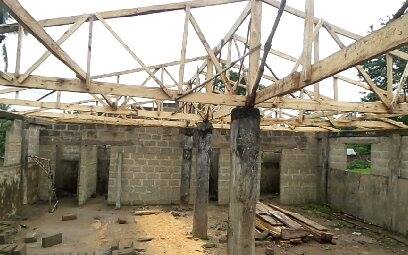
10592057_711825275553279_1085342184_nThese pictures from August 3 show the roof tresses going up.  The sheets of metal roofing were purchased. If they arrived, the roof may be going on as we speak.

This project will provide a permanent building for computer literacy classes and small business services. We already have fifty five Windows 7 laptop computers in Rotifunk waiting for their new home and central access for the whole town.

The building is going up with private donations and  community contributions of the land, building shell, local materials and local unskilled labor.

You can read more about the project here.  I like to call it from tragedy to triumph.  When the computer center construction started, I was referring to rebuilding from the shell of a building burned by rebels during the war.

Today, we can also say despite the Ebola tragedy, the people of Rotifunk and Sierra Leone will triumph. They are still hard at work building a better future.

For now, enjoy these construction pictures.  I am.

Arlene Golembiewski, Executive Director

10589489_711825702219903_1600237143_n


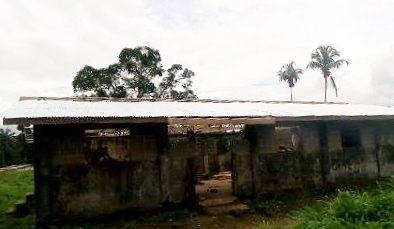
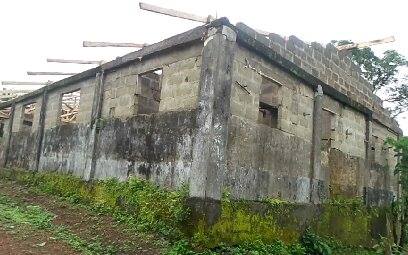
Old exterior walls of the building shell were reinforced with an inner wall of new bricks.  Once the walls are plastered and painted inside and out, you won’t know it’s a building rebuilt from a fire.


10589754_711825898886550_675216109_n


Deep roof overhangs are essential in a place with tropical rains over 120 inches a year.


10592057_711825275553279_1085342184_nYou can still the charred tops of the original inside pillars – evidence of the fire set by rebels during the war, trying to destroy the town.

Rotifunk today is about 60% rebuilt.  With recent construction like a large community hall, a rebuilt hospital, four secondary schools, a new rural community bank, and now a modern computer center, Rotifunk is putting itself back on the map.  It’s regaining its former position as a rural hub for education, health care and trade in southern Sierra Leone.