Sierra Leone’s first Flash Mob – the power’s in your hands

First Flash mob in Freetown for Global Handwashing Day. (From VOA)

First Flash mob in Freetown for Global Handwashing Day. (From VOA)

This is fun – and for a good cause.  Sierra Leone’s first flash mob danced around Freetown’s Cotton Tree in the center of town to bring attention to Global Handwashing Day.  What better way to have people think about the value of washing your hands in preventing disease – and remember it – than a flash mob.

It’s estimated half the deaths of children under five could be prevented by something as simple as hand washing.  Severe diarrhea claims the lives of too many young children every year: 1.8 million globally from diarrhea and other water borne diseases.

So, the power is in your hands.  Always wash with soap and water.

Watch the video of the flash mob and stick with the last minute and a half.  It’s a simple yet strong message.

Here’s the whole story: http://www.thepatrioticvanguard.com/spip.php?article7435

Africa is my Home: A Child of the Amistad

If you have a child in your life, this is a wonderful book to get and read with them.   “Inspired by a true account, here is the compelling story of a child who arrives in America on the slave ship Amistad —and eventually makes her way home to Africa.”

edinger coverAuthor Monica Edinger is a fellow Friend of Sierra Leone and Returned Peace Corps Volunteer. We both made our first trip back to Sierra Leone together in 2011 after many years.  We were privileged to visit the ruins of Bunce Island, an old slave fort in the Freetown harbor from where captives like Magru, the girl in her book would have been shipped. Truly amazing.

I read about Magru’s story after I returned home,  She was an actual nine year old girl in Sierra Leone sold into slavery, sailing on the Amistad ship to Cuba in 1839.  You may recall the Amistad story from Spielberg’s movie of the same name, where captive slaves were able to revolt, take over the ship, and in trying to return to Africa, ended up in the U. S.  Fortunately, the northern U. S. , where their diplomatic and legal case ended up going to the Supreme Court.

It’s most interesting to read stories like this one of the Amistad and the nine year old girl, Magru, from the African perspective.  I’ve learned a lot about this chapter of Sierra Leone’s history in reading various things; but that can be for future posts.

You can read this story of a nine year girl on the Amistad ship in Monica’s beautifully illustrated book with your kids.  You’ll probably learn something yourselves. Thank you, Monica.

You can watch Monica’s Trailer linked here.  http://medinger.wordpress.com/africa-is-my-home/

Interview: The 50/50 Group on Women’s Rights in Sierra Leone

This sounds like a worthwhile effort: women don’t understand their legal rights? Translate them into local languages and present them orally – on the radio, in community listening groups.

Computer Lab Project: First Pictures

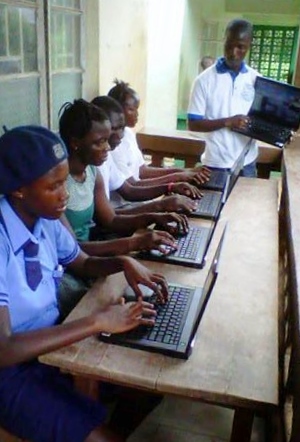
The Computer Lab project is now reality! The Center for Community Empowerment and Transformation (CCET) in Rotifunk is the proud owner of a computer lab with 50 modern laptop computers with Windows 7 and Microsoft Office 2010. And the first pictures are in.

We wish to once again thank the U.S. donors, Schneider Electric and TIP Capital for taking the lead in outfitting the computer lab with up-to-date computers.  We hope you enjoy now watching the transformation of this community as both adults and high school students acquire their first computer skills.

The computer “lab” today is still temporary quarters in a house Chief Caulker has loaned them for now.  Building a new classroom building for the computer lab open to the community will be the next step in the project.  Installing a solar energy system to power lighting for evening classes and to charge computers is also part of the plan.

But with tables and chairs made by local carpenters and computers in hand, computer classes have begun.

Teacher and CCET leader, Mr. Sonnah earlier explained the Center’s logo to me and how it symbolizes what they plan to accomplish.  A man and a woman are together holding one torch light.  Light brings about transformation, and men and women are equally balanced in holding one light.  They are surrounded by olive branches depicting them rescuing the chiefdom from its past traumas.  They are transforming the chiefdom to be a better place.  Mr. Kamara, another teacher and CCET leader said in his quietly confident manner, we are developing our brothers and sisters, and we know with our work today, tomorrow will be a brighter day.  We see our future as bright.

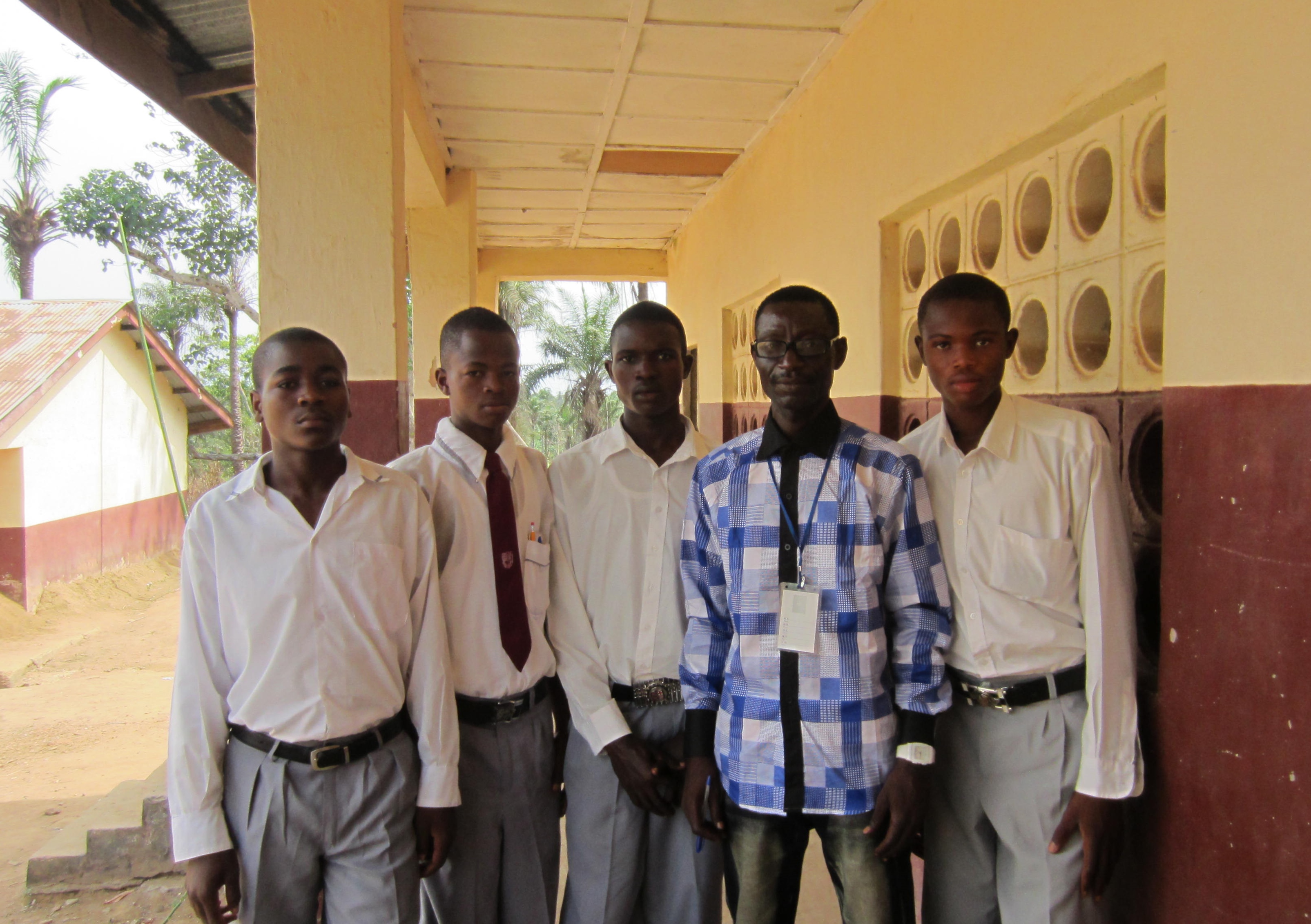
High school computer students, L - R: Bumpeh Christian Academy, Walter Schultz Sec. School, Prosperity Girls HS

High school computer students, L – R: Bumpeh Christian Academy, Walter Schultz Secondary School, Prosperity Girls High School

I, too, see their future getting brighter each day.  I think you can see it in the pictures that follow.

High School students practice on front porch of the CCET offices

High School students practice on front porch of the CCET offices

Adult students get computer instruction

Adult students get computer instruction

CCET teacher instructs adult students.

CCET teacher instructs adult students.

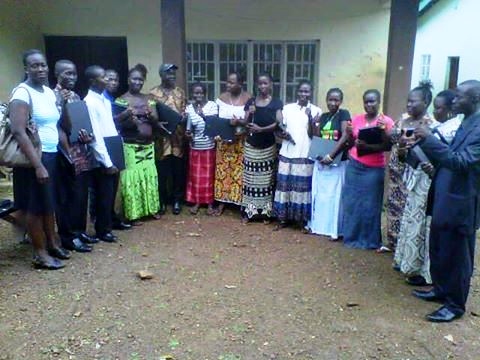
Teachers and adult computer students

Teachers and adult students in front of the temporary computer lab quarters.

Women in adult literacy class in an afternoon lesson

Another CCET program: Women in an adult literacy class in an afternoon lesson

The Girl Effect

Walter Schutz Secondary School students

Walter Schutz Secondary School students in Rotifunk

It’s September. School is starting again and I’m thinking of the Girl Effect.  Getting girls into secondary school in rural Sierra Leone, and keeping them there, is at the core of Sherbro Foundation’s work.

If I ever stop to think of why I put my personal effort into working on this, I only have to be reminded of one thing.

The Girl Effect.

The message is simple. “Invest in a girl, and she will do the rest.”

She’ll invest in her family and community.  With millions of girls in the world, that’s millions of chances to make the world a much better place.  I like those odds  – and return on my investment – when compared to most other development programs.

But I don’t need to explain it. This video says it all.   Click here:  The Girl Effect   

“If you change the prospects of an adolescent girl on a big enough scale, you will transform societies.”    

Mark Lowcock, DflD Permanent Secretary
Prosperity Girls High School 7th graders

Prosperity Girls High School 7th graders

You can be part of the Girl Effect transforming Rotifunk and Bumpeh Chiefdom, Sierra Leone.

Please contribute to Sherbro Foundation’s Girls Scholarship Fund.  Your $25 will pay school fees to send a girl to secondary school In Rotifunk for the year.

The school year is starting and she needs your help.

Click to Donate here

Donations from all countries are welcome through this Paypal link.

Why do people need a computer in rural Sierra Leone?

What will people do with a computer in a rural area like Rotifunk when they have no electricity and no Internet service beyond spotty mobile phone coverage – if you have a smart phone. If most people have at best limited literacy, what does it matter if they have access to a computer?

My original motivation for getting PC’s to Rotifunk was to get job training skills into school programs there.  I especially wanted young girls to get a jump start on skills needed for good jobs in today’s economy.  That’s still a primary objective.

As I got more involved, I saw professionals and leaders already there in Rotifunk did not have computers. The Prosperity Girls High School principal, teachers, chiefdom administrators – all well educated and capable people were being held back by not having a computer to modernize documents and records, improve their productivity and have access to all the information that the Internet can provide.

But I soon found computer access in a rural area can do much more.  It starts with the smallest computer of all – the smart phone. With a smart phone and its Internet access, people can do a lot to improve their day to day lives.  Everyone.

If more than one person, that often where the cell phone cell is stronger.

If there’s more than one person, that’s often where the mobile phone signal is stronger.

When I made my first trip back to Sierra Leone in 2011 with friends, we observed that things largely looked the same as we had left off in the 70’s. Not encouraging.  Then we started seeing one important thing that had changed.  People were walking around with this thing in their ear and talking to themselves.  Just like at home, but we weren’t home.  Wait a minute.  Those were mobile phones everywhere.

The juxtaposition of mobile phones next to a mud house took a minute to register and get used to.  Especially a woman in a traditional lappa with a baby on her back, maybe cooking outside on three stone talking on a mobile phone.

This is not just yakking.  With limited incomes, it’s a pay as you go system.  You buy units from a local vendor and people use them carefully.  I had to get used to people otherwise effusively friendly, abruptly hanging up on me.  They’re conserving units.

So what do they use mobile phones for?  Many things.  In an area where roads are beyond miserable and public transportation infrequent and expensive on their incomes, you can do a certain amount of your day to day business and personal connections now by your phone. Like calling ahead to make sure a shop has the goods in stock you need for your local business or to resell in the market.  You can check prices while you’re at it and find the best price.  Maybe you can arrange to have your order delivered to you with someone you know and avoid the trip yourself.

Cell phone towers announce you're entering a small town.

Cell phone towers announce you’re entering a rural town or village – here Rotifunk.

Most women work by virtue of being small traders as they call it in the informal economy.  They buy goods in one place at a good price and sell in another. Phone orders and other requests are especially empowering for women.  The Internet and phones are good ways to level the playing field. It doesn’t matter who you are and what you look like. Money talks.  And you don’t have to leave your children or waste time you could instead use to do other chores for your family.

I’ve seen many applications for mobile phones now that mobiles have taken hold in Africa.  They involve getting fast and timely access to information, and avoiding costly and difficult trips on bad rural roads.

Farmers can call Agriculture extension services or other advisors to find out why their crops are doing poorly and get advice on what to do.

Health care is one of the most exciting uses of this “mini-computer.” When a woman goes into labor, a call can go to the nearest  health clinic to be ready for her, and where available, arrange for a vehicle to take her.  In a country with one of the highest maternal and infant mortality rates in the world, access to health services when needed is leading to dramatic improvements for mothers and infants.

Likewise, mothers can call clinics to consult with a nurse or community health officer about their family’s illness.  Hours of unnecessary delay can make all the difference when a small child has malaria or acute diarrhea, and parents can be advised on what to do by phone.

Texting health messages to rural clinic health practitioners was noted as one successful measure in averting a replay of last year’s major cholera epidemic in Sierra Leone when hundreds died.  The rainy season is cholera season.  Rains were bad this year, but cholera incidence was not.  Texts went out alerting clinics on symptoms to watch for and what to do.

Banking and paying bills by phone is the next innovation in Africa and coming to Sierra Leone. Traditional banking dings poor people twice.  Bank account minimums and transaction fees are cost prohibitive for people living on $2 a day. Then you have to pay for public transportation to get to a bank, since villages and most small towns have no bank.  Rotifunk only last month had their first small credit union type bank open.

Now, pay by phone services are starting to pop up.  You can pay bills using the same mode as buying call units.  You give a local vendor the information on who you need to pay and how much, pay cash and they transmit the funds to pay your bill. Services are starting that let you use your phone like a debit card. You avoid bank fees – and can stay off those miserable roads wasting your time.  People will need to get used to these services. But the cost-benefit seems clear to encourage use as they become available.

Sierra Leone’s journalists even created “citizen journalists” in the country’s 2012 Presidential election with mobile phones. The government promised free, fair and transparent elections.  So, journalists gave mobile phones to average citizens to report back real time what was going on in their remote polling place.

This video gives an overview of how rural, low income people’s lives are made better with that mini-computer, the mobile phone.  Mobile for Development life stories.

CNN notes other innovative solutions mobile phones made available to people in Africa in their article: Seven ways mobile phones have changed lives in Africa. 

Yes, some of this is just using phone service, and you don’t even need a smart phone.  But others connect computerized services by phone.  And once people are comfortable and proficient with using mobile phone functionality, it’s not a huge step up to using a computer.  And a computer can bring educational, productivity and job skill opportunities to a rural area.

I watched an illiterate girl sell me mobile phone units in Rotifunk.  She had no trouble punching all those numbers into her mobile phone that then connected with a computer that activated my phone with call units. She mastered this in no time because it was a job for her.

I look at mobile phones as the training ground for introducing IT technology to a country ready and willing to use it.

The Computers Have Arrived. Who’s first to use them?

Fifty laptop computers arrived in Rotifunk a week ago.  The shipment generously donated by Schneider Electric and TIP Capital were picked up from the shipping company’s warehouse in Freetown, and carried to Rotifunk by car.  Our dream of a computer lab for this rural town is starting to take shape.

This 77 year old student is a fast learner.

This 77 year old student is a fast learner.

A few things I found needed to be worked out.  After anxiously opening the boxes, they found they wouldn’t turn on. Someone realized the battery is discharged after sitting in a ship for a month.  This means carrying them to a house with a generator to recharge in this town with no electricity.  When they started, a message popped up about wanting to do a WIndows 7 update.  But in a town with no Internet access, you can’t receive automatic updates.  There’s way to handle this, too, in Sierra Leone, and someone was coming from the capital with a Windows 7 program disc to do their magic.

School’s been out for summer break and teachers are just returning to Rotifunk from their holidays to start the new school year.  I called Teacher Osman Kamara who volunteers with the Center for Community Empowerment and Transformation (CCET) – the new owners of the computers – to hear how it was going.  Osman had not yet arrived in Rotifunk himself, but said they will now be gearing up to start computer literacy classes.

In the meantime, some adults have been coming forward expressing their desire to learn to use a computer.  Really, I asked.  Like who?  I was interested to hear which people were among the first to make their interest known.

One is the chief Imam, Osman said.  The chief Imam is the leader of the community mosque.  I thought, well, ministers need to write and keep sermons, so an Imam must do the same.  Yes, Osman said, And he needs to keep written records and make certificates for things like marriage licenses.  So, he wants to learn to do this on a computer.

They’ve acquired a printer and can now print things for teachers and other users – like a marriage certificate for the Imam to present to a newlywed couple. Or exams teachers have prepared. It didn’t take long to learn that printer ink is not cheap.  They will need to charge a small printing fee for these requests. That’s far cheaper than going to the capital to use a computer or printer, when you add in transportation costs and a two day trip. 

I can visualize the CCET office quickly becoming the local Kinko’s or Staples of Rotifunk.  Unfortunately, now run with a generator that’s another expense for fuel.  We’re keeping a solar energy system as a priority on our project list.

Chief Caulker early on expressed interest for the chiefdom clerks to learn how to computerize their records.  They are starting a systematic system for recording births and deaths in the chiefdom.  Computer records will be perfect to not only maintain data, but to start making spreadsheet reports on their statistics.  Likewise, they keep land use records on who has rights to parcels of land and when they acquired these. 

I listened to a land dispute case in the chief’s daily palaver court in a small village last February.  People bring their disputes and complaints before the chief for settlement as in a court.  In this case, the land was on the border between small villages and no one could remember when or if the person claiming land rights had gotten them.  Who’s the oldest man in this area? asked Chief Caulker.  A motorcycle taxi was sent to collect him in hopes of getting an objective and accurate reading on this. The day will soon be here when the chief could make a cell phone call back to Rotifunk for the computer data base on this.  Well, if the village has a cell phone signal, which this one did not.  But that will come, too.

The wheels of my brain start turning.  When you move beyond computer literacy lessons and into actual applications, they need data management procedures.  Do they understand the need to back up data, and how will they do this?   A memory stick or blank CD will work initially, but they’ll soon need something like a remote hard drive. Mr. Kemoh, one of the teachers who studied IT technology will surely understand this. 

I asked an enterprising young Rotifunk man how he would use a computer if he had one. He would start a business to transfer songs to people’s cell phones.  Playing music on your cell phone is hot in Sierra Leone.  And you’d be surprised how many people have cell phones.  People who can download the latest songs on a computer can have a thriving business transferring these to people’s phones for a small fee.

Movies and videos are of course equally popular. They also open a whole new window on the world for people who have been to date isolated.  With a computer and video projector I brought last February, we could show movies in the small village we stayed in of 25 homes. (Had to bring a generator, too, of course.) I brought a number of videos where children were lead characters in hopes of being both entertaining and educating.

What I hadn’t counted on was American English being such a barrier. When the subject matter is culturally different and the language is different than yours, or just hard to understand, you can imagine interest falls off quickly.  How long could you watch a “foreign film” with no subtitles.  Action films of course, do better.  I found the early Harry Potter films hold universal appeal.  Even when we fried the video projector with power surges coming thru the generator.  (Only the fuse I hope.) Rather than give up, we just turned the computer screen towards the crowd gathered outside the house.  With some small speakers I brought, that sufficed for our village cinema.  The kids were happy.

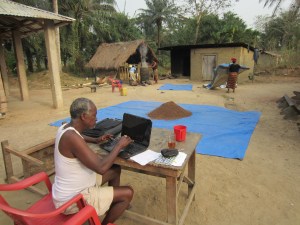
Some adults just want to learn to use a computer because it’s now there. You may be asking who that handsome guy is typing away in the picture at the top of this story.  It’s Chief Caulker’s Uncle Stalin.  Seventy seven year old Uncle Stalin wanted computer lessons when we were together in a village.  He had been a bursar on a freighter carrying goods to and fro from England in his younger days.  That’s where he had learned to type. 

I had panicked when I bought PC’s to take two weeks before my last trip and found they were loaded with Windows 8.  I had to quickly teach myself how to use them to teach others.  In two lessons, Uncle Stalin had mastered Windows 8 basics. He could turn on the computer and start up, locate the last Word document he made and start typing a letter without help.  He was thrilled, and so was I.

It’s not too late for him – or for anyone in Rotifunk – to meet their aspirations using a computer. Yes, we have some ground to make up.  But my experience so far would indicate, that’s not going to be a big problem.


Scholarship program celebrates girls’ education in Rotifunk

I admit it. I sometimes thought my sister Arlene was a bit crazy for trying to start a non-profit organization all by herself to help people with such great needs on the other side of the globe.

But when you look at what’s been accomplished in its first six months, I’m amazed and proud – and my faith is being restored in the generosity of people coming together to improve life for others. We are linking with strangers around the world, interested in what is happening. (And of course, I volunteered to help.)

The Sherbro Foundation’s first round of scholarship awards to young women in Rotifunk’s four secondary schools is the latest point of pride.

2012-13 Girl Scholarships awards - Prosperity Girls High School (blue shirts), Walter Schutz Secondary School (white shirts)

2012-13 Girl Scholarships awards – Prosperity Girls High School (blue shirts), Walter Schutz Secondary School (white shirts)

First, it’s amazing that Prosperity Girls High School, a four-year-old school, achieved an impressive feat last fall when 100% of their students who took the West African standardized senior high entrance exam passed it – a feat for which they received special recognition from the national Ministry of Education for exceptional results!  Each girl passed on her first try AND the school had complete success on its first time sending girls for the exam.

It’s amazing that an impoverished rural community created its first all-girls secondary school. It’s amazing that Rotifunk’s new nonprofit, the Center for Community Empowerment and Transformation, voluntarily formed by teachers at the new Prosperity Girls High School, is administering the scholarship program as a foundation partner. It’s amazing that 138 girls benefited from this year’s scholarship program ranging from 7th to 10th grades.

So it was time to celebrate. To read Teacher Osman Kamara’s account of the recent scholarship presentation ceremony for the young women is heart-warming. It would convince anyone that the Foundation must keep growing.

“The activities of Sherbro Foundation have become visible and the people of Bumpeh Chiefdom are hopeful and have the belief that their lives (are improving) and the burden of their children’s education has been lessened with the involvement of Sherbro Foundation,” he said.

“The people of Bumpeh Chiefdom were very happy and appreciative of the scholarships.”

The celebration was attended by 200 parents and guardians and many community leaders of Moyamba District. Master of Ceremonies S.P. Gibril pointed out that it was the first time in the history of the District that so many female students in all the secondary schools of Bumpeh Chiefdom received scholarships.  He also thanked Paramount Chief Charles Caulker for connecting Arlene with the community.

Chief Caulker and Arlene were fellow teachers more than 35 years ago, when she was a Peace Corps volunteer in Rotifunk.

2012-13 Girl Scholarship awards - Bumpeh Academy (green) and Ahmaddiya Islamic School (white)

2012-13 Girl Scholarship awards – Bumpeh Academy (green) and Ahmaddiya Islamic School (white)

Principals of each school nominated their own students from the junior high and senior high levels. It was decided that female students at all of the community’s schools should benefit. The count:

* Prosperity Girls High School, 41 students

* Bumpeh Academy Senior Secondary School, 20 students

* Walter Schutz Memorial Secondary School , 30 students

* Ahmadiyya Muslim Secondary School, 30 students

* Children of adult literacy students, 17 students

Four categories of students were awarded scholarships:

* Vulnerable students (low income, single parents, orphans, students who had to leave their village and board in town to  attend secondary school)

* Academic achievers

* At least six female football (soccer) players from each school

* Pupils whose parents are students themselves in the new adult literacy program operated by CCET, who are mostly single parents

Home visits were required in most cases, in order to verify economic status and school enrollment.  In a remarkable approach to trimming red tape and ever-present bureaucracy, parents were directly awarded the scholarship money. This was done because this first round of scholarships was awarded for the just-completed 2012-2013 school year. Most of the parents and guardians anxiously awaited the funds because either they could not afford to pay the school fees, or had taken loans for which they still owed.

The nation’s Education Ministry for Moyamba District was also represented at the scholarship event.  Abdul Karim Kanu, who is the Moyamba District Inspector of Schools, commended the Sherbro Foundation.  He promised to report the CCET’s successes to the Education Ministry in the capital of Freetown. The foundation’s partner on the ground has the potential to become a model for the country.

Wish I could have been there.

— Chris Golembiewski

50 Computers Have Shipped Bound for Rotifunk

Fifty computers are on a container ship as I write this steaming its way from New Jersey to Sierra Leone and the grateful people of Rotifunk. These will be the first computers that allow The Center for Community Empowerment and Transformation to set up a computer literacy program and start teaching regular computer classes for Bumpeh Chiefdom.

This will not just provide computer skills, but skills to give the people of Rotifunk a shot at the 21st century job market. Skills to modernize school and chiefdom administration.  Skills to help people start or expand small businesses.

This is the dream that Prosperity Girls High School Principal Rosaline Kaimbay and I had two years ago when I made my first trip to Rotifunk in over 35 years and first met her.  Prosperity Girls was just finishing their second academic year after the school was founded in 2009.  She then had 67 girls in 7th and 8th grades – or as they say Junior Secondary School 1 and 2. The school now has four grades and triple the students. 

As Principal Kaimbay and I talked about her goals for the school in July 2011, we acknowledged that most of these girls were unlikely to go on to college.  They need vocational training programs in the school to give students practical job skills.  We quickly agreed computer training was top of the list.  Whether going to college or being a clerk in a shop, people today need computer skills to excel.

By next month at this time, our dream will become reality.

This dream has been made possible by two generous U.S. companies that I serendipitously met in Cincinnati – Schneider Electric and TIP Capital.

I went on the spur of the moment to a preview showing of the new PBS series, Half The Sky, about the plight of women and girls in the developing world that was given at the public library. Jenny Brady, Schneider Electric employee and CARE volunteer was leading the showing and a discussion afterwards.  She encouraged the audience to not just watch the video, but to find a real project to help a girl or a woman like those we had just seen.  Progress starts with one person here willing to help one girl/one woman somewhere in another country struggling to move her life forward.

OK, I said to myself, raise your hand and let people know you have such a project, and in Sierra Leone, one of the countries just profiled in the Half the Sky video. My “project” then was a discussion with a principal in a small town on the other side of the world, and a piece of paper she and her teachers prepared with their objectives for a computer lab for the school and the community. 

Teaching lab by day, Internet café by night.  Never mind they have no Internet service and no electricity. That was part of our dream for Rotifunk, too.

schneider elec_logoJenny liked this project herself.  She invited me to another Half the Sky showing where she brought the Schneider Electric HR manager, who I spoke with. She liked it, too, and took it back to Schneider Electric management as a proposal to send laptop computers to Rotifunk. 

The project now had legs.

This is an example of the kind of social responsibility effort I found Schneider Electric is globally known for as a multinational corporation in the world of energy management and sustainable development. They are recognized as one of the Top 100 World’s Most Ethical Companies.

TIP Capital logoSchneider leases their office IT equipment from an IT leasing company, TIP Capital.  They would get refurbished computers from TIP, who very generously agreed to sell these at cost and pay shipping charges to the New Jersey port. Giving up their profit on 50 computers was another very kind donation made by TIP.

As we were getting this underway, the Boston marathon tragedy occurred.  A horrific vicious circle of hatred where just two people wreaked incredible havoc and heartache.  How fortunate I remember thinking that I am instead involved in a circle of virtue, where one person’s desire to help on a compelling need enlists the help of another, who in turn draws in another person, and another.

Other donations have followed as people have heard of the project and seen it taking shape.  But a huge thanks goes out to the people at Schneider Electric and TIP Capital for the being the first ones to step up and say, I want to help on this.

A lot has happened in the last year and the project has grown.  More teachers have come to Rotifunk for the growing Prosperity Girls High School and formed an all-volunteer community development Nonprofit they call The Center for Community Empowerment and Transformation (CCET).  I found other worthwhile projects needing support in Rotifunk on a later trip, and formed the Sherbro Foundation. 

The computer lab project has already grown in anticipation of receiving 50 computers.  CCET and Sherbro Foundation decided we should open computer training to more of the community beyond one girls schools.  There are four secondary schools in Rotifunk with girl and boy students needing computer skills.  There are school graduates in town that would like the opportunity learn computer skills for their own career development. There’s other adults who want the chance to learn to use a computer, or who have basic skills, but no access to a computer in town.  People now have to go the capital or another larger town with an Internet café to use a computer.

Even the women in the adult literacy class who are just learning to read and write their own names are excited at the prospect of learning to use a computer.  If primary school kids learn to use them, why not these women?  I say more power to them.  In this way, I hope computer classes will serve as an incentive for all students, young and old, to continue in school and keep learning.

Computer based training via DVD’s can also be a boost for students trying to master basic subjects like math and English grammar.

Paramount Chief Caulker has given CCET a building to use for their office and classes.  Sherbro Foundation has contributed some money to pay for a local carpenter to build office furniture and tables to hold classes.  And, next month, they will be firing up their own computers.

It’s one thing to learn to use a computer, but what do people then do with a computer in rural Africa?  More on that in another post.

If you would like to become part of this circle of virtue going out to the small town of Rotifunk, Sierra Leone, you can by using the on-line donation button to the right of this website.  There’s still plenty to do. 

We need simple things.  $15 will buy a computer bag to store and carry laptops. $25 will buy five gallons of fuel to run a small generator for hours of charging time. Educational DVD’s will help, like math and typing tutorials and programs like National Geographic and PBS.  Used DVD’s you’ve outgrown are fine. Let us know on Contact Us for that.

Top of the list though is a long term plan to provide power for this new computer lab to charge computers and light classrooms at night.  Part of the initial dream is still on the table – to fund a solar power system for the computer lab and to run adult education classes at night.

We haven’t given up on that part of the dream. It’s still growing.

It’s really raining! Bridge collapses

This week is typically the peak of the rainy season in Sierra Leone, and it’s really raining this year.   A main bridge in Freetown collapsed yesterday under the heavy rain and a landslide.  Several people are known dead, and more likely dead with homeless normally sheltering under the bridge.

This bridge connects main routes in the capital, and will further snarl traffic in the already gridlocked city.  The bridge is called a relic of the colonial days, and is perched on one of Freetown’s many steep hillsides that descend down to the bay.

Many U. S. cities feel they are in a dilemma in not being able to repair or replace aging bridges and infrastructure.  In comparison, Sierra Leoneans would feel privileged to have the bridges we have.

You can see pictures of the King Jimmy bridge collapse here.  The road descends to the King Jimmy Market near a wharf.  It’s a popular place to buy fresh produce brought to town from the countryside.  http://africansuntimes.com/2013/08/sierra-leone-landslide-destroys-historic-slave-area-king-jimmy-bridge-causing-fatalities/

It’s also a historic area where slaves leaving Sierra Leone for the New World were brought to the wharf as their departure point.  They usually were taken to Bunce Island, a major slave fort now in ruins on a small island in the bay to await the sale sealing their fate.

Another bridge collapse occurred in February on my route from Rotifunk to the capital. We had planned to take the Mabang bridge back to the capital on a Saturday morning prior to my flight home on Sunday.  Late Friday afternoon Chief Caulker received word that the bridge had collapsed under a heavy truck trying to cross it.  Fortunately, Principal Kaimbay had just safely crossed twenty minutes earlier in a small vehicle.

People blamed the Mabang collapse on the truck.  I said, the truck is bringing goods upcountry, and that means business.  If you want development and bigger business in this area, you need a bigger bridge.  It wasn’t the truck’s problem; the bridge was inadequate for the people who needed to use it. The bridge creaked and groaned when we had crossed a few weeks earlier in a car.  We literally inched our way over loose boards placed length-wise to strengthen the old bridge surface with its many gaps.  It was fightening, especially knowing we were perched 20+ feet in the air and crossing in the dark.

Chief Caulker paused on hearing the news of the collapse that Friday last February.  He then quietly leaned towards me and said, people don’t know how hard we fought to protect the bridge from rebel control during the war.  Four lives were lost, one my cousin.  The bridge is at a strategic point and rebel control would have given them a clear line onto the capital.

So, now the bridge long overdue for rebuilding was lost to overuse. And the people of Rotifunk must today take alternate feeder roads to get to the main highway that goes to the capital.  That adds one to one and half hours onto to their already four hour long trip to Freetown – a city that’s only 55 miles away.  Well, that was in the dry season.  The chief told me two weeks ago it took him eight hours to reach Rotifunk.  That probably includes over an hour to get through Freetown’s traffic gridlock.

Canoes crossing where the Mabang bridge collapsed

Canoes crossing where the Mabang bridge collapsed

Or, people can risk taking a canoe across the river past the collapsed bridge, and pick up another public transportation vehicle on the other side.  The cost of the trip is up significantly either way you go.  You can take the longer detour in one vehicle, or pay two vehicles with the river crossing.  Either way, people who can hardly afford the normal trip, are penalized with extra cost on top of extra time to now make the trip.

The government promised a temporary pontoon type ferry of the type I used 35 years ago.  Fifty five gallon drums are strapped on a platform big enough to hold a small truck. A cable spans the river and you are pulled across – by hand.  Five+ months later, there is still no ferry.

One of my Rotifunk colleagues, Alpha, passed on recent Facebook pictures of the collapsed bridge crossing. The river swollen with the heavy rains is running fast with strong currents, and crocodiles have been noted now in the rainy season.

His caption:  “We are still going through this deadly situation. No ferry, no bridge construction.”

https://www.facebook.com/photo.php?fbid=530494173686391&set=a.204859449583200.51046.100001774385887&type=1&theater 

Two weeks ago he posted: “Here, we were dragged by heavy current of water underneath the suspended part of Mabang bridge. It was horrible. The boat captain did not make it up to pull the boat. I took the paddle from him and captain the boat. Thank God we were saved.”

Most would say climate change is increasing the rains over and above the usual monsoon level rain.  How rainy is rainy?  Here in Cincinnati, we’ve had a year with a lot of rain.  We hit 30 inches now for the year to date, with 27.5 inches the norm.  We’ll easily hit the 42 or so inches normal for the year.

Freetown is the wettest part of Sierra Leone, being the western-most peninsula of the western-most country in West Africa.  It’s the first place to catch all the prevailing winds blowing in from the Atlantic Ocean – and with those winds, all the rain.  The city gets 175 inches/year, with most of that falling June – September.  July and August are the rainiest, each month bringing in over 40 inches.  That’s more than Cincinnati gets for the whole year in one month.

Road outside Rotifunk in last year's rainy season.

Road outside Rotifunk in last year’s rainy season.

Rotifunk used to get “only” about 120 inches per year.  These days, who knows.  When you’re faced with traveling on roads like this, does it matter if it’s 120 or 130?!

I remember this week in Sierra Leone very well.  It’s my anniversary.  Our Peace Corps group arrived  in-country on August 9.  It’s also the week the rain seems to reach the peak of its crescendo over the past three months, and it rains 24 hours a day almost without a break for seven days.  That’s what you call rain.

Let’s pray the Mabang ferry is installed soon, and this new hardship for the people removed.  In the meantime, the silver lining is that all that rain is what’s making the rice grow.

Sierra Leone Devil Dancing – People love it

When I checked my Sierra Leone videos and slide shows on YouTube this week, I was amazed to see the one on devil dancing in Rotifunk had passed 4000 views in ten months.  That in itself is not so remarkable.  What surprised me more was viewers had come from 100 countries.  This video  I put up just to entertain friends and family hit 4224 views this week from 100 countries.

Goboi devil dances in Rotifunk.

Goboi devil dances in Rotifunk.

What makes people drawn to devil dancing? It makes sense that half the views come from the U.S., followed by U. K., Canada, Netherlands and Australia.  There are plenty of former Volunteers like me, and lots of Sierra Leone and West African expats in these countries.  But why would two people hit Like in Turkey? Why 25 views in Greece?  Why eleven in Brazil and nine in Venezuela.  Why Indonesia, Tunisia, Saudi Arabia, Caymen Islands and Afghanistan?  OK, maybe there are Western soldiers of West African descent in Afghanistan.

This video doesn’t have my name on it, nor Sherbro Foundation.  Only a pseudo name – Salone Arlene. You can view it here. http://www.youtube.com/watch?v=ScHVE2B_pHk

Everyone enjoys Sierra Leone devil dancing.  The drumming has an infectious beat. The devils are completely covered to show no sign of the human under a raffia costume disguise that’s flying around with their wild dancing.  It’s exotic. It’s colorful. It’s festive.

It has a nuance of the unknown and the forbidden for Westerners. Or based on the global YouTube viewers, I should say for non-Africans.  What do you do if the devil comes to you? They are leaders in the secret society and command respect and obedience from society members.  Some male devils draw fearful respect from women.

It’s hard to explain “devils” to Westerners.  Devil is no doubt a bad translation to English for what these secret society figures stand for.  They’re not evil. Their purpose is not in doing bad things to people, at least not if you stay in line with the norms of behavior for the secret society and community.

That’s my best understanding of devils and the secret societies they represent.  They’re there to supervise and maintain good behavior and cultural norms in small communities that operated long before the colonial powers brought westernized forms of “law and order.”  Even today, there’s very little, if any government presence in villages and small towns.

Secret societies have long maintained behavior considered proper for their community.  It goes well beyond what we would consider the domain of police in our country, who address criminal acts and unacceptable behavior.  i.e., disorderly conduct.  African secret societies foster good behavior. They teach and enforce positive social and sexual norms; they moderate political activity (the local or traditional kind of politics, anyway.) 

The men’s and women’s societies help keep peace and harmony in their communities, and traditions and customs live on through their schools for young initiates and their ceremonies.  No holiday or special event is complete without a show of devil dancing.  The event in my video was to celebrate the first sports meet held by Prosperity Girls High School, a big community event in a rural town.

Devils are the visible manifestation of the secret society and its leaders.  They’re not really unique to West Africa.  I remember going to a Founder’s Day kind of parade when I lived in Belgium.  The town celebrated their origins going back to the 1200’s with a parade that included ten foot creatures that were men covered in costume on stilts with a huge, somewhat menacing paper mache mask on.  They called them puppets. 

A Belgian friend explained to me the puppets go back to medieval times when townships were first taken over by foreign kings and emperors.  The emperor would visit occasionally to reinforce his power over the local people, and parades and ceremonies would ensue.  This was the chance for the locals to come out with their huge and slightly menacing “puppets” to symbolically let the emperor know he may have power, but so do they.   How did Sierra Leone devils behave when the British colonial governor came to visit?

Puppets, devils – whatever you call them, when they come out to parade and dance today, it’s festive and a time to celebrate local culture.  I thought you might enjoy seeing this video from the Prosperity Girls first sports meet.

Arlene enjoying the devil dancing at the Prosperity Girls sports meet

Arlene enjoying the devil dancing at the Prosperity Girls sports meet

There’s a few still slides (no sound) at the beginning showing the Mokebie dance troupe marching into town from their village.  Then the video begins with drumming and singing.  The big Goboi devil from the men’s society does his dance about a minute in; stick with it as he really gets going as he continues.  There’s a woman Sampa dancer at the end.  I could imagine her getting a standing ovation if she was on America’s Got Talent.

If you can explain why people in 100 countries go to this video on YouTube, please let me know.  That part I would like to know.

But are they happy?

This month we had American Independence Day when we (should) reflect on our country’s many freedoms and gifts, including the right to the “pursuit of happiness.” After spending time in Sierra Leone of late, I’ve thought more about what constitutes happiness.  Sierra Leoneans are known for being warm people and smiling – a lot.  But are they happy?

Westerners seem fixated on pursuing their own personal happiness.  Books abound on how to find happiness.  We have the Happiness Project, Authentic Happiness, even the Dalai Lama’s The Art of Happiness. Time Magazine’s cover story on this cleared up one thing.  Our Founding Fathers weren’t referring to each individual’s pursuit of happiness when they signed the Declaration of Independence.  Rather, they meant a government should be charged with providing an environment that fosters the happiness of its citizens; that gives you the opportunity to freely embark on your own pursuit.  The rest is up to you.

The country of Bhutan has gone a step farther with defining the “Gross National Happiness Index”, and how they as a government will measure the wellbeing of their citizens. They feel governments should be accountable not only for economic prosperity (GDP), but also for the general welfare and happiness of their citizens (GNH Index).  ie., why have economic prosperity unless the average citizen is better off.  http://www.grossnationalhappiness.com/articles/

Sounds good to me.  It’s an especially good message for developing countries to not get stuck on the treadmill of ever increasing GDP to the exclusion of their citizen’s welfare, and, well, happiness.

On any country index of wellbeing and happiness measures, Sierra Leone ranks near the bottom.  At least as measured by macro-measures like per capita income, child mortality rate, etc. Extreme poverty is not a happy place to be.

But what about individuals – real people.  These are some of the sunniest people I’ve met anywhere.  Sierra Leone has been called the Land of Smiles. As Westerners coming from the land of grumps, where people feel they never have enough, you are literally basking in the sunshine of the smiles of Sierra Leoneans.  Their singing and dancing.  Their strong sense of community and family.  But I’ve been wondering, with all the hardship in their lives, are they happy?  So, I decided to ask.

On my last trip, I went with the Paramount Chief and his family to spend two weeks in their ancestral village while they started preparing the rice swamps for next season’s planting.  This is a remote village of about 200 people and 25 houses.  I came with no organized group as a buffer or filter – no church mission, no NGO, no visiting ministry delegation.  Just them and me.  As guest of the chief, I was legitimized.  I was seen as OK to talk to.  In a village like this, there’s plenty of time to relax and talk.
They just came back from working 6 hours in the rice swamp & can still smile.

They just came back from working 6 hours in the rice swamp in the hot sun & can still smile.

So I asked people in a poor village, in one of the lowest income districts of one of the poorest countries in the world – what makes you happy.  I thought I better first get clear on a working definition of happiness here. This usually led to discussion of whether they had enough of what would make them happy, or, on the other hand, what they dislike or fear (unhappiness). Here’s some of the people I met.

Hawa, age 35, was born here.  She, her mother, and previously, her grandmother have been small traders, selling farm goods in bigger towns and markets.  She wants her daughter to get an education and be a nurse.  She would be happy when she has money to build a better house.  She also likes to be a business partner with her husband growing rice and making palm oil to sell in the city.  She’s proud when she gets what she needs, like repairing her house in the rainy season to not leak, and sending her daughter to school. She fears being poor. If you’re sick, you can’t go to the hospital without money.
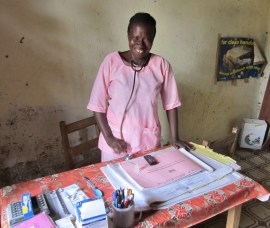
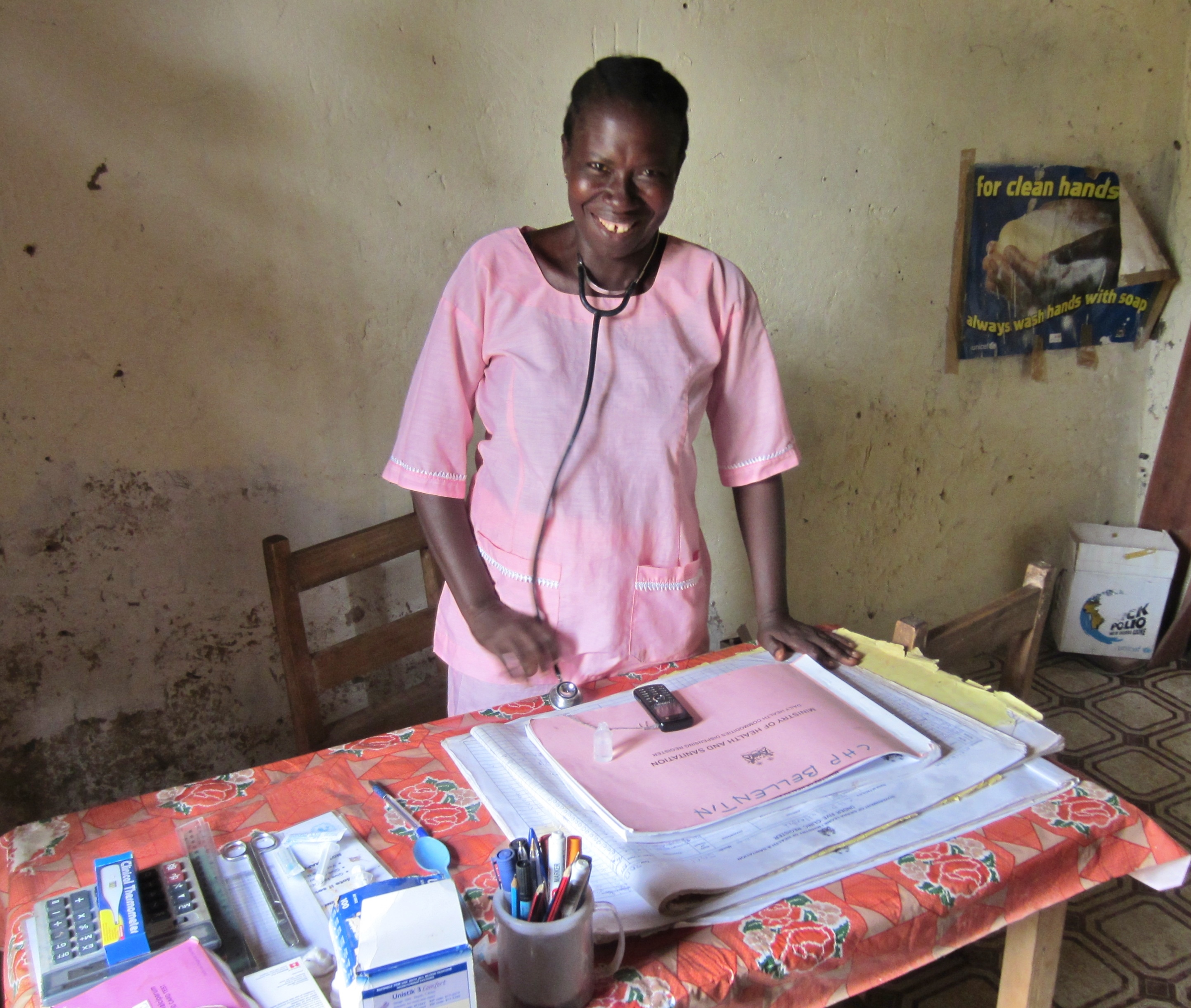
Nurse Adama is happy she safely delivered another baby at the village health clinic.

Nurse Adama is happy she safely delivered another baby at the local health clinic.

Mary, age 30, was born here and is married to a farmer. She makes banga (smoked fish) and palm oil.  It’s hard for her because she doesn’t have money for public transportation to take her things to market where she can earn more. Her family had to flee during the war and live for a year in the bush, collecting wild yams, bananas and fish, and slept on the ground.  People got some money after the war to come back and rebuild, but not enough for a zinc roof.  She has five children, aged 5 to 15, and feels good when she can educate them.  Then they can take care of her in her old age. She hates poverty, sickness like malaria and elephantiasis, and thieves.
Sembu Bendu, boat captain.

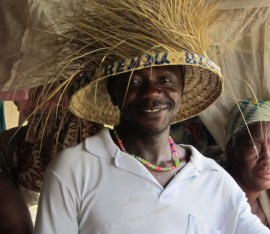
Sembu Bendu is happy as boat captain.

Sembu is a 45 year old man and captain of the paramount chief’s boat that operates like a weekly bus on the river to take people to the big Saturday market in Rotifunk.  He was born here, and has a wife and child in Freetown.  He is happy that he could return here after the war with a paid job, and one that he enjoys.  He’s also happy that he’s healthy.  He needs a zinc roof, a better health clinic and new outboard motor.

Abdul is 36 and came from another village to work for the paramount chief.  He lost his parents during the war and never went to school.  He likes hard work and enjoys planting rice.  He does whatever is needed on the farm, like climbing palm trees for coconuts and tapping palm wine.  He has three children, including an 18 year old boy who helps on the farm.  He’s happy when he has money for a good house, food and can pay school fees for his kids. He’s proud when the chief trains him to do work on the farm or sends him on errands.  He likes good clothes. He fears sickness and when married women flirt with him.  (Adultery is punishable with a stiff fine in this chiefdom.)

Masiry, oldest woman in village on her front porch with Arlene.

Masiry, oldest woman in the village on her front porch with Arlene.

Masiry is 70 and the oldest woman in the village.  She came with her husband over forty years ago to farm for the chief’s father.  She has three sons and two daughters, most of who are in Freetown.  She wants her children to be teachers, lawyers and even president.  One daughter finished high school and runs a small business in Liberia.  Most women voted in the last election and she was happy there was no violence. She will be happy if this president does well for his country.  She enjoys when she can do business, buying rice and palm oil here to sell in Freetown where she can double the price.  She’s proud to have a farm and be able to work it.  With more money, she would pay for her children to get more education.  Then they can take care of her when she’s old.  (Or older!)

Town Chief Ali Kamara in front of his house.

Town Chief Ali Kamara in front of his house.

Chief Ali, at 70 is the oldest man in the neighboring village a half mile away and the town chief.  He was born there, as were his father and grandfather.  He has fond memories of village life as a child, when he and his friends fished and sang and “behaved like devils.”  He had at least 15 girlfriends as a young man. When asked what’s difficult about now being town chief, he said collecting taxes and settling woman palaver cases. When husbands have girlfriends it’s the worst.  He laughed, saying he used to do the things he now has to give fines for (as adultery).  He’s happy he has good health and is strong  enough to still be a rice farmer with his children.  He has fifteen children, the oldest 48 years old and eight that are still in school.  When asked if the things that make you happy change over time, he said he’s only happy with a good house with a zinc roof that doesn’t leak in the rain, and when his children come to see him.

I don’t find people to be all that different in other cultures and countries.  Most people are looking for the chance for a decent job that pays enough for housing and daily needs, to educate their children, have good health and access to health care when they don’t.  And a peaceful town where they can live free of crime. 

With the economic downturn and natural disasters of recent years, maybe the developed and under-developed countries have come closer together in what makes them happy.  They want the basics to live comfortably and have their family and friends around them.

Most people I know who go to Sierra Leone, one of the poorest countries in the world, feel uplifted after their visit. It isn’t so much because while there they feel they “did good” (altho hopefully they did that). It’s because they have taken in all the smiles, warmth, feeling of community, and celebrations of Sierra Leone.  When the music starts, the dancing begins.

Singing & dancing in the village on one of our first nights there.

Singing & dancing in the village on one of our first nights there.

Are Sierra Leoneans happier than Americans? Or are they sadder? Who really knows.  I do think Sierra Leoneans have a more realistic understanding that unhappiness will visit them.  It’s not if, but when. That’s reality for them.  But, in the meantime, they smile.  They don’t act as if they’re entitled to be happy and behave like victims when unhappiness does come their way as many Americans do; the way many Westerners lament, why me? Or dwell on some unhappy event long after it’s past.

So, when you’re not being visited by unhappiness this day or week or year – why not be happy? Why not smile like a Sierra Leonean?  Smile, and maybe you, too, will feel happy.

Adult Literacy Program Has Started

Adult literacy classes organized by The Center for Community Empowerment and Transformation (CCET) in Rotifunk started in May- June.  Here’s a picture of some of the adult learners in a lesson at one of the local primary school buildings.

Adult Literacy students in primary school classroom

Adult Literacy students in Rotifunk primary school classroom

These adult students are women typically in their 30’s with little to no literacy.  As small farmers and market traders, mothers and perhaps single parents, their lives are as full as working women everywhere.  But they are committing themselves to gain new skills that will help improve their small businesses and allow them to take bigger roles in supporting their children’s education.  You can read more about these women and the literacy program CCET is customizing for their needs here: adult-literacy-what-do-they-really-need-to-know/ .

Classes will take a few weeks break now.  It’s planting time for farmers and vegetable gardeners, and these students need to focus on getting their crops in and off to good start as the rainy season moves to a peak.  It’s also Ramadan, the annual month of prayer and fasting for the Muslim students.  These women need to be home cooking in late afternoon and preparing for their family breaking the daily fast at sundown. This is when adult classes would normally be taught – after the day’s work is done and before it gets too dark to see in this small town with no electricity.

The adult literacy instructors from CCET need a break, too.  They are teachers at Prosperity Girls High School, and just completed an intense couple months of preparing students for exams and conducting exams.  They need time off for holiday and to visit their families living in other towns.

Teaching can be a bit hard in the peak of the rainy season anyway.  I’m sitting in my greenhouse as I write this and listening to the rain drumming on the glass above me.  We’ve had unusually heavy rain for July in Ohio.  But this is nothing like the monsoon rain in Sierra Leone’s lowland plains where 100-120 inches a year is the norm, falling all in a seven month period.

Today’s rain is bringing back memories of trying to teach in Rotifunk in July and September when the skies opened and dumped a solid white curtain of rain on the metal roofs of classroom buildings.  No one could hear you when the rain was like horses galloping over your head.  You had to just pause and wait for it to pass before resuming the class.  A break in classes right now for Mother Nature is in order.

I smiled when I saw the above picture of adult students perched on short primary school benches with legs stretched out in front of them, intent on their lesson.  The teacher doesn’t have to keep control of a room of fidgety teen students here.  These women want to be here. They’ve been asking for classes to resume their education after ten or twenty years’ break, or to just begin now.  I can’t wait to see how they progress come September.

Tree Nursery – see them grow

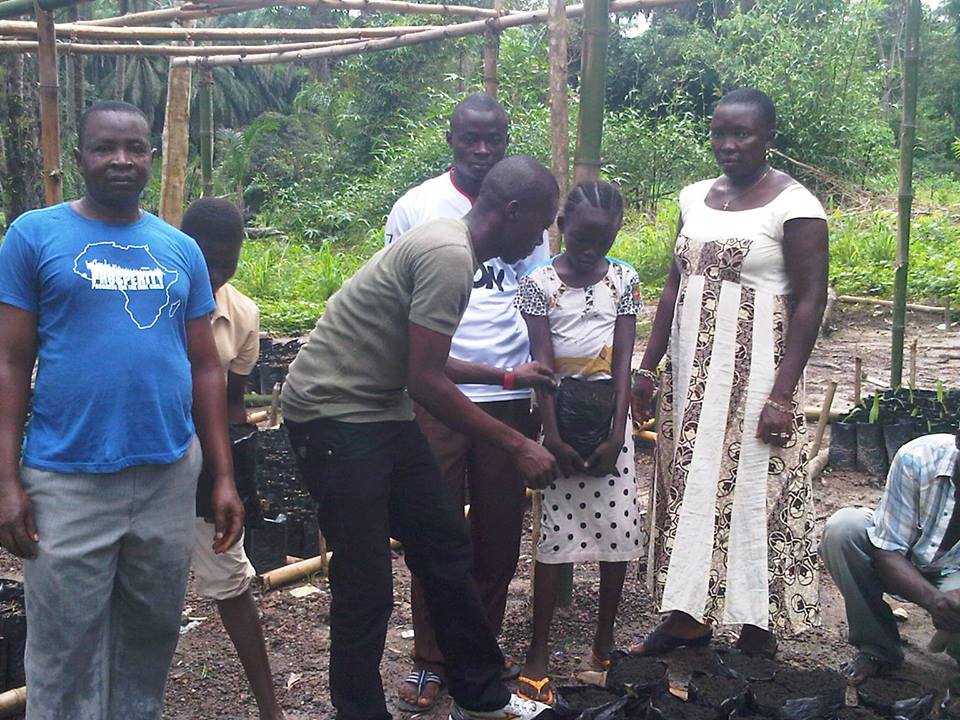
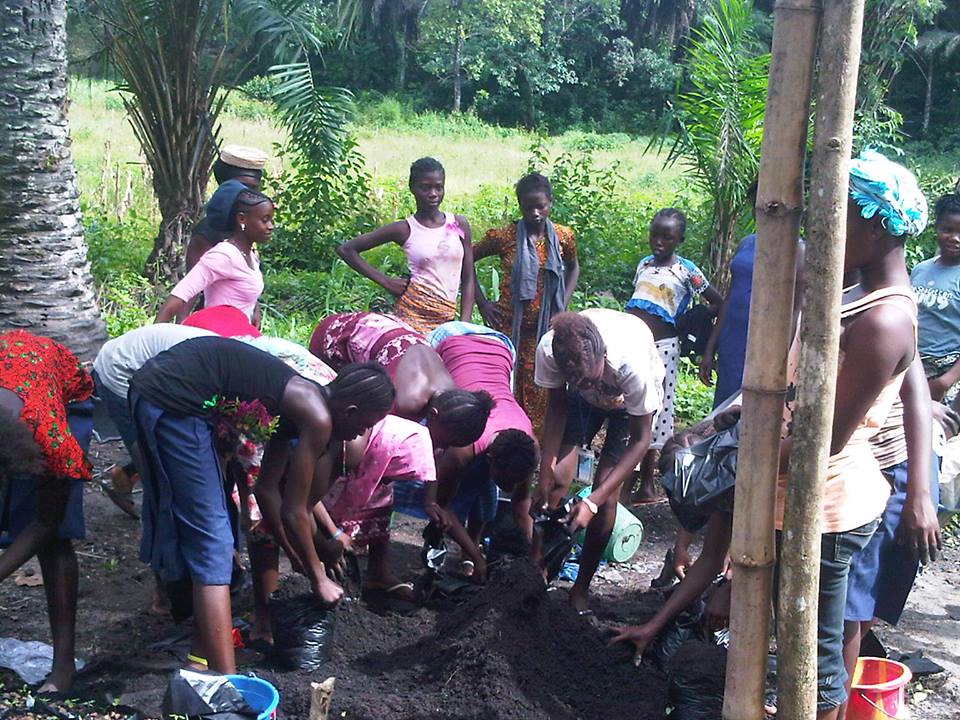
CCET-SL volunteer and local teacher Mr. Sennessy (left, blue shirt) and Mr.s Kaimbay, CCET-SL Director and local principal, left, watch as a young volunteer prepares her seedling bag.

CCET-SL volunteer and local teacher Mr. Sennessy (left, blue shirt) and Mrs. Kaimbay, CCET-SL Director and local principal, right, watch as a young volunteer prepares her seedling bag.

It’s the rainy season now in Sierra Leone and planting time.  Rotifunk is busy planting tree seedlings to raise in their nursery for trees of economic value. 

Thanks to cell phone pictures and Facebook, we can all now see the nursery taking shape and seedlings growing.

The tree nursery is a project of Rotifunk’s home grown nonprofit organization, the Center for Community Empowerment and Transformation.  CCET-SL’s aim is to empower their community in development with projects like the tree nursery.  With these projects, they hope to transform lives of the average person in Bumpeh Chiefdom.

I shouldn’t say they hope to transform lives.  They plan to transform lives. With simple, concrete projects like the tree nursery that will have clear payback, this isn’t a leap of faith.  Next year, the trees will be ready for people to plant in their own gardens and farms to improve their family’s diet and gain income by selling their surplus.   Citrus, coconut and oil palm trees, as well as teak trees for future lumber sale.

Bumpeh Chiefdom is a rural area rich in agriculture.  So, economic development here starts with agriculture projects. To read the whole story about the Economic Tree Nursery,  click here to see an earlier post.  Sherbro Foundation has supported the nursery project with money to buy farm tools and young oil palm seedlings bred for early fruiting.

Filling polythene bags with soil that will allow seedling to form deep roots.  This looks like rich silty soil from the Bumpeh River floodplain.

Filling polythene bags with soil that will allow seedling to form deep roots. This looks like rich silty soil from the Bumpeh River floodplain.

Rotifunk community gets involved with preparing the bags to hold seedlings.

Rotifunk community gets involved with preparing the bags to hold seedlings.

Seedlings will be nursed in the nursery, watered and protected from hot tropical sun in the dry season til ready to plant next year.

Seedlings will be nursed in the nursery, watered and protected from the dry season’s hot tropical sun til ready to plant next year.  Families across Bumpeh Chiefdom are eligible to get trees at a token cost.

CCET-SL volunteers and local teachers Osmun Kamara and Phillip Komoh.

CCET-SL volunteers and local teachers Osmun Kamara and Phillip Komoh.  I’d guess these are coconut seedlings.

Breaking the barrier of illiteracy

Junior Secondary School 3 students (JSS3 or 9th grade in the U. S.) across Sierra Leone last week completed the BECE exam.  The Basic Education Certificate Examination is a standardized exam administered throughout West Africa by the West African Examination Council to certify students are ready to progress to senior high school.

This is a quiet milestone. But progressing to high school should be celebrated as a big deal for a country where 56% of adults over the age of 15 years in 2011 have never attended formal school. (World Bank data) This number seemed high to me.  But if you stop to think, it’s again that group of young adults whose educations were interrupted by the war and its aftermath.

JSS3 students from four Rotifunk secondary schools are glad the rigorous BECE exam is over.  Twenty two subjects are offered, and students expected to test in 10-13 subjects that take 2 to 2 ½ hours each.  That means 5-6 days of testing for each student.

To pass the BECE, students must pass at least six subjects, including English and Math.  Sierra Leone pass rates last year were only 50% of test takers in Language Arts and 57% in Math; it’s not an easy exam.  Less than half the students taking the BECE in 2012 in the Southern Province where Rotifunk sits passed the overall exam.

Four Rotifunk secondary schools are taking the exam:  Walter Schutz Memorial Secondary School (where I taught many years ago), Prosperity Girls High School, Ahmadiyya Islamic School and Rotifunk’s Christian academy.

Student debaters at Walter Schutz Secondary School and their teacher after completing a debate.

Student debaters at Walter Schutz Secondary School and their teacher after completing a debate.

Prosperity Girls High School was the stand-out in 2012, not only in Rotifunk, but in Moyamba District (one of 12 administrative districts in the country). 100% of PGHS girls taking the BECE exam passed. This is significant given the area’s first all-girls secondary school had only been open three years when students first sat for the BECE last year.  It was the first time each individual girl took the exam, and the first time the school sent students to sit for the exam.  It was also the first year JSS3 – or 9th grade – had been offered at this new school.

Prosperity Girls High School was recognized by the Ministry of Education for their exceptional results.  It was noted their results could be compared with schools in the district open for a hundred years. Their net results were seen as second in the district, given their actual scores and smaller number of students.

So, how did PGHS pull this off?  It starts with an excellent principal and excellent teachers who are capable in their respective subjects and highly committed to their students.  But their secret ingredient is holding what Principal Kaimbay calls a camp – a month long study camp.

JSS3 students hunker down at the school and live there dormitory style all week while the teachers conduct comprehensive reviews of the whole curriculum.  Principal Kaimbay sleeps at the school with them, getting them up at 5:00 AM to begin an early study period before review classes start at 8:00 AM.  They have afternoon breaks for sports and rest, and evening review classes begin again after dinner til about 10 PM.  They can go home for the weekend, and return to begin the condensed study program again on Monday – for a whole month.

This approach delivered results.  Every girl passed in 2012, allowing PGHS to open their first senior high class (10th grade) for the current 2013 academic year.  Mrs. Kaimbay attributes their success to the comprehensive review and keeping the students focused.  We make sure we review every subject and the full curriculum before the exam, she said.  We try to verify knowledge and assist each student.  We provide the  focus and discipline for studying that they would not be able to get if they were studying at home.

Twenty eight JSS3 students from PGHS sat for the BECE this year.  So, it requires not only discipline for the students, but a huge commitment by the teachers and principal. As in countries everywhere, the teachers and principal are the heroes of this story.

I asked PGHS teacher Mr. Sonnah how it was going a couple weeks ago.  Great, he said.  They did a better job preparing the study camp this second time around, so he expects to see results on par with last year. 

Sherbro Foundation knows  JSS3 students from all Rotifunk’s secondary schools have worked hard to be ready for the BECE.  We wish them all the best as they await their results.

Growing the ranks of students ready for senior high is essential for this rural community – and for the country – to continue their development journey and move beyond poverty.  There will no doubt be barriers to the students completing senior high and then joining the workforce.  But academic readiness should not be one of them.  It should be an enabler.   Fortunately, in Rotifunk students are being given a good start. 

You can help.   One barrier Sherbro Foundation is helping to remove is the burden of school fees for rural families unable to pay them.  Consider contributing to the Girls Scholarship Fund that awards school fee scholarships to girls in all four Rotifunk secondary schools.   $22 USD pays fees for one senior high girl to attend school for the year.  $18 USD covers annual school fees for one junior high girl.   You can find an on-line donation button in the right hand column of the website.