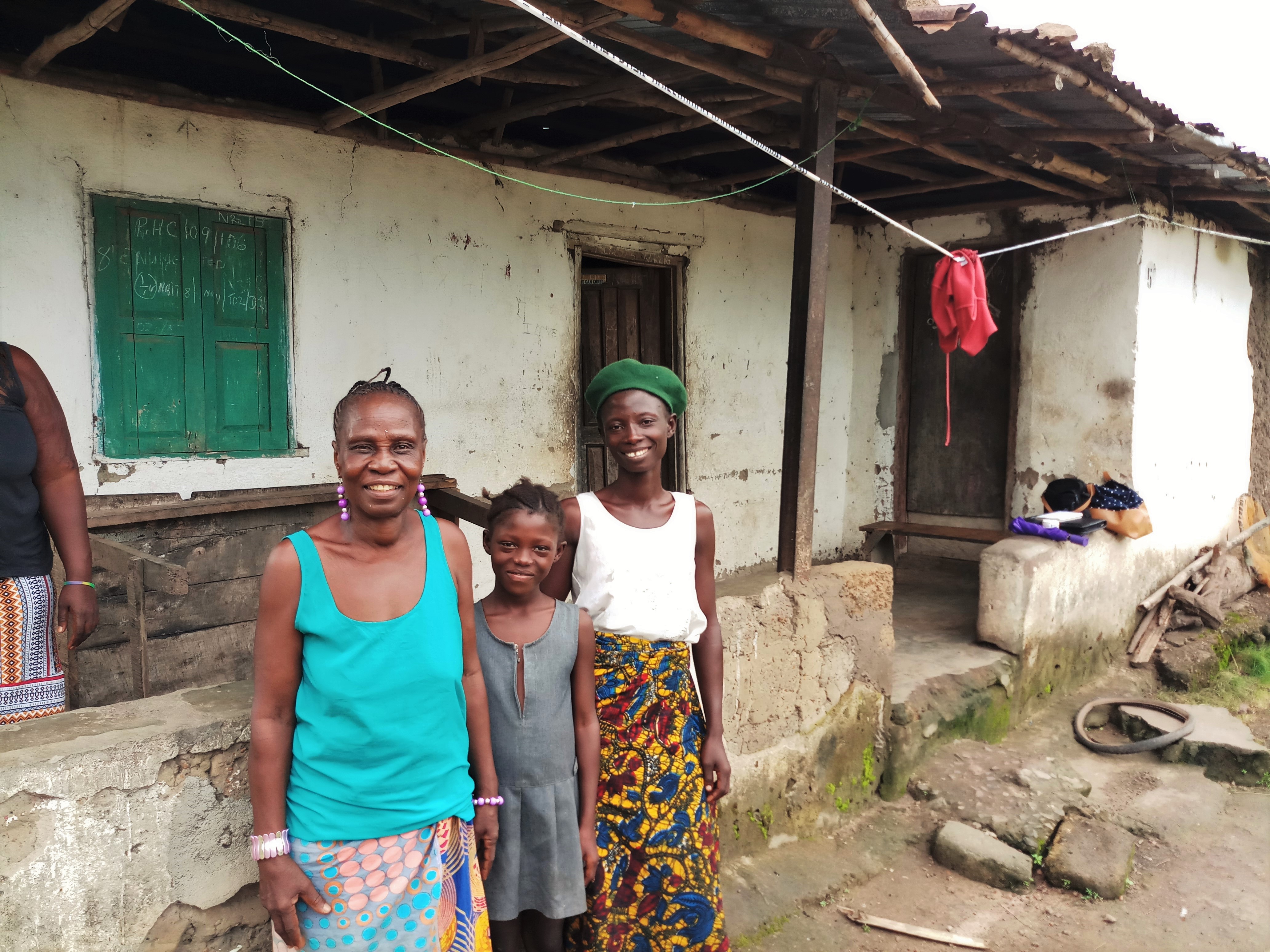
Procter & Gamble Alumni Foundation Grant Boosts Sierra Leone Farmers

Procter & Gamble Alumni Foundation Grant Boosts Sierra Leone Farmers

Sherbro Foundation is honored to announce that the Procter & Gamble Alumni Foundation Fund of the Greater Cincinnati Foundation has awarded us a grant to expand our transformative Let Them Earn project in Sierra Leone. With this funding, 50 more Bumpeh Chiefdom village farmers (majority women) can replicate the success of early participants improving their incomes, livelihoods, and futures.
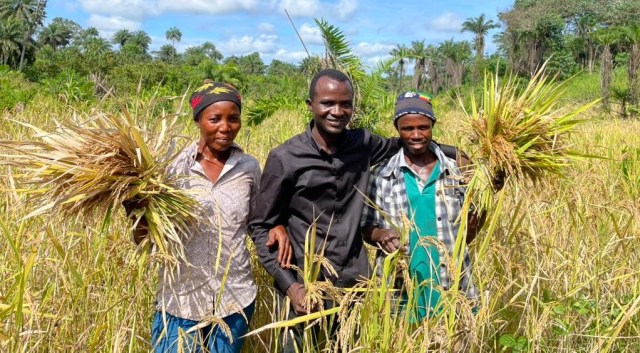
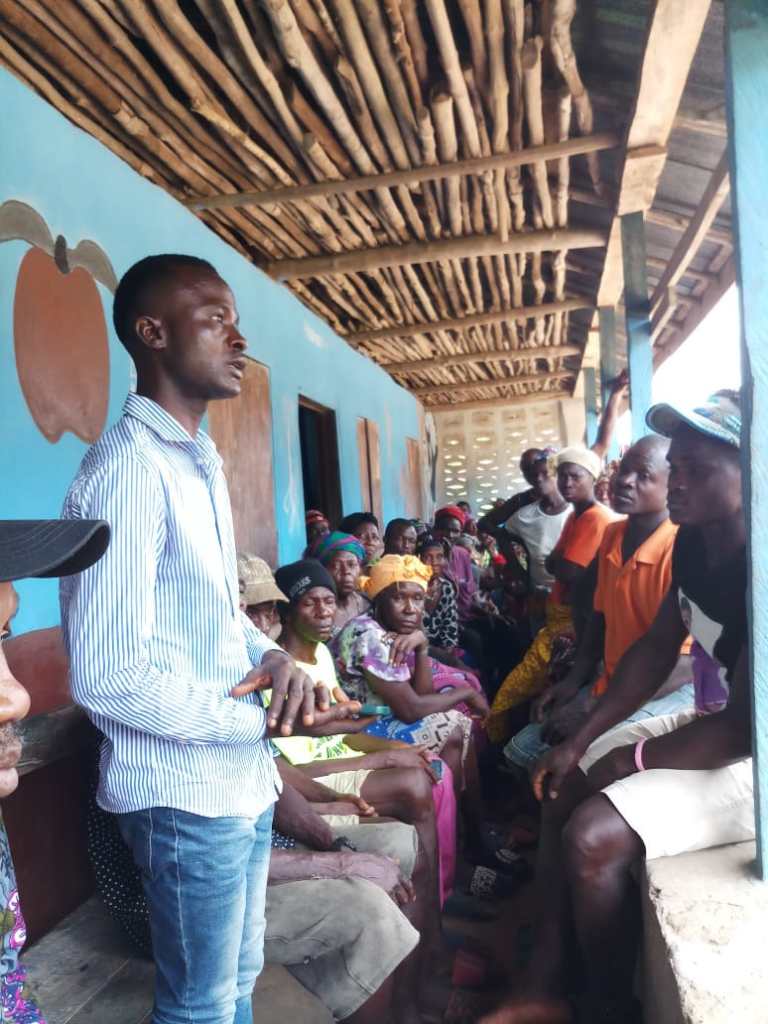
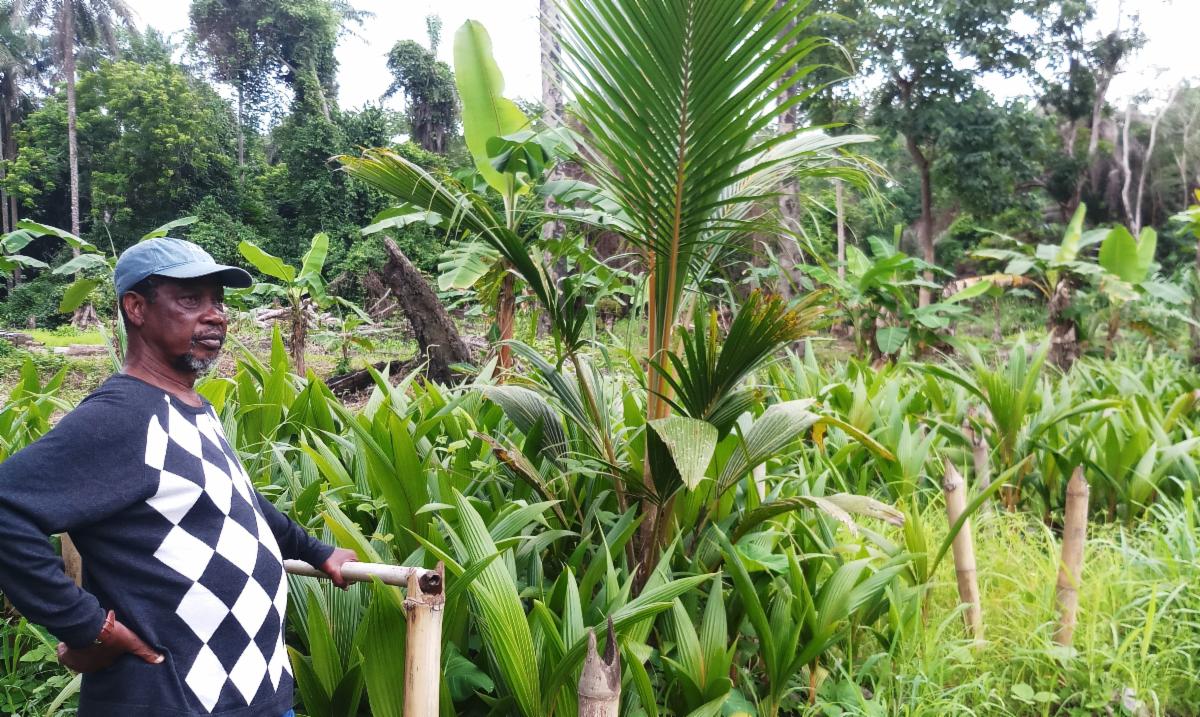
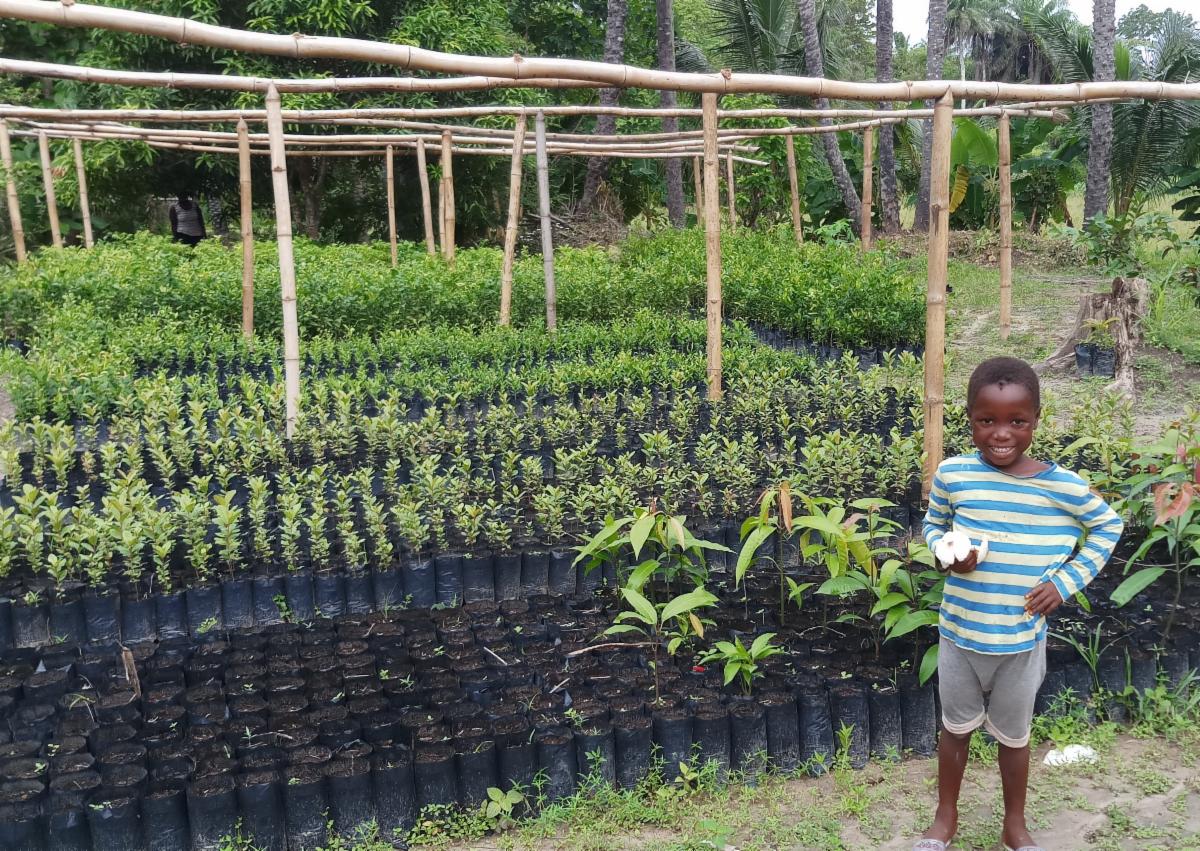
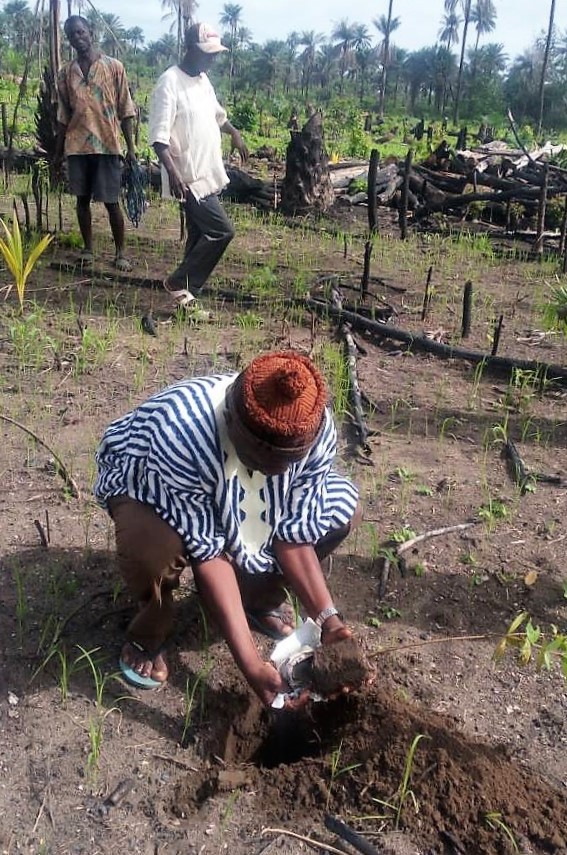
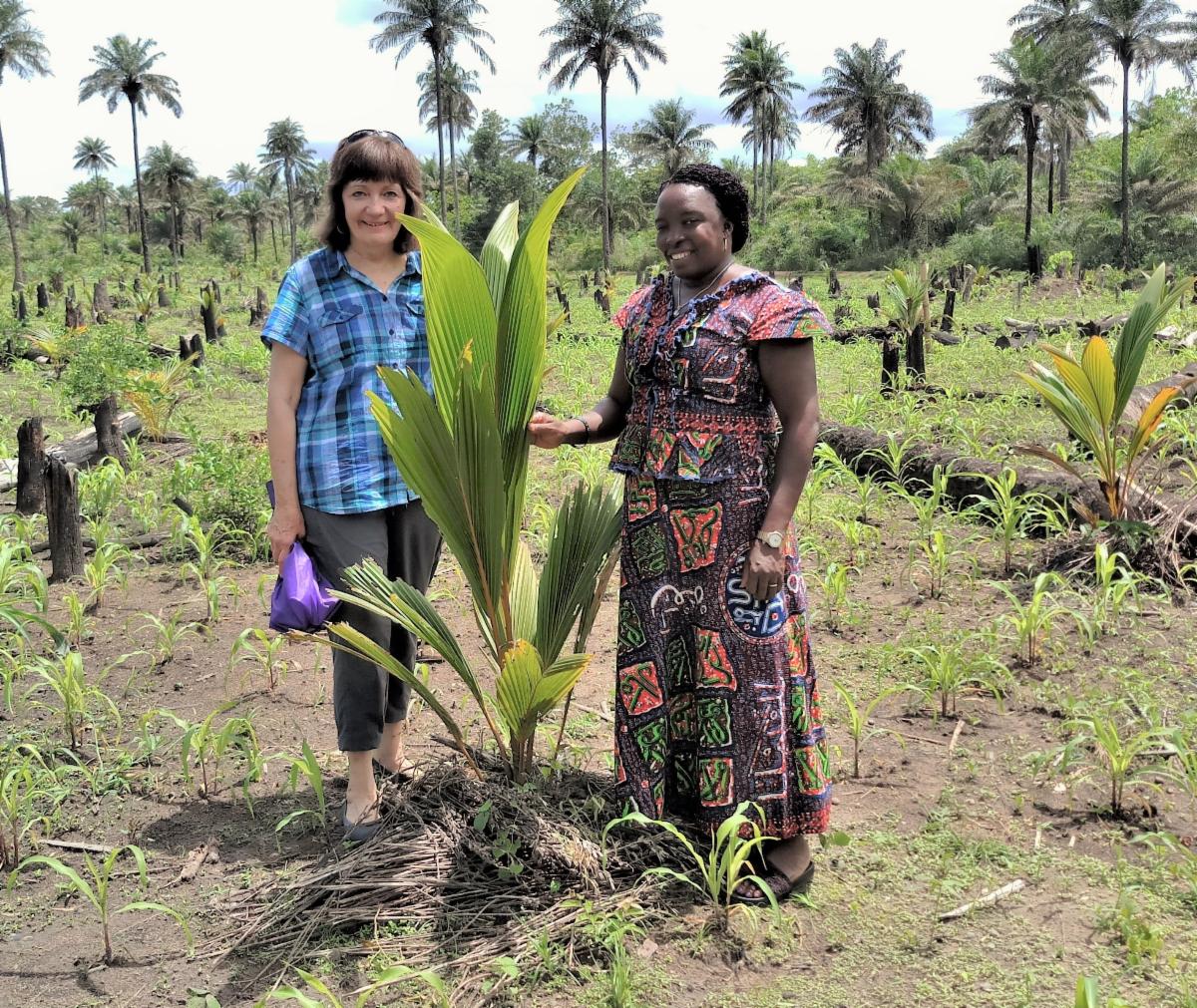
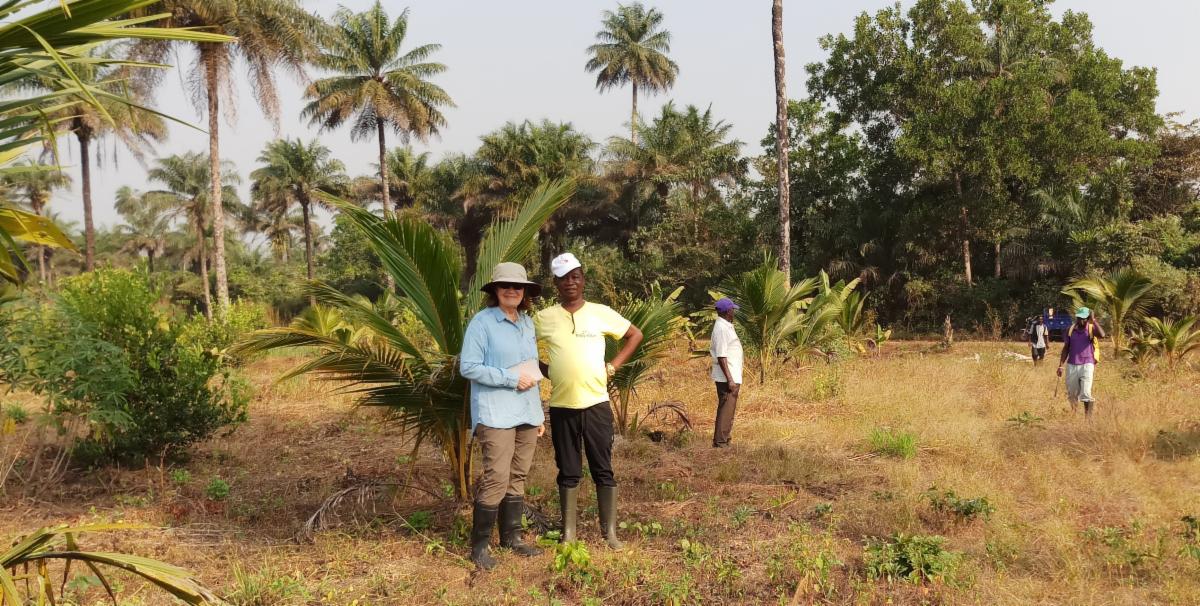
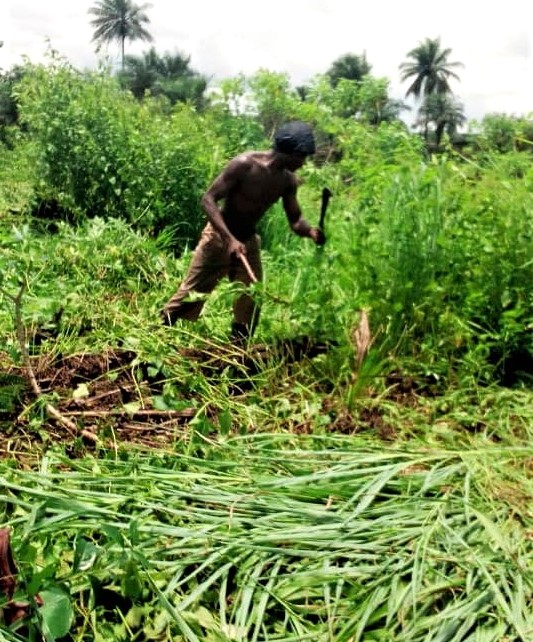
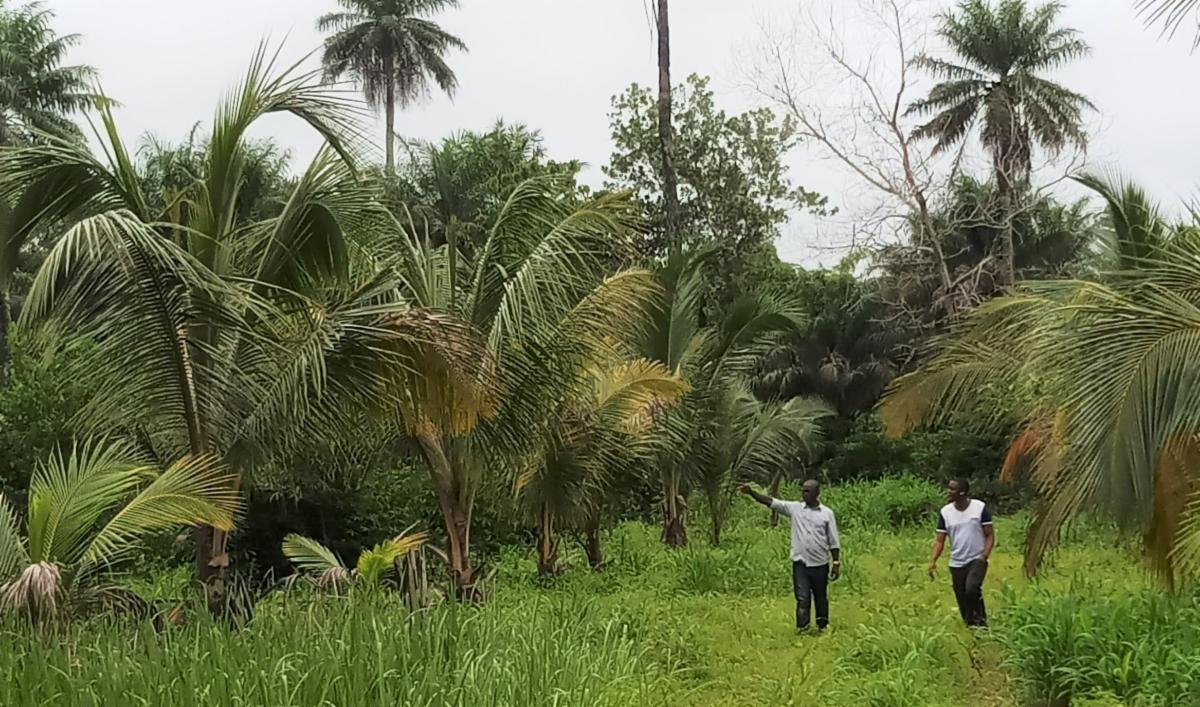
Let Them Earn Project farmers, Bumpeh Chiefdom, Sierra Leone

Through our local partner CCET-SL (Center for Community Empowerment & Transformation—Sierra Leone), Let Them Earn provides smallholder farmers with:

  • Interest-free loans to expand their operations     
  • Year-round training on improved farming practices
  • Classes on basic numeracy and small business management

After covering operating costs, setting aside family food, and repaying their loans, participants have net cash income to improve daily life and reinvest in their farms.

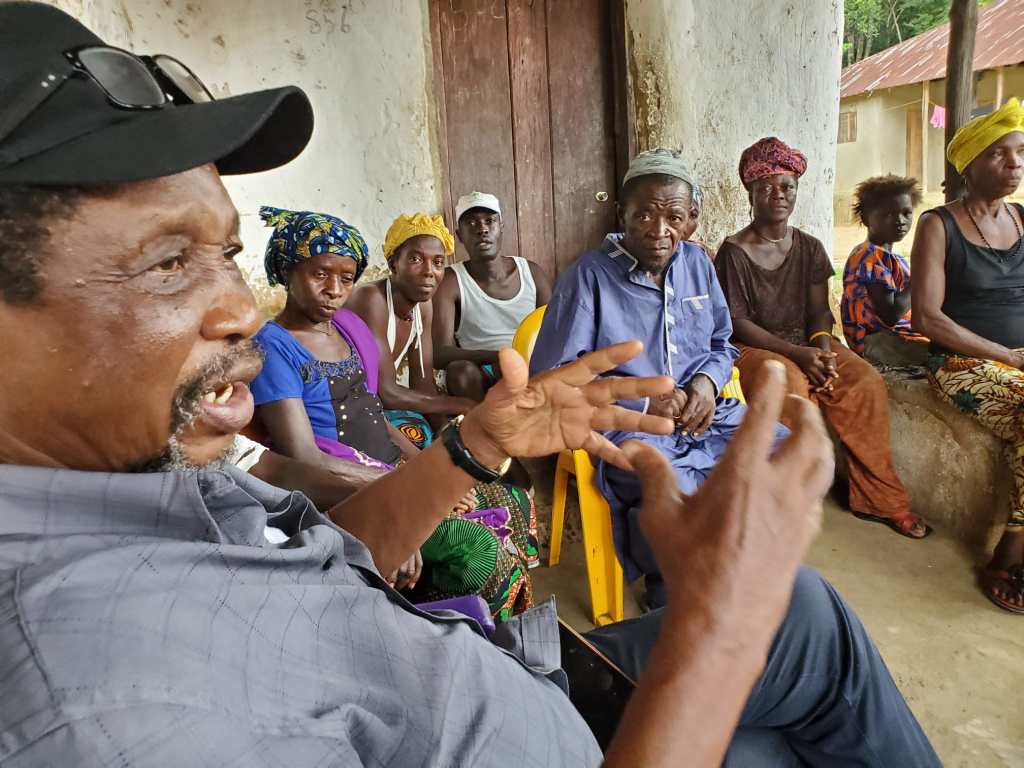
“This grant is a big leap forward that’s adding momentum to what we’re doing with village farmers,” said Bumpeh Chiefdom Paramount Chief Charles Caulker. below right with women farmers. “I want to create a culture of increased productivity where farmers continue to grow more, earn more, and villages lead their own development. I’m deeply grateful to the P&G Alumni Foundation for standing behind us with their support.”

Transforming Lives Through Economic Empowerment

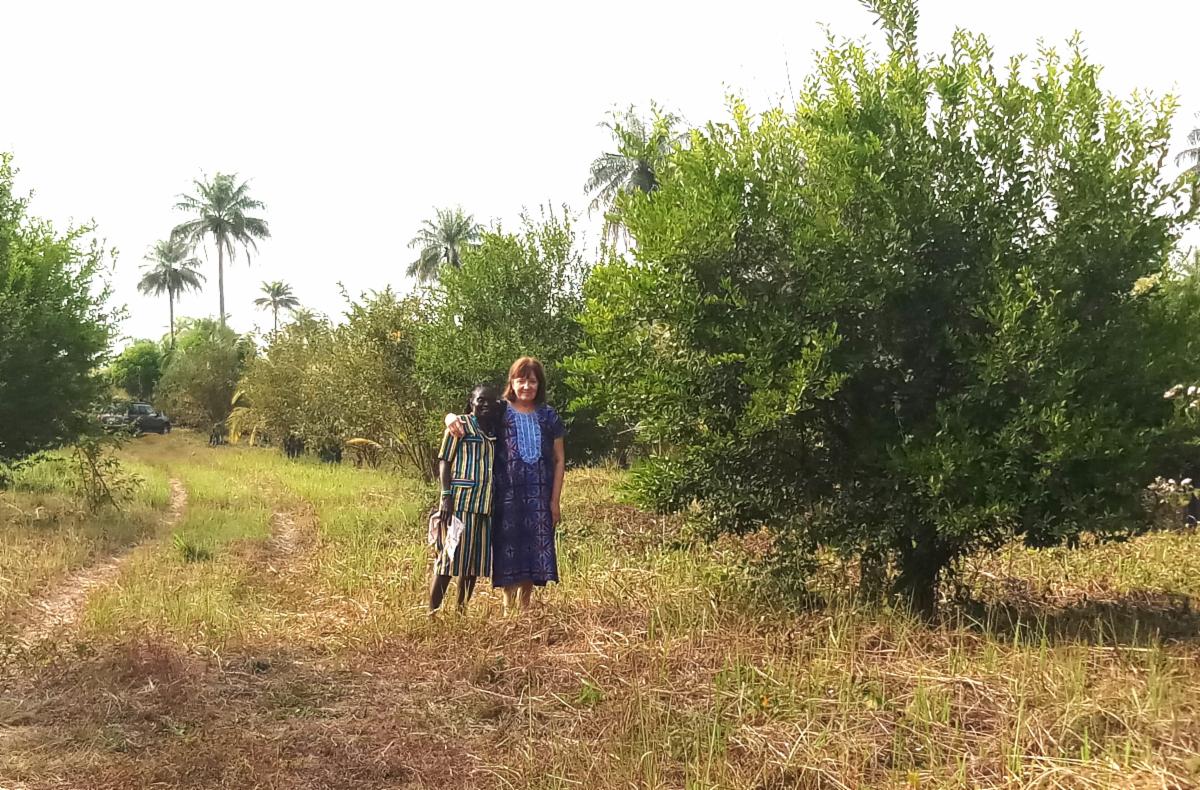
Musu Koroma, below, a mother of three, was one of the first farmers to join Let Them Earn. Last month, she showed me how new earnings from her loan changed her life. She reinforced her mud brick house with strong concrete stucco, safeguarding it for years to come from erosion and collapse in Sierra Leone’s heavy monsoon rains. She installed sturdy hardwood doors and windows that keep out rain and mosquitoes. With pride and confidence, Musu is now sending her son to secondary school in a larger town. 
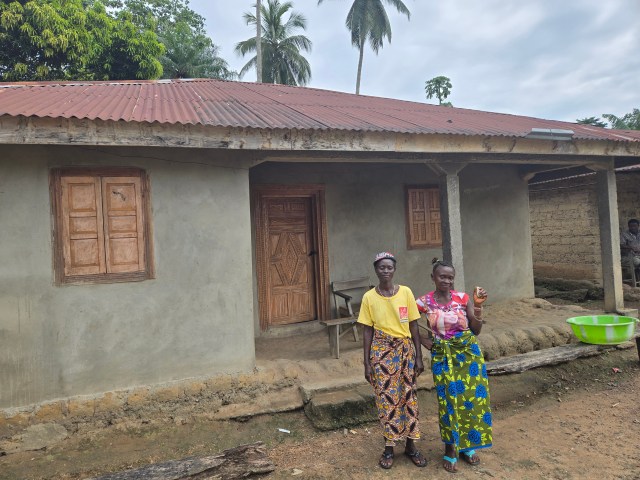
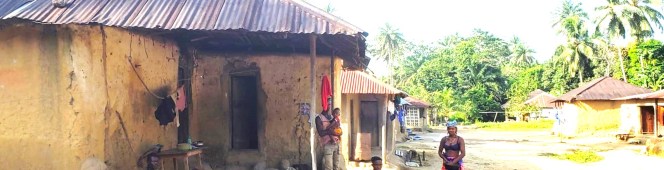
With earnings from her three-acre farm, Musu Koroma, above left, strengthened her house, before like the mud brick house next door.

“Let Them Earn has helped me so much,” Musu said. “I can now do things I never thought possible.”

Results Speak for Themselves

The impact has been dramatic. Families are sending children and grandchildren for higher levels of education. They have more food and can afford protein like fish, important for child development and disease resistance. Homes become safe and healthy places to live with dignity. Villages are becoming debt-free, and communities are rediscovering hope.
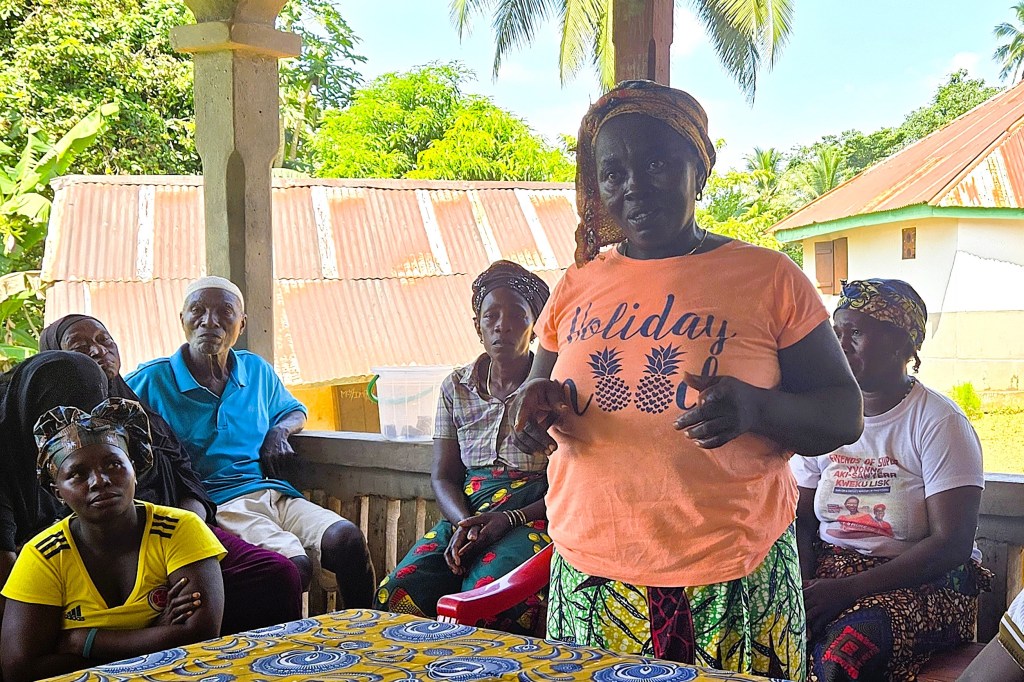
Aminata Sandy, above joined Let Them Earn after losing both her husband and the brother-in-law she became dependent on. With her loan, she hired labor for her farm, secured food for her children, and paid their school fees. As the loan recipient, she manages her farm and a household of eight. She’s repaid most of her loan, with the remainder coming with the year-end harvest.

Aminata confidently stood up in front of her village and Paramount Chief Caulker to tell her story. When women are direct loan recipients, Let Them Earn empowers them to make farm and financial decisions. They’ve gained respect and a voice in managing their village.

Microfinance schemes in rural areas frequently fail. Our partner CCET-SL proudly reported 95+% of year one loans were repaid with the combination of interest-free loans and year-round training tailored to farmer needs. Year two Let Them Earn loan repayment promises to reach the same high level. Repaid loans are reloaned to the next group of farmers eager to improve their lives.

Why This Approach Works

After 14 years working with Sierra Leone, we’ve learned a vital truth: sustainable development doesn’t begin with what you construct — it begins with who you empower.

Schools, wells, and roads are important, but villages can’t develop or sustain growth unless individuals become economically self-reliant. Lasting change happens when you invest directly in people, giving them the means and skills to lift themselves out of poverty.

The Let Them Earn program brings together what truly works: financial access, practical skills, and local empowerment—helping farmers move from subsistence living to building viable, income-generating small businesses. Loans are repaid on schedules that match farm harvests.

Yes, it’s riskier to provide loans to subsistence farmers and small traders. It’s time-intensive to deliver hands-on training in remote villages and provide ongoing coaching. But this is what actually works. This is what moves people and entire communities beyond survival mode to genuine economic opportunity.

Sherbro Foundation sends our deep thanks to the P&G Alumni Foundation for their continued confidence and partnership in Let Them Earn. Year three of the project will bring even greater growth and opportunity to the villages of Bumpeh Chiefdom.

For program details: https://conta.cc/4oVfeom

You can help support Sierra Leone farmers: https://sherbrofoundation.org/donate/
From Darkness to Light – Learning to Read

From Darkness to Light – Learning to Read

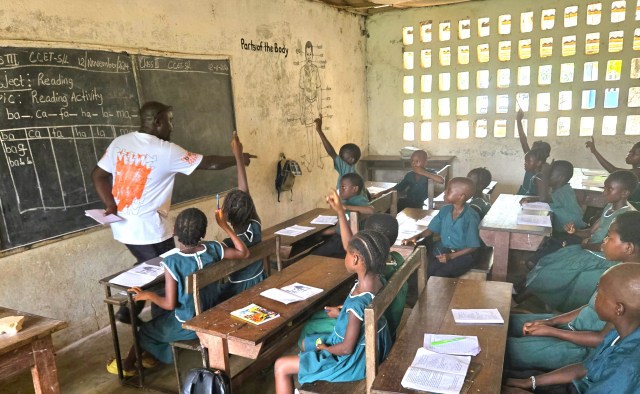
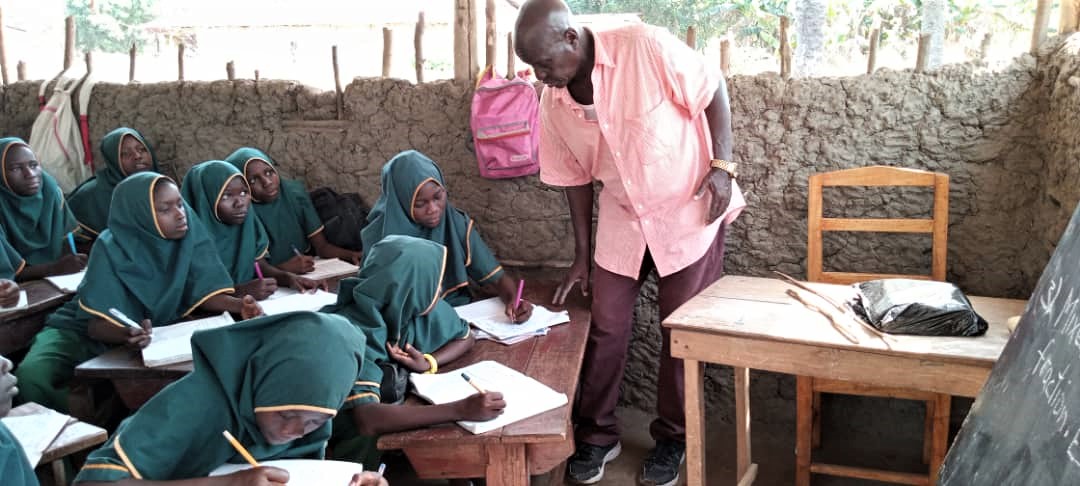
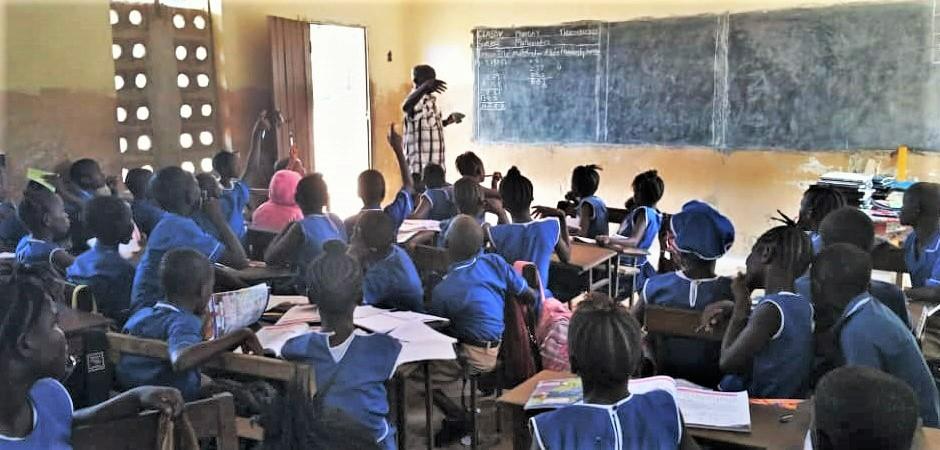
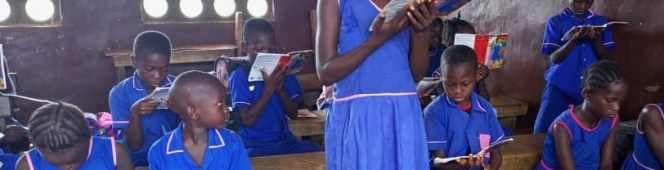
Imagine a child entering Class 3 who can hardly read simple words. Some still struggle naming letters or numbers. This is not uncommon in Bumpeh Chiefdom and across Sierra Leone. These children risk never catching up and often drop out of school in frustration. Their lives remain forever limited without reading skills.

Our partner, the Center for Community Empowerment & Transformation (CCET-SL), fills teaching gaps with a targeted Class 3 learn-to-read program. Experienced, retired teachers work weekly with students in seven schools on their first formal reading steps, while coaching their inexperienced teachers.

CCET-SL submitted this story of a girl struggling to read and her remarkable teacher who was retired “but not yet tired” – eager to keep teaching.

Rachel’s Reading Journey

Modigay is a small village surrounded by lush green fields with a winding dirt road to Rotifunk, the chiefdom headquarters. There lived spirited class-three student Rachel Bangura. Every day, Rachel woke before dawn, her heart filled with learning dreams despite overwhelming circumstances. Her family, struggling as subsistence farmers, could barely afford life’s necessities, let alone help with homework. Rachel often joined her parents in fields after school.

Rachel loved school, but joy was overshadowed by struggles. She could hardly read, spell, or connect sounds to letters, filling her with anxiety. In her bustling Rotifunk classroom, while other children eagerly raised hands, Rachel sat quietly, hoping not to be called upon. She felt lost in a sea of words dancing beyond her reach.

A New Hope

The Center for Community Empowerment and Transformation works with schools and local council to improve education quality in Bumpeh Chiefdom. They train teachers to improve outcomes among underprivileged children. They brought in experienced retired teacher Mr. Koroma, who had a reputation for transforming struggling students’ lives. With his compassionate approach and innovative methods, Mr. Koroma was determined to help children like Rachel.

When Mr. Koroma first met Rachel, he noticed the curiosity spark in her eyes despite looming fear of failure. He took time to know Rachel, learning about her village, family, and dreams of reading stories. Rachel expressed her desire to read about faraway places and adventures. Mr. Koroma promised they would work together to make that dream reality.

Building Foundations

Mr. Koroma began with basics, focusing on phonics and letter sounds through engaging activities. He used colorful flashcards, songs, and rhymes that made learning fun. Rachel’s shy laughter echoed as Mr. Koroma encouraged students to sound letters and blend them into words.

Initially, Rachel struggled to grasp concepts, feeling frustrated and overwhelmed, but Mr. Koroma’s patience kept her motivated. “Every word you learn is a step closer to your dreams, Rachel. Let’s take it one step at a time!” he would say, and Rachel felt hope ignite within her.

Beyond the Classroom

To further support Rachel’s learning, Mr. Koroma organized weekend literacy clubs in their village where children could gather and learn together. Rachel’s parents were thrilled seeing their daughter engaging with other children in learning to read.

During club meetings, Rachel enjoyed storytelling sessions where she listened to tales from different cultures. She was captivated by stories of brave heroes and magical realms, fueling her desire to read. Mr. Koroma encouraged children to draw pictures related to stories, allowing Rachel to express creativity when words felt elusive.

Breakthrough Moments

As the school year progressed, Rachel made significant progress. One sunny afternoon, while practicing with Mr. Koroma, Rachel successfully read a simple book aloud for the first time.

“Saffie’s Mistake!” she exclaimed, her voice filled with joy. Mr. Koroma and other children clapped excitedly, and Rachel’s face lit up with a radiant smile. This moment marked a turning point; she realized she could read, that she was capable.

Buoyed by success, Rachel started writing short sentences about her life and village. She wrote about family, friends, and beautiful sunsets. Each word she penned testified to her growth and determination.

A Year of Transformation

By year’s end, Rachel had transformed remarkably. With Mr. Koroma’s guidance, she could read simple stories, write confidently, and understand word sounds. Rachel’s self-esteem blossomed, and she now participates actively in class discussions. She’s no longer the quiet girl at the back; she’s become a vibrant classroom community member.

Rachel often shared dreams with Mr. Koroma about becoming a teacher to help other children like herself. Mr. Koroma beamed with pride, knowing his influence had sparked fire within Rachel.

Learn to Read Program Impact

Rachel’s story repeats many times with Mr. Koroma and other experienced reading teachers entering classrooms weekly.

CCET-SL reading tutors break through barriers and jumpstart children’s ability and love of reading. Teachers who only graduated high school receive practical, in-classroom training building their skills and motivation to teach.

Because CCET-SL uses experienced community teachers, the cost is only $10 per student for the whole year. The cost is low, the result is priceless.

To keep kids progressing, we will expand the learn-to-read program to Class 4 with the new school year. You can give 350 Class 3 and 4 children like Rachel in seven schools the chance to unlock their potential through reading with your support: here.

You can also help send 14 early primary school teachers to get 3-year teaching certificates on scholarship. They’ll develop skills to start children on the path to mastering reading in classes 1 – 3.

These teachers have only graduated from high school with no means to pay for higher education.  A scholarship for each year is only $400. Give Now

You’ll be giving Bumpeh Chiefdom children a strong education head-start, an advantage they’ll carry through life. We appreciate your support!

–Arlene Golembiewski
   Executive Director

Meet Our Partner CCET-SL’s New Manager

Meet Our Partner CCET-SL’s New Manager

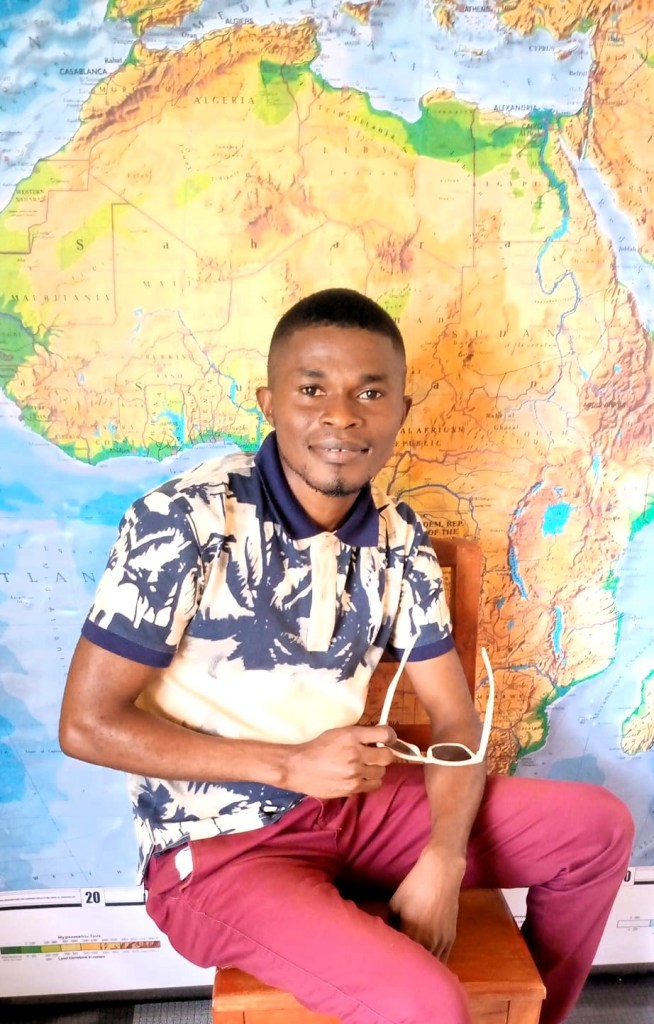
When Mustakin Conteh arrived at the Center for Community Empowerment & Transformation last September, he didn’t just bring professional nonprofit experience—he brought a vision. As our partner organization’s first manager with formal NGO background, Mustakin has spent the past year moving CCET-SL from a small community organization towards his goal of a full-fledged Sierra Leone nonprofit.

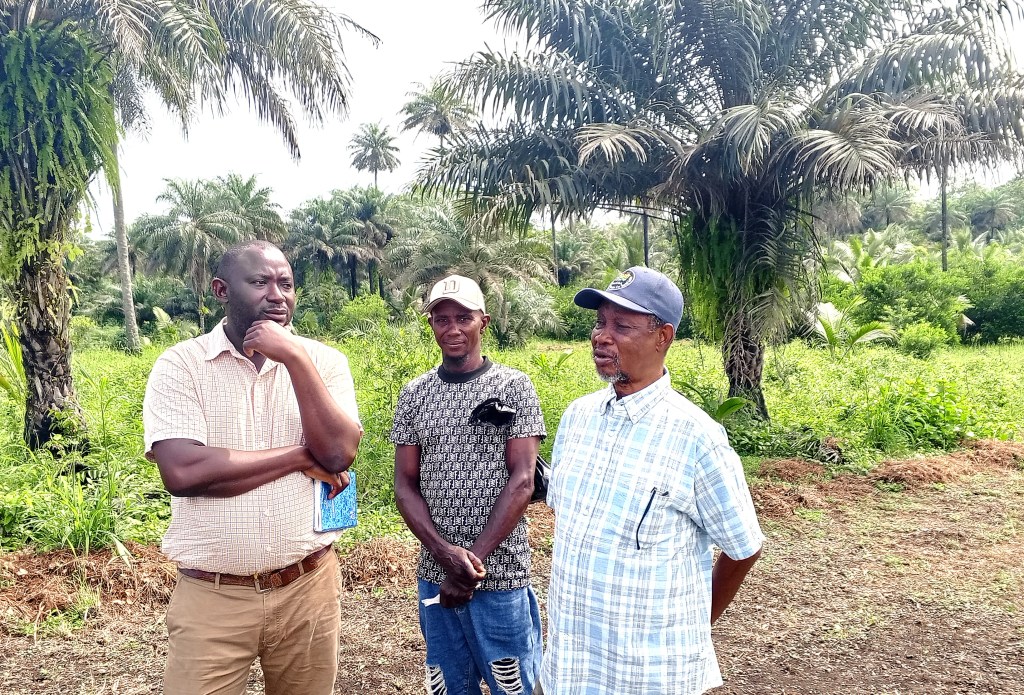
Mustakin, left, reviews CCET-SL’s Orchards for Education with Paramount Chief Charles Caulker, right.

But his story begins much earlier, in a classroom in Bo.

A Teacher’s Calling

Like many first pursuing higher education in Sierra Leone, Mustakin started as a teacher. With a B.A. in Education, he taught secondary school English and English Literature for ten years in Bo, Sierra Leone’s second largest city. But as the country was recovering from its devastating rebel war, he witnessed firsthand how rural communities remained trapped in cycles of poverty that the conflict had only deepened.

That experience changed everything.

Armed with a Master’s in Rural Development from Njala University, Mustakin embarked on a second career dedicated to rural transformation. For 12 years, he honed his skills with Sierra Leone NGOs and international NGO programs like Save the Children and Welthungerhilfe, learning how to turn development theory into real-world impact.

Boots on the Ground Leadership

What sets Mustakin apart is his hands-on approach—still uncommon in rural Sierra Leone. I find him everywhere: meeting with school principals and teachers, visiting Let Them Earn villages, checking operations at CCET-SL’s Orchards for Education at 8am before continuing with his day. He doesn’t manage from behind a desk. He leads from the field and sets operating standards.

Staff and community members could see he’s there to improve the lives of everyday people. His respectful, engaging style quickly earns trust. CCET-SL’s small staff achieves broad community impact through local partnerships. Mustakin’s kind of relationship-building is everything.

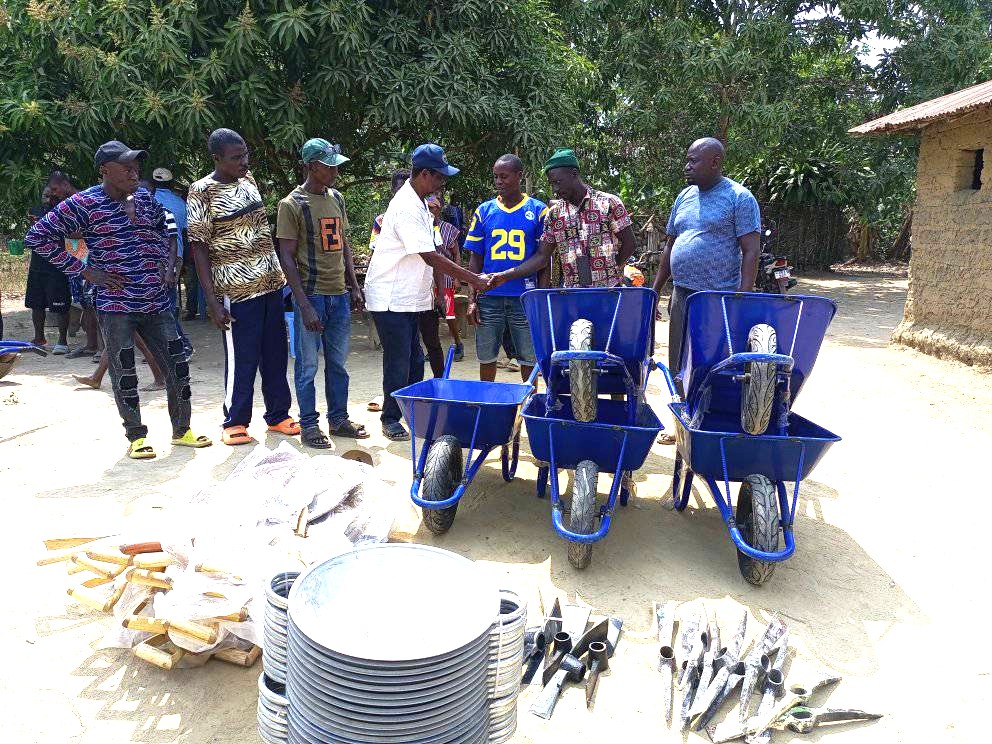
Mustakin, right, officiates a ceremony handing off Sherbro Foundation funded tools for village road repairs. He oversaw work where villagers manually dug roadside rain gutters and filled gullies, keeping roads drivable in the rainy season.

Results, Not Just Reports

Mustakin didn’t come to simply manage programs on paper. His NGO experience trained him to look beyond activities to long-term impact. “How are we actually improving lives?” he asks—a critical question as CCET-SL enters year two of its village farmer development program, Let Them Earn. He’s guiding the project team and villagers to identify early learnings and make modifications to be more effective.

Mustakin, center, explaining Let Them Earn project objectives to Mokomrabai project participants.

Project Management expertise

This results-oriented mindset recently solved a pressing challenge. Climate change is threatening CCET-SL’s 60-acre Orchards for Education with rising dry season temperatures and erratic rainfall. When asked to address this, Mustakin sprang into action.

Within three months, he had:

  • Researched water system solutions, confirming a borehole as cost effective
  • Engaged government advisors for technical design
  • Secured the best borehole contractor
  • Delivered a complete system reaching 220 feet to an aquifer providing plentiful clean water

Today, elevated storage tanks and standpipes cover the 60-acre orchard, ensuring maturing trees have year-round water. Mustakin isn’t an engineer, but he knew how to analyze problems, find technical resources, and execute solutions—exactly the project management skills rural communities desperately need.

Mustakin here supervising installation of a nine-foot water storage tank platform.

Building a Legacy

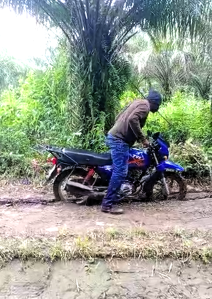
For Mustakin, this work transcends employment. “I’m here to create my own legacy,” he tells us. His commitment to the people of Bumpeh Chiefdom runs deep, driving him to push through the daily challenges of rural development work. Like getting to project sites on roads, left, he found even his motorbike had trouble passing in the rainy season.

As CCET-SL – and Sherbro Foundation – continue our mission of lifting communities out of poverty, we’re grateful to have a leader who understands sustainable change requires both professional expertise and genuine heart for the people being served.

Thank you, Mustakin, for choosing to invest your talents where they’re needed most—and for showing us what dedicated leadership looks like in action.

— Arlene Golembiewski
   Executive Director

Casting Off Barriers – Investing In Young Minds

Casting Off Barriers – Investing In Young Minds

When I visit Bumpeh Chiefdom villages, I see the story of Mariatu Turay’s mother played out again and again. Ya Ramatu is a widow who toils away in her garden using only her own backbreaking manual labor. Foremost in her mind is educating her children. But she hardly earns enough to feed them, let alone take care of school expenses.

Ya Ramatu didn’t have the opportunity for education. Too many children still follow in her footsteps, trapped for generations in the same cycle of illiteracy and poverty.

Too many young minds have been wasted for too long. You can change that. You are changing that.

You helped Mariatu break the mold. We’re kicking off our annual Education Fundraiser so more students repeat her success story this school year. Together we can cast off education barriers and invest in developing more young minds.

Mariatu, left, just managed a feat few rural girls achieve, as a standout secondary school graduate. She was also a school prefect, selected to lead students and enforce school standards.

She now wants to go to university to study accounting. Without our help, she could have been back in her village like her mother, struggling to support two or three children.

Instead, Mariatu and other junior high students you earlier helped, are today’s high school graduates. With early success, they stayed in school, prepared to tackle senior high and now continue for advanced training.

Today, girls and boys routinely graduate from Rotifunk secondary schools, thanks to programs from our partner, the Center for Community Empowerment and Transformation (CCET-SL).

For Paramount Chief Charles Caulker, it’s a transformation. “Our schools have now returned to where they were before the war. Our children no longer have to leave Bumpeh Chiefdom to get a full education.”

Doing what works

Over 11 years, CCET-SL has greatly improved education in Rotifunk. At its core, CCET-SL’s tutorial programs give students the extra teaching support they need to advance to the next level of their education: to junior high, senior high and now higher education.

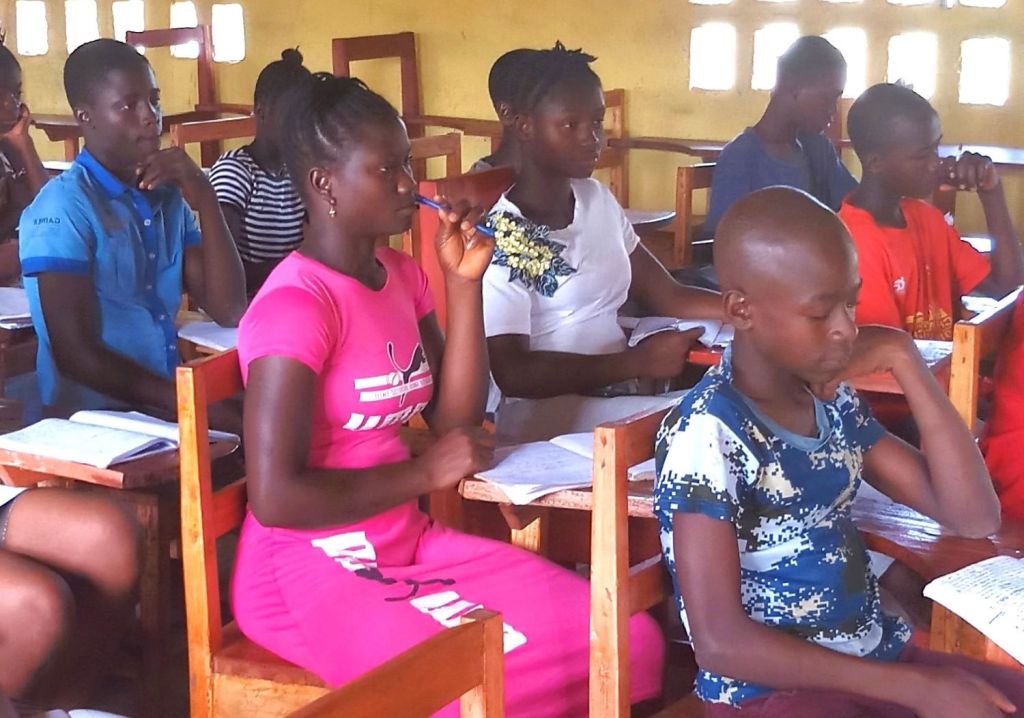
9th grade students, above, intent on passing to senior high return for another 90 minutes of CCET-SL led after-school classes. This tutorial ensures they complete the full curriculum before the national exam.

In a rural area with limited resources, you must be practical. CCET-SL organizes teachers with the best qualifications to prepare students in grades 5, 6, 9 and 12 for their national exams.

The tutorials use existing teachers and existing facilities to achieve better results. Much better.

Over 90% of students in tutorial classes now pass to junior high and senior high better prepared than ever and continue to perform at a higher level. High school graduates are among the first to qualify for college in 30 years.

Charles Caulker, left, got the highest 2023 senior high entrance exam score ever achieved at a Rotifunk school and in his district of 40 schools. He topped students in five other rural districts. A number of his fellow students were close behind. Rotifunk hospital surgical officer and CCET-SL board director, Mohamed Tommy stands proudly with him.

Today’s lowest senior high entrance exam scores were just few years ago the highest scores Rotifunk students achieved.

For Mariatu – and her mother – CCET-SL’s tutorial programs made all the difference, enabling her to graduate with good grades at no extra cost. Sierra Leone schools often charge fees for extra after-school classes to prep for exams. Or parents pay teachers to tutor their children for national exams.

With Sherbro Foundation funding, CCET-SL tutorial classes are free, giving all students equal opportunity to get a full education.

Women often care for children of other family members. Kadiatu, center above, has responsibility for seven children; three are hers, four her brother’s. The family burden to educate children is great.

Program impact

Paramount Chief Charles Caulker sees the impact of CCET-SL program as “a big leap forward.” He told me, “CCET-SL is closing the huge gap left in chiefdom schools by the [11-year] war. For years, few students passed. Now, nearly all students pass. Grades are significantly improved to the point many graduates now qualify for university or [three-year] diploma courses.”

Chief was blunt about the state of Rotifunk schools for years after the war. “Only the students seen as useless remained in our schools.” Bright students found their way out and parents made every effort to send their children to better schools in bigger towns and cities.

Paramount Chief Caulker, above center, is a strong advocate for women. He knows the greatest long-term impact he can have on his chiefdom is helping to educate their children.

Chief Caulker now sends his granddaughters to Rotifunk schools. “This shows my conviction. I wouldn’t send my own children to school here if I didn’t believe the learning process was good,” he said. “I see no difference in their learning compared to Freetown schools. Look at Naomi. Her English is good, and she does very well in math. I’m so happy.”

Rotifunk schools are not overcrowded like those in Freetown. Children get more individual attention and they do better.

Chief Caulker’s dream 11 years ago was to educate his grandchildren in their own chiefdom. Today, granddaughters, Naomi, 7th grade, above left, and Grace, 5th grade, are thriving in Rotifunk schools.

Raising the bar

CCET-SL’s collaborative approach with Rotifunk schools is helping set a higher standard of education. They review and analyze student national exam results with schools by subject and agree on improvements they can work on together. Teachers get help with teaching materials and classroom coaching on teaching methods.

“CCET-SL is creating competition among Rotifunk schools, causing them to rise to a higher level,” Chief Caulker added.

With your support, we’re in the fourth year of CCET-SL managed teacher certification scholarships. CCET-SL handpicked 19 promising primary and secondary school teachers, especially for English, math and science. Women teachers are in short supply. CCET-SL sought out local female high school graduates to develop as teachers. Teachers go to classes during school breaks and apply each term’s learnings back in their classrooms. Nine schools are improving as their teachers improve their own educations.

Young minds are no longer wasting in Rotifunk. With CCET-SL programs, more and more students are graduating high school and at younger ages.

Seventeen-year-old John Sandy, left, just sat for the national graduation exam he’s optimistic will gain him admission to university. Graduating at 20 and 22 years of age had been the norm.

Also, students often must retake the graduation exam to improve results before getting admitted to universities and technical institutes.

They’ll lose a year or two and have to raise funds to pay to repeat the exam and maybe a review class. It’s an expense many can’t afford.

The big education leap Chief Caulker credits CCET-SL with is not just academic success. It also clears a huge financial hurdle for the poorest families – avoiding lost time and substantial cost before students can gain advanced education and productive job skills.

Bumpeh Chiefdom greatly needs highly skilled trades people, not just university grads. We’re planning new scholarships for young people to pursue training in areas like construction, electrical systems, mining technology, agriculture and animal husbandry.

Chief Caulker knows opportunity will open with education. “People get enlightened with education. They’re creative. They’ll use their creativity to create their own opportunities and develop small businesses.”

Ya Ramatu’s life would have been vastly different with even basic education. Our challenge is to help the next generation of Mariatu’s and John’s get the head start they need in school for better, productive lives.

School starts in September. For only $50, you can give a 9th or 12th grade student ten months of instruction to ensure they’re ready to advance to the next level of their education.

A student prepared and confident of progressing to senior high or college for only $5 a month. A bargain!

“It takes a village” to educate Bumpeh Chiefdom children and we’re an essential part of it. Join our village and give a child an opportunity that changes their life.

On behalf of students and parents, thanks so much for all the support you provide!

— Arlene Golembiewski,
 Executive Director

It Takes Money to Make Money – the Let Them Earn Project

It Takes Money to Make Money – the Let Them Earn Project

It takes money to make money. This could not be more true than with the plight of subsistence farmers in Bumpeh Chiefdom.

When you only net $50 to $100 a year in cash from your farming, you don’t have enough to eat and live on. There’s nothing extra to send your children to school; pay unexpected heath care expenses; fix your leaky roof.

You definitely don’t have money to put into expanding your farming so you can grow more and earn more.

We are going to start changing that with the support of The Procter & Gamble Alumni Foundation. We are beyond grateful to start the Let Them Earn Project with a $24,000 grant from the P&G Alumni Foundation Fund of the Greater Cincinnati Foundation.

Subsistence farmers are limited by what they can grow with manual labor. Most harvests are for household food; some is bartered for local goods. That leaves little to nothing to sell for cash.

There are two things I’ve been wanting to do for some time. First, is take our work to the villages beyond Rotifunk, Bumpeh Chiefdom’s headquarters town. 75% of the chiefdom’s population lives in small, hard-to-access villages that the government and NGOs never reach. But with Paramount Chief Charles Caulker and our partner CCET-SL, we can.

Secondly, I’ve long wanted to help village women. Chief Caulker describes women as beasts of burden. They’re constantly working — farming, caring for their house and their children, cooking, lugging water and firewood. They walk miles taking a small amount of produce to market in a basin on their heads. They’ll be lucky to earn a dollar. They do all the work, and their male partners and relatives take control of the money they make.

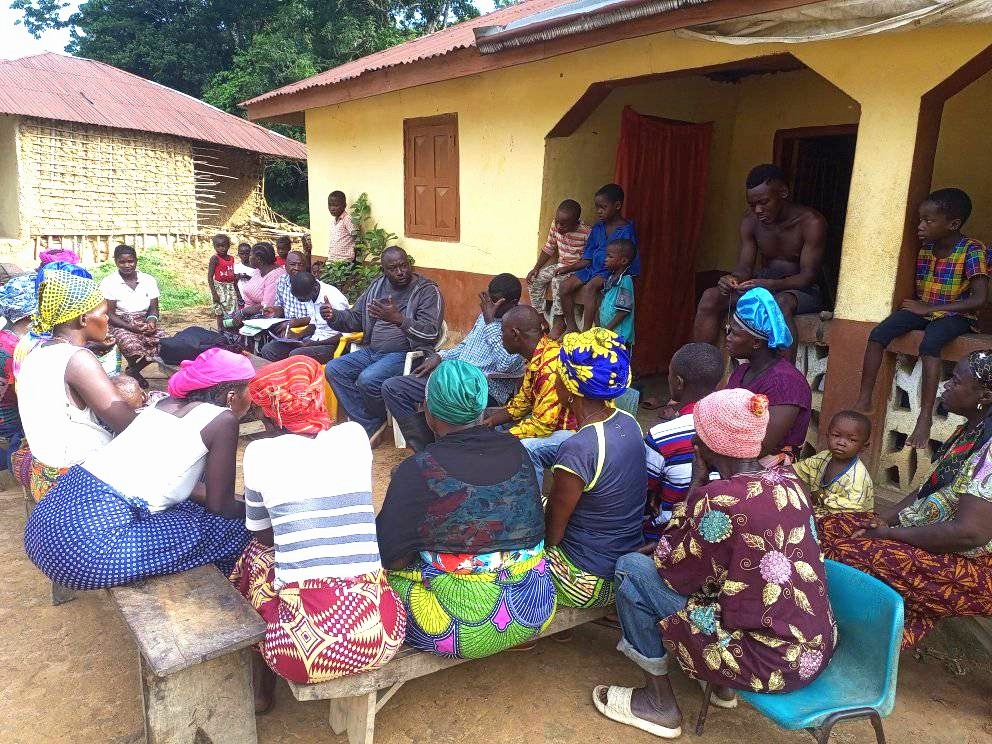
Chief Caulker, lower left, screened villages for the project with a series town hall meetings. He looked for industriousness (eg., backyard gardens) and willingness to comply with project terms.

The Let Them Earn Project combines microfinance farm loans in five villages with specialized training on growing and marketing to ensure participant success. 70% of participants targeted are women.

Let Them Earn will teach small farmers to raise quick-growing vegetables as cash crops and market them in bigger city markets where prices are higher and they can earn more money. The project will help protect their earnings so they can quickly invest in expanding and growing second and third crops. This will help assure they pay back their loans and make the funding available to a new group the next year. 

Typical microfinance loans charge 30% interest. That eats up the small profit farmers earn, leaving them where they started. Let Them Earn will charge zero interest. We want all earnings in their pockets, not ours. We’re commercializing CCET-SL’s tree seedling nursery to finance administrative costs when the grant ends.

Practical training

We’ve hired a professional agriculture manager with a Bachelor of Science degree in Agriculture Economics. Chief Caulker and I are impressed with Tommy Sankoh’s knowledge and the practical advice he offers on managing agriculture in a traditional rural setting.

Tommy will provide guidance on the best crops for local growing conditions. Uneducated farmers need training. But not in a classroom. To boost their success rate, he will train small farmers in demonstration gardens at their level of literacy and monitor progress of their individual farms. Training this extensive for illiterate farmers has never reached the village level.

Left, at a village meeting, Tommy is well-spoken, understands project management and is hard working. Born and raised in a Bumpeh Chiefdom village, he was glad to come home after his degree and accepted Chief’s job offer.

Tommy treats the illiterate project participants with respect and quickly developed rapport. They are like his home village family and neighbors. We’re excited to think of the impact he’ll have as CCET-SL’s agriculture manager and in helping subsistence farmers develop successful small businesses.

Changing village cultural practices

Paramount Chief Caulker is using the project to change two long-held cultural practices that hold back overall development.

Chief is a tireless advocate of women. But village women traditionally don’t make decisions on use of family land independent of husbands and male relatives and embark on business development. Yet, they shoulder the responsibility to feed and care for children and elderly relatives.

Laws were enacted giving them these legal rights. But remote villages are the last to hear of laws and change comes slowly in traditional societies. 

Chief Caulker will be a visible champion of Let Them Earn and use it to create women entrepreneur role models at the village level.

This will not be a simple or quick change. But Chief is skillful in using strategic carrots to change behaviors that influence longer term cultural change. 

Chief Caulker, above, explained his project vision in each village and expectation for majority of women as participants. Most villages welcomed the opportunity for their women. A couple needed calibration.

Project manager Tommy Sankoh, left, interviews each candidate to verify they meet project criteria and are credit worthy for a small loan of $225.

Fatu Kallon, right, of Mobinchi village is typical of most village women with six children. Two are grown, but she cares for the others with no husband.

The project will help Fatu earn more to better sustain her family. Sending children to school is a priority for mothers. This means sending them away for secondary school to a town like Rotifunk, an expense many, if not most, families cannot afford.

It’s common that women care for 7, 8 and more children, including those of other family members, like deceased or disabled siblings.

The other practice Chief Caulker wants to eliminate is using children as farm labor. It’s common for children 8 and 10 years old to leave school and work as free labor on family farms. Once out of school, they’re unlikely to return.

A condition of being in the project is no children 15 years of age and under can be used as labor during school hours. It will be strictly enforced, with participants kicked out for violating the rule.

Project launch

I returned last week from a six-week trip to Bumpeh Chiefdom where I helped launch the project. We were excited in seeing its potential and got off to an auspicious start.

Women rejoiced in song and dance as they thanked their paramount chief for bringing them this opportunity.

Their traditional Sherbro song says, “Hold yourselves tight. Keep the family together.”

We decided to expand right away from three villages in the grant with 35 participants, to five villages and an additional 15 participants. Fifty village farmers will now get opportunities they’ve never had before.

I decided to fund the additional 15 positions. When you see how great the need is, I felt there’s no time to waste in improving the lives of village farmers. Year by year, we want to expand to cover more families in the initial villages and add on more villages.

We can’t thank the P&G Alumni Foundation enough for getting Let Them Earn off the ground. You’re helping us make an important intervention that will have generational impact! A loan of just $225 for a village farmer is life changing.

We’re feeling grateful for a successful 2023. Our partner CCET-SL delivered the best education program results yet to date. Thanks so much to all of you for helping make this happen. Because of you, children from primary school to the university level got new or improved education opportunities!

We’re looking forward to all 2024 will bring.

Sherbro Foundation wishes you and yours very Happy Holidays, Merry Christmas and Happy (belated) Hanukkah.

— Arlene Golembiewski,
 Executive Director

Celebrating Ten Years Working in Rural Sierra Leone

Celebrating Ten Years Working in Rural Sierra Leone

2023 is Sherbro Foundation’s tenth anniversary! We have much to celebrate from a ten-year partnership with our friends in Bumpeh Chiefdom. We formed a joint vision back in 2013 with Paramount Chief Charles Caulker. We would send girls to school and start on his dream of growing fruit trees to fund future education programs. Chief founded our partner group, the Center for Community Empowerment & Transformation (CCET-SL), and I started Sherbro Foundation.

There’s been twists and turns over the ten years and adventures we couldn’t have imagined that only made our relationship stronger. We’ve passed the test of time, met our early goals and expanded beyond them.

This called for celebrating!
Chief Caulker and CCET-SL put on a weekend-long event for their program beneficiaries and 300 chiefdom people. Sherbro Foundation Board directors Steve Papelian and Cheryl Farmer, Mary Avrakotos, Ann Arbor Rotary Club and I joined government officials and other VIP’s as honored guests.

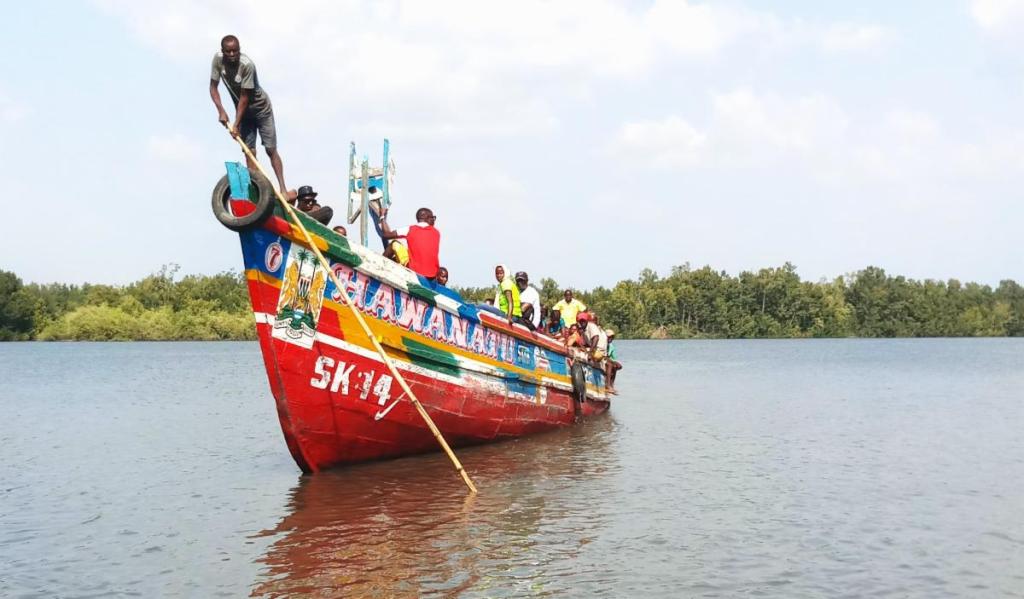
Rotifunk was abuzz with activity for an event this big. To bring people from across the chiefdom, Chief Caulker arranged boats carrying them from villages up and down the Bumpeh River.

Women set up in locations around town cooking to feed all the guests. Massive pots cooked rice and plassas for 40 or 50 people each.

Baffa shelters were built on a school sports field from bamboo cut and lashed together. Big palm branches laid on top shaded us from the hot tropical sun. Hundreds of chairs borrowed from schools were carried over to seat guests.

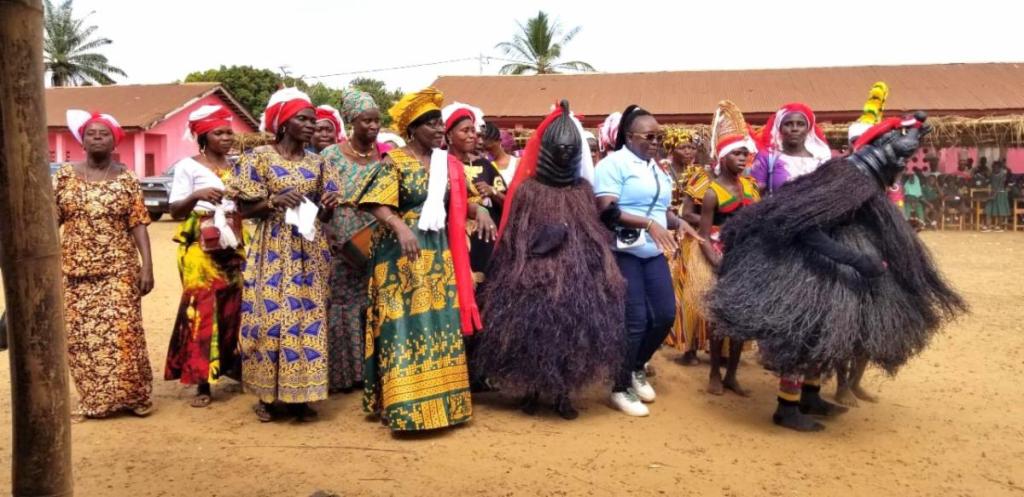
On the big day, the women’s society created a festive atmosphere. Their pulsating drumming and dancing with their Bundu devils, below, energized the crowd. 

Reflecting on our early days
As I sat waiting for the event to start, I was thinking of our early days. CCET-SL and SFSL in 2013 would be unrecognizable today. For four years CCET-SL was a group of volunteer teachers, offering their services after school and on weekends to start new programs.

The living room of Chief Caulker’s small guest house was CCET-SL’s office. I carried the first computers over in a suitcase, and only a couple teachers knew the basics of using them. Memos were written by hand and snapped to send as a photo. Project photos often served as reports. With limited phone service and few smart phones, most business was (and still is) done by Whatsapp calls and texts.

But we got started. SFSL has always followed the principle that we support goals and objectives our partner sets for itself. I still remember Chief Caulker’s words that we will start with “small, beautiful things.” Things we can start quickly that will have an impact on improving the lives of chiefdom people within months, not years.

Chief had already waited for ten years after Sierra Leone’s war for government or NGO funding that never came. With SFSL’s help, he could take charge and act on projects he knew were greatly needed. But SFSL was new. So, we picked things that were simple to start with little funding and achievable in the short term. Concrete results from these fledgling efforts encouraged more donations.

The first two projects SFSL funded in 2013 were $20 school fee scholarships for 120 girls and $600 for a tree nursery to grow fruit tree seedlings to start the Orchards for Education program. $350 to start adult education soon followed when local illiterate women said they want to learn to read and write. 

Today, there’s multiple programs and ten years of results to call out at our celebration.

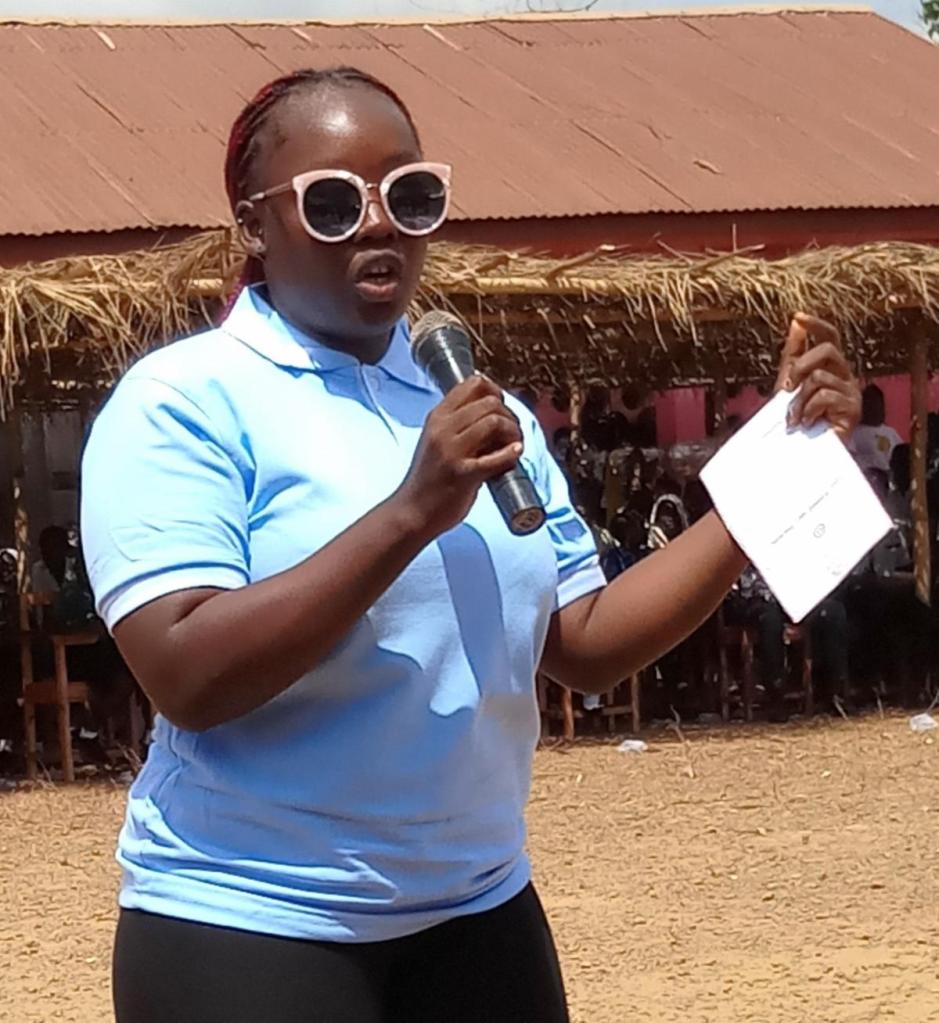
CCET-SL director Rosaline Kaimbay, left, gave an impassioned review of how the organization developed over ten years.

She’s been there from the beginning and deserves the credit for creating innovative education and women’s programs and leading them to where they are today. Thank you, Rosaline!


CCET-SL program graduates who moved on to higher education filled a large part of the main seating area. Their blue T-shirts proudly declare they are CCET-SL alumni. Gathered together in one spot, below, they showed just how far CCET-SL programs have come over ten years.

Program beneficiaries illustrate results
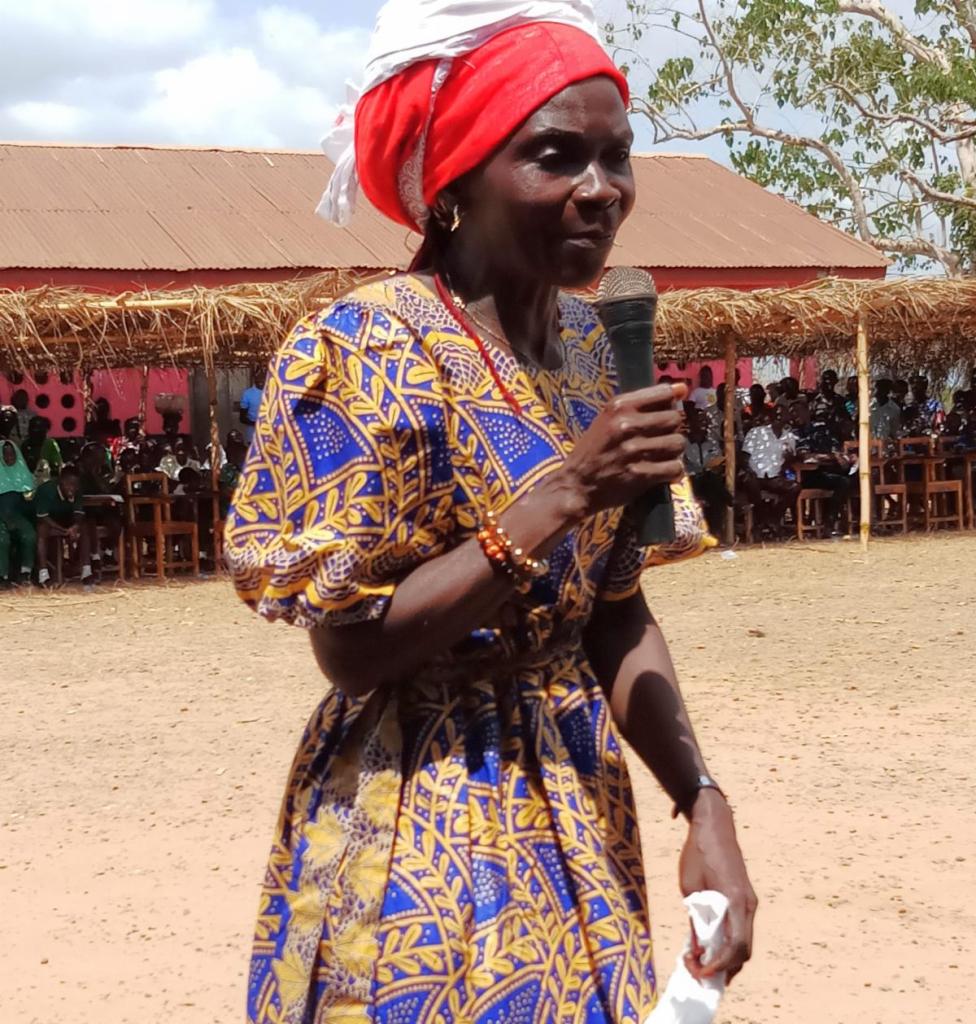
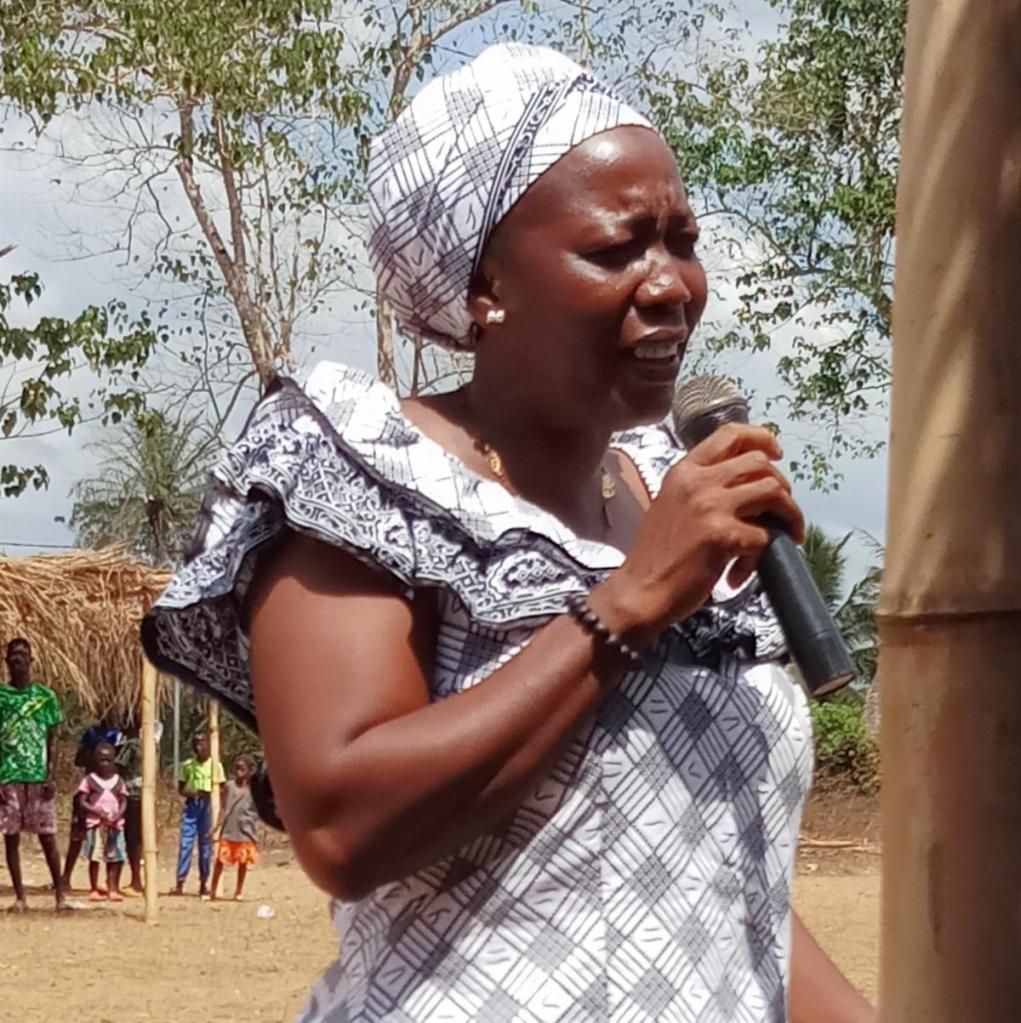
CCET-SL wanted to showcase its results – educating and developing people. Beneficiaries of nine programs talked about the impact CCET-SL had on them and their peers.

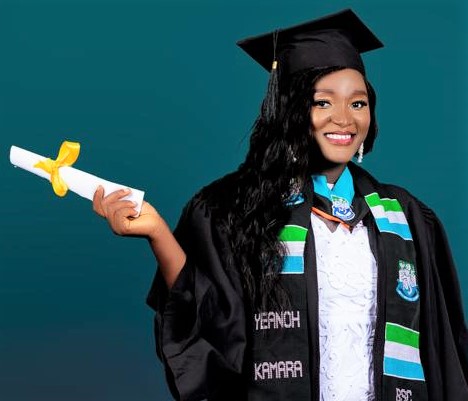
Our first university scholarship graduate, Aminata Kamara, is an alumna of CCET-SL tutorial programs that prepared her for university. An outstanding student, she lost an opportunity to study in China. Now a B.S. degree graduate, she told young students they must seize the opportunities CCET-SL gives them from primary school to university to “learn book”.

She thanked us all for changing her life. We couldn’t be prouder of Aminata. Today, seven students follow her on their education journey with university scholarships.

Salamatu Fofanah, primary school headmistress applauded CCET-SL for coaching primary schools. This is where we build a strong education foundation, she said. Two years ago, Bumpeh Chiefdom primary schools were among the lowest scoring schools in Moyamba district. They’ve rapidly improved to be among the top schools with CCET-SL support. 

Salamatu is one of 13 local teachers completing teaching certificates with CCET-SL scholarships. “We are proud and honored to say we are trained and qualified teachers!”

Anne Marie Kaimbay didn’t get the college entrance exam scores for university admission on her first try. She repeated 12th grade in CCET-SL’s WASCCE preparation class and passed the exam the second time. She’s now a 2nd year civil engineering student at the University of Sierra Leone. 50 more students are in CCET-SL’s WASSCE preparation class.

Anne Marie proudly told the crowd, “Whatever a man can do, a woman can do better.”

Teacher James Kamara’s commitment to leading the 9th grade after-school tutorial program shows in its results.

He described the senior high entrance exam results steadily growing each year to 100% of all students passing in 2022.

“Bravo to CCET-SL,” he declared for offering this program free of charge to students. “Special thanks to our paramount chief for helping Bumpeh Chiefdom make the mark in education.”

Isatu Bendu has a special place in my heart. I met her eight years ago in CCET-SL’s adult education program. Now a primary school teacher, she told her story of being a primary school drop-out from an illiterate farming family. With CCET-SL’s help, she passed the entrance exam for a primary school teacher training program and today teaches class one.

She proudly said she’s gone from being “nobody” to a respected member of the community – a teacher.

Our first women’s program was for Ebola relief. Farming and markets had been shut down for months, slashing incomes.

Hawanatu Sesay explained how the Women’s Vegetable Growing Project helped her and her peers. With project seed for peanuts and vegetables, they harvested within 3 or 4 months, earning cash to feed their families. The project went on to help 400 women get back on their feet over three years.

Graduates of nursing and vocational training programs and primary school students gave their stories of how CCET-SL’s education programs moved them forward.

A Paramount Chief’s vision realized
I don’t think anyone that day was more proud than Paramount Chief Caulker. He realized his dream of educating Bumpeh Chiefdom people that today continues. He beamed as each speaker recounted their personal story of life-changing education made possible by CCET-SL. With education, they’re going on to develop the chiefdom.

Chief spoke of his own goal of bringing the Orchards for Education program to maturity. The orchards will soon begin generating income to fund education programs for years to come.

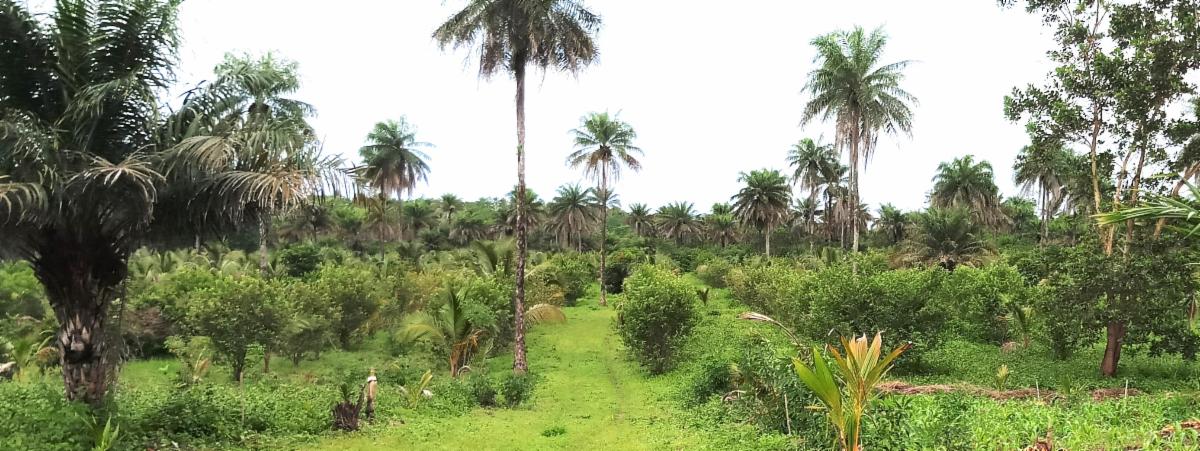
The self-sufficiency vision Chief laid out ten years ago was achieved with 60 acres of fruit orchards well on their way to fruiting stage. The first lime and coconut trees planted now tower over us.

We ended the day relaxing in the orchard we planted from seedlings grown in our own nursery.

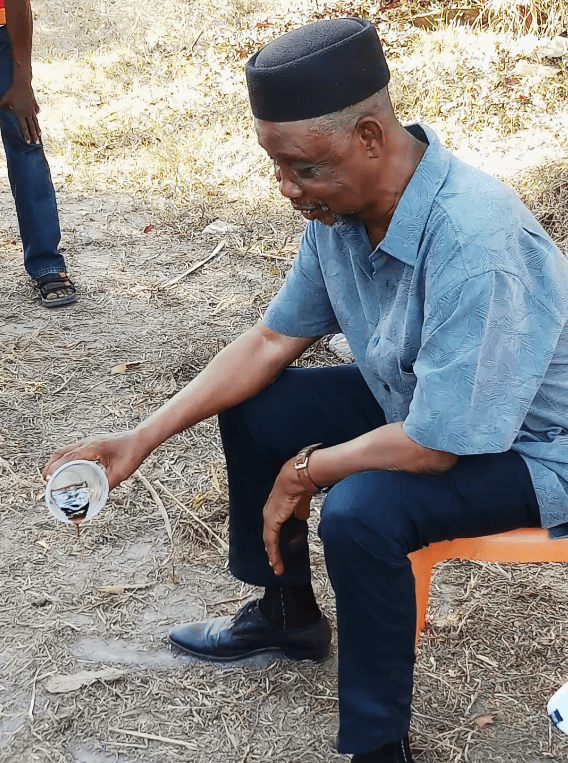
Chief Caulker poured libation, left, to thank the ancestors for looking over the success of our work and asking them to continue to guide us and grant us all long life.


Chief could now lean back now among the orchard trees with friends and relish ten years of work well done. We enjoyed palm wine freshly tapped from orchard palm trees. This is what satisfaction looks like. Mary Avrakotos, Ann Arbor Rotary Club, above left, and Steve Papelian, SFSL Board Director and former Rotifunk Peace Corps Volunteer, right, join Chief Caulker.

You, the supporters of Sherbro Foundation, were called out and thanked many times that day. You weren’t there, but you were in our minds and part of the celebration.

Please stop now to take a virtual bow that you richly deserve. So many of you have continued to support Bumpeh Chiefdom people for years.

On behalf of Chief Caulker, CCET-SL and Bumpeh Chiefdom people, we send you our deepest thanks. We’re grateful that you’ve been part of our ten-year journey. You have truly changed the lives of many people.

Thank you!

— Arlene Golembiewski

Executive Director

Developing Sierra Leone Teachers as Agents for Change

Developing Sierra Leone Teachers as Agents for Change

Bumpeh Chiefdom now has six new college-educated teachers!

Thanks to Sherbro Foundation’s teacher training scholarships, six instructors in Rotifunk schools completed three-year Higher Teachers Certificates.

After passing the government certification exam, they’ll qualify to become government-approved teachers earning regular monthly salaries. And Rotifunk schools are starting to fill their ranks with trained and qualified teachers.

Four of the graduate teachers, above, smile after completing their certification exam. L to R: Salamatu Fofanah, Abul Aziz Bendu, Kadiatu Sesay and Idrissa Smart Kanu.

Long journey to qualified teacher

But that’s just part of it for these dedicated local teachers like Abdul Aziz Bendu, 30. After finishing high school in 2009, Aziz started teaching lower primary school and worked his way up as a Rotifunk secondary school teacher. Many teachers in rural areas have even less education and no training to properly teach the state curriculum.

Without funds for college, it took Aziz 14 years to reach this point where he proudly holds a secondary school teaching certificate. That’s not uncommon. He’s committed to keep teaching in Rotifunk.

“We were born and raised here,” he said. “If we can’t make this a better place, who would?”

Aziz has sacrificed to stay in this rural area. Without certification and government approval, teachers are considered “volunteer.”

Schools must come up with extra funds to pay them, maybe 400 or 500 Leones per month. That’s about $25 with Sierra Leone’s sky-rocketing inflation, and perhaps a third of a certified teacher salary.

And yet, he is supporting a younger brother and sister still in secondary school; they share two rooms with him in a Rotifunk colleague’s home.

Left, Aziz teaches geography and social studies.

Aziz was the seventh of nine children born to one of his father’s four wives. Most of his father’s children have no formal education. His father was a subsistence farmer who grew rice and peanuts in one of the most “deprived sections” of the chiefdom.

His mother died when he was young and he was raised by an older sister. “She didn’t go to school, but she had a passion for education,’’ he said.

He took that passion and ran with it, mastering English and dreaming about advancing his education. He now is one of the first from his home area with a college education.

Dedicated teachers, despite many challenges

With a three-year Sherbro Foundation scholarship, Aziz traveled an hour away for teacher training classes over school holidays. There aren’t textbooks and teacher trainees pay to download assignments at computer cafes.

His school principal pays volunteer teachers stipends with funds gathered from the government and parent donations. “But I can’t even buy a bag of rice for the month with it,” Aziz laments. In his spare time, he grew two acres of peanuts to earn extra money to live on and support his two siblings.

With Sierra Leone’s stunning 30% – 40% inflation rates, food and survival are his focus. Small pleasures are no longer affordable.

The home where Aziz stays is on Rotifunk’s new community solar grid system. But it’s expensive and most homeowners can only afford a few lightbulbs for evening light.

“Some people want to add TVs or freezers,’’ he said. Freezers are more reliable coolers than refrigerators. “But we only use it to charge phones.”

Service frequents shuts off in the rainy season.
He lets his young siblings occasionally play games on his phone for fun. For holidays, he tries to get them clothes. “But now, the focus is on food. I told them they have to use their old shoes for school this year,’’ he said.

The youths have never been to a city because travel is too expensive. Aziz doesn’t visit Freetown either. It costs $8 round trip to catch a minivan ride to the Capitol. The official price of gas just jumped from 20 to 30 Leones per liter – or $6 a gallon in US dollars.

Local teachers work as change agents

Still, Aziz said, “I’m proud to stay in Rotifunk, to be a ‘village boy’. I have a passion for teaching and love for my chiefdom. In the future, I want my name mentioned as one of those who worked hard to develop the chiefdom.”

“We have so many challenges,” he said. “Most schools don’t have the required infrastructure. We need qualified teachers and learning materials. We need computers and IT education.”

But Bumpeh Chiefdom is luckier than most. “We are fortunate to have a paramount chief committed to education,” he said.

It was Paramount Chief Charles Caulker’s vision that created Rotifunk’s nonprofit Center for Community Empowerment and Transformation. CCET-SL leads the innovative programs Sherbro Foundation helps fund, including teacher training scholarships.


“We are making progress. And with support, we can change,’’ Aziz said.

They are changing. Rotifunk schools achieved goals that were just a dream a few years ago. Nearly all students in CCET-SL tutorial programs now pass to the next level, from primary school to junior high to senior high. Many graduates now qualify for higher education. 

Teachers like Aziz are change agents in rural communities. Sustainable progress will continue when local teachers are developed from within the chiefdom. They plan to stay and help children from their families and neighbors go further in education than ever before.

Sherbro Foundation just funded CCET-SL to award thirteen more teachers with scholarships for three-year primary and secondary school teacher certificate courses.

Your support strengthens the leading edge of education and progress in Bumpeh Chiefdom.

We believe stronger teachers make stronger students – and stronger communities. We’re thankful that you do, too. Support more teachers with training scholarships here.

Chris Golembiewski
— Sherbro Foundation VP

Growing the Future of Education in Sierra Leone – Orchards for Education

Growing the Future of Education in Sierra Leone – Orchards for Education


This year marks Sherbro Foundation’s 10th anniversary, bringing back a flood of memories. Few are as vivid or became as important as the Orchards for Education, below 2023.


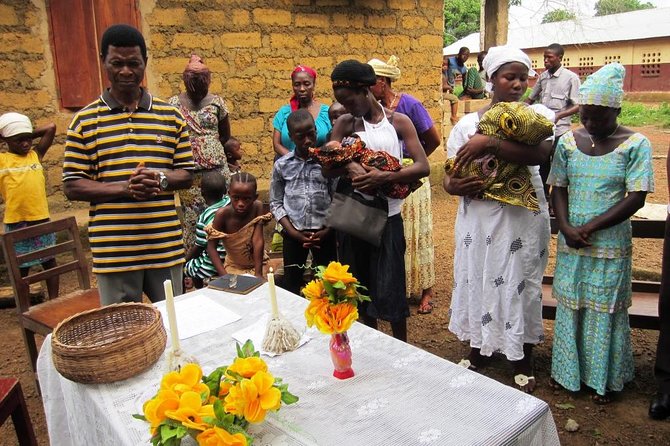
I traveled to Sierra Leone for two years before founding Sherbro Foundation. It was back then that Paramount Chief Charles Caulker told me the story of his baby tree he dearly loved. A coconut tree was planted together with his umbilical cord in his mother’s village at the traditional naming ceremony. After about ten days when it’s clear the newborn will survive, it is presented to the community and their name proclaimed. Baby Charles was named after UK’s Prince Charles, born the year before. Below, a naming ceremony I attended for two newborns in Rotifunk


After weaning, two-year-old baby Charles was sent to live with his maternal grandparents in their village until he started primary school, a traditional practice. His grandfather taught him to water his coconut tree and take care of it. The small child could see his tree growing as he did in his first few years.

It was an early lesson for children in valuing trees and caring for the environment. When he later returned on school holidays, Chief Caulker said the first thing he wanted to see was how his coconut tree had grown and to learn to climb it like the village boys.

I heard this story sitting with Chief under grapefruit trees his father had planted over 40 years before. It was a miserably hot day, when the sweat trickled down your back just sitting still. Chief took me to the grapefruit grove to escape into the shade. Kids climbed the trees and we ate grapefruit they dropped down that were still sweet and delicious.


Chief reminisced about his uncle saying, if you take care of a tree, the tree will take care of you years later. It will provide fruit you can eat and sell for money to live on. Chief Caulker, above, among coconut tree seedlings in today’s tree nursery.

He then lamented that the tradition of planting trees for babies was lost during the war. Today, those trees could be providing money for parents to send their children to school, he said.

It was that hot afternoon under the grapefruit trees in 2013 that we decided we would start partner organizations to send girls to school and grow fruit orchards to later self-fund chiefdom education programs.

Fast-forward to 2023 and Orchards for Education are reality. I had the pleasure in February of sitting under the shade of coconut, lime and guava trees towering over us we planted nearly six years ago. Here’s a look at how the Orchards for Education came to be.

The very first grant newly formed Sherbro Foundation made to its new partner CCET-SL in 2013 was $600 to start a fruit tree nursery. Ebola brought the project to a halt in 2014, but we resumed growing fruit tree seedlings as soon as we could in 2015. All trees in the orchard program have been grown in the nursery from seed of local fruit.


The tree nursery, above, consists of simple pergolas made of bamboo lashed together. Palm fronds are added on top for shade in the dry season. This nursery has grown 30,000 tree seedlings over the years: coconut, orange, lime, grapefruit, guava, avocado, African plum, cashew, soursop and recently, cacao. Some Malaysian oil palm were gifted.
Chief Caulker, left, plants a lime tree seedling in 2017.

Over five years, sixty acres of orchards were developed, fifteen acres at a time. Land is first manually cleared and one to two-year-old tree seedlings are planted in grids of 60 to 100 trees per acre.

Bumpeh Chiefdom is lowland tropical rainforest with a distinct four-month dry season, hot with no rain. Tree seedlings must be hand-watered for 2 -3 years until their roots are established. Then they flourish.


CCET-SL Director, Rosaline Kaimbay and Arlene, above, with a coconut tree one year after planting. In the early days, there was room to intercrop between young trees. Newly germinating corn is seen here.

At three years, trees are well established. Chief Caulker and Arlene, below, admire three-year-old coconut and lime trees reaching their height and more.

In tropical rainforest climate, everything wants to grow. Trees have a huge growth surge in the rainy season – as do the weeds! Workers spend weeks manually cutting back weeds three to four times a year, as well as watering young trees. Cut weeds become a natural mulch and add to soil fertility.

We’re proud the orchards created jobs for 21 full-time workers and one hundred part-time seasonal workers.

Growing fruit trees to maturity takes patience. It’s a labor of love and the reward is worth it. Below, five years after planting, coconut trees are clearly thriving.


Five and a half year-old lime trees, below, tower over Arlene and friend. They’re the first trees to fruit.


In 2023, the first trees reached mature fruiting stage: lime and guava. Pineapples, plantain, bananas and cassava are also being grown as two-year crops. For now, early fruit income is limited and goes into paying orchard operating costs.

It took five years to plant all 60 acres of orchards. Many trees take 7 – 8 years to mature. It will be about thirteen years from first planting to full maturity of all 4500 trees.

The first coconuts planted will take another 2 – 3 years to fruit. But coconuts will be the biggest money-makers and keep fruiting for an estimated 20 years.

I asked Chief Caulker, left, how he felt now that it’s ten years since we embarked on his dream of Orchards for Education. “I’m proud!” he exclaimed.

“We’ve exceeded my early expectations despite the challenges of climate change with more heat and limited water access. Agriculture is a risky business. But we’ve done well and we’re well on our way to our goal of educating our children ourselves.”

We must thank the Rotary Club of Ann Arbor for helping Chief Caulker realize his vision for the orchards. They took the lead in sponsoring two Rotary global grants of two years each to start the orchards. They organized 19 Rotary clubs in the US, Canada and India who contributed to the grants.

Fifteen of the sixty acres of orchards are designated to provide fruit income for indigent health care in Bumpeh Chiefdom. Thanks go to the Wilmington, N.C. Rotary Club, who were partners in the grant and raised funds for this part of the orchards.

Sherbro Foundation donors also contributed to the Rotary orchard grant. With matching from the Rotary International Foundation and district Rotary funds, those donations grew to cover about 25% of the project. Thank you!

I’m now like the young Charles Caulker. Every time I visit Bumpeh Chiefdom, the first thing I want to see are “my trees.” With each year, I’m seeing the orchards growing the future of their children’s education right before my eyes. The dream is reality.

— Arlene Golembiewski
Executive Director

 ‌Visit our website Donate – Thank You!

Contact Us: sherbrofoundation@gmail.com

Giving Opportunity – Honoring a Life

Giving Opportunity – Honoring a Life

Giving Sierra Leone students the opportunity to improve their lives is one of the most rewarding things we do. The higher the student aims, the more exciting it feels to help them reach the next level of their education journey.

We’re announcing four new university scholarships, each in a field of science. With two awarded last year, that’s a total of six scholarships.

Screenshot 2022-01-26 123336 (2)

Five are Saa Chakporna scholarships given in memory of Professor Tucker Childs, an internationally known linguist whose work included study of the Sherbro language.  We’re grateful to the Beaman Family Fund for funding these scholarships in his honor.

Awardees double the impact of the scholarships by returning to Bumpeh Chiefdom for one year of service for every year of scholarship support they receive. Bachelor’s degree grads will fill a big need for senior high math and science teachers. They’ll introduce hundreds of Rotifunk students to STEM careers for years to come.

Education ends at senior high for so many Sierra Leone students can’t afford who can’t afford college; or they drop out when funds run out. Their loss holds back the country’s development.

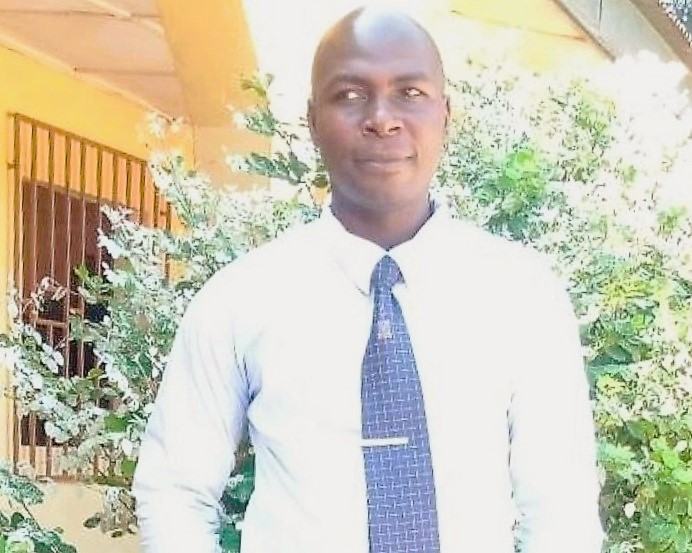
Ibrahim K. Bangua c 2022-12-06Ibrahim Bangura, left, waited a long time for his opportunity to get a bachelor’s degree in science education. Far too long. He qualified for university 18 years ago, soon after Sierra Leone’s rebel war ended. But he lost his father while in primary school, and his mother as a small market trader couldn’t help him.

Ibrahim followed the path of many like him becoming a teacher, one of the few jobs available straight from high school without additional education.


Ibrahim K. Bangua teaching c 2022-12-06“All this while I have been doing community teaching, teaching mathematics and physics,” Ibrahim told me. “So, I have taught pupils at senior high who are now graduates in the fields of medicine, engineering, as well as professional teachers within science.”

Ibrahim was finally able to enroll and complete his first year in science education at Milton Margai Technical University in 2021. This year he was identified him as a student meeting our criteria for a  teacher scholarship .

For the next three years, Ibrahim’s scholarship will cover tuition, living expenses and a laptop computer. He readily committed to teaching in Rotifunk because “teaching is a passion to me.” He’s ready to start by helping to teach during his university breaks.

Without trained science teachers in Rotifunk schools, local students haven’t qualified for admission to bachelor’s degree science programs.

Nationally, only 38% of 2022 high school grads passed the Biology exam with at least a C score for college entrance. Other STEM subjects were even lower: Math – 23%, Chemistry – 2%, Physics – 1%.

We want to change that and open the world of science and technology to Bumpeh Chiefdom students in their hometown.

Our partner CCET-SL contacted Milton Margai Technical University (MMTU) directly to find science teacher candidates to develop science education in Rotifunk. We look for candidates in financial need.

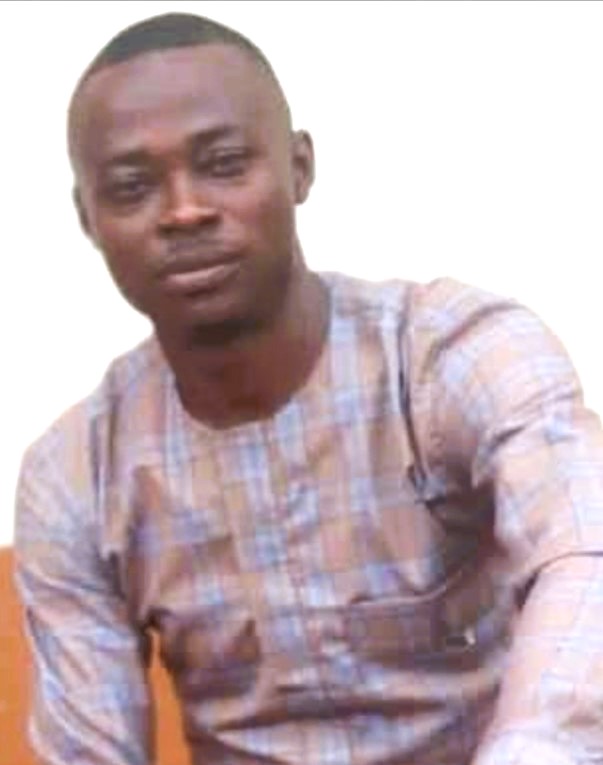
Tamba Gborie bTamba Kemoore Gborie is another MMTU student awarded a scholarship. He attended the Bo Government Secondary School, one of the oldest boys’ high schools in the country, and one of the few offering the full science curriculum. From there, Gborie said, “I started growing my love for science subjects.”

“This journey hasn’t been an easy ride for me reaching this point in my studies, “he told me. That’s why he’s so grateful to Sherbro Foundation and CCET-SL for giving him this scholarship opportunity.

After completing his Rotifunk teaching commitment, Gborie’s goal is to continue his studies to become a Medical Doctor.

Aminata Kanu b 2022-12-12A young woman from Rotifunk started medical school this fall with our third Saa Chakporna scholarship. Aminata Kanu completed two years of premedical science courses at the University of Sierra Leone and was admitted as a full medical student.

Aminata was raised in Rotifunk by her mother, a single parent and local primary school teacher. After primary school and junior high, she transferred to Annie Walsh Memorial Secondary School, a Freetown girls school offering senior high science.

“Coming from a small town, “Aminata said, “I’ve seen people die and suffer because of poor medical facilities in the community. It has been a passion and dream to become a medical doctor as a way of helping my people and community.”

The Methodist-run Hatfield – Archer Memorial Hospital in Rotifunk has come a long way in the six years since Aminata left for her studies. She can get practical experience there in her chosen field of obstetrics and gynecology. The hospital now does cesarean sections and other basic surgeries for the local population.

Gibril. bAnother Rotifunk resident is pursuing primary care medicine as a community health officer. Gibril Bendu will be at the front line of health care when he completes his degree funded by the Sherbro Foundation board.

Community Health Officers (CHO’s) provide primary health care in health clinics mainly in rural areas. For many, this will be the first and perhaps only health care they receive. CHO’s also offer public health programs on preventive care for the community.

I first met Gibril in 2013 as a Rotifunk secondary school science teacher. He comes from a tiny subsistence farming village. He started teaching right out of high school twelve years ago to earn money and help support siblings behind him.

When I observed Gibril’s biology class years ago, I saw he had ability beyond a rural junior high teacher. SFSL helped him get a teaching certificate to improve his teaching skills and get credentials needed to earn more. We then supported him to repeat his old college entrance exam, enabling him to be admitted for the Community Health program.

After his CHO degree, Gibril can also do an internship at the Rotifunk hospital, and hopefully be appointed to an area public health clinic.

We now have a total of six students on university scholarships – all in science and technology!

Our first two Saa Chakporna scholarship students awarded last year are in the third year of bachelor’s degrees.

Tommy Sankoh family farm b Sept '22We anxiously await Tommy Sankoh finishing his degree in agricultural economics at Njala University. With his return to Rotifunk,  he’ll advise CCET-SL on its agriculture program and teach high school students and local farmers improved growing techniques and developing farming as a business.

Alimamy Kamara is completing a bachelor’s in mechanical engineering. He’ll teach math and science in return for his scholarship support.

We are so proud of these students.

Huge thanks go to the Beaman Family Fund for funding five of them to meet goals they’ve worked so hard to prepare for.

We end this year with a sense of deep gratitude to all of you for making this a year of accomplishment. Our partner CCET-SL’s programs did better than ever. You make these things happen and we can’t thank you enough.

We wish you and yours health and much happiness now and in the new year.

–Arlene Golembiewski

How to Change a Child’s Life. For $25!

How to Change a Child’s Life. For $25!

It’s 1 pm and James Kargbo turns back from the blackboard of his fifth-grade class at Evangelical Primary School to find Mr. Barnard in the doorway of his classroom. He wasn’t expecting Mr. Barnard just then, but welcomes him into the class. Mr. Barnard is a familiar face, showing up unannounced once every one or two weeks to observe his class and coach him on his teaching. 

Mr. Barnard, below, occasionally takes over the class to give a demonstration lesson on more difficult topics. You know it’s an experienced teacher when normally bored preteens sit in rapt attention on a subject like fractions.

We are kicking off our annual Education Fundraising Campaign showcasing the new primary school tutorial program our Bumpeh Chiefdom partner CCET-SL launched last September. Nearly 400 students in classes five and six in seven Rotifunk area schools and their teachers participate. 

With your help, we’ve done a lot to raise the quality of education in Rotifunk schools in the last several years. We’re particularly excited now by the potential of the primary school program and the impact we can all have on children’s lives there.

It became clear, to get HERE  ……………… We need to start HERE!

Operating for five years, CCET-SL’s after-school tutorial program for ninth graders now has 95% of students passing their senior high entrance exam. But passing doesn’t mean results are strong. Many are in fact rather marginal. 

To set kids up for success in senior high and give them a good shot at higher education, we need to work with them at the primary school level. 

Fourteen teachers and nearly 400 primary students were put in the capable hands of Oliver Barnard, a retired primary school teacher and headmaster of 30 years’ experience. At 65, this man has energy to spare. “I actually enjoy teaching,” he said. Of retirement age, but not ready for it, he lamented,” I thought I was nowhere. Now I’m back in the system.” His frown turned into a wide grin. Teaching children he says, gives meaning and purpose in his life. 

And Rotifunk’s primary school teachers need him. Only 4 of the 14 teachers he works with have the basic three-year Teacher’s Certificate, qualifying them to teach primary school. 

The other ten only graduated from high school and were put in front of a classroom, like Mohamed Kamara. A teacher for three years, he would like to go to college, but like most, doesn’t have the means to pay for it. Abdul Kanu, at Supreme Islamic Council School, below, is another dedicated teacher who appreciates Mr. Barnard’s guidance.

IMG-20211115-WA0006 (2) Sometimes a principal just hands new teachers a book and sends them to a class to teach. The principal often teaches full time themselves and has little time to monitor or coach a young teacher. 

To make matter worse, without a teaching certificate, the government does not pay unqualified teachers. School principals scrape together donations to pay them from parents who have no money to spare. Maybe half the parents will offer something, often as little as 5000 leones – or 50 cents. From this, unqualified teachers get a token monthly payment of $15 – $25 a month. 

With classrooms like James Kargbo’s at the Evangelical Primary School, below, you know schools don’t have extra money to pay teachers. Nonetheless, teachers are teaching, and kids are learning.

IMG-20211103-WA0016 (2)
Village children are walking 3, 4 and even 5 miles each way to go to primary school like these in Rotifunk. Their village schools often barely function, with one or two teachers for six grades who may have only completed primary school themselves. These are among the children in greatest need of education that we can influence in a positive direction.
 
Most class five and six teachers in Rotifunk are young men because they have at least finished high school. It’s one of the few paid jobs in town, but the pay is hardly enough, especially with a family. Teachers like James and Mohamed leave school to go home and work in gardens growing fruit and vegetables to supplement their tiny family incomes. Their wives may be the primary breadwinners of the family as market women, selling produce in the market.
 
This leads to morale problems and malaise among many unqualified teachers. Without having learned teaching methodologies, they struggle. When one teacher must teach all seven subjects for one grade, they skip over the topics they’re not familiar with. Students end the school year without learning the full curriculum.
 
English language, written composition and math are the weakest subjects in primary school. These remain weak all the way through to the 12th grade national graduating exam. Students never catch up.
 
Mr. Barnard is shaking the trees to change this. In a good way.
 
The teachers know he’s there to help them and look at him as the coach and mentor they never had. Week by week, after observing their class, he gives feedback on improving their teaching. He helps them prepare lesson plans on topics they are weak in. His demonstration classes give teachers confidence to cover topics they didn’t know how to teach and practical tips on handling a class.
 
The kids enjoy him. The class gets a shot of energy when Mr. Barnard confidently takes over a lesson. And they learn.
Sometimes Mr. Barnard puts the chalk down and just talks to the kids about the importance of education in their lives. He points out successful people they know who only got ahead because of their education.
IMG-20211116-WA0009 (2) Too often these young impressionable students see the opposite – young people who dropped out of school and with the little money they earned bought cheap cell phones and flashy clothes.
 
Young women tell the girls, you’re wasting your time in school; I have my own baby.
 
What they don’t realize is, chances are, the women will be abandoned to raise that baby themselves. Young female and male drop-out’s never get ahead and live impoverished lives. Sound familiar?
 
But many times, it’s a role-model teens strongly admire that sparks their imagination and starts a change in their lives. If she or he came from the same place as me and achieved what they did, so can I. Rosaline Kaimbay, CCET-SL’s locally born and college educated managing director has been a role model that sparked this change in many students.
 
We all recall teachers who had a big impact on our lives. Sherbro Foundation is working with CCET-SL to develop more teachers who will play that role for these kids.
Last week 200 class six students lined up to take their National Primary School Exam in Rotifunk, most from CCET-SL’s program. The exam sets the course for their education journey. Either they continue to secondary school, or faced with repeating class 6, many drop out.
 
With nine months preparation and practice exams, Roman Catholic primary school headmistress Salamatu Fofanah could see the difference in the students from CCET-SL’s program this year. She said, “Today our children feel relieved and happy to take the exam in a cool atmosphere. They have the confidence to take their exams with no fear. We appreciate the great support of CCET-SL and Sherbro Foundation.”
 
She knows James Kargbo and his fellow teachers have worked for months to prepare their students for this week with Mr. Barnard’s ever-present coaching. The results will no doubt be better than last year. The teachers are energized to keep improving and pledge to soon achieve the highest results in the district.
 
Sherbro Foundation is excited to kick off our annual Education Fundraising Campaign with this practical program. It’s developing teachers on-the-job, while covering the full primary school curriculum and giving students a better education. It uses existing resources to do this.

 
As the advertisement used to say – the cost per student for the whole school year for all of this? Only $25. Changing a child’s life? Priceless!
 
I can’t think of many things we can do with higher impact on the lives of more people. 
When 400 young students get a strong education foundation and keep progressing in school, the impact will be felt for years to come. Whole families benefit when students turned adults keep succeeding.
 
You can help change a child’s life for $25. Sponsor four for $100. Or why not sponsor a whole class of 20 for $500? It’s a guaranteed feel-good investment you’ll be glad you made. Give HERE.
 
As always, we deeply appreciate your support. Thank you!
 
— Arlene Golembiewski,
Executive Director
How People Give – Let Us Count the Ways

How People Give – Let Us Count the Ways

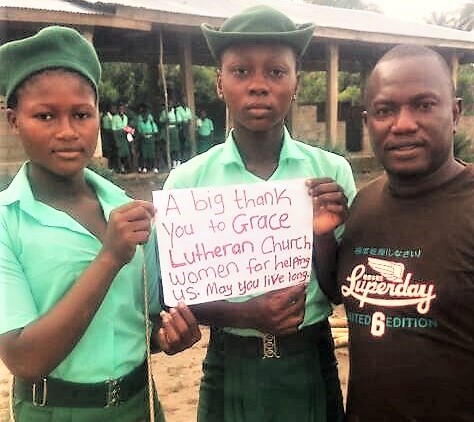
I broke into a smile even before I opened the envelop in last week’s mail from Grace Lutheran Church. It was another annual check from a small-town church in Maine; this one for $421. They’ve donated the proceeds of their church’s winter crafts fair four years running.

IMG-20171204-WA0015 (4)Sherbro Foundation knows no one in Auburn, Maine. But someone there had hosted an exchange student from Sierra Leone. During the 2014 Ebola epidemic, they wanted to help at the grassroots level where they felt their money would be put to good use directly helping a rural Sierra Leone community. They found us on a Google search and have been giving ever since.
Americans are giving and generous. They see a compelling need and just give. I’ve never spoken with Grace Lutheran Church. There’s only been a couple short emails exchanged when I contacted them to understand who was being so generous in their help. Year by year, I inform them how their money has been used, and they keep giving.

After six years of operation, there’s been many different ways people give to Sherbro Foundation in support of our mission to empower rural Sierra Leone through community-led education and agricultural development.

Let us count the ways people give. Church and Faith-based Outreach like Grace Lutheran is only one way.

On-line giving The most common way people donate is on-line through our website. Two-thirds of our donors prefer this convenience using their credit card. The other one-third send checks. We greatly appreciate either mode.

Tax-deferred accounts – More people are using the benefits of donating from tax-deferred accounts. They’re charitable and tax-savvy at the same time. We receive a number of checks from donor-advised funds, holding assets our supporters have already donated for charitable purposes. Fidelity Charitable funds are commonly used. Charles Schwab has others. We’ve also received donation checks as direct IRA distributions. When a check is sent from an IRA account directly to a 501c3 charity, the donation can qualify as part of a minimum IRA distribution and be subtracted in full from that year’s taxable income.

Facebook fundraisers – A fun and easy way to involve others in learning about Sherbro Foundation is a Facebook fundraiser. In lieu of gifts for your birthday or other occasion, ask them to send girls to school instead. Designate Sherbro Foundation as the target charity on your FB page and invite friends to donate with a modest fundraising goal.

In-honor-of gifts – We’ve received a number of memorials in honor of a loved one. It can be comforting to celebrate a loved one’s life with the life-affirming gift of sending girls to school or planting trees that will fund education in Sierra Leone for a generation to come.

People have used many occasions to honor someone by supporting Sherbro Foundation programs: birthdays, Mother’s Day, anniversaries, holiday gift giving. They’re gifts that make a real difference in the world – and with benefits that keep on giving long after the occasion is past.

Estate gifts – We’ve been honored to receive gifts from a loved one’s estate. People have said their mother or other loved one would like the idea of their money going to help girls get educations that launch them on real careers and new lives.

Peer-to-peer fundraising – I need to call out my friend Ginny who has been masterful in encouraging friends to support one of our fundraising campaigns with her email blasts and messages of endorsement. Email, face-to-face contacts or however you do it, word-of-mouth with personal messages of support is one of the best ways for Sherbro Foundation programs to grow.

Retailer giving programs – Amazon, Kroger and other retailers encourage customers to designate a charity to receive a distribution from their charitable funds, based on the customer’s sales. Sign up on their website and name Sherbro Foundation, and we keep getting quarterly checks. Our charitable ID # is 46-2300190.  Amazon Smile   Kroger Community Rewards

Community Foundation grant – In the same vein, we received a grant from a community foundation fund after our programs were recommended to them by a community member.

Civic and Service Organization grants – Many civic groups like Rotary Clubs and Lions Clubs make supporting international development projects part of their mission. Our relationship with Rotary Clubs grew from an unplanned introduction to one Rotarian who made the connection with her club. If you are a club member or know one, contact us to talk about whether Sherbro Foundation programs may be a good match for the club’s support.

Returned Peace Corps Volunteer organization gifts – many cities have Returned Peace Corps Volunteer organizations that like to stay connected with grassroots community projects in countries the Peace Corps serves. Sherbro Foundation stays faithful to Peace Corps’ direction of supporting community-led development. The Cincinnati Area Returned Volunteers (CARV) has been generous in their support, as well as individual former volunteers. Help us get connected with your local Peace Corps group or its members with an introduction.

Corporate donations – One of our early “home-runs” was the gift of refurbished computers by a corporation with local Cincinnati area offices. Many businesses also have charitable funds that employees can tap by applying for grants for charitable projects they support. The employee typically needs to make the submission. Your company may have a charitable grant program.

Does this give you more ideas on how you can help? Please let us know of other ideas you have – or how we can help you act on any of these. Contact us at sherbrofoundation@gmail.com

Sherbro Foundation is deeply grateful for all the ways people have chosen to give in support of the children and women of Bumpeh Chiefdom, Sierra Leone. Thank you!

Sherbro Foundation Executive Director receives National Peace Corps Association’s 2018 Shriver Humanitarian award

Sherbro Foundation Executive Director receives National Peace Corps Association’s 2018 Shriver Humanitarian award

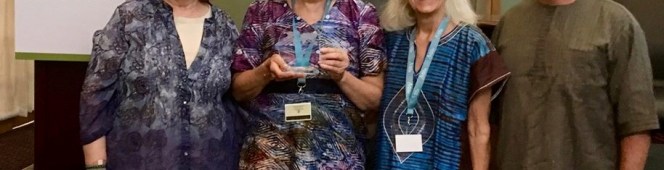
We’re proud to announce Sherbro Foundation Executive Director Arlene Golembiewski received the National Peace Corps Association’s 2018 Sargent Shriver Humanitarian award for her work in Sierra Leone.  The Shriver award is NPCA’s highest award for a returned Peace Crops volunteer and recognizes their continued public service.40137733_1958865257469111_4284494628134060032_n (2)Arlene received the Shriver award at the NPCA annual conference. L to R with Sherbro Foundation Board members: Chris Golembiewski, Arlene, Cheryl Farmer, Steve Papelian.

Arlene said of her award: “My early Peace Corps experience remains the foundation for everything I’ve done. This award really goes to Sherbro Foundation’s community partner, the Center for Community Empowerment & Transformation, whose creative ideas and leadership have achieved so much. CCET hopes to encourage others on community-led rural development and share their examples. It’s been my privilege to work with them.”

IMG_2320 (2)


Arlene and Bumpeh Chiefdom’s Paramount Chief Charles Caulker, visiting with Emma, a participant in the Women’s Vegetable Growing project that helps women farmers move from subsistence to self-reliance.


For more on the award and Arlene’s work in Sierra Leone:  https://www.peacecorpsconnect.org/articles/announcing-the-2018-shriver-award-winner-arlene-golembiewski

Never Too Late to Return to School

Never Too Late to Return to School

Junneth is one of the most enthusiastic 10th graders you’ll meet. She confidently said she’ll pass to Sierra Leone’s 11th grade, and she just did.

Junneth is also a 27 year-old mother of three. She’s back in school again in Rotifunk’s Bumpeh Academy with a scholarship and uniform after a five-year absence.

Junneth had passed the senior high entrance exam years ago, but her single mother just couldn’t afford her school fees, and she had to drop out. She doesn’t know her father. Along the way, Junneth married, bore four children, and lost one.

Sherbro Foundation’s Girls Scholarship program makes it a priority to keep young women like Junneth from dropping out of school. We offer scholarships to advance them to senior high and on to graduation. At $25, it’s an incredible bargain.

20180706_155347 (2)

People tell me Junneth is one of the hardest working people they know. She gardens all around the house she lives in. Her landlady, above left, gave her a room rent-free because she works so hard to support herself and her children.

20180706_151933 (3)Junneth grows sweet potatoes, (left), corn, yams and eggplant to eat and to sell in the market for money to live on. You’ll see her in a nearby river after school catching fish to eat.

Her husband is an “unqualified” teacher in another town. He’s not credentialed to be paid by the government, so his income is meager. He has little to offer his family.

As time went on, Junneth became more and more motivated to return to school. “I don’t want to sit down and be a woman who be in the kitchen,” she told me. “If I don’t have education in my head, he [my husband] will leave me and go to another who has learned. So that give me the cause to return to school.”

20180706_152359_Moment(28)She explained, an educated woman can work and improve the community. People respect her. Men respect her. When a woman can earn a living and help the family, it helps her marriage. She said, “If I learn, I also [will] have something. He will give; I will also give.” A two-career couple is needed in Sierra Leone to move away from subsistence farming to a more middle class life, just as much as it’s needed in the US.

It also frustrated Junneth to watch many of her friends who completed high school do well with paying jobs. “Some of my sisters go to college. Some of them are teachers. Some are nurses right now… When I see them, I feel offended. I say, why? Some of them, I beat them [on the past senior high entrance exam].”

Junneth also knew that her children would fare better with an educated mother’s help. “When I learn, my children also learn.”

Last September, Junneth went to Rosaline Kaimbay, managing director of the Center for Community Empowerment and Transformation, which administers Sherbro Foundation’s Girls’ Scholarship program. “I cry to her, please help me. And she did. I really appreciate it.”

20180706_152359_Moment(30)Mrs. Kaimbay arranged a scholarship, asked Bumpeh Academy to enroll Junneth in school and gave her a uniform. She became a proud 10th grade student, in her first year of senior high, picking up where she left off years before.

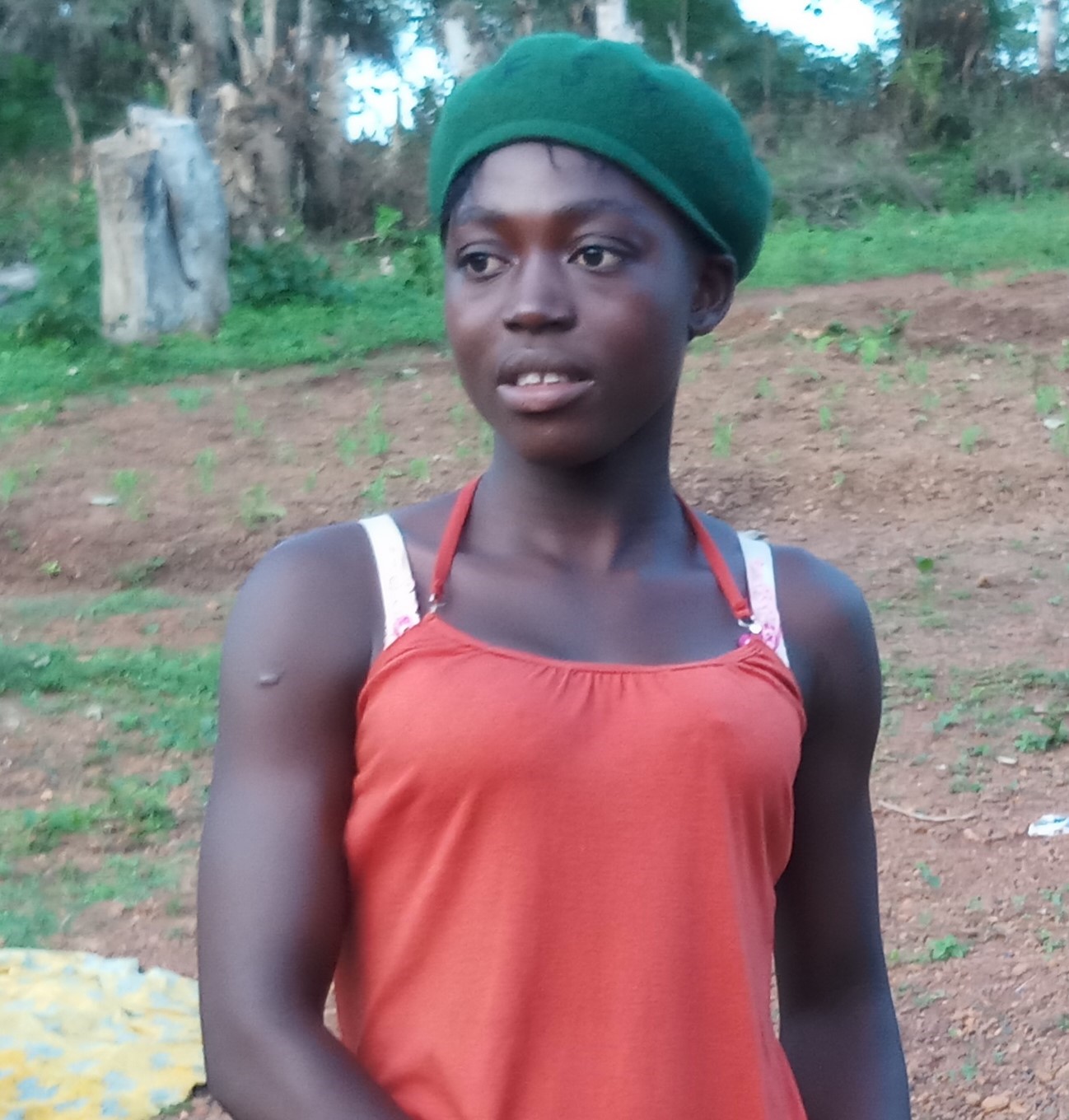
 “She’s doing very well,” Mrs. Kaimbay said proudly.

Her principal just confirmed that Junneth passed her first year despite her long absence, and is moving on to 11th grade. She’s become a role model for other girls in school – and for her children.

Junneth knows where she’s going.

“I want to do nursing. That is my plan.” 

My grandmother was a nurse and taught me many things. She called me, even during the night, when delivering a baby. I want to be higher than [my companions who are nurses] if I put my focus there.”  With a small hospital in Rotifunk and government health centers in villages around the area, there should be a job for Junneth when she’s ready.

Junneth’s story of determination to get an education despite the odds and life’s cruel detours is not unique. Many Sierra Leone senior high “girls” are really young women, 21 and 22 years of age or more by the time they graduate. Their educations were interrupted – maybe more than once – because their families couldn’t continue to pay. Often one or both parents died, became ill, left the home, or aged and stopped working.

Early marriage and children are the fate of too many young women forced to drop out like Junneth. Sherbro Foundation’s goal is to keep them in school, learning and preparing for careers where they can support their families and help develop their communities.

I’d say that’s a tremendous investment from a $25 scholarship. Paramount Chief Charles Caulker sends his thanks for everyone’s support in sending Bumpeh Chiefdom girls to school. Parents, he says, are taking advantage of the opportunity the Scholarship Program offers to educate their children.

“More girls here are learning and at a higher level than ever before.”

You can return Junneth to school in September and young women like her. Please help here: I’ll send a young woman to school. 

We’ll double your impact. Our matching funds are being claimed. But the Sherbro Foundation Board will match the next $4000 donated.

 Thank you!

— Arlene Golembiewski, Executive Director 

Can $25 Be Life Changing? Send a Sierra Leone Girl to School.

Can $25 Be Life Changing? Send a Sierra Leone Girl to School.

Every girl in Sherbro Foundation’s Girls’ Scholarship Program — now more than 600 — has a story to tell. But even in this program for the neediest, Fatmata’s story is heart-wrenching.

We’re kicking off the 2018-19 Girls Scholarship drive, our sixth, with the story of one our first scholarship recipients and how $25 scholarships have changed her life.

Fatmata has received SFSL scholarships for four years, allowing her to finish the 9th grade at Bumpeh Academy. Soft spoken, Fatmata (white headscarf below) enthusiastically attends our partner CCET’s after-school tutoring program, prepping 9th graders for their national junior high completion exams. She breaks into smiles as she joins her classmates, all eager to prepare for senior high. Advancing girls to senior high is one our main objectives.

20180713_171554 (3)

Sherbro Foundation’s scholarship program gives priority to girls who are orphans or with single parents and from low-income families, even by local standards. Many from villages must leave their families to board in town to attend secondary school — another costly expense. Too many drop out after junior high without funds to continue.

20180712_184638 (3)Fatmata’s not sure how old she is. We estimate she’s 17. Her family was typical of many in Bumpeh Chiefdom. Her mother was the first of her father’s three wives. As the senior wife, she took the youngest wife’s child to raise with her own, a tradition. The child went missing and was found dead with no explanation.

Fatmata’s mother was held responsible and put in prison. Pregnant at the time, she delivered in prison and was released when the baby was a year-and-a-half. Fatmata had completed primary school, but her angry father gave no support for her mother or her children. Fatmata couldn’t start secondary school.

The Ebola epidemic hit when her father was home in adjoining Ribbi chiefdom. He was quarantined in a village with the virus, contracted Ebola and died. Fatmata’s mother now widowed with five children became involved with another man. While pregnant again, she had an uncontrolled infection. She and the baby died.

Fatmata’s father’s family wanted her to live with them in Ribbi Chiefdom. She resisted, “I was afraid in Ribbi I wouldn’t be able to go to school.” Another stepmother had enrolled her in junior high in Rotifunk where she received a SFSL scholarship and a uniform. Ribbi has no scholarship program.

20180712_184459 (2)“She made a good choice to stay here,” said our local partner CCET’s Managing Director Rosaline Kaimbay. “She’s determined to learn. We need to motivate her. I love the girl. So bold. I will follow her progress.”

Fatmata (green beret, left with Mrs. Kaimbay) and her two younger sisters (also left) live with their maternal uncle and grandmother in Rotifunk. I counted at least ten in their small house. Her uncle is very supportive of his three nieces. I never met her hard-working grandmother, always out in her small peanut farm.

20180715_171915 (2)During that tumultuous time, Fatmata had to repeat her first year of junior high. She’s continued to advance to the 9th grade with four SFSL scholarships.
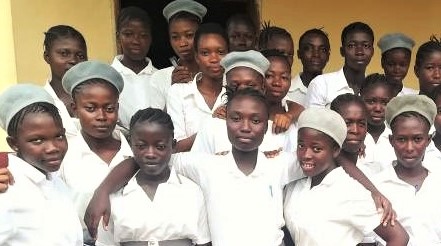
Fatmata, left, at her home’s outdoor kitchen where they cook on a wood fire sheltered from sun and rain.

In two weeks, she’ll take her national 9th grade exams and has a very good chance of moving on to senior high. She’ll be part of a small elite group of rural girls working for high school diplomas.

Fatmata is the kind of success story we work hard to support with our scholarship program.

IMG-20180606-WA0004 (3)Many other bright girls are eager to keep learning, often after interruptions in their educations. 
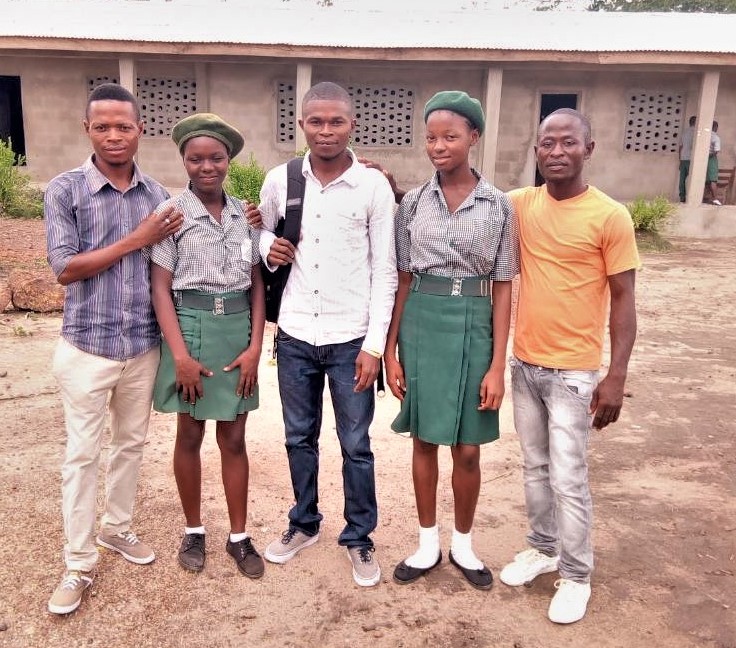
Girls like Fatmata are the future of the country. A number of men and women alike have told me they support girls going to school: “When you educate a girl, you educate the country.  A boy just looks after himself.”

After telling me her story, Fatmata asked, “After school, who will take care of me?” We’ve helped her this far, but then what? She has no role models to follow.

I paused for a moment, and then told her, “You’ll finish school, go to college and get a good job. You’ll be able to take care of yourself and help your family, just as Mrs. Kaimbay and I have done ourselves.” 

Your $25 scholarship will keep Fatmata and girls like her in school and out of early marriage and teenage pregnancy. It will give them the chance to gain independence after graduating by getting a wage-paying job or entering vocational school or college. Teaching, nursing and the police force are traditional jobs. But we want to encourage girls to go into growing fields with jobs like accountants, IT support, lab technicians, floor tilers and electricians. 

We’re also proud to have started our first college scholarship program in 2017-18 for girls meeting college entrance requirements.

In just five years, you’ve made the Girls’ Scholarship Program a great success with over 600 girls getting the help they need to attend secondary school — and keep advancing. What’s happened to last year’s cover story girls?

IMG-20180529-WA0001 (3)Isatu, an orphan in senior high, just completed 12th grade. She’s awaiting the next national senior high completion exam. She could be a candidate for our new college scholarship program.

Alima, (2nd from left) a motherless girl, walked five miles each way to school from her aunt’s house. Now in the 9th grade and living with a Rotifunk relative, she gets CCET tutoring for her junior high completion exam and is in the computer training class, too. One of her school’s brightest, she was one of two students to represent the school in a local interschool quiz competition.

Our goal for this year is to at least match last year’s results and again award 460 scholarships to deserving girls. We continue to emphasize advancement into senior high. Your support has doubled the number of girls in senior high over the last four years!

We have great news from the newly elected Sierra Leone government. They will be paying school fees for all secondary students as part of their program to improve education.  

Sherbro Foundation’s $25 scholarship award this year will consist of a uniform and notebooks for each awardee. These supplies actually cost more than school fees and are a formidable barrier for most Bumpeh Chiefdom students. Uniforms hand sewn by local Rotifunk tailors help keep costs down.

We hope you’ll help send Sierra Leone girls back to school in September. Yes, $25 can be life changing for so many girls like Fatmata.  Please donate here: I’ll send a girl to school. 

We’ll double your impact. The first $5000 in gifts will be matched!

Thank you! 

— Arlene Golembiewski, Executive Director


Five Years of Sending Girls to School   – By the Numbers

Five Years of Sending Girls to School – By the Numbers

We’ll soon kick off the campaign for our sixth year of the Girls Scholarship Program for Bumpeh Chiefdom. We thought you’d like to see what’s been accomplished in the first five years —  by the numbers.

Sherbro Foundation was founded in March 2013. We immediately funded scholarships for 67 junior-high girls in the 2012-13 school year already in progress. The numbers have been steadily increasing:

1250             Total number scholarships awarded

Over 600     Number of girls receiving scholarships, some for more than one year

  4                  Number schools participating — 2 Jr/Sr Highs and 2 Jr High only      

6X                 Increase in scholarships given annually — from 67 in 2013 to 410 in 2017

2X                 Increase in scholarship value in 2017 by adding uniforms for 2/3 of girls         

2X                 Increase in number of girls attending Senior High — from 58 to 120 in 2017

100               Percent of girls wanting to attend Sr. High in 2017 who received scholarships

 18                Number of 12th-grade awardees taking National exam (1st in 2016)

  3                 Number 12th-grade awardees meeting college entry requirements

  1                 College scholarship added in 2017

Here’s our five-year trend in scholarships:


5 yr scholarship data2 (2)

Only one in three Bumpeh Chiefdom teens have been able to attend secondary school. We started by ensuring more girls made the transition from primary school to junior high.

We focus on the most disadvantaged girls at risk of dropping out of school — orphans or with single parents, low-income families, and students who must leave home villages to attend secondary school in town. Often, a girl meets all the criteria.

The drop-out rate from junior to senior high is typically 50%. Our goal is to advance more girls to senior high and help them graduate. So, we expanded senior-high scholarships, while continuing to increase junior-high enrollment.

The short-term dip in 2015-16 came after the seven-month Ebola crisis, when many students from villages, especially senior high girls, returned to school late or not at all.

With your strong support, we doubled scholarships and the value of the awards (scholarship plus uniform) in each of the last two years.

In 2016, the first three scholarship recipients graduated from senior high.

And in 2017, we reached the ultimate goal by awarding the first college scholarship to one of first girls to meet college entrance requirements.

Now in January 2018, we added extra tutoring classes to help ensure 9th and 12th graders pass their junior and senior high national completion exams and advance to their next level of education. We’ll continue this program for the 2018-19 academic year.

Step by step, we’re reaching the goal we set of girls completing secondary school. And now we’re reaching beyond, to help girls advance to college and become leaders in their community and their country.