Growing Fruit Orchards for Peanuts

How do you start an orchard program for Sierra Leone village development income when all you have is your own land and water? You grow thousands of your own trees — all from the saved seeds of fruit you first eat.
IMG-20150523-WA0000 - Copy.jpg

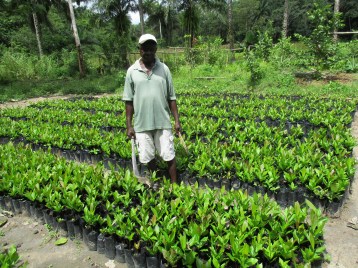
The Center for Community Empowerment & Transformation, CCET, our Bumpeh Chiefdom partner, has grown more than 40,000 fruit tree seedlings from seed in nurseries. We could say they’re raising them for peanuts.

IMG_0144 - Copy.JPGSeedlings are tended and watered for one to two years, then given to villages to plant community orchards and to parents of newborns to raise for income for their child’s education.

Six villages have planted their own orchards with thousands of fruit tree seedlings grown by CCET.

The Mike Diliberti Memorial Orchard is the latest addition, dedicated to funding children’s education in Bumpeh Chiefdom.

CCET is part of the community and works directly with traditional chiefdom leaders to introduce programs like the orchards. They estimate a typical outside aid organization with its overhead would spend at least 5x-6x as much to introduce a similar project, with far less results.
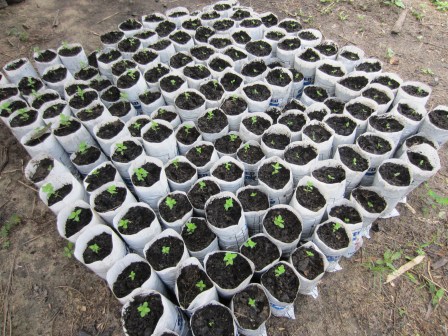
img_2646Here’s how an orchard gets started:

CCET selects fruit that grow well in the area and collects seed. Here they grow oranges, grapefruit, mango, guava, avocado, cashew, African plum and coconut.

They buy fruit inexpensively in local markets and save the seed to start seedlings, after the fruit is eaten.

Seeds are started in growing bags filled with rich, silty soil from a swamp next to the nursery.  Seeds like the oranges above germinate quickly.
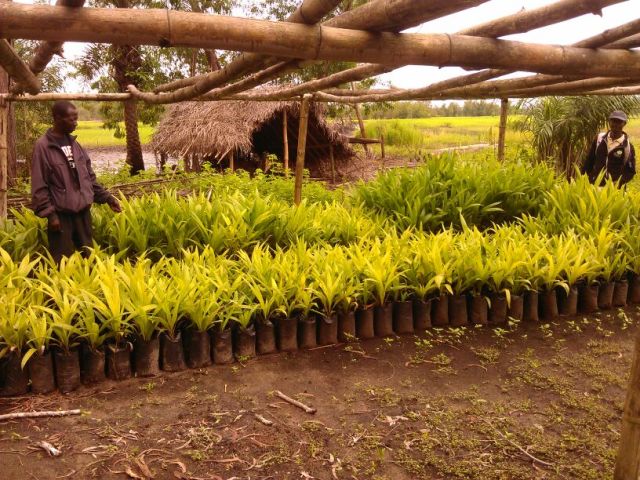
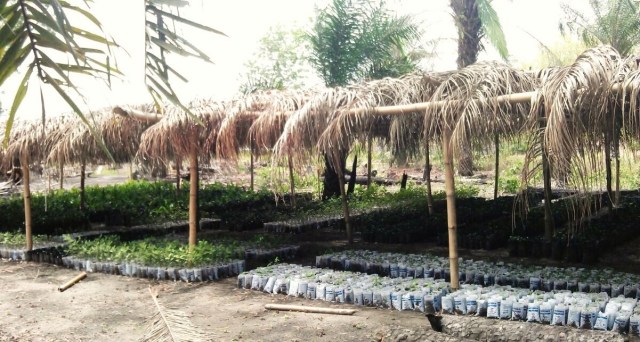
img-20151010-wa0004They position the nursery next to a swamp for a ready supply of soil and water. Nurseries are built inexpensively. They’re bamboo pergolas, made from bamboo felled in nearby forests. Palm fronds laid over the top shelter young seedlings from the hot, dry season sun.

img_0134   img_0137

img_0138


Cashews are one of the fruits that germinate quickly and do well. They germinate like beans, above.

Within four to six weeks, 2,000 cashews germinated and were transplanted into their growing bags, left.
 

mikes-orchard-3-june-16-jpg-copy   img-20150708-wa0000

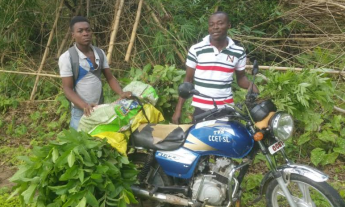
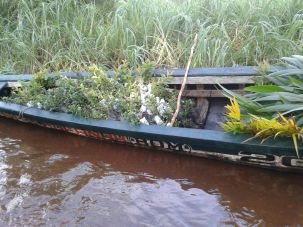
Trees are carried to the orchard site by available transportation – back of a motorcycle or by boat.
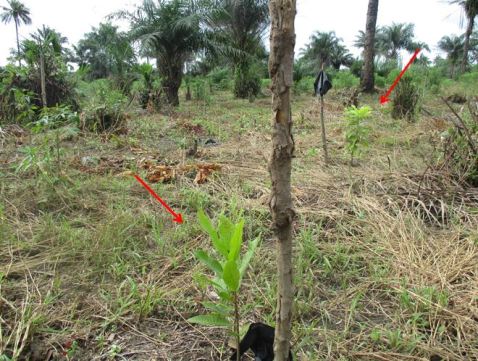
avocado-orchardOrchard sites are usually 10 acres and hand cleared by machete, but not burned.  The cut brush is laid down as an organic mulch.

Villages determine the kind of trees they want to grow. Fields are then measured and “pegged” with tree limb posts and a plastic flag to mark where each tree should be planted. mikes-orchard-2-june-16-copy
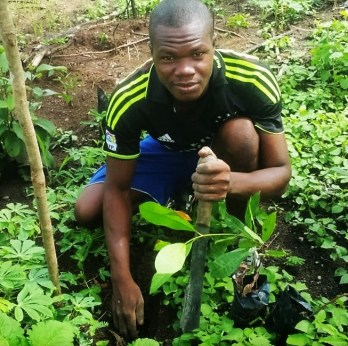


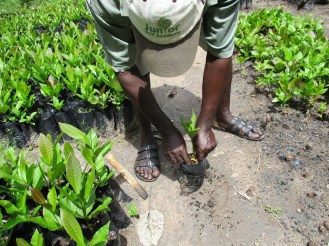
This accurately spaces trees for their mature size, like the avocados, above, and the one being transplanted, left.  All labor is provided the villages themselves. They transplant seedlings after clearing the orchard field.
coconut-orchard


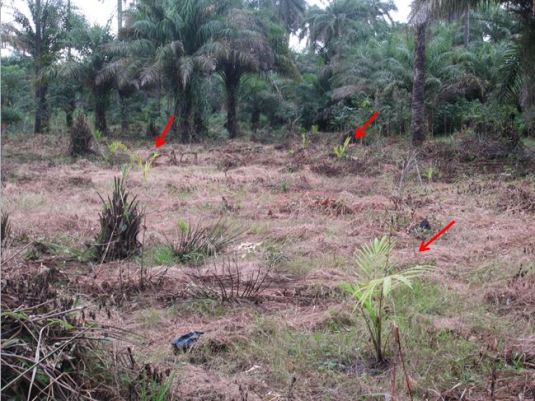
An acre can hold 60 large trees like oil palm, coconuts and mangoes; more if orange, grapefruit, avocado, cashew and guava. So, 600 to 1,200 fruit trees may be planted in a 10-acre orchard.

Coconuts planted left are indicated by arrows.

Fruit trees will mature and bear a full harvest in four to five years.  Managers learned they can inter-plant with other fast-growing fruits like guava, banana and pineapple that mature in one to two years, or other crops like cassava and peanuts.

img_0452Villages will earn money faster as fast-growing fruits and bushes shelter the slower growing fruit tree seedlings from the hot equatorial sun. Cassava bushes, left, shelter a two-year old mango, above.


Adult Literacy – Never Too Late to Improve Lives

Adult Literacy – Never Too Late to Improve Lives

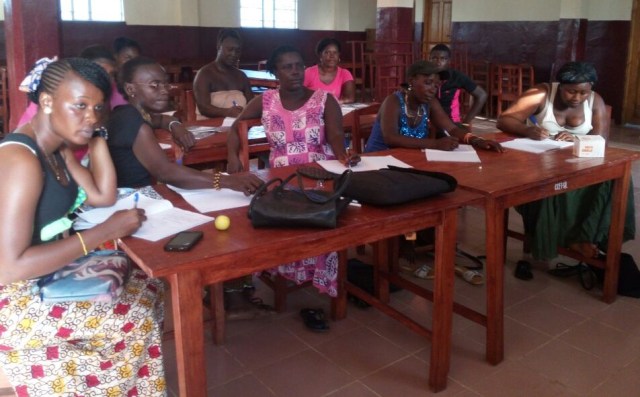
Adult Literacy is the simplest of programs Sherbro Foundation has supported. And one of the most gratifying. Seeing women I recognize, below, resuming classes in October in the new Computer Center made me smile, amid some happiness tears. They were back to eagerly learning after a long hiatus caused by the Ebola crisis and its aftermath.

img-20161025-wa0010-copyThe Adult Literacy program was a fast start and one of our first. Only committed students, dedicated volunteer teachers, a classroom and a blackboard required. No cajoling needed.
Women in the community came to Mrs. Rosaline Kaimbay, Prosperity Girls High School principal, not long after she arrived to start the new high school. They leaned on her, pressing for their own chance to learn to read and write.

In 2013, I saw Mrs. Kaimbay after her school day, leading lessons for the women with a blackboard on her small house’s porch. As PGHS grew and she hired more teachers, they were willing pitch in and teach after-school classes. Sherbro Foundation provided supplies, and adult classes moved to a primary school at 4:30 p.m., after the day’s work. Class was over by 6 when it was too dark to see with only open brick grids as windows.

The women now have a comfortable place to learn in CCET’s new Community Computer Center — new adult-sized tables and chairs, ceiling fans and solar lights.

One thing hasn’t changed — volunteer teachers, including some new instructors. Some retired primary school teachers in the community want to help the new learners.

.img-20161025-wa0007  oct-24-2016-1st-adult-lit-uncle-stalin-teaching-2

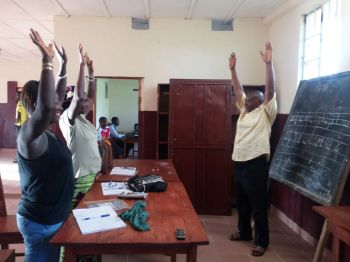
Mr. Francis Senesie, PGHS teacher, left, leads a stretch break for the ABC Group, learning the alphabet.

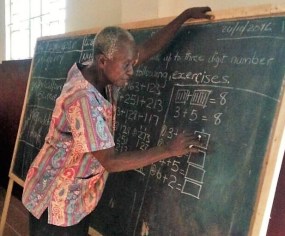
Mr. Stalin Caulker, right, tutored schoolchildren struggling to learn to read for many years as a second career in Freetown. Here, he’s teaching addition to a Rotifunk group. Like many retirees, he finds it satisfying to help.

img_3388I remember the women I met in 2013 and why they wanted to start learning now.  Kadiatu, left,  was chief instigator and lobbied for classes for two years. She was her family’s breadwinner and head of Rotifunk’s women trader’s union, otherwise known as market women.
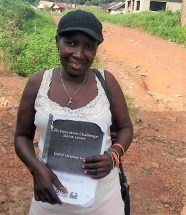
These petty traders sell by the tray and bushel in markets everywhere. She was tired of representing the group at district meetings and workshops and could only use her thumbprint to sign a document.

I talked with over 30 women one on one, and their stories were much the same.  Most were single heads of household, struggling to earn a living as market traders while raising their children. Some were also raising children sent by relatives in small villages to go to school in a bigger town, or children whose parents had passed away.

Some women wanted to learn to read and write their names for the first time, and to count so they wouldn’t be cheated in the market. They knew they could better run their small businesses with practical skills like figuring best prices and sales profits. Others had finished primary school, and after a long break, wanted to resume learning GED style.

All wanted to monitor their children’s progress in school and help with homework, learn more about children’s and their own health, and better run their households.

I wondered why they were so committed to study at the age of 30 and 45. I learned they were getting something priceless: Self esteem. No one is lower in society’s informal caste system than an illiterate woman.  She is belittled, taken advantage of, often abused.

With education, they’re holding their heads higher and not letting others take advantage.

Some of the best news — some women are progressing to other job training programs.

img_4317-copyimg-20161005-wa0000Magdelaine, with me on my far left, took a co-op style nurse’s aide training program in the district capital. Back home in Rotifunk, she works at the hospital.
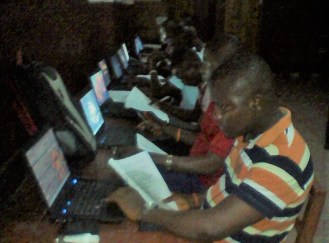
Mariatu, near left,  is part of a more advanced group preparing for primary school teacher training program entrance exams.

First Computer Training Class Starts – Finally Joining the 21st Century

First Computer Training Class Starts – Finally Joining the 21st Century

October 24 was one of my happiest days since founding Sherbro Foundation. It was just days more than five years ago that I formed my first goal, with one of the Rotifunk high school principals, to start a computer training program for students. We had no building, no computers and no electricity, only the determination realize this dream.

Our goal was simple: to give high school students and adults (especially dropouts) computer skills that will make them more competitive in the growing job market.

That grew into teaching adults how to use computers in their jobs, and to start or further develop small businesses. People with computer skills in the community also will help attract new business to the area.

img-20161031-wa0000On October 24, students took their seats for the first evening computer training class in the new Computer Center building. With two months left in the year, it’s a self-paced evening class for adults. An afternoon class for high school students will follow in the next term.
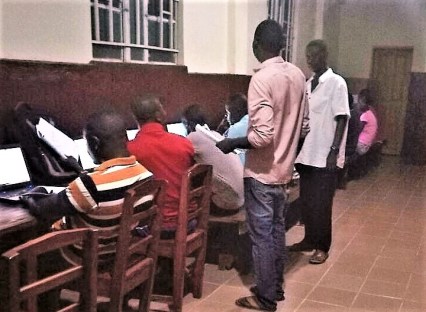
Many of the first adult students are teachers in town. They may have been exposed to computers in college, but without owning one themselves, their practical skills are limited.

img-20161031-wa0008Our Rotifunk partner, the Center for Community Empowerment & Transformation, CCET, hired their first full-time employee to lead computer training classes and run the new printing service.

Sulaiman Tumbo, standing left, had been a local teacher and CCET volunteer. His IT skills and demonstrated commitment made him a great choice for the computer program.

Paramount Chief Charles Caulker, standing right, has championed computer training and the Computer Center concept.

He took on constructing the 2,600-square-foot building from the burned out ruins of a war-torn building during the height of the Ebola crisis. The chiefdom was under an isolation order, so he used that time to build the building that now houses computer and Adult Literacy classes and a new printing service.

The transformation shown below is nothing short of remarkable.

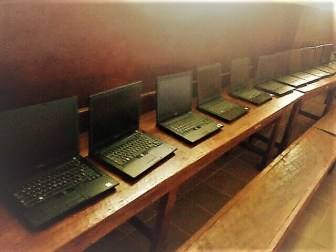
computer-class-open-nov-1-2016The Center can handle 20 computer students in a class. A long table lines a wall so students can plug into wall outlets now powered with solar energy.
Students will complete four training units leading to an IT certificate CCET will issue. With little hands-on experience, they start with Windows, learning to navigate the programs and Apps available, and to create and find documents. They’ll then master basics of Word, Excel and Powerpoint.

Chief Caulker ensured the viability of the program with the Center’s new copy and printing service. Its profits will go to funding  nonprofit education programs in the building, including computer training and Adult Literacy.

I’ll never forget the words of one the adult computer students I talked with. “Arlene,” he said, “I feel like we’re joining the 21st Century.”

— Arlene Golembiewski, Executive Director

First Printing Service Will Fund Rural Education

First Printing Service Will Fund Rural Education

Bumpeh Chiefdom’s new Community Computer Center opened for business in September with the area’s first printing service and its new workhorse copying machine, called a Riso duplicator.

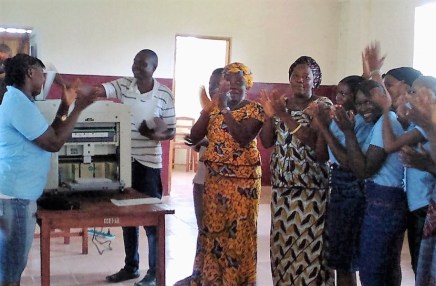
riso-applauseThe economical high-volume, low-energy copier was met with cheers at the Rotifunk facility.  With good reason – it’s the only printing service within several hours drive. Printing once meant a trip to the capital Freetown.

The center now offers faster and cheaper printing and copying for a wide area.

We’re cheering from a distance because the printing service will make money to support nonprofit education programs in the multi-use center, more than four years in the making.

img-20160407-wa0000Now, the computing center — built from a war ruin — is being used to instruct students and adults on computer use. It also hosts adult literacy classes for the many whose educations were cut short by the war. The solar-powered building is available to rent, the only modern building for miles suitable for meetings and community events of 20 – 100. Primary school teacher training, above, was the first rental customer.

There’s two other money-making services inside. The canteen serves as a community hub with drinks and snacks for people visiting the nearby market, hospital and church. And a cell phone charging service can charge 30 phones at a time for a small fee.

center-commissioning-4-oct-10The large duplicator was purchased with a $3,750 grant Sherbro Foundation received from the Ann Arbor (MI) Rotary Club and its District Rotary group. We purchased and shipped the duplicator to our Sierra Leone partner, the Center for Community Empowerment & Transformation (CCET), which operates the Center.
Freetown Rotary Club members, left, joined Paramount Chief Charles Caulker, right, in October for an official Center commissioning ceremony. The Rotarians said this was the most impressive project they have ever reviewed!

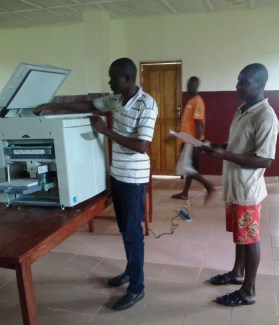
Starting the duplicator took two technicians from opposite ends of the country, with Arlene making international phone calls to relay start-up codes and setup information from our Cincinnati Riso distributor, Bernie Reagan of DSC Office Systems of Blue Ash. (He contributed a deep discount on the equipment.) It’s a newer model and declared “more powerful” than others in the country. Sierra Leone is used to getting outdated technology to save money. This duplicator will serve Bumpeh Chiefdom for many years to come.

img-20160820-wa0000-1Customers soon lined up for the unique service, which spares them an eight hour round-trip to the capital, Freetown. Many are teachers from Bumpeh’s five secondary and 40 primary schools, who need to print reading materials (students have few textbooks), exam papers and report cards.
School sports competitions need programs and fliers; churches and mosques need hundreds of weekly service and wedding/funeral programs. A steady stream of hospital staff and small business owners in town and from surrounding chiefdoms are coming to print their documents.

Paramount Chief Charles Caulker says the chiefdom’s record-keeping will greatly improve and better serve residents, starting with printing a backlog of 1,000 land registrations. Chief Caulker is also chairman of the National Council of Paramount Chiefs. Most chiefs have no email, so he’s using the service to print documents going to all 149 chiefdoms in Sierra Leone.

Four years ago this was all a dream. Now, the printing service is the mainspring of a busy community center, bringing a town into the 21st century.


We Met Our Goal – 300 Girls Sent to School on Scholarship!

We Met Our Goal – 300 Girls Sent to School on Scholarship!

We met our goal! This summer we pledged to double the number of girls’ scholarships for the new school year from 150 to 300 Bumpeh Chiefdom girls. With your positive response to Sherbro Foundation Girls’ Scholarship Fund appeal, 300 girls are in school with their school fees paid for the full year. 

These are girls who can’t afford $20 annual fees for junior high or $25 for senior high. They’re at risk of dropping out in Sierra Leone’s post-Ebola economic crisis that has gone from bad to worse. But for these 300 girls, another year of school is assured.

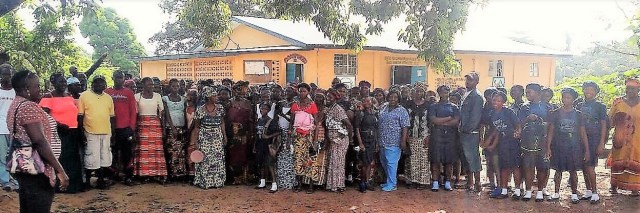
Our Bumpeh Chiefdom partner, the Center for Community Empowerment & Transformation, CCET, administers the girls’ scholarship program with Sherbro Foundation funding. Scholarship students and parents gathered below, outside CCET’s new building after awards were made in October.

img-20161120-wa0001-copy

Few development programs have greater impact than helping girls go to school.  Now more Bumpeh Chiefdom girls are enrolled in secondary school than ever before. They’re progressing to higher grades and avoiding early marriage and teenage pregnancy.

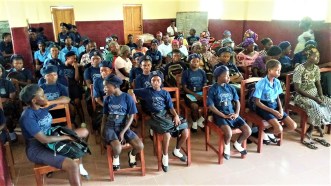
Happy girls and parents from five schools joined principals to receive the scholarships. Scholarships were distributed based on each school’s female student enrollment.

img-20161120-wa0004   img-20161120-wa0011

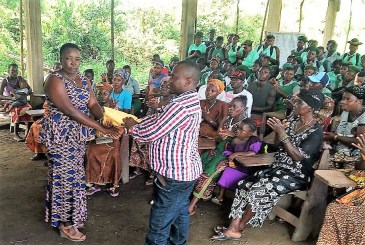
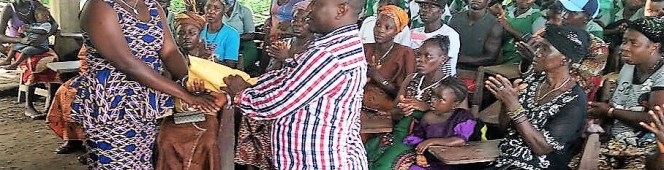
Retired head teacher and CCET program volunteer Mr. Banard, above left, presented Prosperity Girls High School Principal Rosaline Kaimbay with 100 scholarships for PGHS students before the students and their parents.

oct-2016-ba


Parents and scholarship students look on as Bumpeh Academy Principal Rashid Conteh, right, accepts 70 scholarships for his female students from CCET Executive Director Rosaline Kaimbay.


oct-2016-wsmss-pricipal-tarawalie


Principal Satigie Tarawallie, left,  accepts 70 scholarships on behalf of Walter Schultz Memorial Secondary School girl students from CCET’s Mrs. Kaimbay.


oct-2016-ahmidiya-principal


Girls at Ahmadiyya Junior Secondary School received 30 scholarships from CCET accepted by Principal Ibrahim Tarawallie center.


Thirty scholarships were additionally awarded to Ernest Bai Koroma Junior Secondary School female students.

Our sincere thanks to everyone who contributed to this year’s scholarship program appeal. This simple gesture of a $20 junior high scholarship can change a girl’s life!


US Caulker Family Sends Bumpeh Chiefdom Girls to School

Sherbro Foundation sends a big thank you to U.S. members of the Caulker family for donating to Sherbro Foundation’s Girls’ Scholarship Fund. Family members at this year’s annual reunion donated $1050.

Their generosity means 63 Junior Secondary School girls are returning to school as the new school year starts! Their donation amounts to nearly 20% of this year’s scholarship campaign goal.

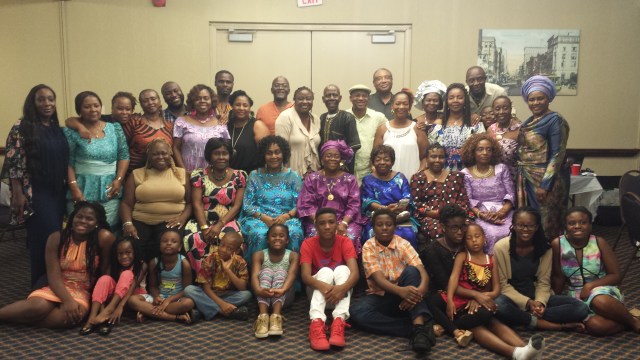
20160730_235449Members of the Caulker Descendants Association at their July 2016 family reunion – their 17th reunion.

The Caulkers are one of the oldest ruling families in Sierra Leone. They are the descendants of paramount chiefs from two branches of the Caulker family in Bumpeh Chiefdom and Kagboro Chiefdom.

This remarkable family traces their heritage back to Thomas Coker, one of the earliest British traders in Sierra Leone who set up a trading post for the Royal African Company in 1684. Coker, himself Irish, was the British company’s agent. He married a daughter of the one of kings in the coastal area of today’s Kagboro and Bumpeh chiefdoms. Their progeny were the start of the Caulker clan.

The Caulker Descendants Association formed in 1999 to teach and celebrate their family history and heritage. They’ve been meeting annually for seventeen years.

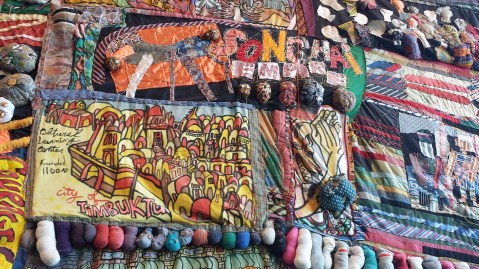
20150801_105739 The Caulker Family tree documents their 350 year history starting at the base of the tree with Thomas Coker, born 1667 in Ireland. The tree was constructed by Imodale Caulker Burnett after many years of research into the family’s history she then chronicled in The Caulkers of Sierra Leone: The Story of a Ruling Family and Their Times.  Fascinating reading.
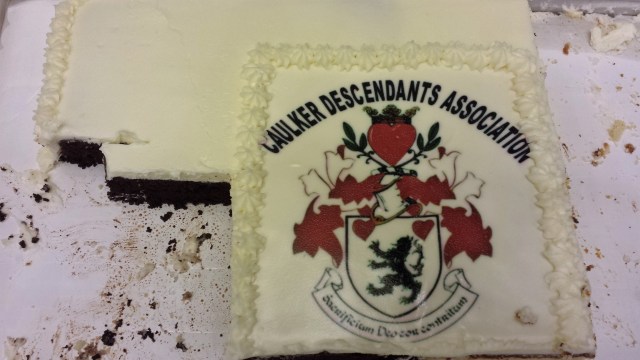
20160730_232654A family reunion wouldn’t be complete without a sheet cake to serve a crowd. But how many families can decorate their cake with a family coat of arms dating to the 1600’s. 
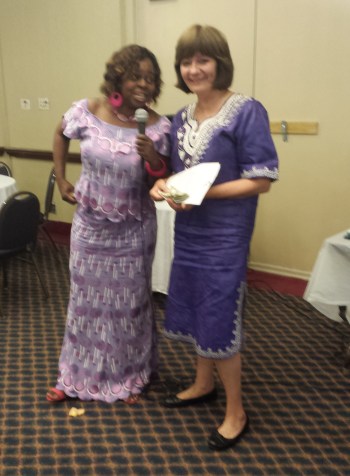
20160730_220831Arlene Golembiewski, Sherbro Foundation Executive Director, accepts the Caulker family Scholarship Fund donation from Enid Rogers, a Caulker grandchild, at their reunion banquet dinner.
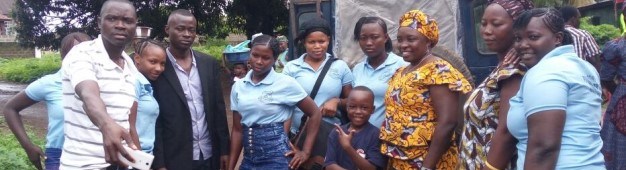
Many extended Caulker family members remain in Bumpeh Chiefdom, including teenage girls who will benefit from Sherbro Foundation’s Girls’ Scholarship Program.

The Caulker family has long placed a premium on education. Sherbro Foundation is grateful for their support for girls education in Bumpeh Chiefdom. We hope this remains the basis for a strong partnership between the Caulker Descendants Association and Sherbro Foundation.


She is Why We Do What We Do – Where is She Now?

She is Why We Do What We Do – Where is She Now?

I wrote about Zainab last year in a post called “She is why we do what we do.” She’s now made it through seven years of secondary school against all odds. Her Sherbro Foundation school fee scholarship helped her reach her goal.

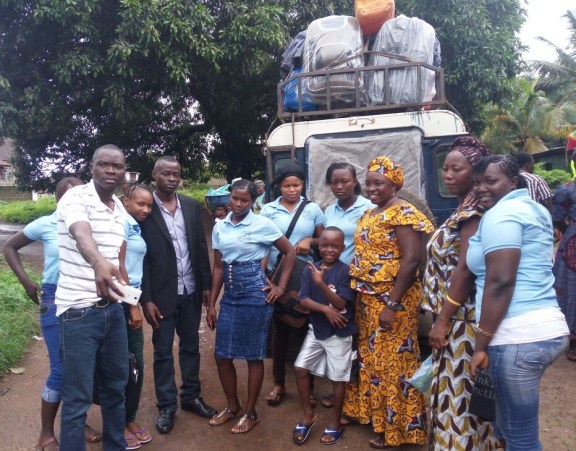
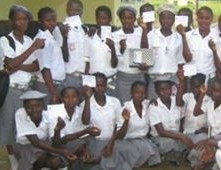
Here’s Zainab in July (center, hand on her hip) with a group of Rotifunk girls, all scholarship recipients, leaving for Freetown to take the WASSCE exam – the West African Senior School Certificate Exam. She’s one of a small group that are the first to complete senior high in Rotifunk and sit for this month-long standardized exam. Yes, I said month long.IMG-20160821-WA0005

Sherbro Foundation works to get girls like Zainab into secondary school with our Girls’ Scholarship Fund. But our real goal is that they graduate and move on to good careers and productive lives – and leave behind the poverty that has trapped their families for generations.

Zainab Bangura 2 - PGHS scholarship awardeeZainab’s story stated out badly. She’s one of many girls faced with poverty and an early arranged marriage when her mother could no longer pay for her to stay in secondary school. Zainab later left this older man, who already had a wife, and she returned to school.
Zainab’s story is all too common in Sierra Leone.  But she caught my eye with her determination to complete school and go to college. I was impressed with her maturity when she matter-of-factly asked if Sherbro Foundation would be helping to set-up a science lab for her school needed to complete the senior high science curriculum.

Life had already dealt Zainab a bad hand, but she was determined to pursue science and become a doctor. When I asked her why a doctor, she said, so I can save lives. And that conversation was before Ebola hit.

I was excited to hear Zainab returned to school when it reopened last year after Ebola. I’m now thrilled she is among the first group of girls finishing senior high and taking the completion exam.

Zainab’s story could have ended sadly. When girls reach 15 or 16, it’s too much of a burden for many parents to keep paying for school. An arranged marriage like Zainab’s is an easy solution and eliminates one mouth to feed.

Imagine the strength and determination of Zainab to pursue a new life and realize her obvious potential. I can still see it in her latest picture above. It all starts with getting girls like her into secondary school and keeping them there.

This is why Sherbro Foundation maintains the Girls Scholarship Fund and is pushing it hard this year.

Bumpeh Chiefdom’s Paramount Chief Charles Caulker underlined the importance of reaching this year’s stretch goal to double the program and send 300 girls to school in September.

“Over the past three years we’ve made successful efforts to get girls into secondary school. There were more girls enrolled than ever before when school ended in July.

“But I fear half the girls enrolled are at risk of dropping out this year because their parents just can’t pay their school fees. The economy is that bad now.”

“I’m passionate about this. I want to take the lead in asking all our family and friends to go the extra mile to save these children from dropping out and the abuses so many girls face with teenage marriage and pregnancy. Let’s not let all their efforts to get an education go in vain,” Chief Caulker said.

Sherbro Foundation is determined to keep girls in school. The dollar is strong now and goes further than ever in Sierra Leone. Just $50 will pay school fees for three junior high girls for the whole year.

We need your help: we’re at 75% of goal. We’d love to surpass our goal — hundreds more girls need scholarships! 

You can do it now by donating here — send a girl to school.   

Thank you!

Arlene Golembiewski
Executive Director, Sherbro Foundation

The easiest way to send girls to school

The easiest way to send girls to school

Can you contribute to Sherbro Foundation with automatic monthly recurring payments? Two people recently asked, and the answer is, Absolutely.

Just go to the Donate page and hit the Donate button as you would for any donation. Fill in the amount you wish to donate monthly and tick the “make this recurring monthly” box. That’s it.

WSSS scholarship students Sept 2013 - CopyEnter any monthly amount you choose. $10 a month is a painless way to ensure you’re sending girls to school throughout the year. In twelve months, you’ll have paid for six girls to go to junior high school for a whole year.

At $20 a month, you’ll be helping a girl pay her annual school fees every month. Yep, one month from you could mean 9 months of schooling for her.

Or, you can designate your money to go to any of our projects. Help villages plant community orchards that will produce income for them to dig wells, build a school or improve their road. Help parents start saving for their child’s education from birth with our Newborn Education Savings Program. Pay for our Community Computer Center to receive solar power ensuring computer and Adult Literacy classes go on every day – and at night.

Monthly recurring donations are kind of a no-brainer. You set it up. You send a message when you want it to stop. Consider it. The easy way to make a difference in a girl’s life – every month of the year.

Let Sierra Leone Girls Learn

Let Sierra Leone Girls Learn

Girls 2016-17 8-13-16 - Copy

When food costs skyrocket, school is out of the question for many Sierra Leone students. Especially for girls. When girls are forced to drop out, they’re at risk of early marriage. Or getting pregnant with no marriage. Their lives change forever.

The Ebola health crisis may have ended in 2015, but a country-wide economic crisis has followed. Families can’t send girls to secondary school — which is not free — if they can barely feed themselves.

But we can help, and change their lives for the better. Learn more here.

If you’re ready now, DONATE HERE.

The Feminist Paramount Chief: Why Girls Must Go to School

The Feminist Paramount Chief: Why Girls Must Go to School

PC CaulkerFor years, the longtime traditional leader of Bumpeh Chiefdom dreamed of ways life could improve for its 44,000 rural residents.

Most of Paramount Chief Charles Caulker’s chiefdom is made up of small, inaccessible villages of 200-500 people, living a subsistence farming existence scarcely changed in 100 years. These are among the poorest people in the world, living on $1 a day. It’s hard to ever get ahead and break the cycle of poverty on $1 a day.

For Chief Caulker, one fundamental is key:  girls must go to school.

Today, only an estimated 10 to 20 percent of girls in his chiefdom make it to secondary school. If it became the norm, he believes his chiefdom’s and the country’s culture – and fortunes – would change.

IMG_4342 - Copy

“With education, women can assert themselves and can get their own jobs, or start or expand their own small businesses. They’ll take their own decisions,’’ Chief Caulker told us during a recent discussion about the importance of Sherbro Foundation’s Girls Scholarship Program.

Chief Caulker is emphatic: “There’s a growing understanding that educating girls brings more benefit to the family than educating boys.

IMG_0411“Girls are more serious and work harder. They get better jobs. They take their family responsibilities seriously, and ensure their children and parents are taken care of.

“Women are more industrious,’’ he explained bluntly. “As Rotifunk grows and business opportunities open up, women will be the ones to start restaurants, shops and expanded markets for the growing middle class.”

And if girls aren’t educated?

“Women in rural Sierra Leone continue to suffer indignities dictated by outdated customary practices and unenlightened male chauvinism,’’ Chief Caulker says.

What kind of indignities do women suffer, we asked. We got an earful.

IMG_3559 - Copy“Women do 70 percent of the work on the family farm but are not allowed to make decisions on running the farm or selling crops. Their husband controls the money and may carelessly spend it on himself for things like gambling with his friends,” he said frankly.

“The woman is up at dawn and making a fire to warm bath water for her husband and reheat food for breakfast, if they have it. When going to work on the farm, pregnant women can be seen carrying loads on their head and another baby on their back. Her husband may accompany her to the farm without helping carry anything, do a couple hours work and return home to sit out the rest of the day.

IMG_3174“His wife returns late in the day as the sun is going down. She may still need to go buy fresh produce and collect firewood and water before making a fire to cook the family dinner. Her husband will then expect her to have sex that night and she can’t refuse.”
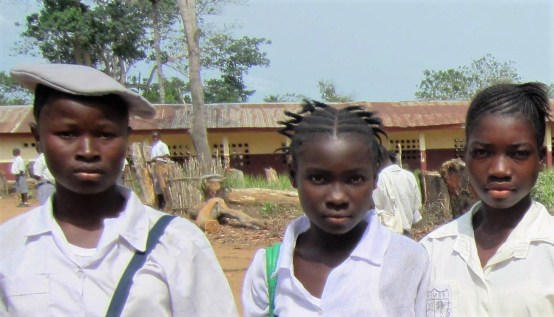
That is rural life as it has been for hundreds of years. “Women are treated like beasts of burden,” Chief Caulker says.

“Today by 14 or 15, girls not in school are seen as grown up and ready to work and get married. If they marry, it means their family has one less mouth to feed.”

But with our help, we can send – and keep – more girls in school.  They will be able to avoid early marriage and dangerous early pregnancies.

IMG_0352 - Copy

Chief Caulker is determined to empower parents to send their children beyond primary school and get a good education. “With education, women will be more enlightened and understand their rights.” They’ll act on these rights, to the benefit of the whole chiefdom.

Chief Caulker is grateful for Sherbro Foundation’s goal to send 300 Bumpeh Chiefdom girls to secondary school this year.  He sees these girls as the future of his chiefdom.

Help us meet this goal and send a girl to school:  DONATE HERE

Save

Save

Keep Girls in School

Girl appeal image 2016

When food costs soar, school is too often out of the question for Sierra Leone students.

The Ebola health crisis may have ended in 2015, but a country-wide economic crisis has followed. Inflation has skyrocketed with no end in sight. Everyday needs like rice, cooking oil and public transportation have risen 30% in less than a year.

All at a time when rural farmers and small market traders are still trying to recover incomes slashed in half during the Ebola period.

Families can’t send girls to secondary school — which is not free – if they can barely feed themselves.

The good news in Bumpeh Chiefdom is that more girls are in school than ever before. Nearly 900 girls were enrolled in the chiefdom’s five secondary schools as the school year ended in July.

Over three years, Sherbro Foundation’s scholarship program has helped 300 girls enter – and stay in — secondary school. With every year of school, a young woman earns 10% more income.  She marries later and has fewer, healthier children, when her body is ready for them.

The bad news is many of these girls will now be forced to drop out. Unless they get a helping hand.

Our goal this year is to double the number of scholarships from 150 to 300 girls.

Bumpeh Chiefdom’s Paramount Chief Charles Caulker told us why the Girls Scholarship Program is important to him. “With education, women can assert themselves and take their own decisions. They can get their own jobs, or start or expand their own small businesses,” he said. “They won’t suffer the indignities of outdated customary practices and unenlightened male chauvinism.”

Girls with secondary education will have skills to get wage- paying jobs or start small businesses. Some girls will complete senior high and may be able to go on to college. They want to become the nurses, teachers, lawyers, accountants, social workers and environmental managers their country desperately needs. They’ll move beyond a subsistence lifestyle and break the cycle of poverty they grew up in.

One silver lining – since the US dollar is strong and now worth much more in Sierra Leone, your donation goes further than ever before!

Just $50 will cover a whole year’s school fees for three junior high girls.

It means three girls will make the transition from primary to secondary school. Three girls now in junior high will stay in school and keep learning.  We’re helping girls progress to senior high, and the first group is ready to graduate.

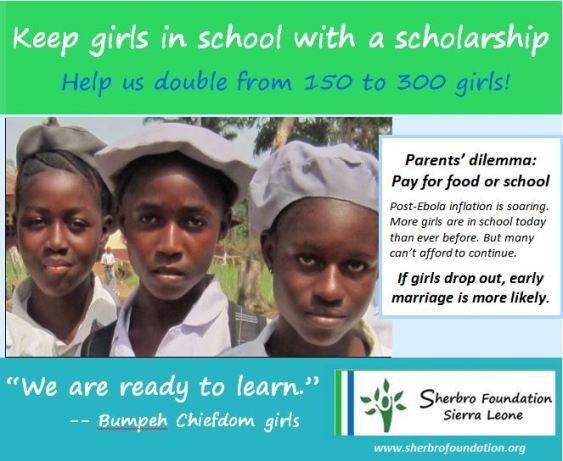
Bumpeh Chiefdom school girls have told us, “We’re ready to learn.”

And we want to help. Our 2016 Scholarships goal is $5,000. We’re 40% of the way to our goal. But that won’t cover 300 girls.

Most Bumpeh Chiefdom female students are the first in their families to get any education. They can escape the subsistence lifestyle that’s trapped generations.

You can help these girls change the direction of their lives and their communities.  Just click here, and it’s done:  DONATE

Thank you!

Arlene Golembiewski, Chris Golembiewski, Cheryl Farmer and Steve Papelian
— the Sherbro Foundation Board of Directors

P.S. If you can give a little more, you’ll ensure our goal is reached when school starts in September!


Save

Paramount Chief Caulker visits Freedom Center

Paramount Chief Caulker had a unique museum experience visiting Cincinnati’s National Underground Railroad Freedom Center. The Freedom Center chronicles three centuries of slavery in the US and educates on today’s human trafficking and modern-day slavery.

DSC_0336

Many African- American ancestors came from Sierra Leone, as now shown through analysis of slave ship records and DNA testing. The Freedom Center spotlights the Cincinnati area’s important role in abolition and the Underground Railroad that secretly moved slaves to safety in the North.

Richard Cooper, the center’s director of museum experiences, gave Chief Caulker a personal tour, starting with two huge artifacts on the main floor. The first is Journey I and II, dramatic textiles depicting West African history and the slave trade by Aminah Robinson, made over 35 years.

20160416_125910

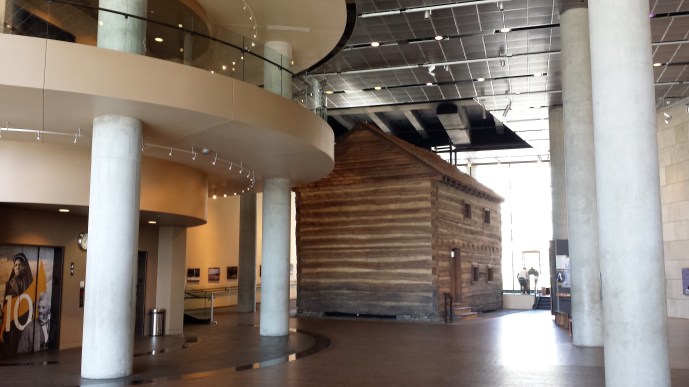
20160416_130138 - Copy20160416_130503It’s an unforgettable experience to step inside an actual slave pen moved intact from only 60 miles away. It was used in Kentucky to hold enslaved people until they were moved farther south. 

20160416_130427The names of a group of slaves were posted in front. Chief Caulker noted one name, Amada, saying it sounded like a Sierra Leone name. Could this have been a Sierra Leonean?  20160416_131149 - Copy

We were lucky to view a special exhibit with an original handwritten copy of the 13th Amendment abolishing slavery — with Abraham Lincoln’s signature.

A Freedom Center visit serves to underscore the special connections between the US and Sierra Leone and how our histories are linked.

Rotary Club Grant Kick-Starts New Computer Center

Rotary Club Grant Kick-Starts New Computer Center

ready to open - CopyRotifunk’s first Community Computer Center will soon start the area’s first copy and printing service, thanks to a grant from the Rotary Club of Ann Arbor, MI.

The community gets much faster and cheaper printing access. The Center will earn income to operate and offer computer training for students and adults. That’s what you call win – win.


Rotary-Web-Banner-New12[1] (2)Ann Arbor’s public service club awarded a $2,500 grant to Sherbro Foundation Sierra Leone, matched by $1,250 from Rotary District 6380. The money will equip a copying and printing business, helping the much-needed nonprofit center quickly become self-sustaining and introduce computer technology in the chiefdom.

Computer training means local residents gain wage-paying job skills, especially girls and single mothers. And printers will eliminate a difficult and costly eight-hour round-trip to the capital city for educators and others who need any printed materials.

Today, every report card, exam paper and classroom handout in schools with few text books need to be printed in Freetown. These and programs and flyers for churches, mosques, sports meets and community events will now be printed much faster and much more cheaply with the local service. The printing service will be open to all, including chiefdom and government authorities, local businesses and nearby chiefdoms that need printed materials.

ready to open - Copy (2)Sherbro Foundation’s local nonprofit partner, the Center for Community Empowerment and Transformation (CCET), comprised of teacher-volunteers, will operate the Computer Center and hire an IT manager. They transformed a centrally located ruin into a spacious, modern Computer Center complete with a snack bar – all done during the Ebola crisis.

Sherbro Foundation funded its completion, wiring excess solar power from a solar system on a nearby building. We also hired local carpenters to build wooden desks and chairs and office and canteen furniture.

The Center will offer other educational programs, starting with Adult Literacy that’s been interrupted since the start of Ebola.  Other income-producing services will fund the Center’s operation, including cell phone charging, the snack bar and facility rental for conferences and meetings.

20160331_202850Paramount Chief Charles Caulker joined Sherbro Foundation in meeting with the Ann Arbor Rotary Club during his March – April US visit.  We all celebrated Bumpeh Chiefdom’s work with a dinner, left, hosted by Rotarians Mary Avrakotos and Barb Bach.

The Rotary Club of Ann Arbor is the largest in Michigan, and one of the largest in the world. It’s observing its 100th anniversary this year. Nearly 20 percent of the Club’s annual giving budget supports international humanitarian organizations.

Making Personal Connections

The beauty of Paramount Chief Caulker’s recent US trip was how many person-to-person connections he made. You couldn’t help but feel the connection when Chief talked earnestly of the small village communities he’s working to transform with education and income-producing fruit orchards.

Sierra Leone was no longer a strange and distant land. It was one of girls excitedly going to secondary school for the first time and people planting home-grown trees to improve their lives and protect their environment.

Chief Caulker was able to connect with Americans in five states and the District of Columbia, sharing his personal stories of Bumpeh Chiefdom’s difficult life and his message of hope and hard work. 20160414_215258

Sherbro Foundation especially appreciated making connections with the Sierra Leone community in the US.

Who knew there is a Sierra Leone Group of Cincinnati with a Facebook page? Page organizer Hashim Williams 20160414_214742found my invitation message and brought a group to Chief’s April 6th presentation.

Mr. Michael Foday of the group then extended his and wife Evelyn’s hospitality with a dinner of Sierra Leone food at their home. He and a number of invited guests generously gave their support for the Chief’s Bumpeh Chiefdom programs. (Above L to R, Sanussi Janneh, Arlene Golembiewski, Chief Caulker, Hashim Williams, Michael Foday)

We started the evening as new acquaintances, and left feeling bonded as friends. Chief Caulker poured libation on Mr. Foday’s doorstep (left) in appreciation of the new friendships forged that evening.

Susan and Jim Robinson (below left)  hosted a reception in their home so people like Pam Dixon (far left) could talk with Chief Caulker firsthand. Winona McNeil (below right), Cincinnati Chapter President of The Links, a professional women’s society, joined in meeting the Chief.

20160416_191027   DSC_0398

20160330_104104Sherbro Foundation Board Members Arlene Golembiewski and Steve Papelian, left, are former Peace Corps Volunteers who served in Rotifunk, Chief Caulker’s hometown. They reminisced with Chief on their life-changing experience at the steps of the University of Michigan Union, where then-presidential candidate John Kennedy first presented his new concept of the Peace Corps in 1960. The 50th anniversary of the Peace Corps was commemorated at Ann Arbor’s U-M Union with this historic marker, depicting President Kennedy’s speech.
No visit to Michigan would be complete for Baby Boomers without a trip to Detroit and the Motown Museum.  Chief Caulker, a big Motown fan, enjoyed reliving the soundtrack of his youth with Sherbro Foundation Board Director Cheryl Farmer.

20160401_134248


Women’s Vegetable Growing Project – Making millionaires out of peanuts

Women’s Vegetable Growing Project – Making millionaires out of peanuts

Seventy five women farmers have a chance to become Sierra Leone millionaires. Sherbro Foundation just funded a new group of 75 women to grow groundnuts (we call them peanuts) in the Women’s Vegetable Growing Project – one of our most successful projects to date.

 I can still vividly remember last November when I approached Mobainda village to visit the first women’s project. Women had gathered and filled the narrow dirt road. The car stopped, so I got out to see what was happening. The women began singing and dancing around me. They had come out to honor me and escort me into their village — the traditional way of the women’s society.

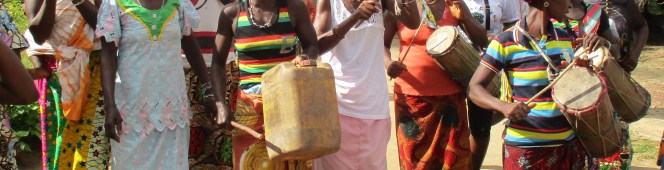
No words, no speeches. They just surrounded me with their harmonized singing and drumming on hand-made drums, and slowly moved towards the village.  So, I moved with them, their singing filling the air for the last quarter mile.

They were thanking me – thanking Sherbro Foundation – for helping them plant peanuts in April 2015, right as the Ebola crisis was lifting. These are women who normally live on the slimmest of margins, earning an average of less than $1 a day. They couldn’t even earn that during Ebola, when much farming stopped and markets for selling their produce closed for over four months.

“The Women’s Vegetable Project is one of the most successful projects introduced in my chiefdom,Paramount Chief Caulker said.

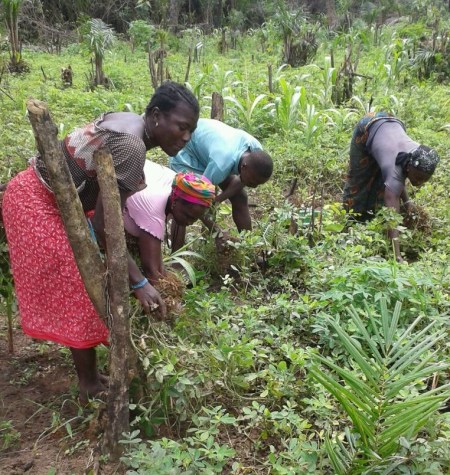
Veg - Groundnut harvesting3It was conceived as a way to quickly help women earn income again. We started small with 30 women, supplying each with enough peanut seed for a half-acre garden and other vegetable seed like cucumbers and corn. They also got a 50Kg (100-pound) bag of rice to feed their families before their harvest.

Leave it to women to make the best use possible of resources they were given. Most women grew a bumper crop of peanuts in four short months, harvesting 6-7 bags of peanuts for each bag of seed they received.

We jokingly said we were making millionaires out of peanuts. A large bag of peanuts went for 160,000 leones. So, 7 bags are worth over a million leones. Or about US$200.

TIMG_0211hat may not sound like much, but it was three times more than the women would make in cash in a whole year of traditional rice farming, an incredibly labor intensive crop. And they still had the rest of the year to grow rice and do fishing in the Bumpeh River.

Leave it to these women to be grateful for this help. In these small, close-knit villages of 200-300 people, the women wanted to help other women do what they just did. They came up with the idea of each donating back a half-bag of groundnut seed for the next group to plant. They showed me their donated seed, left.

A local survey found 450 more women in this area of eight villages want to be part of the program. This part of Bumpeh Chiefdom was selected because it has the largest concentration of active women farmers. They were the most severely affected when Ebola abruptly curtailed their normal farming.

13177990_689055534567081_9185847638175857474_n[1]
Executive Director Rosaline Kaimbay, right, of CCET, our partner organization, distributes seed and supplies to the May 2016 group of women farmers, holding white drying tarps they received on their heads. We bought any seed locally available, saving transport cost for both buyer and sellers.

So, the program is expanding to 150 women per year in two groups of 75 women each in the spring and fall.  The program is meant to be a stopgap measure to help women farmers get back on their feet after Ebola. It will continue for three years and cover all 450 interested women. The women draw lots to select who will be in each group.

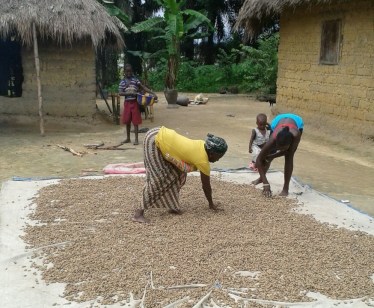
Veg - drying groundnutsThe 2014-15 farming year was exceptionally hard with Ebola. The first group of women peanut farmers unfortunately didn’t become self-sufficient with just one peanut crop in 2015. They were forced to eat a large part of their first peanut harvest to avoid hunger. But this allowed them to save some of the previous year’s rice as seed to grow their next rice crop. We’re giving these first 30 women partial support again in the current project to ensure they can make enough profit in 2016 to go from there.

This year we are also giving each woman a large tarpaulin to safely dry their harvest of groundnuts (or peppers) and avoid losses due to rotting.

I’m already looking forward to my next visit when I can join the women and again celebrate their success. I learned the song the women sang for me last November loosely translated said: “If you wake up in the morning and just work hard, you will succeed.”

And succeed these hard-working women did. In only five months after my first long-distance phone call that conceived the project, the women were harvesting a bumper crop. Their success became our success. And now we’re expanding to help more women succeed.

Arlene Golembiewski, Executive Director