But are they happy?

This month we had American Independence Day when we (should) reflect on our country’s many freedoms and gifts, including the right to the “pursuit of happiness.” After spending time in Sierra Leone of late, I’ve thought more about what constitutes happiness.  Sierra Leoneans are known for being warm people and smiling – a lot.  But are they happy?

Westerners seem fixated on pursuing their own personal happiness.  Books abound on how to find happiness.  We have the Happiness Project, Authentic Happiness, even the Dalai Lama’s The Art of Happiness. Time Magazine’s cover story on this cleared up one thing.  Our Founding Fathers weren’t referring to each individual’s pursuit of happiness when they signed the Declaration of Independence.  Rather, they meant a government should be charged with providing an environment that fosters the happiness of its citizens; that gives you the opportunity to freely embark on your own pursuit.  The rest is up to you.

The country of Bhutan has gone a step farther with defining the “Gross National Happiness Index”, and how they as a government will measure the wellbeing of their citizens. They feel governments should be accountable not only for economic prosperity (GDP), but also for the general welfare and happiness of their citizens (GNH Index).  ie., why have economic prosperity unless the average citizen is better off.  http://www.grossnationalhappiness.com/articles/

Sounds good to me.  It’s an especially good message for developing countries to not get stuck on the treadmill of ever increasing GDP to the exclusion of their citizen’s welfare, and, well, happiness.

On any country index of wellbeing and happiness measures, Sierra Leone ranks near the bottom.  At least as measured by macro-measures like per capita income, child mortality rate, etc. Extreme poverty is not a happy place to be.

But what about individuals – real people.  These are some of the sunniest people I’ve met anywhere.  Sierra Leone has been called the Land of Smiles. As Westerners coming from the land of grumps, where people feel they never have enough, you are literally basking in the sunshine of the smiles of Sierra Leoneans.  Their singing and dancing.  Their strong sense of community and family.  But I’ve been wondering, with all the hardship in their lives, are they happy?  So, I decided to ask.

On my last trip, I went with the Paramount Chief and his family to spend two weeks in their ancestral village while they started preparing the rice swamps for next season’s planting.  This is a remote village of about 200 people and 25 houses.  I came with no organized group as a buffer or filter – no church mission, no NGO, no visiting ministry delegation.  Just them and me.  As guest of the chief, I was legitimized.  I was seen as OK to talk to.  In a village like this, there’s plenty of time to relax and talk.

They just came back from working 6 hours in the rice swamp & can still smile.

They just came back from working 6 hours in the rice swamp in the hot sun & can still smile.

So I asked people in a poor village, in one of the lowest income districts of one of the poorest countries in the world – what makes you happy.  I thought I better first get clear on a working definition of happiness here. This usually led to discussion of whether they had enough of what would make them happy, or, on the other hand, what they dislike or fear (unhappiness). Here’s some of the people I met.

Hawa, age 35, was born here.  She, her mother, and previously, her grandmother have been small traders, selling farm goods in bigger towns and markets.  She wants her daughter to get an education and be a nurse.  She would be happy when she has money to build a better house.  She also likes to be a business partner with her husband growing rice and making palm oil to sell in the city.  She’s proud when she gets what she needs, like repairing her house in the rainy season to not leak, and sending her daughter to school. She fears being poor. If you’re sick, you can’t go to the hospital without money.
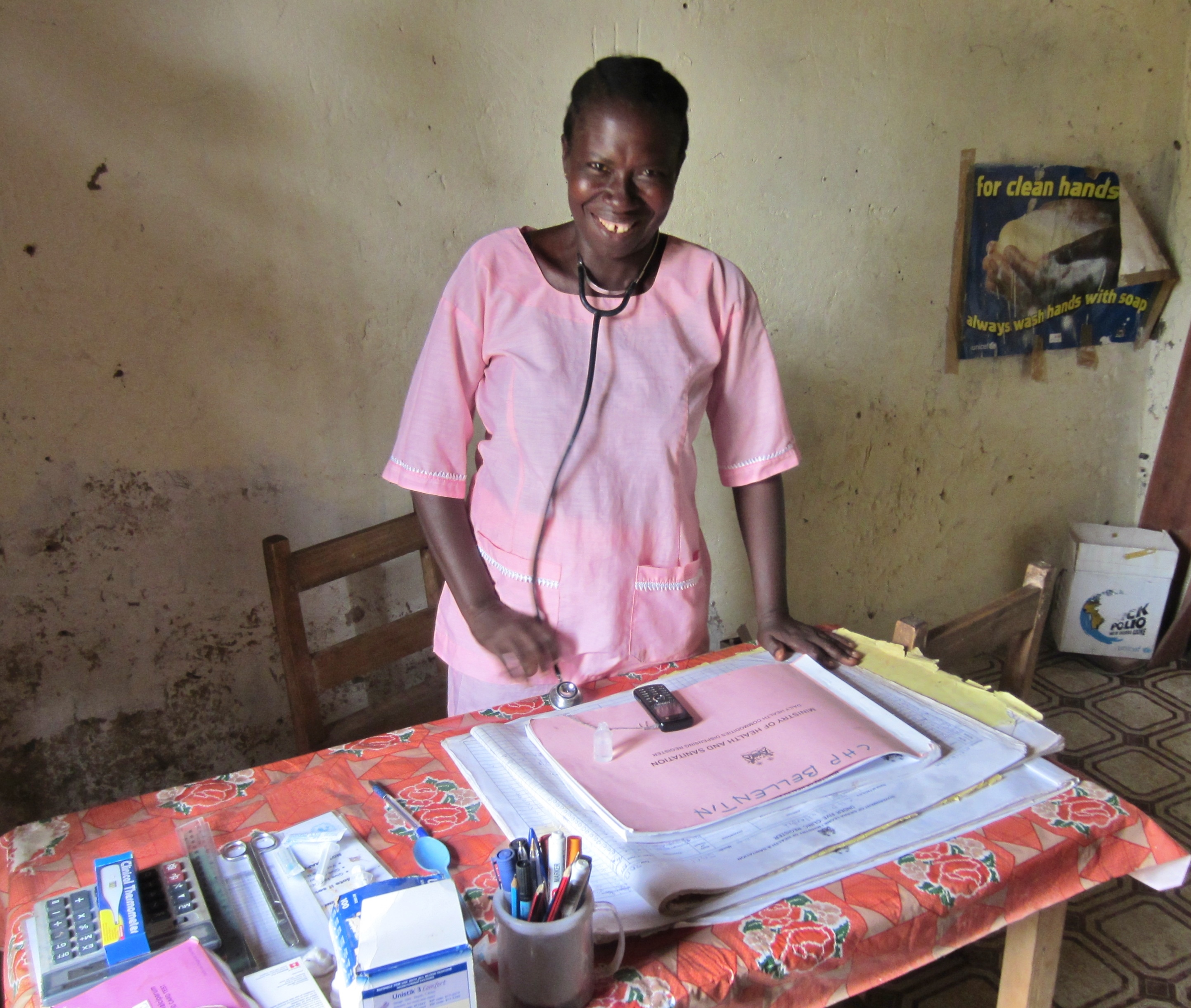
Nurse Adama is happy she safely delivered another baby at the village health clinic.

Nurse Adama is happy she safely delivered another baby at the local health clinic.

Mary, age 30, was born here and is married to a farmer. She makes banga (smoked fish) and palm oil.  It’s hard for her because she doesn’t have money for public transportation to take her things to market where she can earn more. Her family had to flee during the war and live for a year in the bush, collecting wild yams, bananas and fish, and slept on the ground.  People got some money after the war to come back and rebuild, but not enough for a zinc roof.  She has five children, aged 5 to 15, and feels good when she can educate them.  Then they can take care of her in her old age. She hates poverty, sickness like malaria and elephantiasis, and thieves.

Sembu Bendu, boat captain.

Sembu Bendu is happy as boat captain.

Sembu is a 45 year old man and captain of the paramount chief’s boat that operates like a weekly bus on the river to take people to the big Saturday market in Rotifunk.  He was born here, and has a wife and child in Freetown.  He is happy that he could return here after the war with a paid job, and one that he enjoys.  He’s also happy that he’s healthy.  He needs a zinc roof, a better health clinic and new outboard motor.

Abdul is 36 and came from another village to work for the paramount chief.  He lost his parents during the war and never went to school.  He likes hard work and enjoys planting rice.  He does whatever is needed on the farm, like climbing palm trees for coconuts and tapping palm wine.  He has three children, including an 18 year old boy who helps on the farm.  He’s happy when he has money for a good house, food and can pay school fees for his kids. He’s proud when the chief trains him to do work on the farm or sends him on errands.  He likes good clothes. He fears sickness and when married women flirt with him.  (Adultery is punishable with a stiff fine in this chiefdom.)

Masiry, oldest woman in village on her front porch with Arlene.

Masiry, oldest woman in the village on her front porch with Arlene.

Masiry is 70 and the oldest woman in the village.  She came with her husband over forty years ago to farm for the chief’s father.  She has three sons and two daughters, most of who are in Freetown.  She wants her children to be teachers, lawyers and even president.  One daughter finished high school and runs a small business in Liberia.  Most women voted in the last election and she was happy there was no violence. She will be happy if this president does well for his country.  She enjoys when she can do business, buying rice and palm oil here to sell in Freetown where she can double the price.  She’s proud to have a farm and be able to work it.  With more money, she would pay for her children to get more education.  Then they can take care of her when she’s old.  (Or older!)

Town Chief Ali Kamara in front of his house.

Town Chief Ali Kamara in front of his house.

Chief Ali, at 70 is the oldest man in the neighboring village a half mile away and the town chief.  He was born there, as were his father and grandfather.  He has fond memories of village life as a child, when he and his friends fished and sang and “behaved like devils.”  He had at least 15 girlfriends as a young man. When asked what’s difficult about now being town chief, he said collecting taxes and settling woman palaver cases. When husbands have girlfriends it’s the worst.  He laughed, saying he used to do the things he now has to give fines for (as adultery).  He’s happy he has good health and is strong  enough to still be a rice farmer with his children.  He has fifteen children, the oldest 48 years old and eight that are still in school.  When asked if the things that make you happy change over time, he said he’s only happy with a good house with a zinc roof that doesn’t leak in the rain, and when his children come to see him.

I don’t find people to be all that different in other cultures and countries.  Most people are looking for the chance for a decent job that pays enough for housing and daily needs, to educate their children, have good health and access to health care when they don’t.  And a peaceful town where they can live free of crime. 

With the economic downturn and natural disasters of recent years, maybe the developed and under-developed countries have come closer together in what makes them happy.  They want the basics to live comfortably and have their family and friends around them.

Most people I know who go to Sierra Leone, one of the poorest countries in the world, feel uplifted after their visit. It isn’t so much because while there they feel they “did good” (altho hopefully they did that). It’s because they have taken in all the smiles, warmth, feeling of community, and celebrations of Sierra Leone.  When the music starts, the dancing begins.

Singing & dancing in the village on one of our first nights there.

Singing & dancing in the village on one of our first nights there.

Are Sierra Leoneans happier than Americans? Or are they sadder? Who really knows.  I do think Sierra Leoneans have a more realistic understanding that unhappiness will visit them.  It’s not if, but when. That’s reality for them.  But, in the meantime, they smile.  They don’t act as if they’re entitled to be happy and behave like victims when unhappiness does come their way as many Americans do; the way many Westerners lament, why me? Or dwell on some unhappy event long after it’s past.

So, when you’re not being visited by unhappiness this day or week or year – why not be happy? Why not smile like a Sierra Leonean?  Smile, and maybe you, too, will feel happy.
Adult Literacy Program Has Started

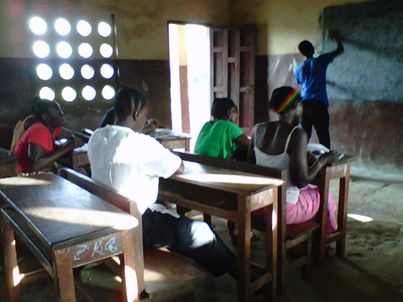
Adult literacy classes organized by The Center for Community Empowerment and Transformation (CCET) in Rotifunk started in May- June.  Here’s a picture of some of the adult learners in a lesson at one of the local primary school buildings.

Adult Literacy students in primary school classroom

Adult Literacy students in Rotifunk primary school classroom

These adult students are women typically in their 30’s with little to no literacy.  As small farmers and market traders, mothers and perhaps single parents, their lives are as full as working women everywhere.  But they are committing themselves to gain new skills that will help improve their small businesses and allow them to take bigger roles in supporting their children’s education.  You can read more about these women and the literacy program CCET is customizing for their needs here: adult-literacy-what-do-they-really-need-to-know/ .

Classes will take a few weeks break now.  It’s planting time for farmers and vegetable gardeners, and these students need to focus on getting their crops in and off to good start as the rainy season moves to a peak.  It’s also Ramadan, the annual month of prayer and fasting for the Muslim students.  These women need to be home cooking in late afternoon and preparing for their family breaking the daily fast at sundown. This is when adult classes would normally be taught – after the day’s work is done and before it gets too dark to see in this small town with no electricity.

The adult literacy instructors from CCET need a break, too.  They are teachers at Prosperity Girls High School, and just completed an intense couple months of preparing students for exams and conducting exams.  They need time off for holiday and to visit their families living in other towns.

Teaching can be a bit hard in the peak of the rainy season anyway.  I’m sitting in my greenhouse as I write this and listening to the rain drumming on the glass above me.  We’ve had unusually heavy rain for July in Ohio.  But this is nothing like the monsoon rain in Sierra Leone’s lowland plains where 100-120 inches a year is the norm, falling all in a seven month period.

Today’s rain is bringing back memories of trying to teach in Rotifunk in July and September when the skies opened and dumped a solid white curtain of rain on the metal roofs of classroom buildings.  No one could hear you when the rain was like horses galloping over your head.  You had to just pause and wait for it to pass before resuming the class.  A break in classes right now for Mother Nature is in order.

I smiled when I saw the above picture of adult students perched on short primary school benches with legs stretched out in front of them, intent on their lesson.  The teacher doesn’t have to keep control of a room of fidgety teen students here.  These women want to be here. They’ve been asking for classes to resume their education after ten or twenty years’ break, or to just begin now.  I can’t wait to see how they progress come September.

Tree Nursery – see them grow

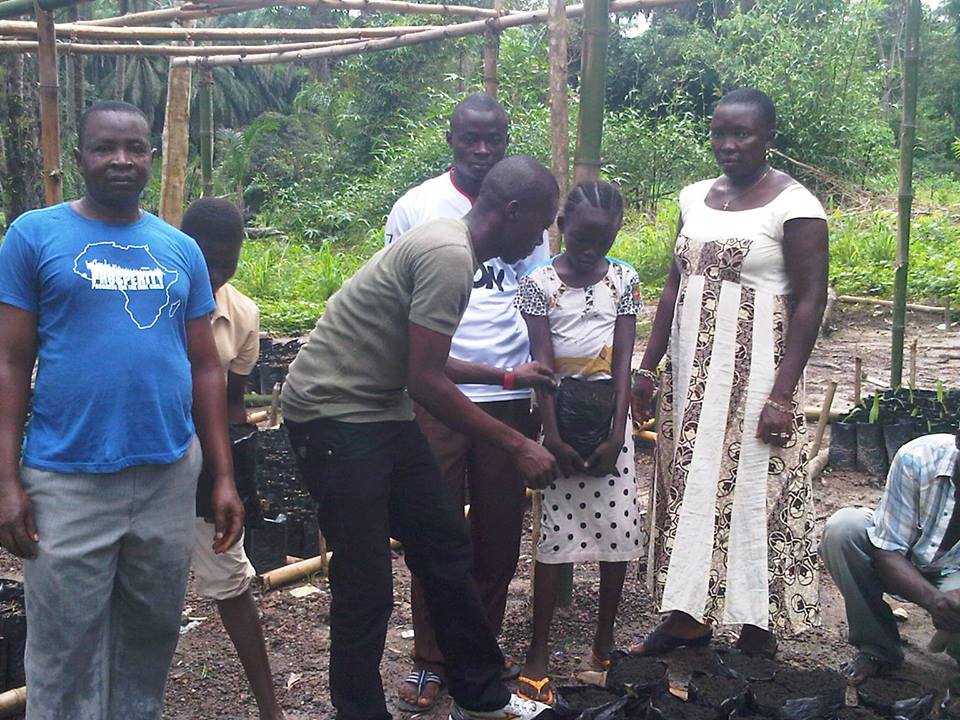
CCET-SL volunteer and local teacher Mr. Sennessy (left, blue shirt) and Mr.s Kaimbay, CCET-SL Director and local principal, left, watch as a young volunteer prepares her seedling bag.

CCET-SL volunteer and local teacher Mr. Sennessy (left, blue shirt) and Mrs. Kaimbay, CCET-SL Director and local principal, right, watch as a young volunteer prepares her seedling bag.

It’s the rainy season now in Sierra Leone and planting time.  Rotifunk is busy planting tree seedlings to raise in their nursery for trees of economic value. 

Thanks to cell phone pictures and Facebook, we can all now see the nursery taking shape and seedlings growing.

The tree nursery is a project of Rotifunk’s home grown nonprofit organization, the Center for Community Empowerment and Transformation.  CCET-SL’s aim is to empower their community in development with projects like the tree nursery.  With these projects, they hope to transform lives of the average person in Bumpeh Chiefdom.

I shouldn’t say they hope to transform lives.  They plan to transform lives. With simple, concrete projects like the tree nursery that will have clear payback, this isn’t a leap of faith.  Next year, the trees will be ready for people to plant in their own gardens and farms to improve their family’s diet and gain income by selling their surplus.   Citrus, coconut and oil palm trees, as well as teak trees for future lumber sale.

Bumpeh Chiefdom is a rural area rich in agriculture.  So, economic development here starts with agriculture projects. To read the whole story about the Economic Tree Nursery,  click here to see an earlier post.  Sherbro Foundation has supported the nursery project with money to buy farm tools and young oil palm seedlings bred for early fruiting.

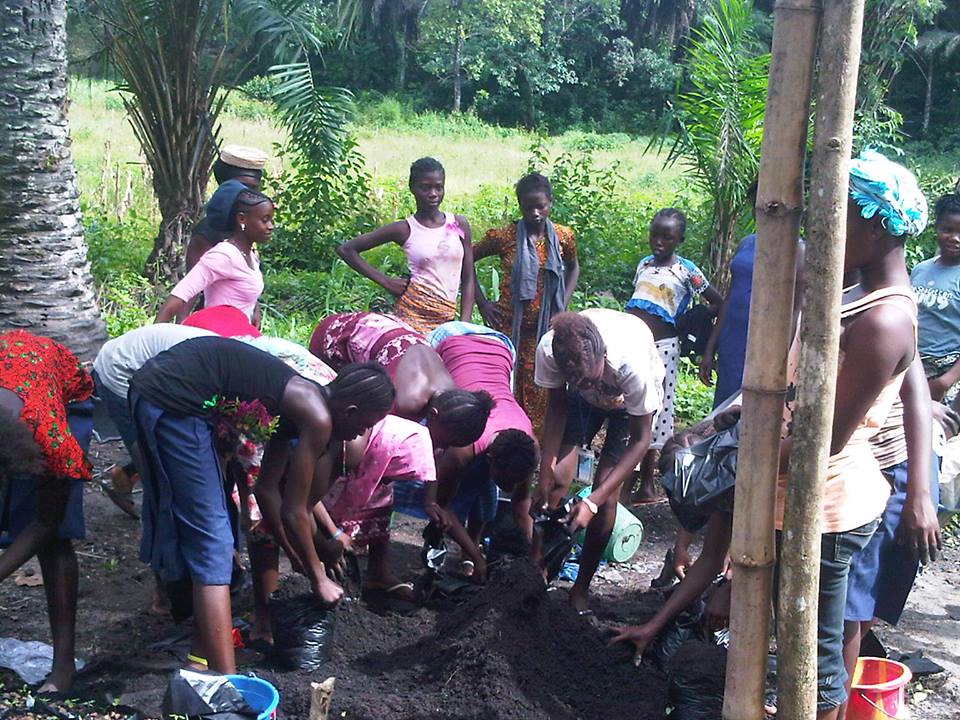
Filling polythene bags with soil that will allow seedling to form deep roots.  This looks like rich silty soil from the Bumpeh River floodplain.

Filling polythene bags with soil that will allow seedling to form deep roots. This looks like rich silty soil from the Bumpeh River floodplain.

Rotifunk community gets involved with preparing the bags to hold seedlings.

Rotifunk community gets involved with preparing the bags to hold seedlings.

Seedlings will be nursed in the nursery, watered and protected from hot tropical sun in the dry season til ready to plant next year.

Seedlings will be nursed in the nursery, watered and protected from the dry season’s hot tropical sun til ready to plant next year.  Families across Bumpeh Chiefdom are eligible to get trees at a token cost.

CCET-SL volunteers and local teachers Osmun Kamara and Phillip Komoh.

CCET-SL volunteers and local teachers Osmun Kamara and Phillip Komoh.  I’d guess these are coconut seedlings.

Breaking the barrier of illiteracy

Junior Secondary School 3 students (JSS3 or 9th grade in the U. S.) across Sierra Leone last week completed the BECE exam.  The Basic Education Certificate Examination is a standardized exam administered throughout West Africa by the West African Examination Council to certify students are ready to progress to senior high school.

This is a quiet milestone. But progressing to high school should be celebrated as a big deal for a country where 56% of adults over the age of 15 years in 2011 have never attended formal school. (World Bank data) This number seemed high to me.  But if you stop to think, it’s again that group of young adults whose educations were interrupted by the war and its aftermath.

JSS3 students from four Rotifunk secondary schools are glad the rigorous BECE exam is over.  Twenty two subjects are offered, and students expected to test in 10-13 subjects that take 2 to 2 ½ hours each.  That means 5-6 days of testing for each student.

To pass the BECE, students must pass at least six subjects, including English and Math.  Sierra Leone pass rates last year were only 50% of test takers in Language Arts and 57% in Math; it’s not an easy exam.  Less than half the students taking the BECE in 2012 in the Southern Province where Rotifunk sits passed the overall exam.

Four Rotifunk secondary schools are taking the exam:  Walter Schutz Memorial Secondary School (where I taught many years ago), Prosperity Girls High School, Ahmadiyya Islamic School and Rotifunk’s Christian academy.

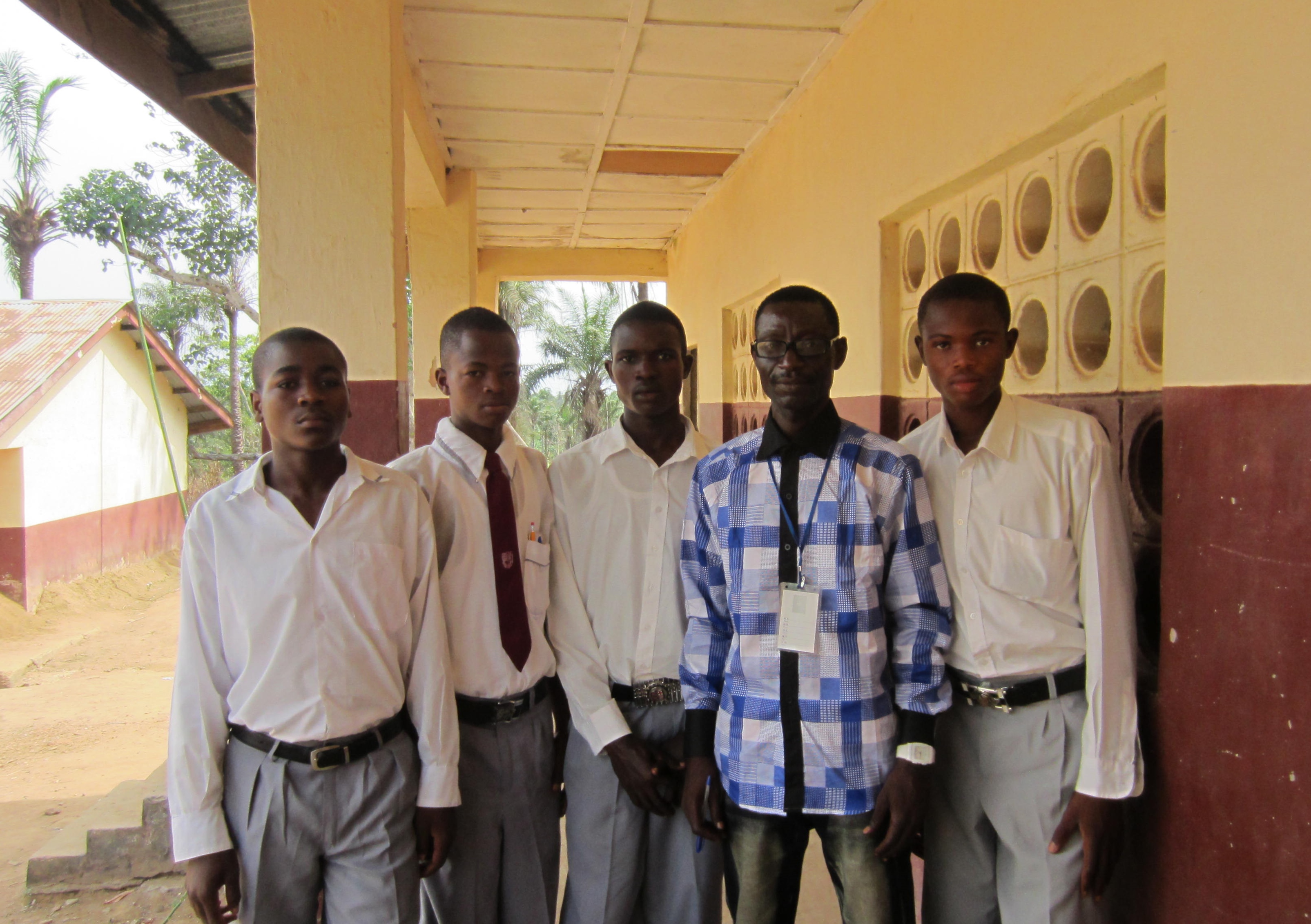
Student debaters at Walter Schutz Secondary School and their teacher after completing a debate.

Student debaters at Walter Schutz Secondary School and their teacher after completing a debate.

Prosperity Girls High School was the stand-out in 2012, not only in Rotifunk, but in Moyamba District (one of 12 administrative districts in the country). 100% of PGHS girls taking the BECE exam passed. This is significant given the area’s first all-girls secondary school had only been open three years when students first sat for the BECE last year.  It was the first time each individual girl took the exam, and the first time the school sent students to sit for the exam.  It was also the first year JSS3 – or 9th grade – had been offered at this new school.

Prosperity Girls High School was recognized by the Ministry of Education for their exceptional results.  It was noted their results could be compared with schools in the district open for a hundred years. Their net results were seen as second in the district, given their actual scores and smaller number of students.

So, how did PGHS pull this off?  It starts with an excellent principal and excellent teachers who are capable in their respective subjects and highly committed to their students.  But their secret ingredient is holding what Principal Kaimbay calls a camp – a month long study camp.

JSS3 students hunker down at the school and live there dormitory style all week while the teachers conduct comprehensive reviews of the whole curriculum.  Principal Kaimbay sleeps at the school with them, getting them up at 5:00 AM to begin an early study period before review classes start at 8:00 AM.  They have afternoon breaks for sports and rest, and evening review classes begin again after dinner til about 10 PM.  They can go home for the weekend, and return to begin the condensed study program again on Monday – for a whole month.

This approach delivered results.  Every girl passed in 2012, allowing PGHS to open their first senior high class (10th grade) for the current 2013 academic year.  Mrs. Kaimbay attributes their success to the comprehensive review and keeping the students focused.  We make sure we review every subject and the full curriculum before the exam, she said.  We try to verify knowledge and assist each student.  We provide the  focus and discipline for studying that they would not be able to get if they were studying at home.

Twenty eight JSS3 students from PGHS sat for the BECE this year.  So, it requires not only discipline for the students, but a huge commitment by the teachers and principal. As in countries everywhere, the teachers and principal are the heroes of this story.

I asked PGHS teacher Mr. Sonnah how it was going a couple weeks ago.  Great, he said.  They did a better job preparing the study camp this second time around, so he expects to see results on par with last year. 

Sherbro Foundation knows  JSS3 students from all Rotifunk’s secondary schools have worked hard to be ready for the BECE.  We wish them all the best as they await their results.

Growing the ranks of students ready for senior high is essential for this rural community – and for the country – to continue their development journey and move beyond poverty.  There will no doubt be barriers to the students completing senior high and then joining the workforce.  But academic readiness should not be one of them.  It should be an enabler.   Fortunately, in Rotifunk students are being given a good start. 

You can help.   One barrier Sherbro Foundation is helping to remove is the burden of school fees for rural families unable to pay them.  Consider contributing to the Girls Scholarship Fund that awards school fee scholarships to girls in all four Rotifunk secondary schools.   $22 USD pays fees for one senior high girl to attend school for the year.  $18 USD covers annual school fees for one junior high girl.   You can find an on-line donation button in the right hand column of the website.

West African Peace Corps?

As a former Peace Corps Volunteer, this article caught my eye.  ECOWAS, the Economic Community of West African States, is sending forty volunteers from their states to serve in education and health care in Sierra Leone.  Twenty have arrived to serve as French and Science teachers in eleven of the country’s upcountry districts, with twenty doctors and intensive care nurses to follow.

I think of ECOWAS as akin to the European Union.  The purpose given for this Volunteer group: “ECOWAS Volunteers are young men and women professionals from the 15 Member States, who contribute to regional development efforts and the consolidation of peace and reconstruction in crisis affected-communities of the region.”

They will work under “at times, difficult conditions” and help “to strengthen the capacities of local organizations, establishing and supporting partnerships between communities.”

Sounds like something a U. S. Peace Corps Volunteer can identify with.

I applaud their effort.  Another sign that peace and stability have taken hold in West Africa with countries sending volunteers to promote peace and development  in their fellow states.

I would say to these volunteers, you’re likely to get more out your experience there than you feel you are able to give.  Experiences that will serve you well for the rest of your life.  Most U. S. Peace Corps Volunteers fondly say this of their Peace Corps service.  Enjoy it!

Read the full article here: http://awoko.org/2013/06/26/sierra-leone-20-ecowas-volunteers-to-serve-in-sierra-leone/

Obama’s Bumpeh Chiefdom fans

Obama may not be visiting Sierra Leone this week, but he has fans in Bumpeh Chiefdom.  You don’t need to look far to see people proudly showing their support for Obama.

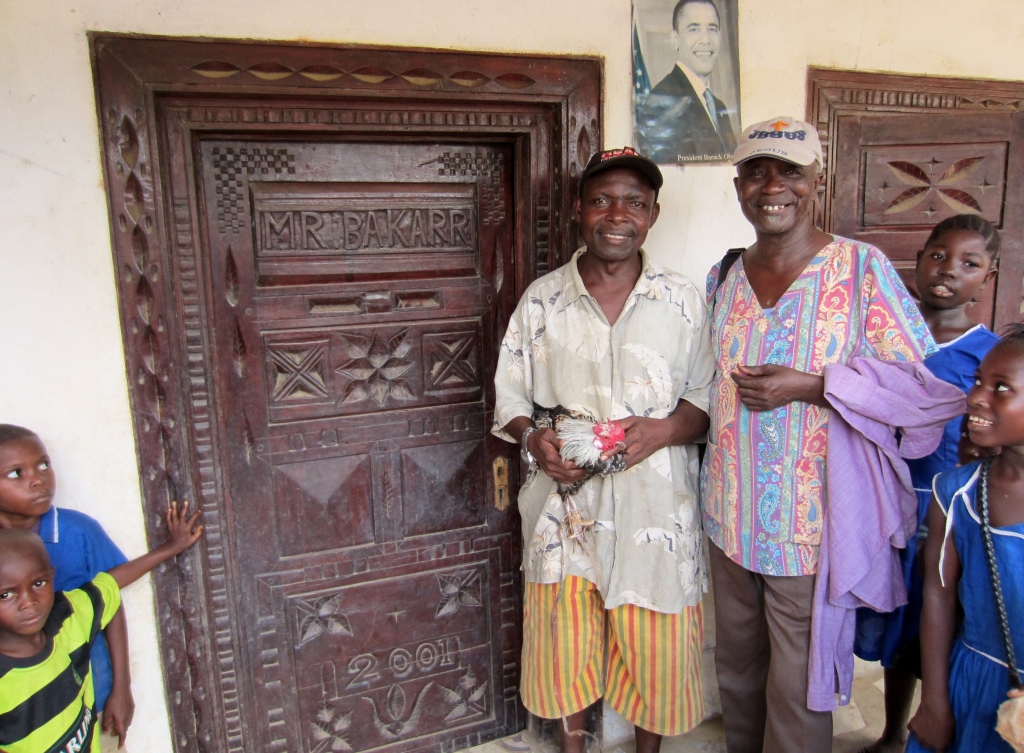
Mr. Bendu, left, of Moyeamoh village, proudly wears his Obama hat in front the Obama picture on his front porch. (He's holding the chicken I've been presented with.)

Mr. Bendu, left, of Moyeamoh village, proudly wears his Obama hat in front the Obama picture he keeps on his front porch. (He’s holding the chicken Arlene’s been presented with.)

Mr. Bendu, Moyeahmoh village, displays his Obama watch.

Mr. Bendu, Moyeahmoh village, displays his Obama watch.

Woman Sampa dancer in Rotifunk wears her Obama shirt.

Woman Sampa dancer in Rotifunk wears her Obama shirt.

Registering births – a basic human right

I’ve always thought of having a birth certificate in the U. S. as a legal right of U. S. citizenship.  But I never stopped to think of it as a basic human right.  Maybe that’s because we’ve always had birth certificates here.  I frankly never thought much of it because I never had to experience what it’s like to have to prove who you are.

Mr. Sonnah described birth certificates in Sierra Leone as being a basic human right – that your birth is documented and you as a person are legitimized.  Simple and straightforward – but not easy in today’s rural Sierra Leone.

Mr. Sonnah, teacher and volunteer organizer at Rotifunk’s Center for Community Empowerment and Transformation (CCET), said birth and death registration is required by law today in Sierra Leone, but the majority of rural communities either do not understand this or do not have the means to do it.

Sixty percent of Sierra Leone’s population lives in rural areas with little to no national government presence.  Traditional paramount chief rulers are the primary – and often the only – means of ensuring basic law and order, and delivering the fundamental systems of organized societies.  Systems like registering births and deaths.

So CCET is embarking on a project to organize a grass roots system to register births and deaths on a monthly level down to the smallest villages in Bumpeh Chiefdom.  With 208 villages, many of them remote with barely drivable roads (in good weather) and little or no public transportation, this is no small task. 

The birth and death registration project is the brain child of Bumpeh Chiefdom Paramount Chief Charles Caulker.  When Chief Caulker asked if Sherbro Foundation could help with sponsoring an initial training workshop, I asked him to explain why this project is important and how it fit within the foundation’s mission of furthering rural development.  I could intuitively make the connection, but wanted his perspective.

Paramount Chief Caulker in village meeting with his official staff bearer & horn blower.

Paramount Chief Caulker in village meeting with his official staff bearer & horn blower.

Arlene, he said, NGO’s (non-governmental organizations) and UN groups like UNICEF (United Nations Children’s Fund) come to Sierra Leone all the time to do studies and planning for their aid programs.  We can’t accurately tell them about our population demographics, especially for children and children under the age of five – one their major program target groups.  They then can’t do accurate forecasts and plan program budgets.  They’re spending money to provide for children born in the past, and we can’t accurately tell them how many we have and where they are today.

Sierra Leone is a country where 60% of its population is under the age of 24 years of age.  The Infant Mortality Rate is still is 74.95 of 1000 live births – 11th highest of 224 countries worldwide.  (From CIA World Factbook, Sierra Leone – last updated 2013) So, accurately counting children and planning program services for children is indeed an important part of rural development.

There are more immediate and practical reasons why the people of Bumpeh Chiefdom need a birth registration system.  Without a birth certificate, you cannot gain admission to schools and get the free health services the government provides. You must prove you are a Sierra Leone citizen. Nor can you cannot get a passport or contest election and run for local office. 

I asked Mr. Sonnah what people do today without birth certificates. They are penalized for not having one when they need it, he said, by paying a fine of Le 5000 (about $1.25USD). Then they are given one.

Proving your birth and place of birth is more fundamental to us, Mr. Sonnah said.  Beyond proving you are a Sierra Leone citizen, people want to claim their home village.  They want to claim the cultural set (tribal group or ethnicity) they belong to.  These are social rights that are important to us.

When we consistently give people their rights to citizenship, Mr. Sonnah said, then we can ask them to perform the responsibilities of citizens.  Things like paying taxes and voting, both institutions still in the early formative stages in Sierra Leone.

Chief Caulker was frustrated with the lack of accurate population data and people in his own chiefdom missing their personal documentation.  So he’s decided to organize a model program to register births and deaths in his own chiefdom.

Bumpeh Chiefdom is divided into thirteen sections, each with a Section Chief and local leaders.  Like the paramount chief, section chiefs are elected from traditional ruling families.  They rule for life and are responsible for the welfare of the villages in their section.  They periodically meet with Chief Caulker and other chiefdom leaders in a Chiefdom Council to discuss issues that affect them and their people.

Bumpeh Chiefdom Council meeting - town hall style.

Bumpeh Chiefdom Council meeting – town hall style.

This cascading system of traditional leaders will be used for the birth and death registration system.  Villages will have a representative trained to keep a ledger recording births and deaths as they occur and bring them to their Section Chief.  Monthly, sections will report their data to the chiefdom level to compile overall stats.

It’s a simple manual system for now.  But it’s the strong organization of traditional chiefdom leaders used to working together in a collaborative process that will make it work.  That and the inclusiveness and steady hand Chief Caulker brings to managing chiefdom programs.

An old tradition will also be reinstated with the birth registration system.  The Center for Community Empowerment and Transformation will ensure each child born has a tree planted in their home village to recognize their birth.  Read more about CCET’s Economic Tree Nursery project and how this will be used to provide birth trees here.

The Sherbro Foundation is pleased to be sponsoring costs for an initial workshop where village representatives will be trained on registering births and deaths.

Growing trees with economic value

Let’s talk about the another part of the Sherbro Foundation’s work – helping to spur economic development in a rural community.

On my last two trips to Sierra Leone an idea was percolating in my brain that finally crystalized.  I recognized I wanted to do something beyond the cycle of donations for traditional nonprofit work supporting education, health, community services and the like.  Don’t get me wrong.  These are important and much needed.  These are a lot of what Sherbro Foundation is doing, too.

But I also wanted to do something else.  Something more.

The more is giving the chiefdom a boost in economic development, and their main economic livelihood is agriculture.  This chiefdom is blessed with fertile land for agriculture and rivers with which to irrigate.  It is lacking the means for most people to develop and expand beyond subsistence agriculture, or to further develop agriculture as a business.

Doing more is helping people expand and diversify their family farm crops, increasing their own food security and allowing them to sell a little excess for much needed cash.

Doing more is also helping spur small farming business that can expand, and in doing so, create paid jobs where none now exist. Getting jobs with regular paid wages can help people join the “formal economy” where they can then pay their own children’s school fees and buy their own mosquito nets.

I was astounded when Bumpeh Chiefdom Paramount Chief Caulker told me what typical cash incomes are in many small villages.  It may be as small as 50,000 Leones/year.  This is little more than $10 USD.  $10 per year, that is.  This is the bottom of the subsistence scale, an informal economy of barter.  You locally trade or sell small amounts of what you grow.  Otherwise, you live off the land, and the fish in the rivers.  Or small game you may be able to hunt.  Bush beef we called it.  You may be able to raise a few goats and chickens.

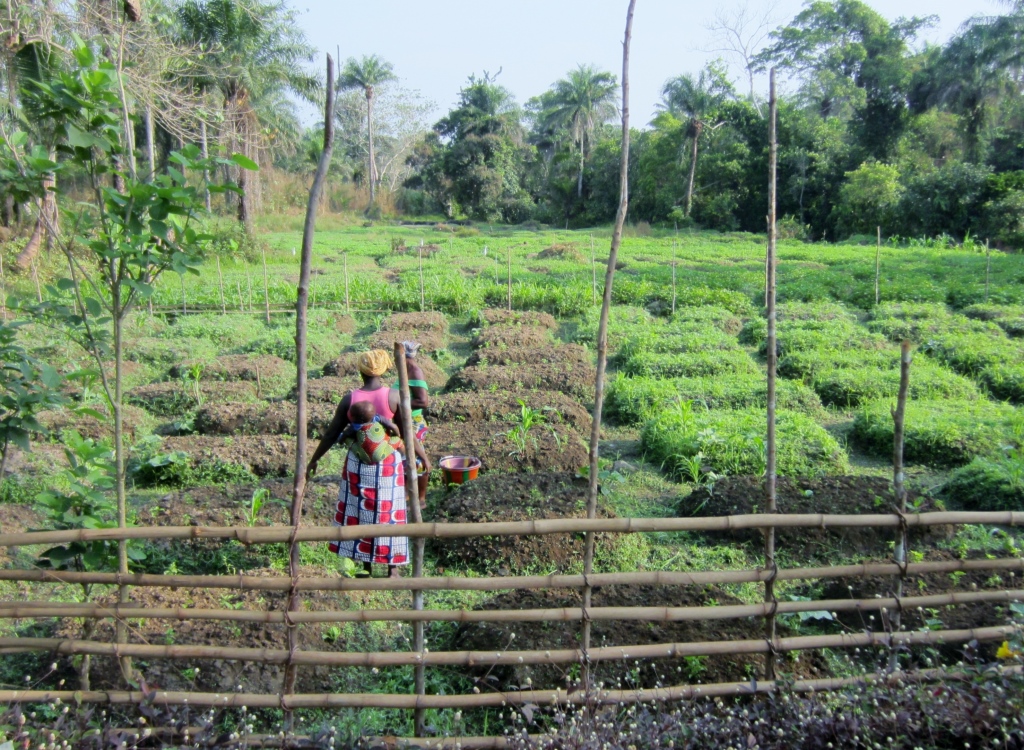
Tending a vegetable garden.  Day care on your back.

Tending a vegetable garden. Day care on your back.

The most disadvantaged are young adults, eighteen and up, ready to start out on the own.  Also women divorced or separated from husbands, left to fend for themselves and their children.  The families of these groups literally do not have any excess money to loan them to start their farms and vegetable gardens.  With no money for tools, seed, and fertilizer, these groups are stuck. Stuck in extreme poverty.

The Center for Community Empowerment and Transformation, Rotifunk’s all-volunteer group for community development is beginning to tackle this area by starting a tree nursery for trees of economic value.

The idea came up one day on my last trip when we needed to escape the heat of a tropical afternoon in the dry season.  Come on, said Chief Caulker, let’s go pick grapefruits.  We took chairs beyond his house and down a hill to an old citrus orchard started by his father fifty years ago.  I didn’t know citrus trees live 50+ years; maybe the non-hybridized kind.

Boys catch grapefruits being picked.

Boys catch grapefruits being picked in mature fruit orchard.

Picking fruit meant sending boys to shinny up a tree in their bare feet to drop grapefruits down to other waiting kids.  They hold out gunny sacks to break the fall of fruits and not squash them.  Then we divvy up the fruit so everyone gets some.  We sent someone to find bread and made “sandwiches” for the kids with groundnut paste – roasted peanuts you grind up with an empty bottle on a board.

We were enjoying the grapefruits and Chief Caulker reminisced about how he had had “his tree,” his birth tree, and how this is no longer being done.  Probably another casualty lost to the war. Your Tree is where your umbilical cord is planted after your birth together with a tree seedling.  It grows as you grow, and it’s Your Tree.  An old custom in many parts of Africa.

A charming and practical custom, I agreed.  We need more trees planted in this country.  I see fire wood being cut left and right.  How are trees being replanted?

This led to a conversation about how we should start planting trees and get the new community based organization – the Center for Community Empowerment and Transformation, still an idea, but at least that day drafted on paper – to start this.

Four months later, as I write this, CCET volunteers are planting the Economic Tree Nursery.  The rainy season has started, and it’s time to plant trees.

CCET has started with fruit trees they are germinating from seed and growing themselves to seedlings.  Orange, grapefruit, lemon (we call lime) and mango.

CCET will transplant seedlings to small polythene bags and nurse them til next season, when local people can buy them at a small nominal cost for their farm or garden. Mr. Sonnah, agriculture teacher and CCET volunteer explained, people take things more seriously when they have to pay something for them.  Same thing at home, I said.  These small fees will go back to purchase materials to start new seedlings each year.

Mr. Sonnah said getting fruit trees will improve a family’s food security, giving them another food source and diversifying their diet.  Fruit trees are typically planted near rivers and streams, helping keep them watered.  As trees mature, they then protect the water catchment area. Trees are like sponges, taking up water, and their roots prevent run-off and erosion in the heavy tropical rains.  These water filled trees then help keep streams from easily drying up in the dry season.  People will need chiefdom permission to cut down economic trees and pay a small fee, as well as replant the tree.  This is to discourage trees being cut for firewood.  Acacia, a fast growing “weed tree” can be used for fire wood.

Village woman extracting oil from palm fruits in her canoe.

Village woman extracting oil from palm fruits in her canoe.

CCET is also starting to nurse oil palm seedlings they bought from Njala University’s agriculture school.  Oil palms are native to Sierra Leone, and the oil from the palm fruits is a mainstay of the local diet.  Palm oil is increasingly used globally for a variety of applications, and is a good cash crop.  The Njala seedlings are a new variety that will produce faster,  fruiting in about four years.

Nine hundred teak seedlings from another source have also been added to CCET’s tree nursery.  These need special care with careful pruning and cultivation as young seedlings.  Next rainy season they’ll be bigger and stronger, and ready to be sold and transplanted again for future lumber harvesting.

CCET will organize workshops and 1:1 training on how to plant and care for all the trees that will be sold.  With 60% of the country’s population under 24 years of age, these are skills that were lost in the war years and now needed for young adults and women needing to become farmers.

The custom of children getting “their tree” will start again, as well.  CCET will ensure each child has a tree planted at birth.  In this way, you will also be able to tell how many children were recently born in a village by counting the number of new trees.

This project is a good example of how a few people can make a big difference when they work together and just get going on a practical first step.

Many benefits follow this project: economic development, food security, environmental protection, protecting cultural traditions, empowering youth and women as farmers.

Sherbro Foundation is glad to have contributed the funding to buy farm tools for the tree nursery and the oil palm seedlings.

Adult Literacy – what do they really need to know?

It’s estimated that 70% of Sierra Leone’s population lives at the impoverished level of $2 USD/day or less. This is sometimes globally called the bottom billion, the lowest tier on the ladder of the world’s seven billion population.

This is true of rural Bumpeh Chiefdom. As you move into more remote villages, the percent no doubt climbs above 70% to most if not all of these communities.  With this kind of poverty comes lack of education.   

If you want to provide adult literacy education, where do you start? Literally, where should you begin in this kind of environment?

A good place is to know the group you aim to educate.  This is where Rotifunk’s Center for Empowerment and Transformation, a local all-volunteer group of Rotifunk teachers is beginning their work on adult literacy.

Shortly after Prosperity Girls High School Principal, Rosaline Kaimbay came to Rotifunk to begin her work on the school, adults expressed their interest in learning to read and write.  Others had attended school, but had to drop out and wanted to continue and develop skills to join the job market.  Or to help their own children as they progress through school.  The Center for Community Empowerment and Transformation has made adult literacy for these people a cornerstone of the Center’s work.

I asked about a profile of the current adult learners.  All are now women; hopefully the men will follow.  The majority of the women are single heads of household, divorced, separated or widowed.  They are mainly in their mid-30’s, but range from 20 years old and up.  This is the group that would have had their schools abruptly shut or interrupted during Sierra Leone’s civil war when towns and villages were abandoned to rebel fighting.  In the early years of rebuilding following the war, schooling would have either not yet been available, or the cost beyond the reach of rural families.  Girls’ education would traditionally have been given low priority, especially as a girl approached marriageable age.

Women fetching water for their vegetable garden.

Women fetching water for their vegetable garden.

Early primary school learning for these women has long been lost and forgotten.  They moved on with their lives in the footsteps of their mothers and grandmothers, doing the work available in a subsistence agriculture community.  They became small traders and small farmers.

In one way or another, 70% of Sierra Leone’s population is involved in agriculture.  Either they grow things themselves, or they are small traders who buy agricultural products like rice, palm oil and vegetables in quantity from small farms and bring them to resell in larger village and town markets.

Small traders may also buy “general store” items in larger towns to resell in local markets – cooking utensils, plastic buckets and basins, soap, batteries, plastic sandals, cloth and so on.

These are working women, working in what’s called the informal economy.  It’s the economy of small farmers whose schedules are driven by the planting and harvesting seasons, and of small traders who must be available for market days in towns and villages where they sell their wares.  They need knowledge that will help them improve their current lives, and on a flexible schedule.

Women selling fish in Rotifunk's market.

Small trader selling smoked fish in Rotifunk’s market.

Traditional reading and writing is not the first priority for these women.  The typical classroom reading, grammar and writing kind of stuff that you get over twelve years of public education is not of immediate use to them.  Basic arithmetic is a priority.  Vocational skills tailored to their kind of work are another need.

The volunteer teachers at the Center for Community Empowerment and Transformation are embarking on a “functional adult literacy” program. They will teach their adult learners what they need to know to successfully conduct their business and improve their lives.

Traders need to know basic computations to ensure they’re getting the best price for their goods, how to calculate interest for the small loans they invariably take (or maybe give to friends), and skills on how to better market the goods they sell.

Small farmers need to know about applying fertilizer and manure, when and how much, and how to “add value” to their agricultural products by further processing or packaging to get a better price.

They would all like to know more about female reproductive health and social skills to better manage conflicts (known here as palavers), useful when you’re living in the confines of a small village.  And they’re enjoying recreation organized specifically for them – women’s football (soccer) teams.  Where else would a village mother find the time (or give herself the permission) to play sports and release the pent up stress of living in poverty and develop the camaraderie of a group of peer women.

There’s no curriculum for this kind of functional learning, so the Center’s volunteer teachers will develop their own lessons.  Experienced teachers know how to do this, and build as they go.  They understand these things when they lived embedded in the community with their students, and are committed to working with them.

Now, how to give these women the time from their busy lives to take advantage and improve themselves?  Sound familiar? I have no doubt this program will grow and the merits be known by word of mouth from the initial group of students.  Success breeds more success.

The Center for Community Empowerment and Transformation – another bright star

Trying to do good in another country is not always straightforward.  First, you need to find well-defined projects you believe will “do good” in the area you want to serve.  Then you need a trusted partner on the ground who shares your objectives and can effectively deliver the nuts-and-bolts work, and do it with integrity.

The Sherbro Foundation is fortunate to have found such a partner in The Center for Community Empowerment and Transformation.  CCET is a grassroots, all-volunteer nonprofit group of Sierra Leoneans organized for the development of Rotifunk and Bumpeh Chiefdom.

It’s quite a name and tells you right off what the vision of this group is. It’s no less than the empowerment and transformation of their community.

I was fortunate to have had an early and impactful learning from my old days in the Peace Corps that I’ve carried with me all these years.  To make lasting change or improvements, don’t show up with your pre-cooked “solution” and try to give it to people who aren’t sold on – or maybe even aware of – the problem you’ve selected for them. This is generally true anywhere, and even more true when working with a rural community of another culture. 

Still today, I see too many NGOs (nongovernmental organizations) trying to solve the problems of the world with their own “programs”.  They may not spend enough time in the developing country communities they want to serve to jointly set priorities and agree on approaches to use.

It was a stroke of luck that found me back in Rotifunk for my third return trip right as the concept for the Center for Community Empowerment and Transformation was taking shape.  I was visiting more of the chiefdom and better understanding the extent of the needs there.   I arrived already frustrated in not finding existing nonprofit organizations in the U. S. interested in supporting the kind of small community projects I saw needed in Bumpeh Chiefdom.  Grant applications, even if successful, can take months if not a year or more to process. I was already toying with the idea of creating my own nonprofit.

At the same time Prosperity Girls High School had just started their first senior high class, and with that, hired several new teachers.  More competent and committed teachers joined those already at PGHS, ready to serve this rural community.   Within a month of their arrival, several of the new teachers joined up with existing teachers to form the concept for a community based organization.

The Center concept

I asked Mr. Sonnah and Mr. Kamara, PGHS teachers and thought leaders in the Center, how their concept had come about. Both relayed the same story.  Some old university friends of theirs representing an NGO had come to Rotifunk to do a survey.  They challenged them to create their own community-based organization.  Come on, they said.  You’re in this rural place with time on your hands; you have the education and potential to be doing more. 

Mr. Sonnah and his 7th grade class.

Mr. Sonnah and his 7th grade class.

The teachers had already seen how PGHS principal Rosaline Kaimbay was struggling to start adult literacy classes, holding intermittent lessons on the front porch of her house after school let out.  The majority of the adult students were women whose educations were interrupted, or maybe never started, because of the war.

The teachers agreed adult literacy would become the first core program for the Center to take on and they would do it on a volunteer basis.

Mr. Kamara in a moment of relaxing.

Mr. Kamara in a moment of relaxing.

More projects soon followed.  The Center’s current project portfolio includes:

  1. Adult literacy – starting with creating a curriculum of practical skills for small traders and farmers that are illiterate, mainly women.  
  2. Girls Scholarship program – paying school fees to keep teenage girls in Rotifunk’s four secondary schools at a time when drop out rates for girls climb and families have great difficulty paying for the cost of an education.
  3. Tree nursery for trees of economic value – nursing small teak tree and oil palm seedlings and starting citrus and avocado trees from seed to provide to the community at nominal cost.
  4. Computer literacy – building the computer skills of local teachers in preparation for organizing the community computer lab the Sherbro Foundation has facilitated with a donated shipment of fifty computers now on their way to Rotifunk.
  5.  Registration of chiefdom births and deathshelping set up a model process where none now exists in Bumpeh Chiefdom, or most of rural Sierra Leone.
  6.  Adult sports teams for women – organizing women’s football (soccer) teams to give women still traumatized from the war a physical outlet for stress and team building for a peer network.

Within five months of their initial conceptual discussion, the Center volunteers are busy planting trees, teaching computer skills, and developing lessons on basic computations for illiterate market women.

This is what I call empowerment.  They’re getting going on concrete, practical programs that can help transform their community using  the limited resources they have.

The Sherbro Foundation is proud to have helped with start-up costs for the Center.  We have donated money to pay fees for the Center to officially register as a nonprofit with several Sierra Leone ministries, making them eligible for local grant funds.  We have also provided money for classroom furniture to be locally built for the computer lab, and to purchase farming tools and oil palm seedlings for the tree nursery.  We will fund a one-day workshop where people will be taught how to complete the birth/death registrations.

More will follow on each of these projects.

Mr. Sonnah explained the Center’s logo to me and how it symbolizes what they plan to accomplish.  A man and a woman are together holding one torch light.  Light brings about transformation, and men and women are equally balanced in holding one light.  They are surrounded by olive branches depicting them rescuing the chiefdom from its past traumas.  They are transforming the chiefdom to be a better place.  Mr. Kamara said in his quietly confident manner, we are developing our brothers and sisters, and we know with our work today, tomorrow will be a brighter day.  We see our future as bright.

The Sherbro Foundation sees their future as bright, too, and we’re happy to be helping them on their way.

See today’s Sierra Leone by video – Brand Sierra Leone

Freetown beachTo bring business and tourists to Sierra Leone, they need to see the country and what’s going on today.  Brand Sierra Leone aims to do this.
Brand Sierra Leone is a global initiative started by a group made up of diaspora and media experts…, who want to promote a fresh perspective of Sierra Leone by spreading the most important and positive news in the areas of culture, economy and society from all around the country.
In order to do this, Brand Sierra Leone offers via http://brandsierraleone.tv/ a selection of short videos, documentaries, dedicated news and programmes especially focused toward tourism, arts & culture, history, music, fashion, inward investment, business, etc.
Brand Sierra Leone is made up of a team of professionals specialising in communication, marketing and creative applications for digital media such as pre/post-production video, graphic & editorial design, advertising optimisation strategies, etc.
Click through their website for interesting mix of videos about development, history and contemporary Sierra Leone culture.

How you can help

DSCN0359

Donations are great, but there’s other ways to help, too.

  • Like us on Facebook and “share” Sherbro Foundation Facebook news items to your Friends list.
  • Identify organizations interested in supporting girls education, solar energy & agriculture in West Africa.  eg., Churches doing mission & outreach work;  Schools doing public service & educational projects; Foundations & Nonprofits interested in these areas.  Help connect us and advocate for us.
  • Help design a logo for Sherbro Foundation with a .jpeg image.
  • Sponsor a girl for one year in secondary school by paying school fees:
    • $18  for Junior High
    • $22  for Senior High
    • $35  for a school uniform & shoes she’ll wear for two years or more
  • Find used or in-kind donations for schools:
    • Educational videos, tutorials on DVD (eg., math lessons), school supplies, books, computer mouse & mouse pads.
  • Support our current Projects – donate online using the “Donate” button to the right on each page
    • Fifty Laptop computer carrying bags for the new computer lab – about $15 /bag    Current need!
    • Solar Energy System for the Computer Lab
    • Office printer (need 220V equipment)
    • Sponsor a Science teacher for additional teacher training – $250/year
    • Community economic tree nursery – nurse seedlings for local families / create demonstration garden and train on growing
    • Village Cooperative Store – stock household items to sell at cost for a small, subsistence agriculture village; avoid markup costs & provide initial stock for a co-op store

Sherbro Foundation invited to be part of Cincinnati’s Freedom Center event

The Sherbro Foundation was delighted to be invited to participate in an important event for women worldwide May 22 at Cincinnati’s National Underground Railroad Freedom Center.

The free public evening kicked off with a 5:30 p.m. reception and Action Fair. National and local nonprofits – including Sherbro Foundation — offered information about their efforts to uplift women and eliminate oppression and discrimination, both here and abroad, and how you can help.

The event is a follow-up to the recent traveling exhibit at the Freedom Center, “Women Hold Up Half the Sky,’’ based on the bestselling book, “Half the Sky – Turning Oppression into Opportunity for Women Worldwide.” Both serve as wake-up calls to the injustices perpetrated against women worldwide and the ways to effect change.

The program began with a 40-minute version of the PBS Half the Sky documentary.  A short keynote address was presented via live satellite by Half the Sky Executive Producer Mikaela Beardsley and followed by a brief panel discussion with local volunteers and activists.

The evening wrapped up with a longer Action Fair at to give attendees an opportunity to learn more about organizations supporting women locally and globally and how you can get involved and support them through volunteerism, advocacy or giving.

For more information on the Half the Sky movement, visit: www.halftheskymovement.org

Become an Agent of Change - Half the Sky Event Invitation (2)

Rebuilding Bumpeh Chiefdom after Sierra Leone’s civil war

Rebuilding Bumpeh Chiefdom after Sierra Leone’s civil war

Rotifunk, the seat of Bumpeh Chiefdom, was devastated in Sierra Leone’s 11-year civil war.  About 55 miles southeast of the capital, Freetown, Rotifunk was hit hard as rebel soldiers burned and looted their way to the capital.  Every building in the town of about 10,000 was burned except for a church and a mosque, and its people forced to flee. The town abandoned for several years.  The result:  total collapse of the socio-economic fabric, and a once bustling town found itself in abject poverty.

The war ended in 2001. Now a safe, peaceful, country, Sierra Leone is still, however, one where 70% of families struggle to survive in the aftermath of the civil war on $2 a day or less.   This is true for the rural community of Rotifunk and Bumpeh Chiefdom where agriculture is the main livelihood.

Back on its feet, Rotifunk has rebuilt itself to once again serve as the center of trade, education and health care for the area. Rotifunk is known for its lively Saturday market, where farmers and small traders from across the chiefdom come to sell their wares.  Fish from local  rivers are plentiful, as well as locally grown fruit and vegetables.   Rotifunk is preparing for its future by educating its children.  Four secondary schools are now operating, including all-girls and Islamic schools.

August 28, 2014 update: Latest up on Rotifunk’s first computer program.  We are turning a town tragedy into a triumph.  A community computer center is being built as I write this from the ashes of a rebel burned building. http://sherbrofoundation.org/2014/08/25/computing-center-roof-is-up/   This is all going on while the Ebola crisis rages.  Sherbro Foundation is helping Rotifunk and Bumpeh Chiefdom with a community-led Ebola prevention program that reaches down to the small village level.  You can help, too. Read on here.

We work as partners

We work as partners

As a U.S. based all-volunteer nonprofit, we partner with Sierra Leone community organizations to complete projects.  We support locally based groups in achieving their goals to strengthen and develop their communities.

Founder Arlene Golembiewski’s work in Rotifunk and Bumpeh chiefdom started with the Prosperity Girls High School, the first all-girls secondary school in the chiefdom.  PGHS was founded in 2009 and was expanding quickly.  Her aim to encourage girls in secondary education found fertile ground by partnering with PGHS on specific mutually agreed objectives like a scholarship fund for school fees in 2011.

With formation of Sherbro Foundation, this has expanded to a scholarship fund that is eligible to girls from all four secondary schools in Rotifunk.  The Center for Community Empowerment and Development now manages the scholarship fund and other community development projects in Bumpeh Chiefdom.  The PGHS teachers founded this “community based organization” and are volunteering their efforts in the Center to improve the community.  Other competencies they’re working on are adult literacy and computer literacy.

Sherbro Foundation works closely with organizations to first understand community needs, and then define clear and achievable project objectives we can work on together. By partnering with well regarded local organizations to deliver projects, Sherbro Foundation is able to avoid overhead and ensure every dollar we contribute goes directly to grass roots rural development.