How do you start an orchard program for Sierra Leone village development income when all you have is your own land and water? You grow thousands of your own trees — all from the saved seeds of fruit you first eat.
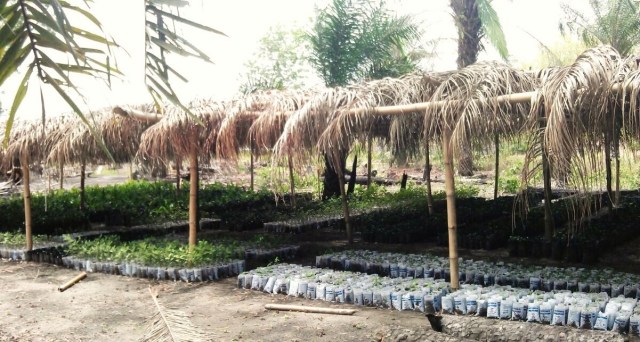
The Center for Community Empowerment & Transformation, CCET, our Bumpeh Chiefdom partner, has grown more than 40,000 fruit tree seedlings from seed in nurseries. We could say they’re raising them for peanuts.
 Seedlings are tended and watered for one to two years, then given to villages to plant community orchards and to parents of newborns to raise for income for their child’s education.
Six villages have planted their own orchards with thousands of fruit tree seedlings grown by CCET.
The Mike Diliberti Memorial Orchard is the latest addition, dedicated to funding children’s education in Bumpeh Chiefdom.
CCET is part of the community and works directly with traditional chiefdom leaders to introduce programs like the orchards. They estimate a typical outside aid organization with its overhead would spend at least 5x-6x as much to introduce a similar project, with far less results.
 Here’s how an orchard gets started:
CCET selects fruit that grow well in the area and collects seed. Here they grow oranges, grapefruit, mango, guava, avocado, cashew, African plum and coconut.
They buy fruit inexpensively in local markets and save the seed to start seedlings, after the fruit is eaten.
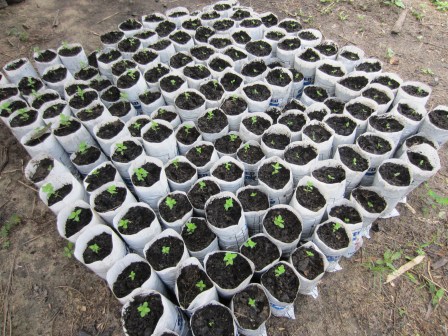
Seeds are started in growing bags filled with rich, silty soil from a swamp next to the nursery. Seeds like the oranges above germinate quickly.
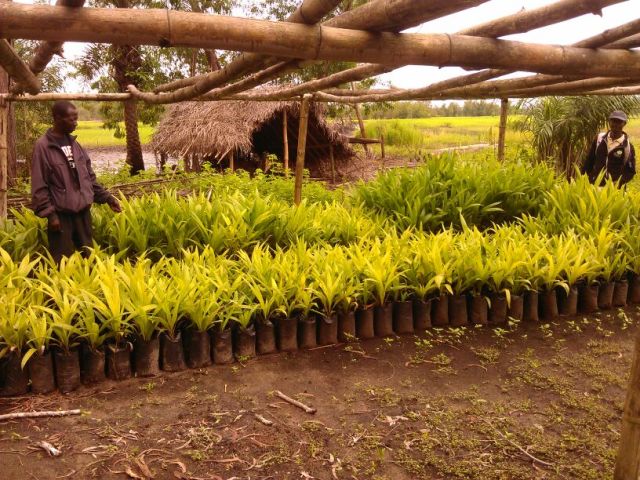 They position the nursery next to a swamp for a ready supply of soil and water. Nurseries are built inexpensively. They’re bamboo pergolas, made from bamboo felled in nearby forests. Palm fronds laid over the top shelter young seedlings from the hot, dry season sun.
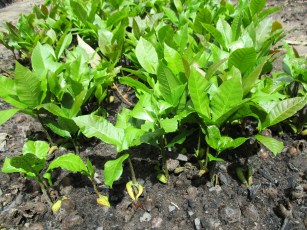
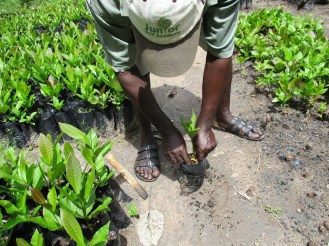
Cashews are one of the fruits that germinate quickly and do well. They germinate like beans, above.
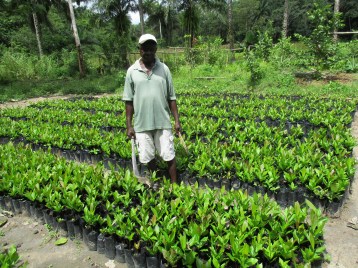
Within four to six weeks, 2,000 cashews germinated and were transplanted into their growing bags, left.
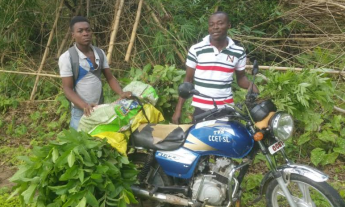
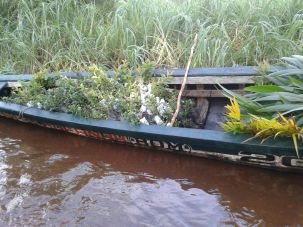
Trees are carried to the orchard site by available transportation – back of a motorcycle or by boat.
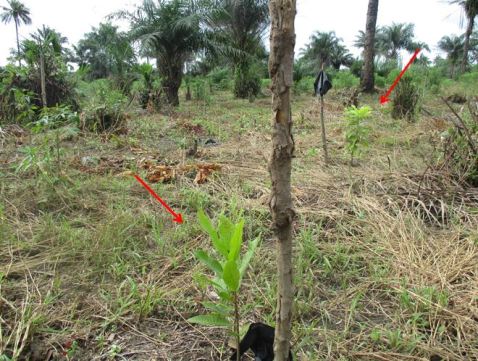 Orchard sites are usually 10 acres and hand cleared by machete, but not burned. The cut brush is laid down as an organic mulch.
Villages determine the kind of trees they want to grow. Fields are then measured and “pegged” with tree limb posts and a plastic flag to mark where each tree should be planted. 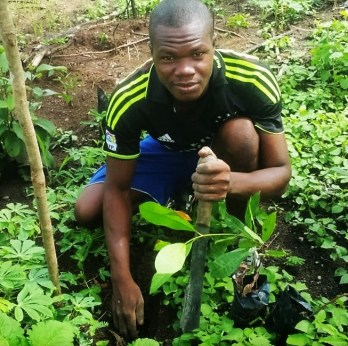
This accurately spaces trees for their mature size, like the avocados, above, and the one being transplanted, left. All labor is provided the villages themselves. They transplant seedlings after clearing the orchard field.
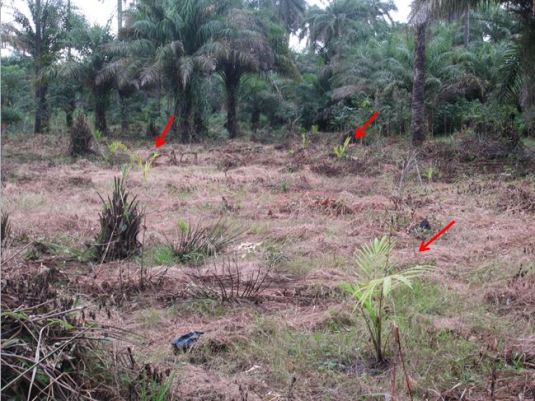
An acre can hold 60 large trees like oil palm, coconuts and mangoes; more if orange, grapefruit, avocado, cashew and guava. So, 600 to 1,200 fruit trees may be planted in a 10-acre orchard.
Coconuts planted left are indicated by arrows.
Fruit trees will mature and bear a full harvest in four to five years. Managers learned they can inter-plant with other fast-growing fruits like guava, banana and pineapple that mature in one to two years, or other crops like cassava and peanuts.
 Villages will earn money faster as fast-growing fruits and bushes shelter the slower growing fruit tree seedlings from the hot equatorial sun. Cassava bushes, left, shelter a two-year old mango, above.

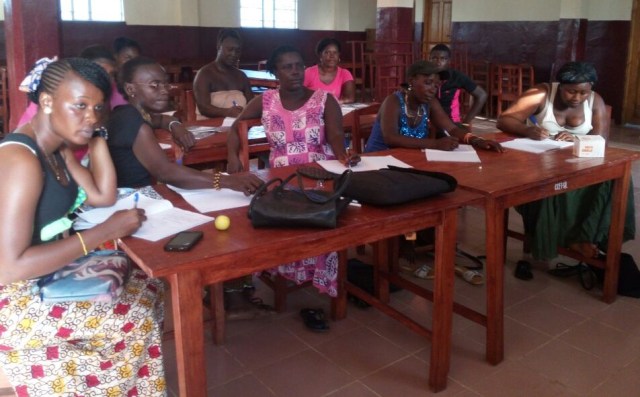 The Adult Literacy program was a fast start and one of our first. Only committed students, dedicated volunteer teachers, a classroom and a blackboard required. No cajoling needed.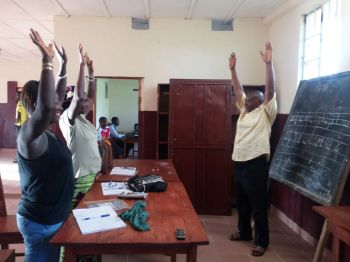
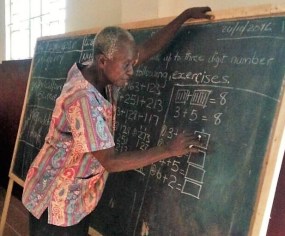
 I remember the women I met in 2013 and why they wanted to start learning now. Kadiatu, left, was chief instigator and lobbied for classes for two years. She was her family’s breadwinner and head of Rotifunk’s women trader’s union, otherwise known as market women.
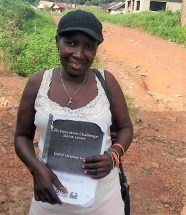 Magdelaine, with me on my far left, took a co-op style nurse’s aide training program in the district capital. Back home in Rotifunk, she works at the hospital.
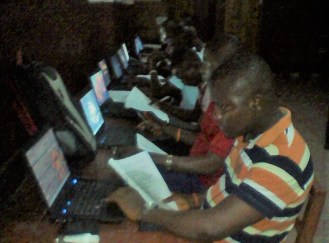 On October 24, students took their seats for the first evening computer training class in the new Computer Center building. With two months left in the year, it’s a self-paced evening class for adults. An afternoon class for high school students will follow in the next term.
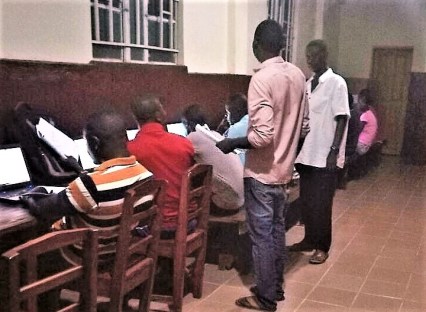 Our Rotifunk partner, the Center for Community Empowerment & Transformation, CCET, hired their first full-time employee to lead computer training classes and run the new printing service.


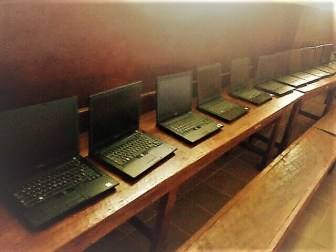 The Center can handle 20 computer students in a class. A long table lines a wall so students can plug into wall outlets now powered with solar energy.
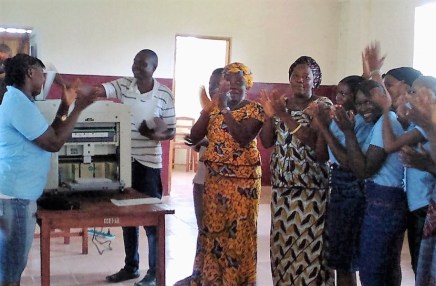 The economical high-volume, low-energy copier was met with cheers at the Rotifunk facility. With good reason – it’s the only printing service within several hours drive. Printing once meant a trip to the capital Freetown.
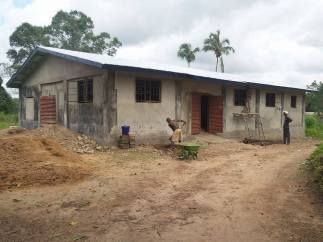
 Now, the computing center — built from a war ruin — is being used to instruct students and adults on computer use. It also hosts adult literacy classes for the many whose educations were cut short by the war. The solar-powered building is available to rent, the only modern building for miles suitable for meetings and community events of 20 – 100. Primary school teacher training, above, was the first rental customer.
 The large duplicator was purchased with a $3,750 grant Sherbro Foundation received from the Ann Arbor (MI) Rotary Club and its District Rotary group. We purchased and shipped the duplicator to our Sierra Leone partner, the Center for Community Empowerment & Transformation (CCET), which operates the Center.
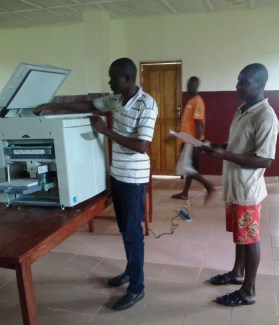 Customers soon lined up for the unique service, which spares them an eight hour round-trip to the capital, Freetown. Many are teachers from Bumpeh’s five secondary and 40 primary schools, who need to print reading materials (students have few textbooks), exam papers and report cards.



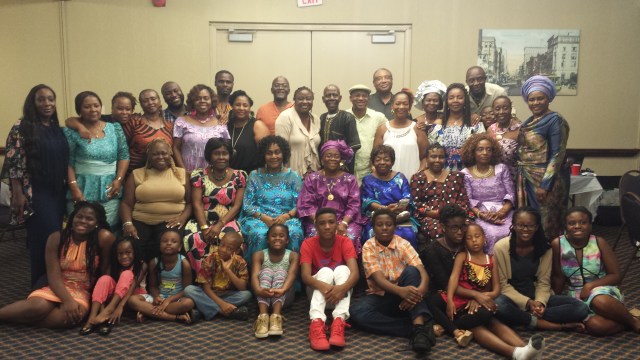 Members of the Caulker Descendants Association at their July 2016 family reunion – their 17th reunion.
 The Caulker Family tree documents their 350 year history starting at the base of the tree with Thomas Coker, born 1667 in Ireland. The tree was constructed by Imodale Caulker Burnett after many years of research into the family’s history she then chronicled in
 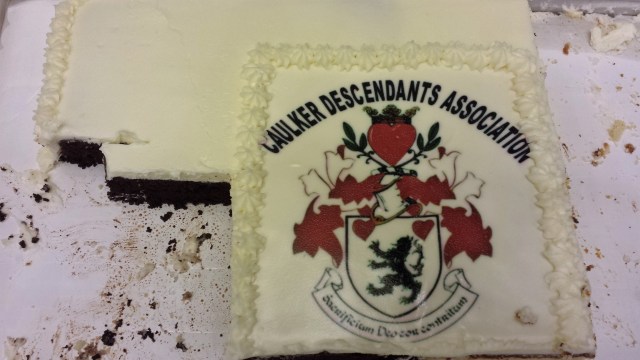 A family reunion wouldn’t be complete without a sheet cake to serve a crowd. But how many families can decorate their cake with a family coat of arms dating to the 1600’s.
 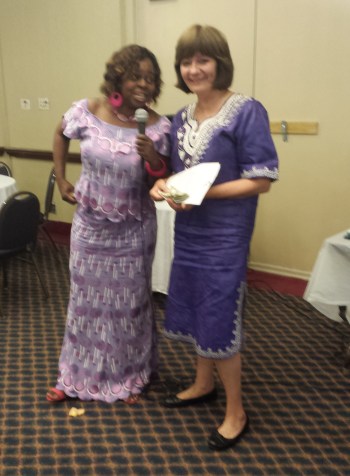 Arlene Golembiewski, Sherbro Foundation Executive Director, accepts the Caulker family Scholarship Fund donation from Enid Rogers, a Caulker grandchild, at their reunion banquet dinner.
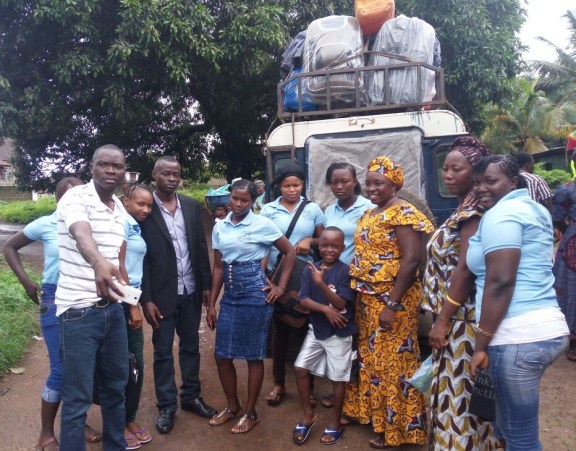
 Zainab’s story stated out badly. She’s one of many girls faced with poverty and an early arranged marriage when her mother could no longer pay for her to stay in secondary school. Zainab later left this older man, who already had a wife, and she returned to school.


 For years, the longtime traditional leader of Bumpeh Chiefdom dreamed of ways life could improve for its 44,000 rural residents.
 “Girls are more serious and work harder. They get better jobs. They take their family responsibilities seriously, and ensure their children and parents are taken care of.
 “Women do 70 percent of the work on the family farm but are not allowed to make decisions on running the farm or selling crops. Their husband controls the money and may carelessly spend it on himself for things like gambling with his friends,” he said frankly.
 “His wife returns late in the day as the sun is going down. She may still need to go buy fresh produce and collect firewood and water before making a fire to cook the family dinner. Her husband will then expect her to have sex that night and she can’t refuse.”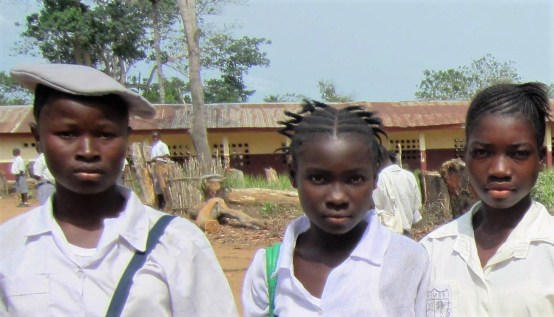


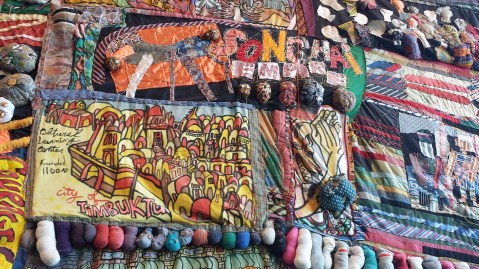

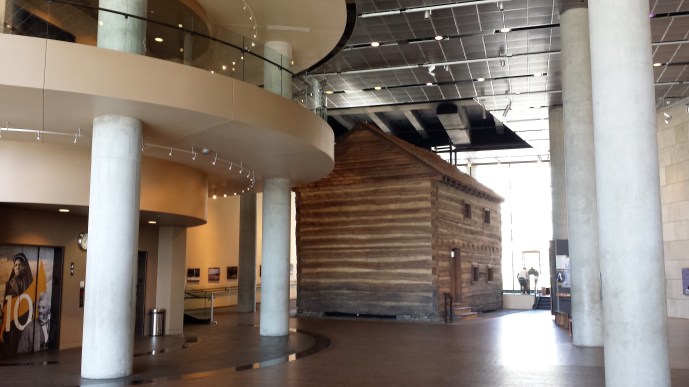 The names of a group of slaves were posted in front. Chief Caulker noted one name, Amada, saying it sounded like a Sierra Leone name. Could this have been a Sierra Leonean?

 found my invitation message and brought a group to Chief’s April 6th presentation.

 Sherbro Foundation Board Members Arlene Golembiewski and Steve Papelian, left, are former Peace Corps Volunteers who served in Rotifunk, Chief Caulker’s hometown. They reminisced with Chief on their life-changing experience at the steps of the University of Michigan Union, where then-presidential candidate John Kennedy first presented his new concept of the Peace Corps in 1960. The 50th anniversary of the Peace Corps was commemorated at Ann Arbor’s U-M Union with this historic marker, depicting President Kennedy’s speech.
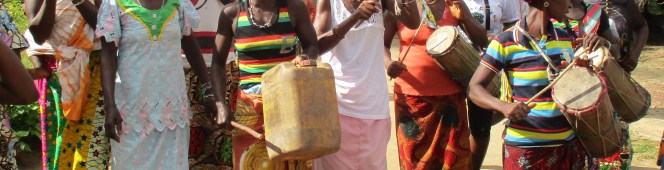
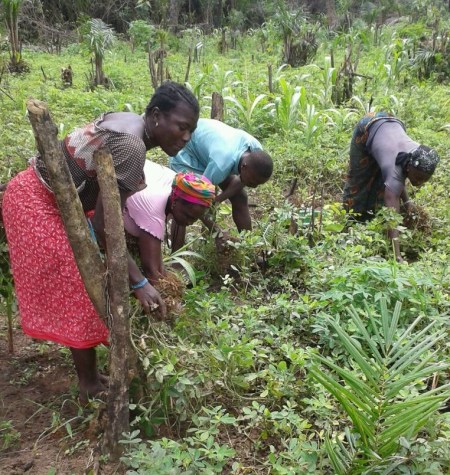 It was conceived as a way to quickly help women earn income again. We started small with 30 women, supplying each with enough peanut seed for a half-acre garden and other vegetable seed like cucumbers and corn. They also got a 50Kg (100-pound) bag of rice to feed their families before their harvest.
 hat may not sound like much, but it was three times more than the women would make in cash in a whole year of traditional rice farming, an incredibly labor intensive crop. And they still had the rest of the year to grow rice and do fishing in the Bumpeh River.
![13177990_689055534567081_9185847638175857474_n[1]](https://sherbrofoundation.org/wp-content/uploads/2016/05/13177990_689055534567081_9185847638175857474_n1.jpg?w=640)
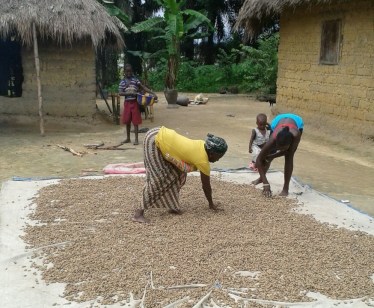 The 2014-15 farming year was exceptionally hard with Ebola. The first group of women peanut farmers unfortunately didn’t become self-sufficient with just one peanut crop in 2015. They were forced to eat a large part of their first peanut harvest to avoid hunger. But this allowed them to save some of the previous year’s rice as seed to grow their next rice crop. We’re giving these first 30 women partial support again in the current project to ensure they can make enough profit in 2016 to go from there.
 During an April 6 public program Sherbro Foundation hosted in Cincinnati, Chief Caulker told the rapt gathering about the stark realities of life in Bumpeh Chiefdom. Conditions actually have worsened in the last 20 years. The partial recovery following a brutal 11-year rebel war was dealt a big setback with the recent Ebola epidemic. People are struggling to feed their families.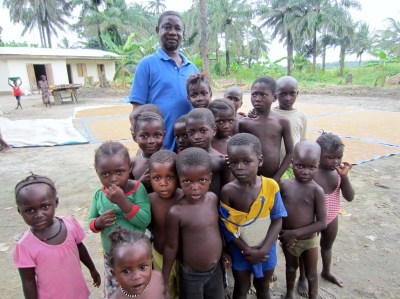


 The pieces are falling into place for Rotifunk’s first computer center, a project over four years in the making. When we first identified a proposal to teach computer literacy in 2011, we had no computers, no building and no power. Nor did we know where we’d get any of these. No one in town had a computer, and only three teachers had any PC skills.
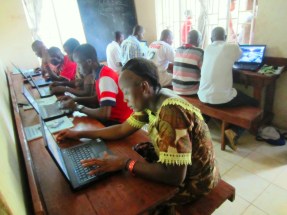 Our local partner, the Center for Community Empowerment and Transformation, CCET, started teaching adults in the living room of a borrowed house. There was only room for ten students at a time, but it was a start. Then Ebola hit in mid-2014 and all public gatherings were banned. Classes stopped.


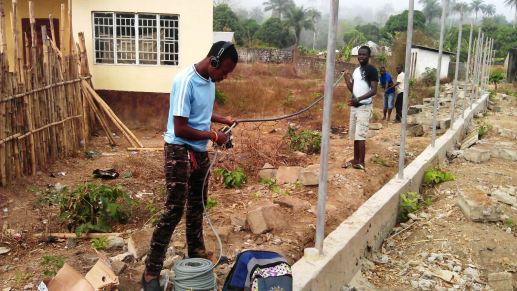
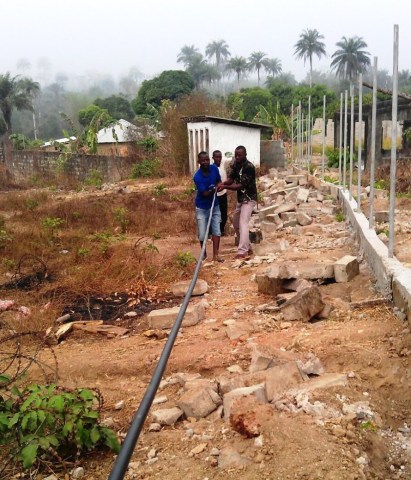
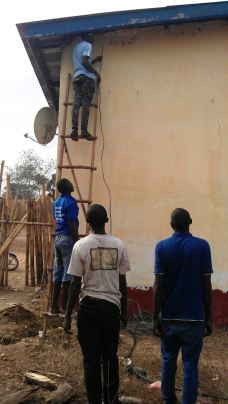

 est you think we’re now all set, well, not quite. I’ve learned a lot about solar systems and their capacity. The parent system we’re drawing from, shown here, is considered large at 5000 Watts. We’ll be able to use 3000 – 4000 Watts on most days. But this will just cover basic operation of the computer center running 25 laptops at a time, a twenty 11 W LED lights, six small ceiling fans and a desktop printer.
 Sherbro Foundation