Good News from Sierra Leone – Computer Center Construction Progress

The entire country of Sierra Leone may be living in the grip of fear of Ebola.  But life does go on beyond the two epicenters of the epidemic. We need good news to share right now.  Here’s some. Construction on the Rotifunk community Computer Center is on track for its November debut.

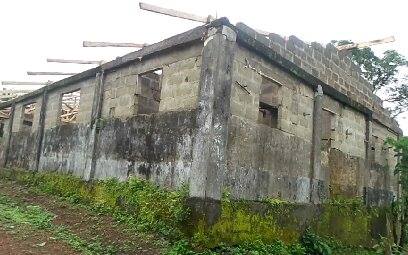
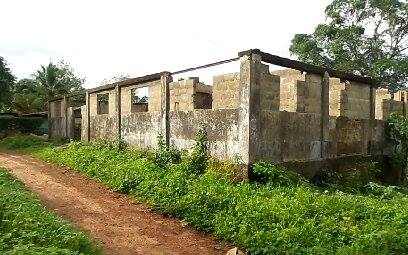
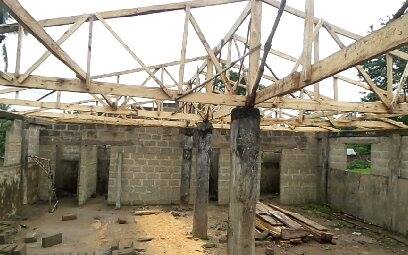
10592057_711825275553279_1085342184_nThese pictures from August 3 show the roof tresses going up.  The sheets of metal roofing were purchased. If they arrived, the roof may be going on as we speak.

This project will provide a permanent building for computer literacy classes and small business services. We already have fifty five Windows 7 laptop computers in Rotifunk waiting for their new home and central access for the whole town.

The building is going up with private donations and  community contributions of the land, building shell, local materials and local unskilled labor.

You can read more about the project here.  I like to call it from tragedy to triumph.  When the computer center construction started, I was referring to rebuilding from the shell of a building burned by rebels during the war.

Today, we can also say despite the Ebola tragedy, the people of Rotifunk and Sierra Leone will triumph. They are still hard at work building a better future.

For now, enjoy these construction pictures.  I am.

Arlene Golembiewski, Executive Director

10589489_711825702219903_1600237143_n


Old exterior walls of the building shell were reinforced with an inner wall of new bricks.  Once the walls are plastered and painted inside and out, you won’t know it’s a building rebuilt from a fire.


10589754_711825898886550_675216109_n


Deep roof overhangs are essential in a place with tropical rains over 120 inches a year.


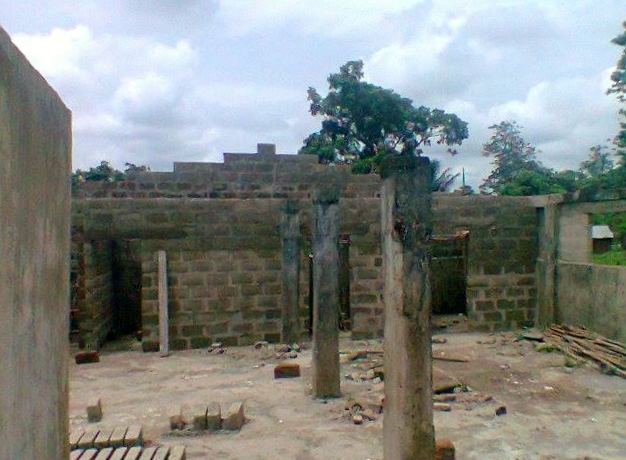
10592057_711825275553279_1085342184_nYou can still the charred tops of the original inside pillars – evidence of the fire set by rebels during the war, trying to destroy the town.

Rotifunk today is about 60% rebuilt.  With recent construction like a large community hall, a rebuilt hospital, four secondary schools, a new rural community bank, and now a modern computer center, Rotifunk is putting itself back on the map.  It’s regaining its former position as a rural hub for education, health care and trade in southern Sierra Leone.


A Phoenix Rises From the Ashes to Live Again

A phoenix is rising in Rotifunk to live again.  But not a bird.  A different kind of phoenix.

A phoenix is a mythological bird that arises from the ashes of its own funeral pyre as a newborn bird to live again.

Computer Lab 2Rotifunk had to abandon their town to rebel control for seven years during Sierra Leone’s civil war. Townspeople fled for their lives, and rebels burned the town to the ground.

Today, on the main road in Rotifunk, a building torched by rebels is rising once again from its own ashes. It’s being rebuilt as the new community computer center.

The computer center for Rotifunk that started as our dream three years ago is coming to life. No myth here. It’s being built, bricks and mortar style.  Or rather, being rebuilt.

Charred wood support posts.

Charred wood support posts.

In Sierra Leone, necessity is the mother of many things. Rebuilding structurally sound but damaged buildings to live again is a common thing. Especially buildings like this one that died a premature death at the hands of rebels intent on destroying a town.

This large building is being given over to house Rotifunk’s new community computer lab.  The concrete slab and foundation walls are good. It’s large enough to house two classrooms, offices and storage rooms. And importantly, it’s centrally located on the main road to easily serve residents and visitors alike as a computer café and business service center.

Anything wood, like these roof supports, burned when set on fire by rebels.  But the concrete foundation and original walls remain to work with.

Computer Lab 4Local materials are further bringing down the project cost.  Bricks made in wooden frames from the hard laterite clay mixed with cement dry in the hot tropical sun. Locally cut lumber from tropical hardwoods will support and frame the roof.

Inner walls of new bricks are being laid to reinforce the old walls and to rebuild upwards.

Window openings were left all around.  An important design feature for this town that still has no electricity and needs natural light coming in.

Computer Lab 10

Partitions – mud brick inner walls – will go in next to create classrooms, two offices, a storeroom and toilets.  These days modern style buildings in Rotifunk are built with inside toilets and underground septic systems.

This picture I just got shows the roof support starting to go up.  Roof trusses will go in that are one the biggest cost of the re- build.  We need roof trusses and a corrugated metal roof strong enough to hold solar panels.

You may ask how can a town build a computer center if it has no electricity. Well, we’ve already been operating a temporary computer center in a small house for nearly a year.  We were fortunate to get 50 up-to-date PC’s last year with a corporate donation from Schneider Electric.  Our local Rotifunk partner, the Center for Community Empowerment and Transformation wasted no time starting computer literacy classes. But classes end by 6:00 or 6:30 pm when it becomes too dark to see.

The PC’s are re-charged remotely. Too bad I don’t have a picture  of kids carrying 20 computers at a time (in PC bags) on their heads across town to a place that charges cell phones. It’s a standard these days to have small cell phone charging businesses run by generators.

But this is no way to run a real computer center.  Our next stage for this project is fundraising for a solar energy system.  We want to maximize use of the center and operate for twelve hours a day, seven days a week. We need reliable solar power.

People in Rotifunk are eager to learn to use a computer.  Most people can’t afford their own PC now. They can come here to take classes or rent a PC by the hour for a token fee.  Those who just want to have something typed or printed, can come here like a local Kinko’s or Staples for business services.  And the center will earn some money to make itself self supporting.

Rebels may have tried to destroy Rotifunk. But Rotifunk is no longer destroyed.  It’s a vibrant small town that’s rebuilding itself.  It’s once again taking its position as the rural hub for education, health care and trade it’s been for over a hundred years.

Rotifunk is rebuilding itself to be better than its former self.  Computers are linking its residents with the rest of world.

Sherbro Foundation is proud we arranged the original computer donation and are now fundraising for the building’s solar system.  The building itself is being paid by private donations and community contributions, including the building shell, local materials and local unskilled labor.

It definitely is “taking a village” to make this computer center become a reality for the rural town of Rotifunk.  It’s an international village of donors and supporters.

Why not join us? If you’d like help, you can read more about our donations and donate yourself here.


The Extra Gift Adult Literacy Brings

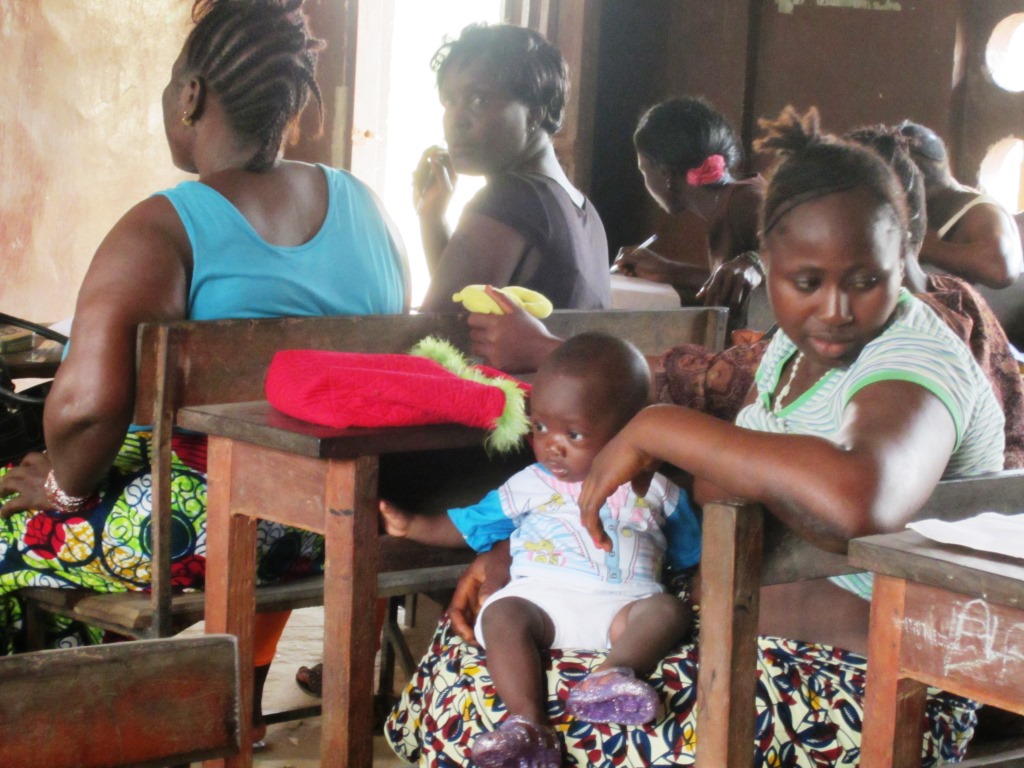
Adult Lit classI wondered why the group of adult literacy students were so motivated to come to class at the end of their busy day.  They are mainly working women who are single mothers, too.  They come three afternoons a week to enthusiastically join in lessons in a dim, hot primary school classroom on a hard wooden benches that sit low to the ground. 

Adult studentsBabies share the space with their mothers, quietly nursing or getting passed around to fellow students to hold for a while.  Small children play outside, waiting for their mothers to finish. Lessons go from 4:30pm until 6:00pm when it’s getting too dark to read in the unlit classroom in Rotifunk, a small rural town in Sierra Leone with no electricity.  Day after day, week after week they come, filling two classrooms. 

After spending time with them, I found there was a gift they received that went beyond learning to read and write.  A special gift.

Olivia Bendu, 47 yrs, 6 children, in Advanced group and proud to be learning again.

Olivia Bendu, 47 yrs, 6 children, proud to learn again in Advanced group.

This day’s lesson for the level one class was two letter words.  At, to, in, on, by.  They drilled on spelling each word, then using it in a sentence.  Each student took their turn standing at the chalk board with a pointer reciting and spelling each word.  If anyone stumbled on a word, their fellow students encouraged her on. It was support group as much as it was classroom. 

After classes, I interviewed each adult student. I had told them I wanted to talk with each of them and hear their personal story.  They came willingly, and spoke candidly about their lives and personal situations.  In fact, they followed me around town if they had missed class, stopping me to have their interview.

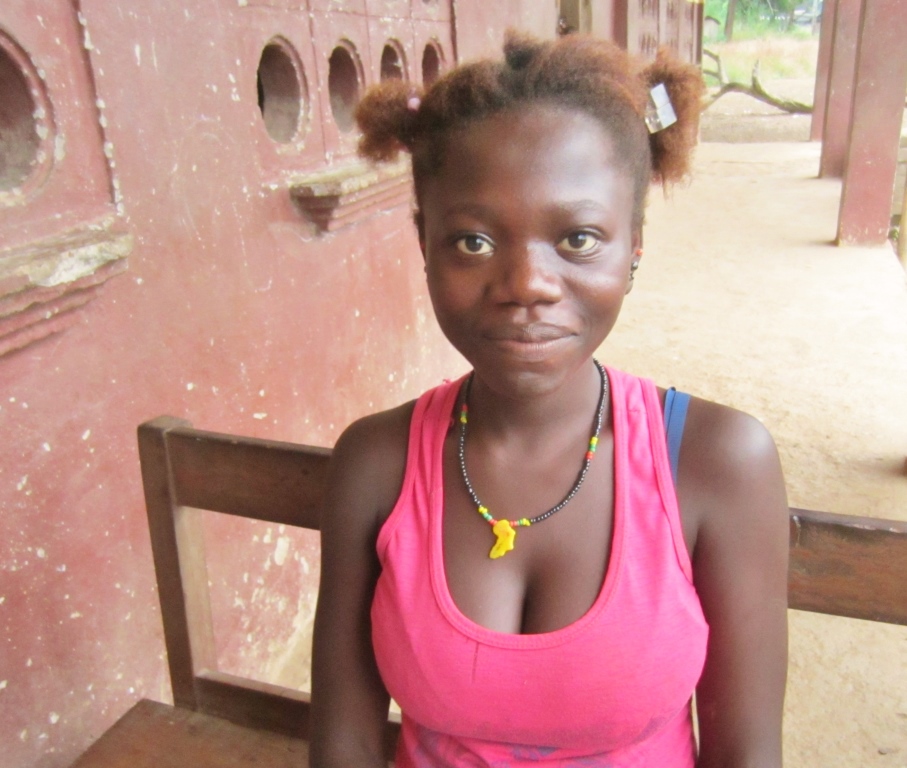
Zainab Caulker, 28 yrs, market trader, wants to become a nurse.

Zainab Caulker, 28 yrs, market trader, wants to become a nurse.

Many were abandoned by boyfriends and husbands after having one or more children. This often came after dropping out of primary school years before because their father had died or left, or because the family just couldn’t pay for school.  Without money, teenaged girls often get involved with an older man (older than them with a little money) and become pregnant.  More likely than not,  the man doesn’t stay with them for long. Or perhaps they have a husband who dies.  Then it’s repeated again with another man.  

Kadiatu Sillah, 15 yrs, father died; no one can to pay for school; wants to learn  to be a seamstress and support her mother.

Kadiatu Sillah, 15 yrs, father died, no one to pay for school; wants to be a seamstress and support her mother.

To care for and feed their families, the women become market traders, buying rice or palm oil or vegetables from village farms to re-sell in bigger town markets. Or food vendors, selling food they cooked. These are some of the only options available to an illiterate woman.  They make up the informal economy, where people buy and sell just enough to scrape by, never managing to get ahead. They have to eat most of the day’s profits.

Some of those who had husbands were the wives of teachers, one of the only paying jobs in town.  Once they became mothers, they never managed to pursue or finish an education because there was no option for adults.

Victoria Koroma, 31 yrs, five children and no husband; sells donuts, wants to be a nurse.

Victoria Koroma, 31 yrs, 5 children, no husband; sells donuts she makes; wants to be a nurse.

Whether fifteen or fifty years old, the women had similar stories. So, why go through this extra effort of starting school now.  Some students were learning the alphabet for the first time, the teacher’s hand held over theirs, guiding them as they repeatedly traced four letters at a time, A – B – C – D.

They told me they were coming to school to learn to read and write and learn numbers so they could get a job.  Or, so they could better manage their market business.  If their daughter was sent to sell the donuts they made, they needed to better keep inventory.  They wanted to count how many they gave them, and were any lost and unaccounted for at the end of the day. They wanted to count change accurately, and know they weren’t cheated. 

Importantly, they wanted to follow their children’s progress in school and check that their lessons were done.  Or help tutor them when needed.

But after thirty five interviews, something more became apparent to me.  Another theme emerged that was a big underlying factor in motivating these adult students to come to school. 

By coming to school, they were gaining self esteem.

Zainab Caulker, two children, wants to follow her children's lessons and learn to be a secretary.

Zainab Caulker, two children, wants to monitor her children’s lessons and learn to be a secretary.

The lowest person in society’s informal caste system is the illiterate woman.  Illiterate men may find jobs as farmers and laborers, and by virtue of being paid, their stature goes up a notch.  Uneducated men can be village leaders.  But no one is lower in stature than an uneducated, illiterate woman.

I heard stories repeatedly of men leaving them, often for a woman with some education.  An educated woman likely contributes to the family in a bigger way – perhaps by finding a paying job, or by better building their own farm or market business. They have knowledge to better bring up their children, taking care of their health and monitoring their school work.

And an educated woman has more self esteem.  It’s unspoken, but you can see it.  They think better of themselves, they hold their heads higher, and men find that attractive. 

Zainab Kamara 39 yrs, 5 children, friends who can read and write inspired her to come to school; wants to learn to build her business.

Zainab Kamara 39 yrs, 5 children, friends who can read and write inspired her to come to school; wants to learn to build her business.

Women who have been told directly and indirectly that when they can’t read and write they are lacking and worth less than others, are ashamed of themselves.  And that shows in how they conduct themselves. They let themselves be taken advantage of, and are discarded for someone the man perceives as better.

In the Adult Literacy classes, the women were being shown they are worth something and that they have a future in front of them.  The teachers encourage them and invest their time in them.  Their fellow students support them.  This American woman (this white woman) is taking an interest in them, and “sponsoring” them to learn. 

Lucy Manley, 35 yrs, 4 children, no husband; wants to learn nursing and  midwifery.

Lucy Manley, 35 yrs, 4 children, no husband; wants to learn nursing and midwifery.

And week by week, they can see they are learning things.  Things that make them proud and encourage them to learn more.

One lesson the students seemed to get into was greeting people in English.  Hello, my name is Lucy.  How are you?  I hope you are well today.  Each student got up and practiced her greetings in front of the class.  They laughed and joked, and made sure each person had their turn. 

When I asked Lucy after class what she learned that day, she broke into a huge smile.  I learned to give greetings in English, she said, and I felt civilized.  I can give a speech – in English.  This made me proud!

Aminata Otterbein, 60 yrs, saw other educated people her age and wants to learn herself.

Aminata Otterbein, 60 yrs, saw other educated people her age and wants to learn herself.

This response felt priceless to me. So, what was the actual cost of building this kind of self esteem in forty five women and five men?  A few hundred dollars to buy exercise books and pens for each student to copy the day’s lesson, and to run off copies of lessons and tests for the advanced class like math problems.

Fortunately, the teachers at the Center for Empowerment & Transformation continue to volunteer their time for the Adult Literacy program.  They are the heroes of this story. The teachers come to patiently teach again at the end of their long school day to help develop their sisters and brothers, as they call them.  It’s reinforced by students who really want to learn. 

I was seeing empowerment take place right in front of me, and the transformation in these adult students was visible.  It was palpable.  This really was priceless.

Sherbro Foundation is proud to have contributed the cost of exercise books and learning materials to launch the Adult Literacy program. 

Growing a Baby’s Future in Sierra Leone – The Newborn Baby Project

“Children born today have no provision that will guarantee they survive.” — Paramount Chief Charles Caulker, Bumpeh Chiefdom, Sierra Leone.

Every newborn life holds the promise of tomorrow.   Yet, Chief Caulker’s recent comment is reality in Sierra Leone. 

But maybe you can grow a baby’s future.  Literally.

Planting a tree for a newborn infant is an old Sierra Leone tradition.  Now, the Center for Community Empowerment and Transformation (CCET) in Rotifunk is kicking off a new program to plant an income-producing fruit tree for each newborn in Bumpeh Chiefdom.

And they’re taking it to the next level by opening a bank account for the newborn where income from selling the tree’s fruit can be deposited and grow. In 12 years, it will fund the child’s education.  Simple.  And that’s why it should work.

Being a newborn baby in rural Sierra Leone is tough.  The proverbial deck is stacked against them, but it’s slowly getting better.  Sierra Leone is no longer among the countries with the top ten infant mortality rates.  It’s No. 11, and, that’s a post-war low of 75 infant deaths per 1000 births in 2013 — a 50% drop in ten years.  

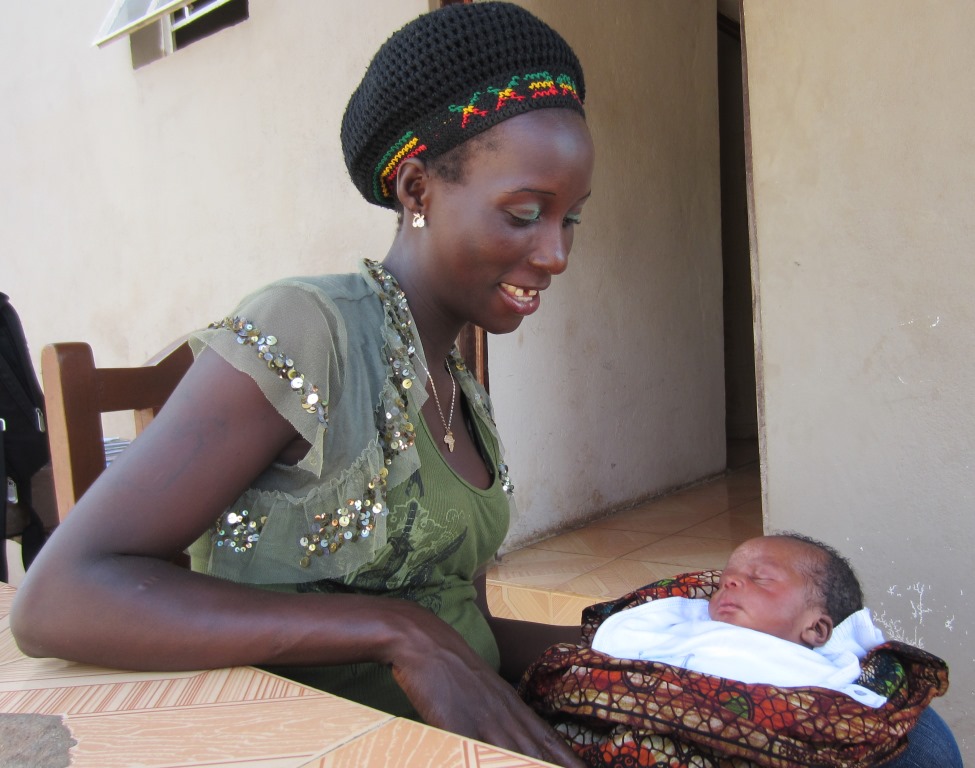
Baby Abraham is a healthy baby.

Baby Abraham is a healthy baby.

Little Abraham is one newborn in Rotifunk awaiting his tomorrow and what it will bring.  Born to a single mother, he crossed his first milestone by successfully reaching his first month’s birthday. A healthy baby delivered in a safe delivery, he now faces the challenge of moving beyond the poverty of his peer group.

Children survive only to be stuck in a cycle of poverty as they become adolescents.  Breaking this cycle in rural villages is a tough nut to crack.  In subsistence agriculture environments like Bumpeh Chiefdom, there’s very little left over after feeding and clothing your family for things like schooling.

It’s clear to all that education is one of the biggest keys to escaping the poverty cycle.  Yet, sending your kids to the local primary school may be as big a stretch as you can make.  Secondary school – often in another town involving room and board – can be an impossibly high hurdle.

The Center for Community Empowerment & Transformation has kicked off a new program designed to help Bumpeh Chiefdom parents prepare well in advance for clearing this hurdle.  The Newborn Baby Project combines the old tradition of planting a tree for a newborn infant with a new opportunity:  savings accounts in a newly opened rural community bank.

CCET is reinstating Bumpeh Chiefdom’s practice of newborn tree planting by providing fruit trees that will produce $100 of income a year for years to come.  They will also initially pay the minimum balance to open an account for the infant in the community bank.  Parents are then expected to add to the account with income from selling the tree’s fruit and other savings over time. 

By the time the child is twelve or fourteen years of age, they should have money to fund their secondary school education and, hopefully, additional money to help their start in life as a young adult.

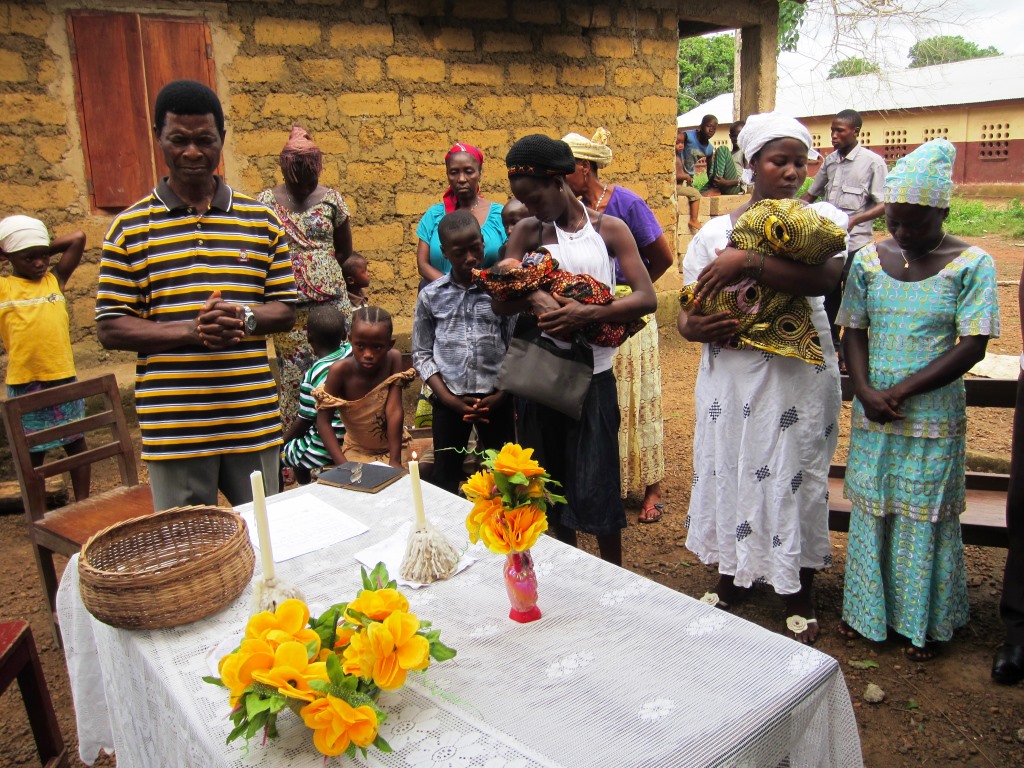
Two mothers at their babies' naming ceremony.

Two mothers at their babies’ naming ceremony.

CCET is using another old tradition, the Naming Ceremony, to initiate the program.  Parents gather family and friends a week after the child’s birth to officially announce the child’s name and seek blessings for the infant.  This is the time to plant the infant’s tree, and allow the child and the tree to grow up together. 

The innovative part of CCET’s program is to open a bank account for each newborn in their first weeks of life, paying the required minimum balance, and then have income from the child’s tree added over time.  Parents are encouraged to add to the account when they can. 

In the West, we take savings and bank accounts for granted.  In October, Rotifunk opened its first-ever bank, a rural community bank.  This bank operates more like a credit union does here in the US.  Account holders are seen as members and shareholders of the bank.  Money held by the bank is invested in conservative investments and income is paid out to shareholders. 

As a community bank, accounts can also be opened for a small minimum deposit – as small as Le15,000 or about $3.50 USD.  Having a safe and accessible place to save small amounts of money has long been a barrier to the world’s lowest-income people saving money. 

They want to save.  But the amount of money they can set aside for saving is usually so small, traditional banks don’t want to bother with this kind of account.  Traditional banks also impose transaction fees that can be as large as the deposit or withdrawal the saver wants to make.  Add to that, problems with access.  Traditional banks are usually located far from small village savers in bigger population centers. 

With the new community bank in Rotifunk, the Newborn Baby Project will now start providing for the infant’s future within their first weeks of their life.  The symbolism of a child and their tree growing up together will be expanded with an income producing tree and a bank account to grow that income.

Growing a child’s future – that’s what this project aims to do.   Sherbro Foundation is happy to be part of this program by providing initial money to open newborn bank accounts.


I confess – I’m not a blogger

I thought I should confess.  I’m not really a blogger.  I’m the founder and executive director of Sherbro Foundation, a nonprofit organization supporting rural Sierra Leone.  I also happen to blog.

There’s been a lot positive comments lately about the Sherbro Foundation website and the blog.  Readers find the content informative and interesting.  Information that is hard to otherwise find.  You like the way it looks.  You enjoy reading the blog with your morning coffee. You’re forwarding it to family and friends.  I appreciate those comments. Truly. Thank you.

But I must be doing something wrong.

Arlene and CCET Volunteer, Foday Fofanah view palm seedlings.

Arlene and CCET Volunteer, Foday Fofanah view palm seedlings in the tree nursery.

I am hard pressed to remember one comment that said: “The work you’re doing in this impoverished country of Sierra Leone is important and much needed.”  Or a commenter who said: “it’s great Sherbro Foundation has a scholarship program that helps keep girls in secondary school to finish their education.”  Or: the tree-planting project is a wonderful way to stimulate development in rural areas through agriculture, and at the same time provide environmental protection. Or: how wonderful to see computers donated to this rural area and people using their first computer.

So, I must be doing something wrong.

My purpose in blogging is not to become a popular blogger and draw attention to myself.  Rather, it’s meant to be a vehicle to educate people on life in today’s struggling rural Sierra Leone and generate interest in the work of the Sherbro Foundation.  

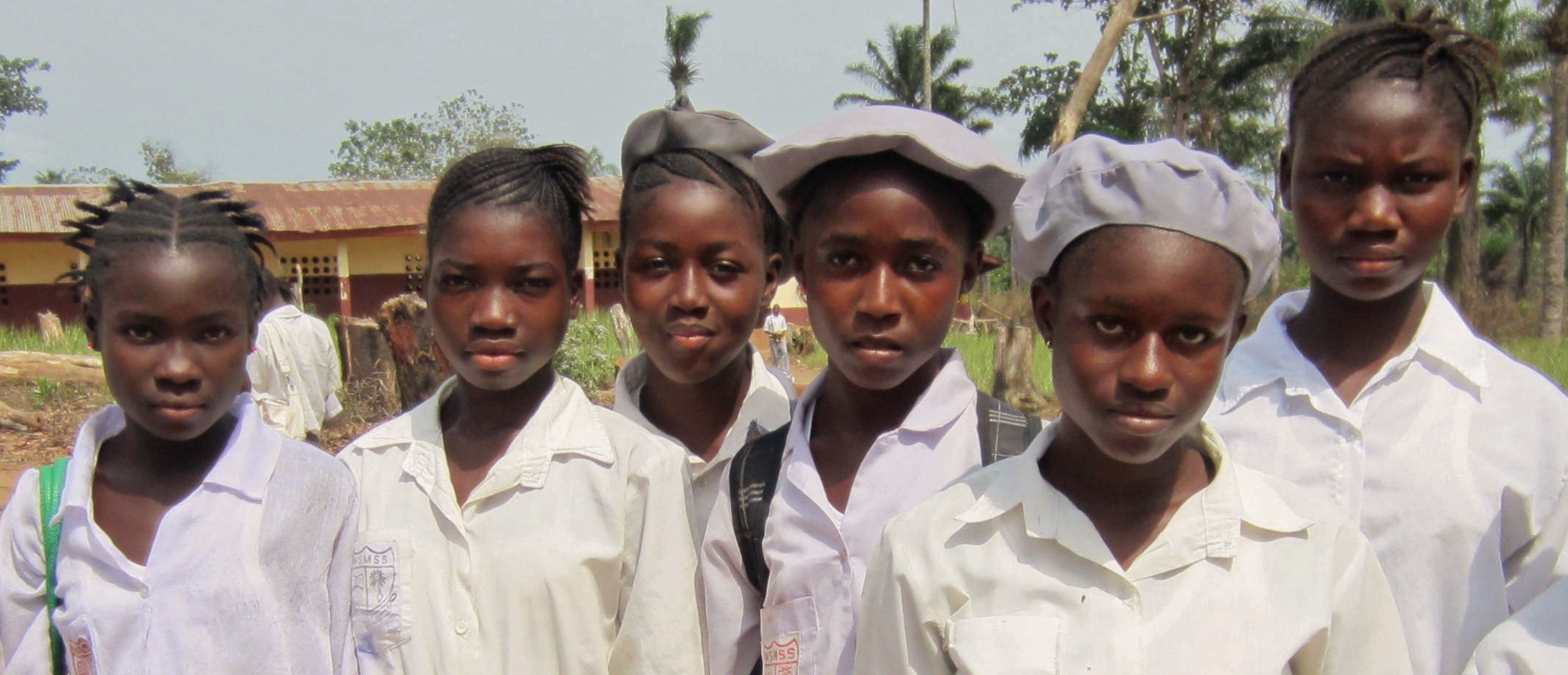
Walter Schutz Secondary School students

Walter Schutz Secondary School students

Interest, support, and frankly, readers, donations. That’s how the work will continue to get done.  And it’s through the Foundation’s work that there will continue to be content to put in a blog.

So, I’m going to re-examine how the Sherbro Foundation website content is organized and be more transparent on why we’re there.  We exist – and I blog  – in order to fund projects in rural Sierra Leone communities.  It’s as simple as that.

You don’t get something unless you ask for it:  I need you, dear readers, to contribute to Sherbro Foundation projects.

If each one of you who wrote a comment about the blog to date sent in $10, together we’d send 80 girls to secondary school for a year by paying their $20 annual school fees.  Imagine. Girls are not going to school because their parents cannot afford $20 a year for school fees. 

Or, together we’d expand the tree nursery program so surrounding chiefdoms can get income-producing fruit trees quickly for the coming planting season.  For $10, you could buy 50 fruit tree seedlings.  Orange, guava and mango trees mature in a few years to produce $100 worth of fruit per tree – year after year for 20 years, 30 years and more.

This is kind of like those programs that give villagers goats and chickens to raise. Except, I don’t know of any goats or chickens that live for more than 20 years and produce $100 income every year. I also don’t know of any animals that provide environmental protection by holding the water table, preventing erosion and fighting global warming by taking greenhouse gases out of the air. 

All this for an initial investment of 25 cents a tree. The next time you’re drinking a Starbucks latte, think of how many trees that purchase could plant.

So, my blog readers, thank you so much for enthusiastically reading the blog.  I’m grateful you think I’m a good writer and blogger.  But what I really want to be is the best foundation director who can motivate people to join in supporting our projects.  And I want to give you more than a few idle minutes of blog reading.

I want to give you the experience of helping a remote rural community in Sierra Leone make a big leap toward a prosperous future. 

One hundred percent of your donation goes directly to projects in the community.  Really.  Sherbro Foundation and our Sierra Leone counterparts are volunteer organizations.  And any small expenses we have are paid by a separate donation.

Convinced?  All you need is a major credit card. Go to the Donate tab: Donate 

We take donations via Paypal (no Paypal account needed), and accept currencies from the US, Canada, UK, EU, Norway, Sweden, Russia, Australia, Japan, Hong Kong, Singapore and Mexico.  If we missed yours, let us know.  And, we pay the currency exchange fee. 

So, go hit that Donate tab.  It feels a lot better than tapping out a comment.  Trust me, you’ll feel good. 

As long as I’m asking, there’s one more thing.  Please continue to forward Sherbro Foundation articles to family and friends.  That helps a great deal.  But instead of saying, “Hey, I found a good blog you may enjoy,”  can you please say, “Look at this great foundation I found doing work in rural Sierra Leone.  We should support them.”

Eliminating Poverty One Tree at a Time

Planting a tree is a simple thing. We plant them for their beauty, and maybe to create shade.  I haven’t thought about trees as a poverty elimination tool. 

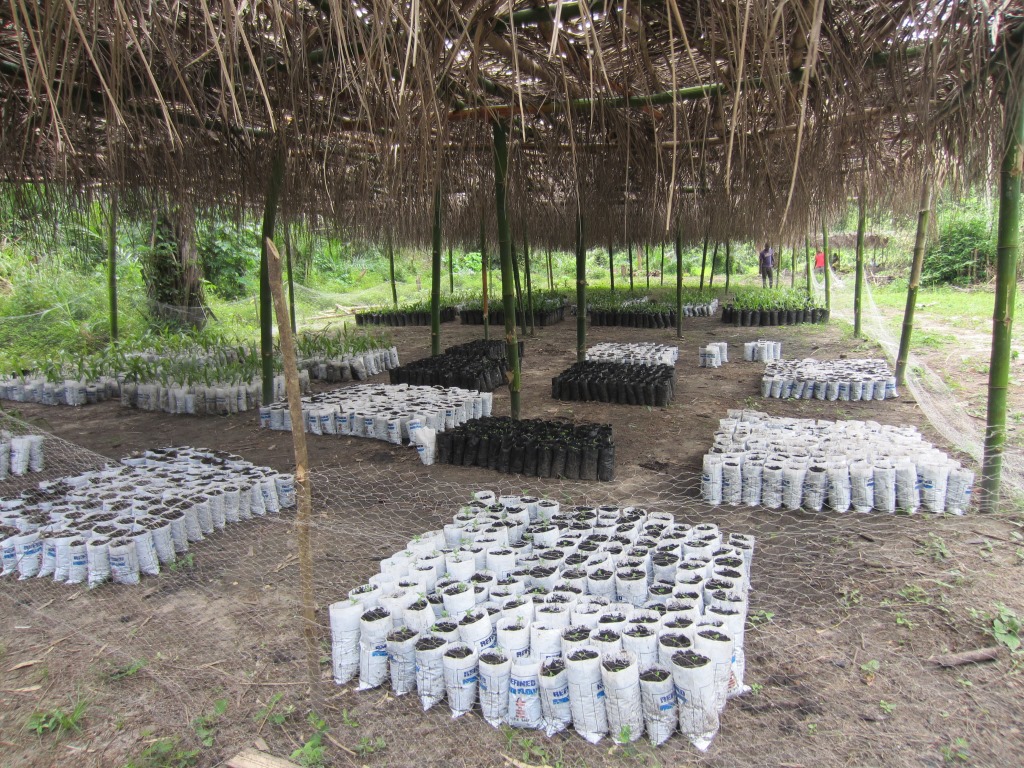
Oil palm, teak, citrus, guava and mango seedlings are shielded from the hot sun.

Oil palm, teak, citrus, guava and mango seedlings are shielded from the hot sun in a tree nursery.

But this is what Paramount Chief Charles Caulker and the Center for Community Empowerment & Transformation (CCET) have in mind for Bumpeh Chiefdom.  They plan to plant 15,000 trees in villages each year for five years. In doing so, they will provide economic empowerment for villagers to improve their own lives and escape poverty.

Bumpeh Chiefdom is one of the most rural areas of Sierra Leone and agriculture is their bread and butter.  It’s a subsistence agriculture area where people barely grow enough to eat, often falling short before the next harvest.  With most of the people living in small, remote villages, it’s a place that receives few government and NGO development programs.  The trickle down to their level is small and slow.

So, Paramount Chief Caulker is taking on poverty reduction himself by building on his chiefdom’s strengths of rich land, good water sources and agriculture know-how.  With the chief as their sponsor, CCET has started a tree nursery to raise trees with economic value.  Oil palms, coconuts, teak and a range of fruit trees – orange, grapefruit, lime, guava, mango, avocado, banana. 

Tree nursery now holds 8000 seedlings.

Tree nursery now holds 8000 seedlings.

They are purchasing small seedlings for trees that are more difficult to start, like oil palms, coconuts and teak.  Others they are starting themselves from seeds, seeds you literally spit out when eating an orange or grapefruit, or pits collected from avocado and mangoes.  They’re planted in deep polythene bags with rich swamp bottom compost, and they quickly germinate and thrive in the tropical heat and humidity.

The nursery is set up on land donated by the chief, made of local materials and set up with volunteer labor.  The ground was brushed with machetes and bamboo stakes cut to make long pergolas.  When covered with palm branches, the pergolas provide the right amount of filtered light for young seedlings. 

Arlene and CCET Volunteer, Foday Fofanah view oil palm seedlings.

Arlene and CCET Volunteer and teacher, Abdul Phoday view oil palm seedlings.

The plan is that each year for five years, 30 villages will set aside ten acres of community land for their own orchard. Come planting season with the start of the next rains in June, each of these villages will be given 600 trees to plant.  It’s their job to plant and maintain their community orchard.  In five years, 150 of the chiefdom’s 208 villages will be covered.

The village will get the income from selling the fruits of the trees, and eventually the teak lumber, to use for development projects of their own choice. 

I asked how much money is to be made with fruit trees like this.  I found it’s quite a lot.  Using an orange tree as an example, the tree will mature in about 4 years and it commonly produces at least 1000 oranges a year, often more. 

If 600 orange trees are planted and reach maturity, they will yield enough fruit to fetch in Freetown Le500,000 ($120) per tree – or Le 300,000,000 ($72,000) per year for the whole community orchard. Trees continue to bear fruit, so this is Le 300,000,000 for the community year after year.  Even if not 100% successful, or if fruit is sold at lower upcountry prices, the orchards will generate a lot of much needed cash for these communities.

Chief Caulker's father planted grapefruit trees fifty years ago that continue to bear a lot of fruit.

Chief Caulker’s father planted grapefruit trees fifty years ago that continue to bear a lot of fruit.

Multiply by 30 villages and the tree nursery’s first crop of seedlings and this is a big income stream that continues each year. Individual farmers can build small businesses. Money can also go to build village schools and health clinics, dig wells, start community cooperative stores and set up internal microfinance programs at little to no interest.  Villages choose what they each need. 

This is transformation from the grass roots level.  With self-managed programs and almost no overhead costs, it all goes to the community.

As the tree nursery program expands, more villages will get their trees and the net value of this program to the chiefdom will only grow. 
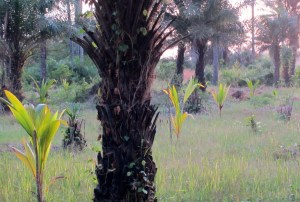
Newly planted coconut orchard a few months old.

Newly planted coconut orchard a few months old.

At an initial project cost that today equates to Le1000/seedling, or Le 600,000 per village orchard, this is a 500% return on investment within four years when trees reach mature fruit bearing capacity.  Not a bad return from polythene bags and bamboo shelters.

This return on investment – and the sustainability of the program – is possible because of a very important program element: local ownership.  This program is conceived and led from within the chiefdom.  No outside organization is coming to implement an outsider’s program. 

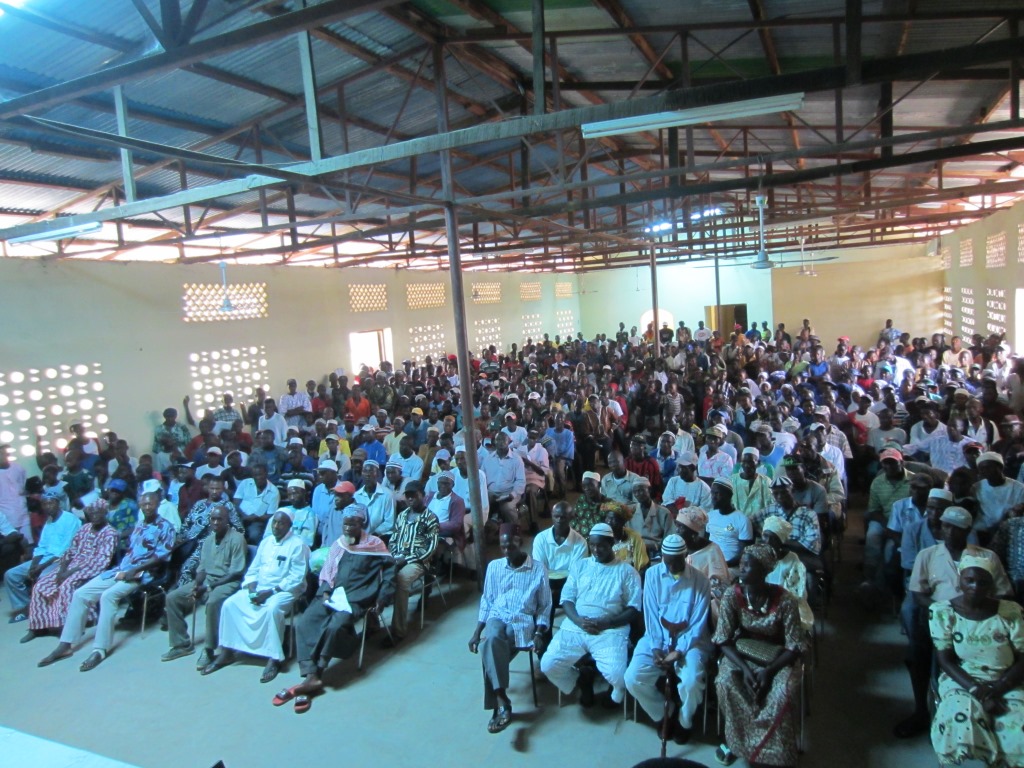
Chiefdom leaders and rank and file gather to hear about CCET projects, including the tree project.

Chiefdom leaders and rank and file gather to hear about CCET projects, including the tree project.

CCET identified their own community needs and designed the program to be managed across the chiefdom using existing chiefdom administration as the most reliable vehicle to reach the people.  By using traditional chiefdom leadership roles and communication systems, they can quickly cascade down to the small village level and be readily accepted.  

Village headmen are responsible to organize their own community orchard.  They get direction and oversight from their section chiefs.  These are traditional chiefs who are chiefs for life, and well known and trusted by their people. The paramount chief oversees the whole program in the course of his normal chiefdom business, and using his established chiefdom council.

I asked Chief Caulker how does he know the program will be managed as conceived.  We’ll write practices governing the planting and harvesting of trees into chiefdom and village bylaws, he said.  If people don’t follow them, they will be fined.  People have little extra cash, so they fear getting fines and abide by the bylaws.  The chief has also embarked on a formal and informal educational program to positively reinforce the value of trees and encourage people to plant their own.
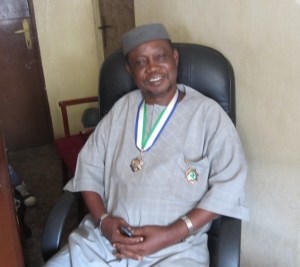
Paramount Chief Charles Caulker

Paramount Chief Charles Caulker

The chiefdom bylaws will include environmental practices that designate water catchment areas where trees are to be planted to protect the water table.  People and the environment are inseparable, Chief Caulker said.  Any attempt to improve one at the expense of the other will ultimately fail.  We have a desire and responsibility to protect the environment, but our approach is different.  Instead of targeting an environmental program, we integrate environmental protection into everything we do.  The tree planting program will do our part to fight global warming and will protect our water resources.

Programs led by the chiefdom eliminate the need – and cost – of introducing new staff and bureaucratic systems subject to failure.  The pride of local ownership has stimulated people to participate and volunteer.  They want to be involved and to help each other.  And because these are simple, transparent programs, they can.  The work goes quickly, at low cost and with ready acceptance.  This is empowerment from the bottom up.

Many government and NGO led programs either take a long time or never reach the small village level where the need is the greatest. Within one year from its conception, CCET is doing this.  With a blend of modern technology and traditional practices, it is already paying dividends and promises to only lead to more success.  

Chiefdom men learn about the promise of planting trees.

Chiefdom men learn about the promise of planting trees.

I asked a young man what he learned from the launch meeting where the tree program was introduced to people in the chiefdom.  He said, young men learned about their future and what they can achieve with planting trees.  In five years, they can improve their future.   Planting trees is a common thing.  Anyone can brush their land and do this in one week.  Young men downriver have land to plant 10 to 20 trees for themselves.  Now they have the zeal to do it.

Using agriculture and planting trees is an interesting thing, he said.  A tree is your child and you must take care of it like a child.  It will give you its children – its fruit – to eat.  It’s not ungrateful like your own children.  A tree will always be there for you. Tree planting will be the support for all other programs we do – for our children, for education, for environmental protection.

I later heard the Paramount Chief telling a young section chief, I wasted my time as a young man without planning for my future.  You need to plant trees now for your retirement and for your children to inherit.  Every man and woman in Bumpeh Chiefdom should be planting trees.

Poverty elimination by planting trees.  At the program launch meeting Chief Caulker said to his chiefdom, I’m a farmer and I take this challenge personally.  I believe it will make a big difference in peoples lives.  By building on traditional agriculture practice and social norms, we can be proactive in empowering the vast majority of people down to the small village level and get started quickly.

Treating agriculture and tree orchards as a business is indeed a practical and achievable way for Bumpeh Chiefdom to lead its people out of poverty, and into a middle class existence in the not too distant future.

You can help accelerate the process by donating to buy tree seedlings for Bumpeh Chiefdom.  Only $10 will buy 50 citrus and guava seedings!  $20 will buy twenty coconut seedlings.  And you will do your part to fight global warming by helping plant trees.  To donate, go to the website’s Donate tab:  https://sherbrofoundation.org/donate/
Joining the Rest of the World – Rotifunk’s First Computer Students

Joining the rest of the world – this is how two of Rotifunk’s first computer literacy students described the way they feel about starting computer lessons.  They know the world is computerized, and they have, to date been left out of the opportunities and the knowledge afforded by computers.

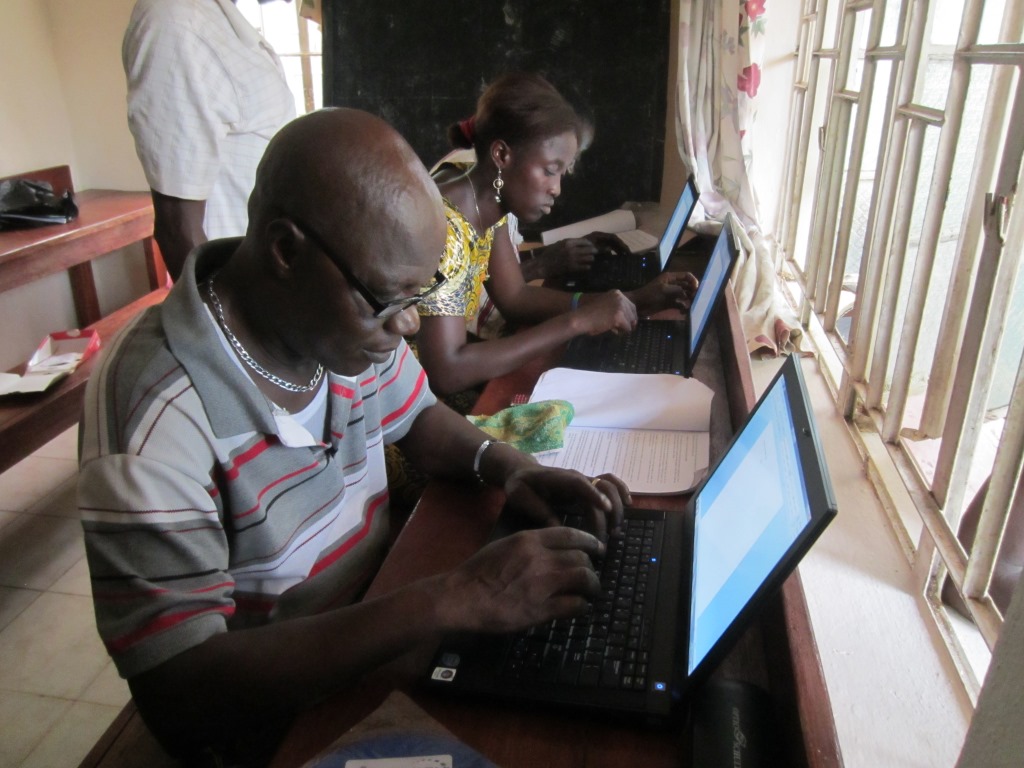
Computer class at CCET office.

Computer class at CCET office.

Computer literacy and regular access to using a computer are among the most coveted resources in today’s Sierra Leone.  People know this is their link to gain valuable job skills, better manage their work, and communicate with the rest of the world.

The Center for Community Empowerment and Transformation received 50 laptop computers in August from American donors Schneider Electric and TIP Capital. They lost no time in building tables and benches with local lumber and creating a practical manual for students who have never used a computer.  Lesson One started in Sept – October with how to turn it on and find the Word software.

The first students are community teachers and other adults with a need to use a computer.  They will form the core group to serve as trainers for high school students and others in the community. Only three or four of the 30+ secondary school teachers in area had any computer proficiency.  Some had been exposed in college to manuals with screen shots of computer monitors as introduction, but never had access to using one themselves.

Here’s a profile of some of Rotifunk’s first computer students.

Samuel Caulker at his computer lesson.

Samuel Caulker at his computer lesson.

Deputy Paramount Chief – Samuel Caulker stands in as the ranking chiefdom authority for his brother, the Paramount Chief when both the Chief and his Chiefdom Speaker are out of town.  Samuel says the world has gone computerized, but until now, Rotifunk was not part of this.  This is his first opportunity for computer lessons and he wanted to take advantage of it.

He was embarrassed when going to training workshops outside the chiefdom, and he had to say he did not know how to use a computer.

Soon he can see computers in the Chiefdom Administrative Office.  Records can be kept and accessed when needed on computers, like amount of taxes collected for the year and who paid in each Section.  They can maintain land transfer records and avoid land disputes; they can keep names of all 208 villages in the chiefdom and the responsible headmen. Importantly, they can maintain minutes of Chiefdom Council meetings and other key chiefdom events.

Samuel is not finding using a PC as difficult as he may have thought.  They have excellent tutors from CCET committed to teaching them.  It would go faster if they had more time to practice. They come at 5:00pm at the end of their work day.  Lack of electricity and cost of running a generator limit the time of the class to 6:30pm when it’s too dark to see.  Today they had to stop when the battery on the computer ran down.

Samuel wants to thank Schneider Electric and TIP Capital for the opportunity to learn to use a computer and will make good use of his class. He also appreciates the low cost of CCET classes.  They are paying Le30,000 (~$7.50 USD) for classes that would cost Le150,000 in Freetown.

Secondary School Teacher – Emanuel Mbasy teaches at Walter Schutz Secondary School.  Emanuel sees technology quickly changing and wants to be part of it.  With computer literacy for himself, he can then also teach his children.  He can create his own documents and quickly find them, like class lessons, exams and other documents.  Files get missing at school, and he could better maintain them.

Practical computer instruction manual designed by CCET.

Practical instruction manual designed by CCET: how to boot a computer.

The CCET teachers are good and he’s not finding it too hard to learn, if you concentrate and practice.  Practice is unfortunately limited to a few hours of classroom time each week, and students like him do not have their own computer to practice on at home.  They do have a good manual CCET prepared for them they can take home and review.

Emanuel wants to give his special thanks to Schneider Electric and TIP Capital for allowing him to join the rest of the world with learning computers.  May God bless them.  More computers for their personal use would be great. 

Muslim Missionary and Imam – Osman Sesay is a young Imam with the Amaddiyah Islamic mission present in Rotifunk. Technology is improving, and the Amaddiyah mission has a computer, but he didn’t know how to use it.  He’s glad for the chance for lessons now.  He wants to be able to keep speeches on the computer, as well as lessons and exams for the Amaddiyah school.  They conduct marriages and need to issue marriage certificates. 

Imam Sesay really wants to learn to use a computer. It’s difficult, but he will learn.  He’s not fortunate to have his own personal computer, and would really like to have one.

Computer lesson.

Computer lesson: teachers give 1:1 help.

Construction Contractor – Abu Bakar Conteh is a contractor building new buildings at the Prosperity Girls High School.  As a contractor, he needs to give bids and estimates and keep them. Offices with files are a luxury in rural Sierra Leone, and his work keeps him on the move anyway.  A computer would help him organize his work and keep it available, as well as make calculations easier.

A computer would also allow him to advertise his business through the internet.

Abu Bakar enjoys computer lessons very much and is finding it easy, despite this being his first class.  He’s learned to write and save some documents, and he’s become familiar with the keyboard.

He would like to thank Schneider Electric and TIP Capital so much.  They find it difficult to get computer lessons in Sierra Leone, especially in a rural place, and these companies have made it so easy and inexpensive for him.

DSTV Satellite Dish Operator – Sembu Fallah maintains DSTV service for the area. We are living in a computerized world where knowledge has advanced, he says, and he would like to know it better.  He wants to be a perfect man and learn enough to teach others as an additional job.

He could also use a computer to join the DSTV signal to a computer for viewing sports games here in Rotifunk as an additional source of income.

Sembu wants to thank Schneider Electric and TIP Capital for what they’ve done for them.  He really appreciates it, and prays they will bring more.  If he had his own computer he would continue to practice at home and not be limited to three 90 minute classes a week at the CCET office.

**************************

August 28, 2014 update: I see people continue to read this post, so I wanted to direct you to the latest up on Rotifunk’s computer program.  We are turning a town tragedy into a triumph.  A community computer center is being built as I write this from the ashes of a rebel burned building. You can read about it here: https://sherbrofoundation.org/2014/08/25/computing-center-roof-is-up/


Tree Nursery – see them grow

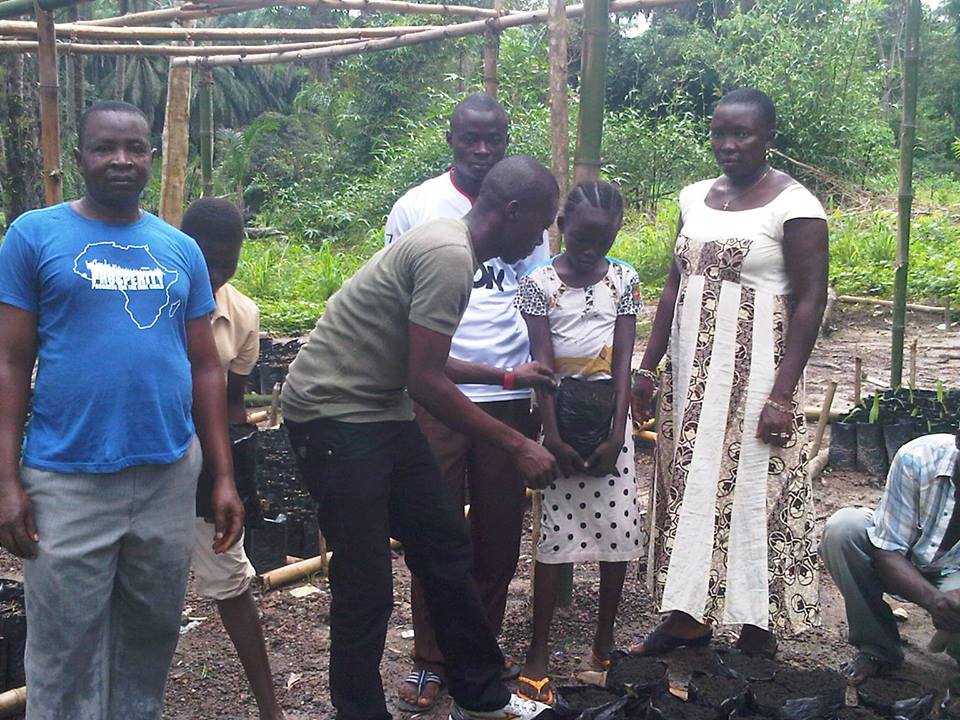
CCET-SL volunteer and local teacher Mr. Sennessy (left, blue shirt) and Mr.s Kaimbay, CCET-SL Director and local principal, left, watch as a young volunteer prepares her seedling bag.

CCET-SL volunteer and local teacher Mr. Sennessy (left, blue shirt) and Mrs. Kaimbay, CCET-SL Director and local principal, right, watch as a young volunteer prepares her seedling bag.

It’s the rainy season now in Sierra Leone and planting time.  Rotifunk is busy planting tree seedlings to raise in their nursery for trees of economic value. 

Thanks to cell phone pictures and Facebook, we can all now see the nursery taking shape and seedlings growing.

The tree nursery is a project of Rotifunk’s home grown nonprofit organization, the Center for Community Empowerment and Transformation.  CCET-SL’s aim is to empower their community in development with projects like the tree nursery.  With these projects, they hope to transform lives of the average person in Bumpeh Chiefdom.

I shouldn’t say they hope to transform lives.  They plan to transform lives. With simple, concrete projects like the tree nursery that will have clear payback, this isn’t a leap of faith.  Next year, the trees will be ready for people to plant in their own gardens and farms to improve their family’s diet and gain income by selling their surplus.   Citrus, coconut and oil palm trees, as well as teak trees for future lumber sale.

Bumpeh Chiefdom is a rural area rich in agriculture.  So, economic development here starts with agriculture projects. To read the whole story about the Economic Tree Nursery,  click here to see an earlier post.  Sherbro Foundation has supported the nursery project with money to buy farm tools and young oil palm seedlings bred for early fruiting.

Filling polythene bags with soil that will allow seedling to form deep roots.  This looks like rich silty soil from the Bumpeh River floodplain.

Filling polythene bags with soil that will allow seedling to form deep roots. This looks like rich silty soil from the Bumpeh River floodplain.

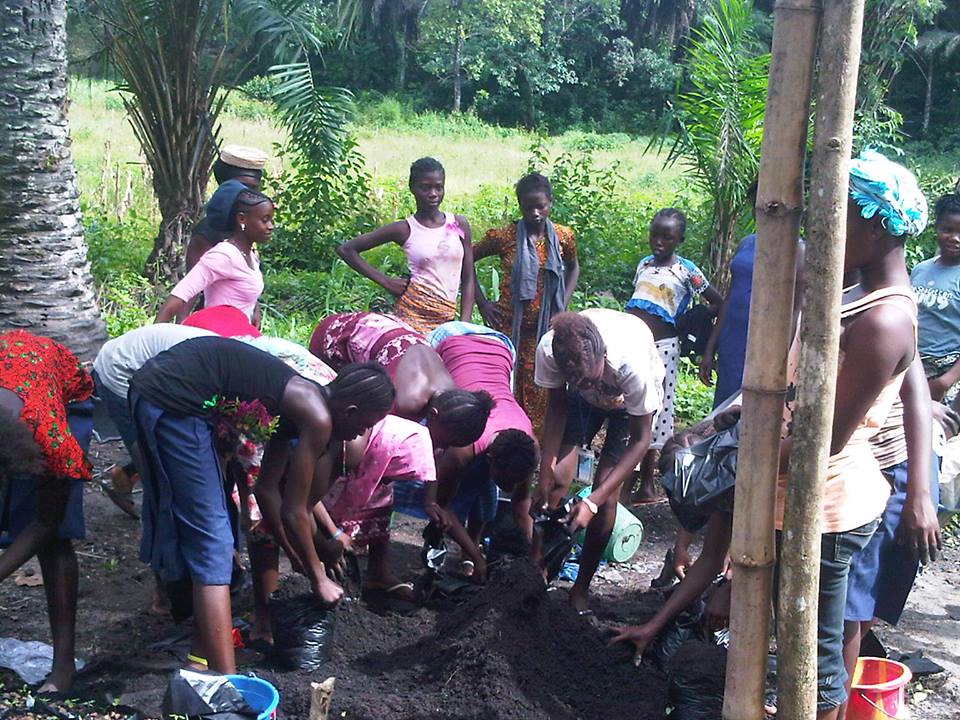
Rotifunk community gets involved with preparing the bags to hold seedlings.

Rotifunk community gets involved with preparing the bags to hold seedlings.

Seedlings will be nursed in the nursery, watered and protected from hot tropical sun in the dry season til ready to plant next year.

Seedlings will be nursed in the nursery, watered and protected from the dry season’s hot tropical sun til ready to plant next year.  Families across Bumpeh Chiefdom are eligible to get trees at a token cost.

CCET-SL volunteers and local teachers Osmun Kamara and Phillip Komoh.

CCET-SL volunteers and local teachers Osmun Kamara and Phillip Komoh.  I’d guess these are coconut seedlings.

West African Peace Corps?

As a former Peace Corps Volunteer, this article caught my eye.  ECOWAS, the Economic Community of West African States, is sending forty volunteers from their states to serve in education and health care in Sierra Leone.  Twenty have arrived to serve as French and Science teachers in eleven of the country’s upcountry districts, with twenty doctors and intensive care nurses to follow.

I think of ECOWAS as akin to the European Union.  The purpose given for this Volunteer group: “ECOWAS Volunteers are young men and women professionals from the 15 Member States, who contribute to regional development efforts and the consolidation of peace and reconstruction in crisis affected-communities of the region.”

They will work under “at times, difficult conditions” and help “to strengthen the capacities of local organizations, establishing and supporting partnerships between communities.”

Sounds like something a U. S. Peace Corps Volunteer can identify with.

I applaud their effort.  Another sign that peace and stability have taken hold in West Africa with countries sending volunteers to promote peace and development  in their fellow states.

I would say to these volunteers, you’re likely to get more out your experience there than you feel you are able to give.  Experiences that will serve you well for the rest of your life.  Most U. S. Peace Corps Volunteers fondly say this of their Peace Corps service.  Enjoy it!

Read the full article here: http://awoko.org/2013/06/26/sierra-leone-20-ecowas-volunteers-to-serve-in-sierra-leone/

Registering births – a basic human right

I’ve always thought of having a birth certificate in the U. S. as a legal right of U. S. citizenship.  But I never stopped to think of it as a basic human right.  Maybe that’s because we’ve always had birth certificates here.  I frankly never thought much of it because I never had to experience what it’s like to have to prove who you are.

Mr. Sonnah described birth certificates in Sierra Leone as being a basic human right – that your birth is documented and you as a person are legitimized.  Simple and straightforward – but not easy in today’s rural Sierra Leone.

Mr. Sonnah, teacher and volunteer organizer at Rotifunk’s Center for Community Empowerment and Transformation (CCET), said birth and death registration is required by law today in Sierra Leone, but the majority of rural communities either do not understand this or do not have the means to do it.

Sixty percent of Sierra Leone’s population lives in rural areas with little to no national government presence.  Traditional paramount chief rulers are the primary – and often the only – means of ensuring basic law and order, and delivering the fundamental systems of organized societies.  Systems like registering births and deaths.

So CCET is embarking on a project to organize a grass roots system to register births and deaths on a monthly level down to the smallest villages in Bumpeh Chiefdom.  With 208 villages, many of them remote with barely drivable roads (in good weather) and little or no public transportation, this is no small task. 

The birth and death registration project is the brain child of Bumpeh Chiefdom Paramount Chief Charles Caulker.  When Chief Caulker asked if Sherbro Foundation could help with sponsoring an initial training workshop, I asked him to explain why this project is important and how it fit within the foundation’s mission of furthering rural development.  I could intuitively make the connection, but wanted his perspective.

Paramount Chief Caulker in village meeting with his official staff bearer & horn blower.

Paramount Chief Caulker in village meeting with his official staff bearer & horn blower.

Arlene, he said, NGO’s (non-governmental organizations) and UN groups like UNICEF (United Nations Children’s Fund) come to Sierra Leone all the time to do studies and planning for their aid programs.  We can’t accurately tell them about our population demographics, especially for children and children under the age of five – one their major program target groups.  They then can’t do accurate forecasts and plan program budgets.  They’re spending money to provide for children born in the past, and we can’t accurately tell them how many we have and where they are today.

Sierra Leone is a country where 60% of its population is under the age of 24 years of age.  The Infant Mortality Rate is still is 74.95 of 1000 live births – 11th highest of 224 countries worldwide.  (From CIA World Factbook, Sierra Leone – last updated 2013) So, accurately counting children and planning program services for children is indeed an important part of rural development.

There are more immediate and practical reasons why the people of Bumpeh Chiefdom need a birth registration system.  Without a birth certificate, you cannot gain admission to schools and get the free health services the government provides. You must prove you are a Sierra Leone citizen. Nor can you cannot get a passport or contest election and run for local office. 

I asked Mr. Sonnah what people do today without birth certificates. They are penalized for not having one when they need it, he said, by paying a fine of Le 5000 (about $1.25USD). Then they are given one.

Proving your birth and place of birth is more fundamental to us, Mr. Sonnah said.  Beyond proving you are a Sierra Leone citizen, people want to claim their home village.  They want to claim the cultural set (tribal group or ethnicity) they belong to.  These are social rights that are important to us.

When we consistently give people their rights to citizenship, Mr. Sonnah said, then we can ask them to perform the responsibilities of citizens.  Things like paying taxes and voting, both institutions still in the early formative stages in Sierra Leone.

Chief Caulker was frustrated with the lack of accurate population data and people in his own chiefdom missing their personal documentation.  So he’s decided to organize a model program to register births and deaths in his own chiefdom.

Bumpeh Chiefdom is divided into thirteen sections, each with a Section Chief and local leaders.  Like the paramount chief, section chiefs are elected from traditional ruling families.  They rule for life and are responsible for the welfare of the villages in their section.  They periodically meet with Chief Caulker and other chiefdom leaders in a Chiefdom Council to discuss issues that affect them and their people.

Bumpeh Chiefdom Council meeting - town hall style.

Bumpeh Chiefdom Council meeting – town hall style.

This cascading system of traditional leaders will be used for the birth and death registration system.  Villages will have a representative trained to keep a ledger recording births and deaths as they occur and bring them to their Section Chief.  Monthly, sections will report their data to the chiefdom level to compile overall stats.

It’s a simple manual system for now.  But it’s the strong organization of traditional chiefdom leaders used to working together in a collaborative process that will make it work.  That and the inclusiveness and steady hand Chief Caulker brings to managing chiefdom programs.

An old tradition will also be reinstated with the birth registration system.  The Center for Community Empowerment and Transformation will ensure each child born has a tree planted in their home village to recognize their birth.  Read more about CCET’s Economic Tree Nursery project and how this will be used to provide birth trees here.

The Sherbro Foundation is pleased to be sponsoring costs for an initial workshop where village representatives will be trained on registering births and deaths.

Growing trees with economic value

Let’s talk about the another part of the Sherbro Foundation’s work – helping to spur economic development in a rural community.

On my last two trips to Sierra Leone an idea was percolating in my brain that finally crystalized.  I recognized I wanted to do something beyond the cycle of donations for traditional nonprofit work supporting education, health, community services and the like.  Don’t get me wrong.  These are important and much needed.  These are a lot of what Sherbro Foundation is doing, too.

But I also wanted to do something else.  Something more.

The more is giving the chiefdom a boost in economic development, and their main economic livelihood is agriculture.  This chiefdom is blessed with fertile land for agriculture and rivers with which to irrigate.  It is lacking the means for most people to develop and expand beyond subsistence agriculture, or to further develop agriculture as a business.

Doing more is helping people expand and diversify their family farm crops, increasing their own food security and allowing them to sell a little excess for much needed cash.

Doing more is also helping spur small farming business that can expand, and in doing so, create paid jobs where none now exist. Getting jobs with regular paid wages can help people join the “formal economy” where they can then pay their own children’s school fees and buy their own mosquito nets.

I was astounded when Bumpeh Chiefdom Paramount Chief Caulker told me what typical cash incomes are in many small villages.  It may be as small as 50,000 Leones/year.  This is little more than $10 USD.  $10 per year, that is.  This is the bottom of the subsistence scale, an informal economy of barter.  You locally trade or sell small amounts of what you grow.  Otherwise, you live off the land, and the fish in the rivers.  Or small game you may be able to hunt.  Bush beef we called it.  You may be able to raise a few goats and chickens.

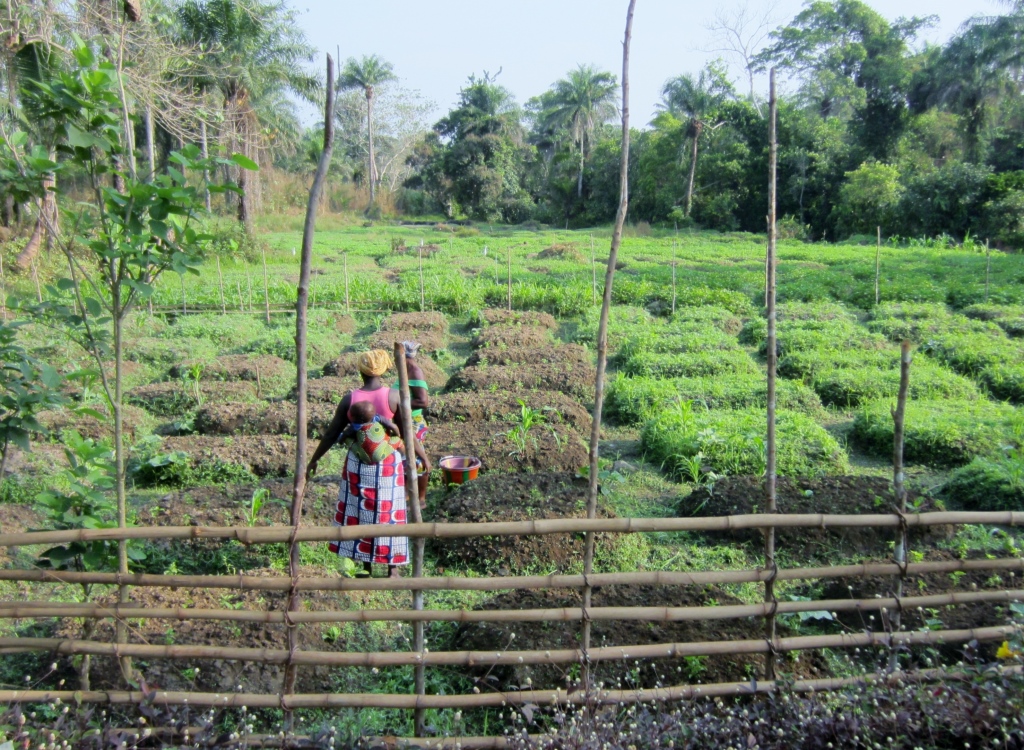
Tending a vegetable garden.  Day care on your back.

Tending a vegetable garden. Day care on your back.

The most disadvantaged are young adults, eighteen and up, ready to start out on the own.  Also women divorced or separated from husbands, left to fend for themselves and their children.  The families of these groups literally do not have any excess money to loan them to start their farms and vegetable gardens.  With no money for tools, seed, and fertilizer, these groups are stuck. Stuck in extreme poverty.
The Center for Community Empowerment and Transformation, Rotifunk’s all-volunteer group for community development is beginning to tackle this area by starting a tree nursery for trees of economic value.

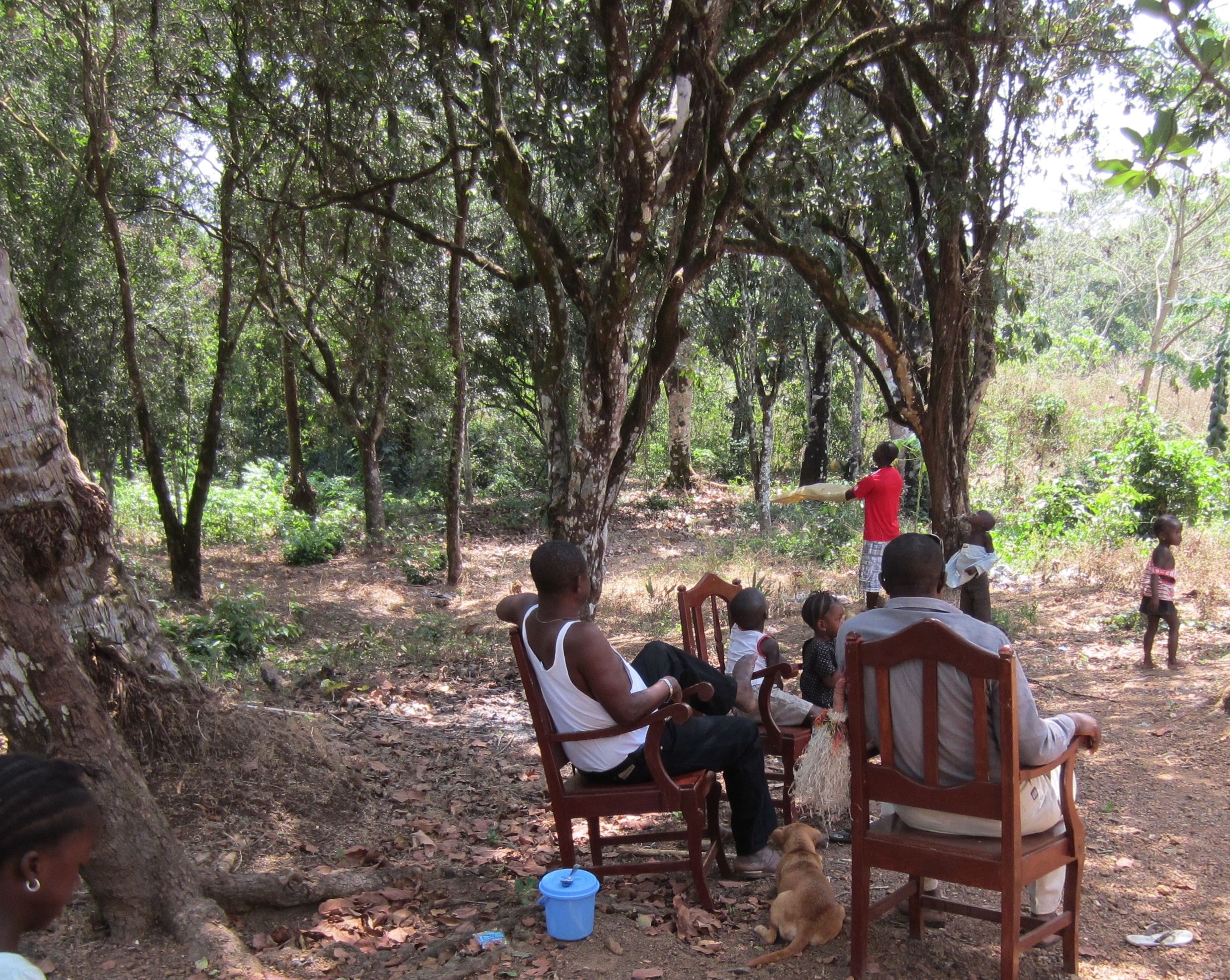
The idea came up one day on my last trip when we needed to escape the heat of a tropical afternoon in the dry season.  Come on, said Chief Caulker, let’s go pick grapefruits.  We took chairs beyond his house and down a hill to an old citrus orchard started by his father fifty years ago.  I didn’t know citrus trees live 50+ years; maybe the non-hybridized kind.

Boys catch grapefruits being picked.

Boys catch grapefruits being picked in mature fruit orchard.

Picking fruit meant sending boys to shinny up a tree in their bare feet to drop grapefruits down to other waiting kids.  They hold out gunny sacks to break the fall of fruits and not squash them.  Then we divvy up the fruit so everyone gets some.  We sent someone to find bread and made “sandwiches” for the kids with groundnut paste – roasted peanuts you grind up with an empty bottle on a board.

We were enjoying the grapefruits and Chief Caulker reminisced about how he had had “his tree,” his birth tree, and how this is no longer being done.  Probably another casualty lost to the war. Your Tree is where your umbilical cord is planted after your birth together with a tree seedling.  It grows as you grow, and it’s Your Tree.  An old custom in many parts of Africa.

A charming and practical custom, I agreed.  We need more trees planted in this country.  I see fire wood being cut left and right.  How are trees being replanted?

This led to a conversation about how we should start planting trees and get the new community based organization – the Center for Community Empowerment and Transformation, still an idea, but at least that day drafted on paper – to start this.

Four months later, as I write this, CCET volunteers are planting the Economic Tree Nursery.  The rainy season has started, and it’s time to plant trees.

CCET has started with fruit trees they are germinating from seed and growing themselves to seedlings.  Orange, grapefruit, lemon (we call lime) and mango.

CCET will transplant seedlings to small polythene bags and nurse them til next season, when local people can buy them at a small nominal cost for their farm or garden. Mr. Sonnah, agriculture teacher and CCET volunteer explained, people take things more seriously when they have to pay something for them.  Same thing at home, I said.  These small fees will go back to purchase materials to start new seedlings each year.

Mr. Sonnah said getting fruit trees will improve a family’s food security, giving them another food source and diversifying their diet.  Fruit trees are typically planted near rivers and streams, helping keep them watered.  As trees mature, they then protect the water catchment area. Trees are like sponges, taking up water, and their roots prevent run-off and erosion in the heavy tropical rains.  These water filled trees then help keep streams from easily drying up in the dry season.  People will need chiefdom permission to cut down economic trees and pay a small fee, as well as replant the tree.  This is to discourage trees being cut for firewood.  Acacia, a fast growing “weed tree” can be used for fire wood.

Village woman extracting oil from palm fruits in her canoe.

Village woman extracting oil from palm fruits in her canoe.

CCET is also starting to nurse oil palm seedlings they bought from Njala University’s agriculture school.  Oil palms are native to Sierra Leone, and the oil from the palm fruits is a mainstay of the local diet.  Palm oil is increasingly used globally for a variety of applications, and is a good cash crop.  The Njala seedlings are a new variety that will produce faster,  fruiting in about four years.

Nine hundred teak seedlings from another source have also been added to CCET’s tree nursery.  These need special care with careful pruning and cultivation as young seedlings.  Next rainy season they’ll be bigger and stronger, and ready to be sold and transplanted again for future lumber harvesting.

CCET will organize workshops and 1:1 training on how to plant and care for all the trees that will be sold.  With 60% of the country’s population under 24 years of age, these are skills that were lost in the war years and now needed for young adults and women needing to become farmers.

The custom of children getting “their tree” will start again, as well.  CCET will ensure each child has a tree planted at birth.  In this way, you will also be able to tell how many children were recently born in a village by counting the number of new trees.

This project is a good example of how a few people can make a big difference when they work together and just get going on a practical first step.

Many benefits follow this project: economic development, food security, environmental protection, protecting cultural traditions, empowering youth and women as farmers.

Sherbro Foundation is glad to have contributed the funding to buy farm tools for the tree nursery and the oil palm seedlings.

Adult Literacy – what do they really need to know?

It’s estimated that 70% of Sierra Leone’s population lives at the impoverished level of $2 USD/day or less. This is sometimes globally called the bottom billion, the lowest tier on the ladder of the world’s seven billion population.

This is true of rural Bumpeh Chiefdom. As you move into more remote villages, the percent no doubt climbs above 70% to most if not all of these communities.  With this kind of poverty comes lack of education.   

If you want to provide adult literacy education, where do you start? Literally, where should you begin in this kind of environment?

A good place is to know the group you aim to educate.  This is where Rotifunk’s Center for Empowerment and Transformation, a local all-volunteer group of Rotifunk teachers is beginning their work on adult literacy.

Shortly after Prosperity Girls High School Principal, Rosaline Kaimbay came to Rotifunk to begin her work on the school, adults expressed their interest in learning to read and write.  Others had attended school, but had to drop out and wanted to continue and develop skills to join the job market.  Or to help their own children as they progress through school.  The Center for Community Empowerment and Transformation has made adult literacy for these people a cornerstone of the Center’s work.

I asked about a profile of the current adult learners.  All are now women; hopefully the men will follow.  The majority of the women are single heads of household, divorced, separated or widowed.  They are mainly in their mid-30’s, but range from 20 years old and up.  This is the group that would have had their schools abruptly shut or interrupted during Sierra Leone’s civil war when towns and villages were abandoned to rebel fighting.  In the early years of rebuilding following the war, schooling would have either not yet been available, or the cost beyond the reach of rural families.  Girls’ education would traditionally have been given low priority, especially as a girl approached marriageable age.

Women fetching water for their vegetable garden.

Women fetching water for their vegetable garden.

Early primary school learning for these women has long been lost and forgotten.  They moved on with their lives in the footsteps of their mothers and grandmothers, doing the work available in a subsistence agriculture community.  They became small traders and small farmers.

In one way or another, 70% of Sierra Leone’s population is involved in agriculture.  Either they grow things themselves, or they are small traders who buy agricultural products like rice, palm oil and vegetables in quantity from small farms and bring them to resell in larger village and town markets.

Small traders may also buy “general store” items in larger towns to resell in local markets – cooking utensils, plastic buckets and basins, soap, batteries, plastic sandals, cloth and so on.

These are working women, working in what’s called the informal economy.  It’s the economy of small farmers whose schedules are driven by the planting and harvesting seasons, and of small traders who must be available for market days in towns and villages where they sell their wares.  They need knowledge that will help them improve their current lives, and on a flexible schedule.

Women selling fish in Rotifunk's market.

Small trader selling smoked fish in Rotifunk’s market.

Traditional reading and writing is not the first priority for these women.  The typical classroom reading, grammar and writing kind of stuff that you get over twelve years of public education is not of immediate use to them.  Basic arithmetic is a priority.  Vocational skills tailored to their kind of work are another need.

The volunteer teachers at the Center for Community Empowerment and Transformation are embarking on a “functional adult literacy” program. They will teach their adult learners what they need to know to successfully conduct their business and improve their lives.

Traders need to know basic computations to ensure they’re getting the best price for their goods, how to calculate interest for the small loans they invariably take (or maybe give to friends), and skills on how to better market the goods they sell.

Small farmers need to know about applying fertilizer and manure, when and how much, and how to “add value” to their agricultural products by further processing or packaging to get a better price.

They would all like to know more about female reproductive health and social skills to better manage conflicts (known here as palavers), useful when you’re living in the confines of a small village.  And they’re enjoying recreation organized specifically for them – women’s football (soccer) teams.  Where else would a village mother find the time (or give herself the permission) to play sports and release the pent up stress of living in poverty and develop the camaraderie of a group of peer women.

There’s no curriculum for this kind of functional learning, so the Center’s volunteer teachers will develop their own lessons.  Experienced teachers know how to do this, and build as they go.  They understand these things when they lived embedded in the community with their students, and are committed to working with them.

Now, how to give these women the time from their busy lives to take advantage and improve themselves?  Sound familiar? I have no doubt this program will grow and the merits be known by word of mouth from the initial group of students.  Success breeds more success.

The Center for Community Empowerment and Transformation – another bright star

Trying to do good in another country is not always straightforward.  First, you need to find well-defined projects you believe will “do good” in the area you want to serve.  Then you need a trusted partner on the ground who shares your objectives and can effectively deliver the nuts-and-bolts work, and do it with integrity.

The Sherbro Foundation is fortunate to have found such a partner in The Center for Community Empowerment and Transformation.  CCET is a grassroots, all-volunteer nonprofit group of Sierra Leoneans organized for the development of Rotifunk and Bumpeh Chiefdom.

It’s quite a name and tells you right off what the vision of this group is. It’s no less than the empowerment and transformation of their community.

I was fortunate to have had an early and impactful learning from my old days in the Peace Corps that I’ve carried with me all these years.  To make lasting change or improvements, don’t show up with your pre-cooked “solution” and try to give it to people who aren’t sold on – or maybe even aware of – the problem you’ve selected for them. This is generally true anywhere, and even more true when working with a rural community of another culture. 

Still today, I see too many NGOs (nongovernmental organizations) trying to solve the problems of the world with their own “programs”.  They may not spend enough time in the developing country communities they want to serve to jointly set priorities and agree on approaches to use.

It was a stroke of luck that found me back in Rotifunk for my third return trip right as the concept for the Center for Community Empowerment and Transformation was taking shape.  I was visiting more of the chiefdom and better understanding the extent of the needs there.   I arrived already frustrated in not finding existing nonprofit organizations in the U. S. interested in supporting the kind of small community projects I saw needed in Bumpeh Chiefdom.  Grant applications, even if successful, can take months if not a year or more to process. I was already toying with the idea of creating my own nonprofit.

At the same time Prosperity Girls High School had just started their first senior high class, and with that, hired several new teachers.  More competent and committed teachers joined those already at PGHS, ready to serve this rural community.   Within a month of their arrival, several of the new teachers joined up with existing teachers to form the concept for a community based organization.

The Center concept

I asked Mr. Sonnah and Mr. Kamara, PGHS teachers and thought leaders in the Center, how their concept had come about. Both relayed the same story.  Some old university friends of theirs representing an NGO had come to Rotifunk to do a survey.  They challenged them to create their own community-based organization.  Come on, they said.  You’re in this rural place with time on your hands; you have the education and potential to be doing more. 

Mr. Sonnah and his 7th grade class.

Mr. Sonnah and his 7th grade class.

The teachers had already seen how PGHS principal Rosaline Kaimbay was struggling to start adult literacy classes, holding intermittent lessons on the front porch of her house after school let out.  The majority of the adult students were women whose educations were interrupted, or maybe never started, because of the war.

The teachers agreed adult literacy would become the first core program for the Center to take on and they would do it on a volunteer basis.

Mr. Kamara in a moment of relaxing.

Mr. Kamara in a moment of relaxing.

More projects soon followed.  The Center’s current project portfolio includes:

  1. Adult literacy – starting with creating a curriculum of practical skills for small traders and farmers that are illiterate, mainly women.  
  2. Girls Scholarship program – paying school fees to keep teenage girls in Rotifunk’s four secondary schools at a time when drop out rates for girls climb and families have great difficulty paying for the cost of an education.
  3. Tree nursery for trees of economic value – nursing small teak tree and oil palm seedlings and starting citrus and avocado trees from seed to provide to the community at nominal cost.
  4. Computer literacy – building the computer skills of local teachers in preparation for organizing the community computer lab the Sherbro Foundation has facilitated with a donated shipment of fifty computers now on their way to Rotifunk.
  5.  Registration of chiefdom births and deathshelping set up a model process where none now exists in Bumpeh Chiefdom, or most of rural Sierra Leone.
  6.  Adult sports teams for women – organizing women’s football (soccer) teams to give women still traumatized from the war a physical outlet for stress and team building for a peer network.

Within five months of their initial conceptual discussion, the Center volunteers are busy planting trees, teaching computer skills, and developing lessons on basic computations for illiterate market women.

This is what I call empowerment.  They’re getting going on concrete, practical programs that can help transform their community using  the limited resources they have.

The Sherbro Foundation is proud to have helped with start-up costs for the Center.  We have donated money to pay fees for the Center to officially register as a nonprofit with several Sierra Leone ministries, making them eligible for local grant funds.  We have also provided money for classroom furniture to be locally built for the computer lab, and to purchase farming tools and oil palm seedlings for the tree nursery.  We will fund a one-day workshop where people will be taught how to complete the birth/death registrations.

More will follow on each of these projects.

Mr. Sonnah explained the Center’s logo to me and how it symbolizes what they plan to accomplish.  A man and a woman are together holding one torch light.  Light brings about transformation, and men and women are equally balanced in holding one light.  They are surrounded by olive branches depicting them rescuing the chiefdom from its past traumas.  They are transforming the chiefdom to be a better place.  Mr. Kamara said in his quietly confident manner, we are developing our brothers and sisters, and we know with our work today, tomorrow will be a brighter day.  We see our future as bright.

The Sherbro Foundation sees their future as bright, too, and we’re happy to be helping them on their way.

How you can help

DSCN0359

Donations are great, but there’s other ways to help, too.

  • Like us on Facebook and “share” Sherbro Foundation Facebook news items to your Friends list.
  • Identify organizations interested in supporting girls education, solar energy & agriculture in West Africa.  eg., Churches doing mission & outreach work;  Schools doing public service & educational projects; Foundations & Nonprofits interested in these areas.  Help connect us and advocate for us.
  • Help design a logo for Sherbro Foundation with a .jpeg image.
  • Sponsor a girl for one year in secondary school by paying school fees:
    • $18  for Junior High
    • $22  for Senior High
    • $35  for a school uniform & shoes she’ll wear for two years or more
  • Find used or in-kind donations for schools:
    • Educational videos, tutorials on DVD (eg., math lessons), school supplies, books, computer mouse & mouse pads.
  • Support our current Projects – donate online using the “Donate” button to the right on each page
    • Fifty Laptop computer carrying bags for the new computer lab – about $15 /bag    Current need!
    • Solar Energy System for the Computer Lab
    • Office printer (need 220V equipment)
    • Sponsor a Science teacher for additional teacher training – $250/year
    • Community economic tree nursery – nurse seedlings for local families / create demonstration garden and train on growing
    • Village Cooperative Store – stock household items to sell at cost for a small, subsistence agriculture village; avoid markup costs & provide initial stock for a co-op store

Sherbro Foundation invited to be part of Cincinnati’s Freedom Center event

The Sherbro Foundation was delighted to be invited to participate in an important event for women worldwide May 22 at Cincinnati’s National Underground Railroad Freedom Center.

The free public evening kicked off with a 5:30 p.m. reception and Action Fair. National and local nonprofits – including Sherbro Foundation — offered information about their efforts to uplift women and eliminate oppression and discrimination, both here and abroad, and how you can help.

The event is a follow-up to the recent traveling exhibit at the Freedom Center, “Women Hold Up Half the Sky,’’ based on the bestselling book, “Half the Sky – Turning Oppression into Opportunity for Women Worldwide.” Both serve as wake-up calls to the injustices perpetrated against women worldwide and the ways to effect change.

The program began with a 40-minute version of the PBS Half the Sky documentary.  A short keynote address was presented via live satellite by Half the Sky Executive Producer Mikaela Beardsley and followed by a brief panel discussion with local volunteers and activists.

The evening wrapped up with a longer Action Fair at to give attendees an opportunity to learn more about organizations supporting women locally and globally and how you can get involved and support them through volunteerism, advocacy or giving.

For more information on the Half the Sky movement, visit: www.halftheskymovement.org

Become an Agent of Change - Half the Sky Event Invitation (2)