From Darkness to Light – Learning to Read

From Darkness to Light – Learning to Read

Imagine a child entering Class 3 who can hardly read simple words. Some still struggle naming letters or numbers. This is not uncommon in Bumpeh Chiefdom and across Sierra Leone. These children risk never catching up and often drop out of school in frustration. Their lives remain forever limited without reading skills.

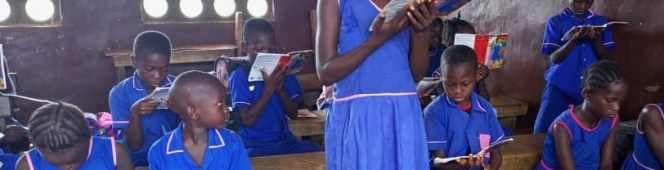
Our partner, the Center for Community Empowerment & Transformation (CCET-SL), fills teaching gaps with a targeted Class 3 learn-to-read program. Experienced, retired teachers work weekly with students in seven schools on their first formal reading steps, while coaching their inexperienced teachers.

CCET-SL submitted this story of a girl struggling to read and her remarkable teacher who was retired “but not yet tired” – eager to keep teaching.

Rachel’s Reading Journey

Modigay is a small village surrounded by lush green fields with a winding dirt road to Rotifunk, the chiefdom headquarters. There lived spirited class-three student Rachel Bangura. Every day, Rachel woke before dawn, her heart filled with learning dreams despite overwhelming circumstances. Her family, struggling as subsistence farmers, could barely afford life’s necessities, let alone help with homework. Rachel often joined her parents in fields after school.

Rachel loved school, but joy was overshadowed by struggles. She could hardly read, spell, or connect sounds to letters, filling her with anxiety. In her bustling Rotifunk classroom, while other children eagerly raised hands, Rachel sat quietly, hoping not to be called upon. She felt lost in a sea of words dancing beyond her reach.

A New Hope

The Center for Community Empowerment and Transformation works with schools and local council to improve education quality in Bumpeh Chiefdom. They train teachers to improve outcomes among underprivileged children. They brought in experienced retired teacher Mr. Koroma, who had a reputation for transforming struggling students’ lives. With his compassionate approach and innovative methods, Mr. Koroma was determined to help children like Rachel.

When Mr. Koroma first met Rachel, he noticed the curiosity spark in her eyes despite looming fear of failure. He took time to know Rachel, learning about her village, family, and dreams of reading stories. Rachel expressed her desire to read about faraway places and adventures. Mr. Koroma promised they would work together to make that dream reality.

Building Foundations

Mr. Koroma began with basics, focusing on phonics and letter sounds through engaging activities. He used colorful flashcards, songs, and rhymes that made learning fun. Rachel’s shy laughter echoed as Mr. Koroma encouraged students to sound letters and blend them into words.
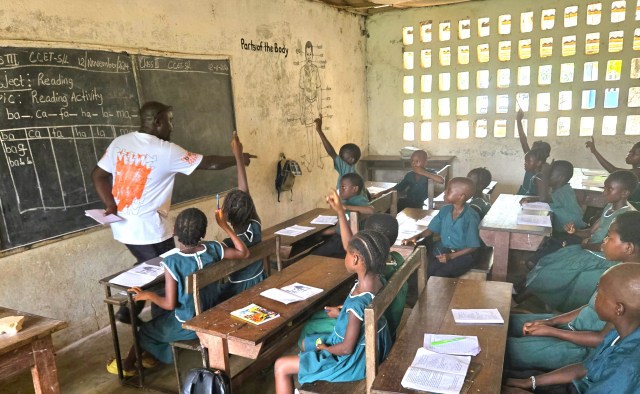
Initially, Rachel struggled to grasp concepts, feeling frustrated and overwhelmed, but Mr. Koroma’s patience kept her motivated. “Every word you learn is a step closer to your dreams, Rachel. Let’s take it one step at a time!” he would say, and Rachel felt hope ignite within her.

Beyond the Classroom

To further support Rachel’s learning, Mr. Koroma organized weekend literacy clubs in their village where children could gather and learn together. Rachel’s parents were thrilled seeing their daughter engaging with other children in learning to read.

During club meetings, Rachel enjoyed storytelling sessions where she listened to tales from different cultures. She was captivated by stories of brave heroes and magical realms, fueling her desire to read. Mr. Koroma encouraged children to draw pictures related to stories, allowing Rachel to express creativity when words felt elusive.

Breakthrough Moments

As the school year progressed, Rachel made significant progress. One sunny afternoon, while practicing with Mr. Koroma, Rachel successfully read a simple book aloud for the first time.

“Saffie’s Mistake!” she exclaimed, her voice filled with joy. Mr. Koroma and other children clapped excitedly, and Rachel’s face lit up with a radiant smile. This moment marked a turning point; she realized she could read, that she was capable.

Buoyed by success, Rachel started writing short sentences about her life and village. She wrote about family, friends, and beautiful sunsets. Each word she penned testified to her growth and determination.

A Year of Transformation

By year’s end, Rachel had transformed remarkably. With Mr. Koroma’s guidance, she could read simple stories, write confidently, and understand word sounds. Rachel’s self-esteem blossomed, and she now participates actively in class discussions. She’s no longer the quiet girl at the back; she’s become a vibrant classroom community member.

Rachel often shared dreams with Mr. Koroma about becoming a teacher to help other children like herself. Mr. Koroma beamed with pride, knowing his influence had sparked fire within Rachel.

Learn to Read Program Impact

Rachel’s story repeats many times with Mr. Koroma and other experienced reading teachers entering classrooms weekly.

CCET-SL reading tutors break through barriers and jumpstart children’s ability and love of reading. Teachers who only graduated high school receive practical, in-classroom training building their skills and motivation to teach.

Because CCET-SL uses experienced community teachers, the cost is only $10 per student for the whole year. The cost is low, the result is priceless.

To keep kids progressing, we will expand the learn-to-read program to Class 4 with the new school year. You can give 350 Class 3 and 4 children like Rachel in seven schools the chance to unlock their potential through reading with your support: here.

You can also help send 14 early primary school teachers to get 3-year teaching certificates on scholarship. They’ll develop skills to start children on the path to mastering reading in classes 1 – 3.

These teachers have only graduated from high school with no means to pay for higher education.  A scholarship for each year is only $400. Give Now

You’ll be giving Bumpeh Chiefdom children a strong education head-start, an advantage they’ll carry through life. We appreciate your support!

–Arlene Golembiewski
   Executive Director

Meet Our Partner CCET-SL’s New Manager

Meet Our Partner CCET-SL’s New Manager

When Mustakin Conteh arrived at the Center for Community Empowerment & Transformation last September, he didn’t just bring professional nonprofit experience—he brought a vision. As our partner organization’s first manager with formal NGO background, Mustakin has spent the past year moving CCET-SL from a small community organization towards his goal of a full-fledged Sierra Leone nonprofit.

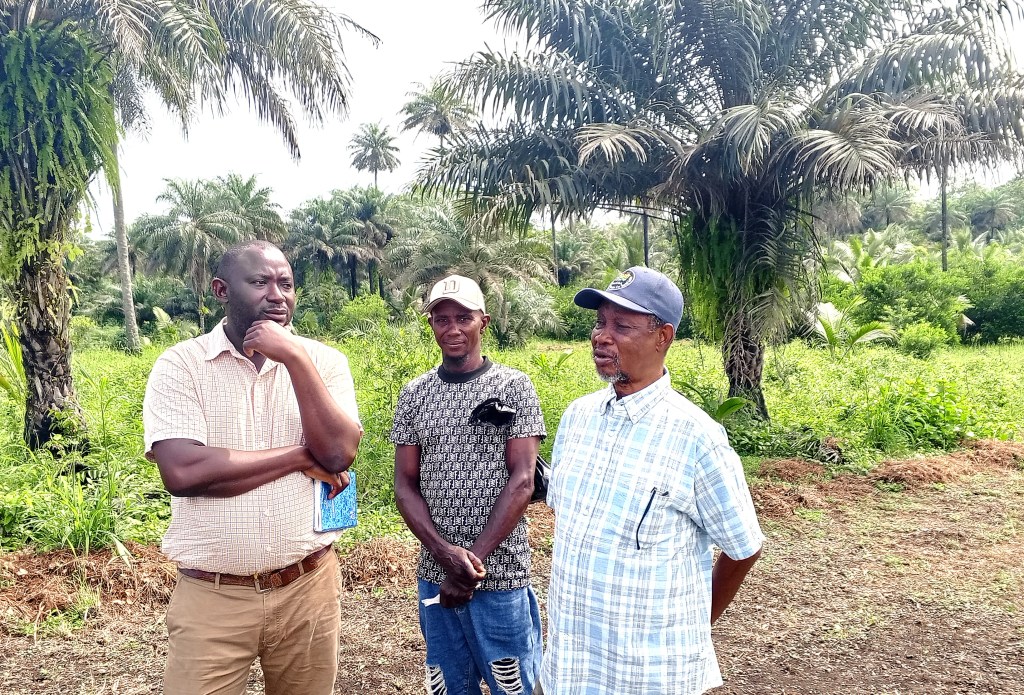
Mustakin, left, reviews CCET-SL’s Orchards for Education with Paramount Chief Charles Caulker, right.

But his story begins much earlier, in a classroom in Bo.

A Teacher’s Calling

Like many first pursuing higher education in Sierra Leone, Mustakin started as a teacher. With a B.A. in Education, he taught secondary school English and English Literature for ten years in Bo, Sierra Leone’s second largest city. But as the country was recovering from its devastating rebel war, he witnessed firsthand how rural communities remained trapped in cycles of poverty that the conflict had only deepened.

That experience changed everything.

Armed with a Master’s in Rural Development from Njala University, Mustakin embarked on a second career dedicated to rural transformation. For 12 years, he honed his skills with Sierra Leone NGOs and international NGO programs like Save the Children and Welthungerhilfe, learning how to turn development theory into real-world impact.

Boots on the Ground Leadership

What sets Mustakin apart is his hands-on approach—still uncommon in rural Sierra Leone. I find him everywhere: meeting with school principals and teachers, visiting Let Them Earn villages, checking operations at CCET-SL’s Orchards for Education at 8am before continuing with his day. He doesn’t manage from behind a desk. He leads from the field and sets operating standards.

Staff and community members could see he’s there to improve the lives of everyday people. His respectful, engaging style quickly earns trust. CCET-SL’s small staff achieves broad community impact through local partnerships. Mustakin’s kind of relationship-building is everything.

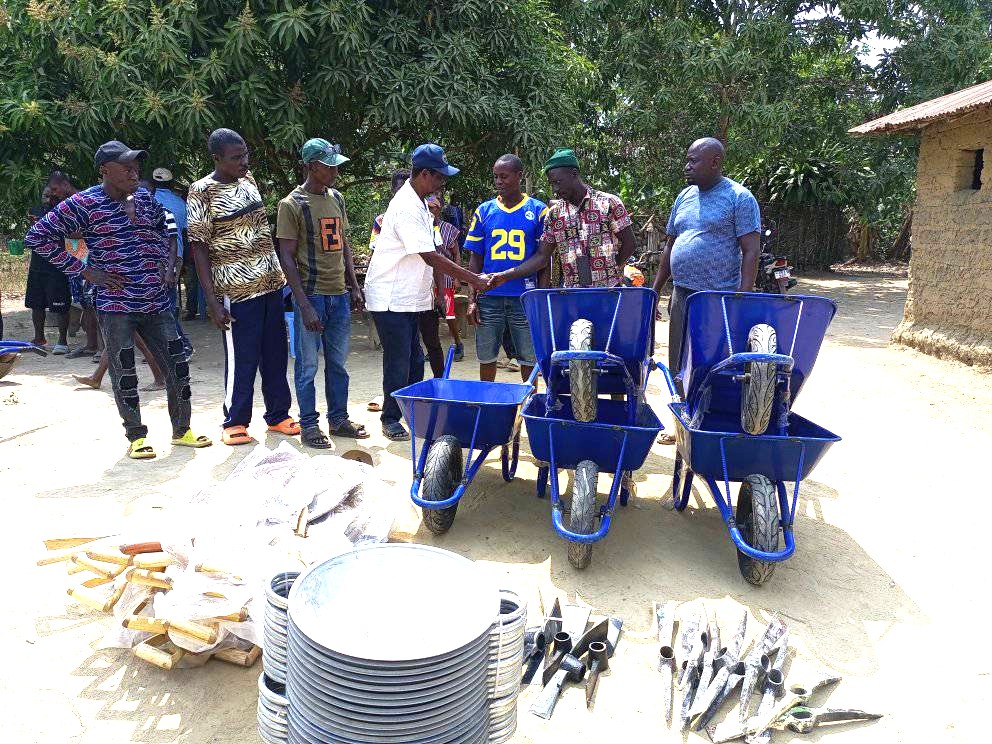
Mustakin, right, officiates a ceremony handing off Sherbro Foundation funded tools for village road repairs. He oversaw work where villagers manually dug roadside rain gutters and filled gullies, keeping roads drivable in the rainy season.

Results, Not Just Reports

Mustakin didn’t come to simply manage programs on paper. His NGO experience trained him to look beyond activities to long-term impact. “How are we actually improving lives?” he asks—a critical question as CCET-SL enters year two of its village farmer development program, Let Them Earn. He’s guiding the project team and villagers to identify early learnings and make modifications to be more effective.

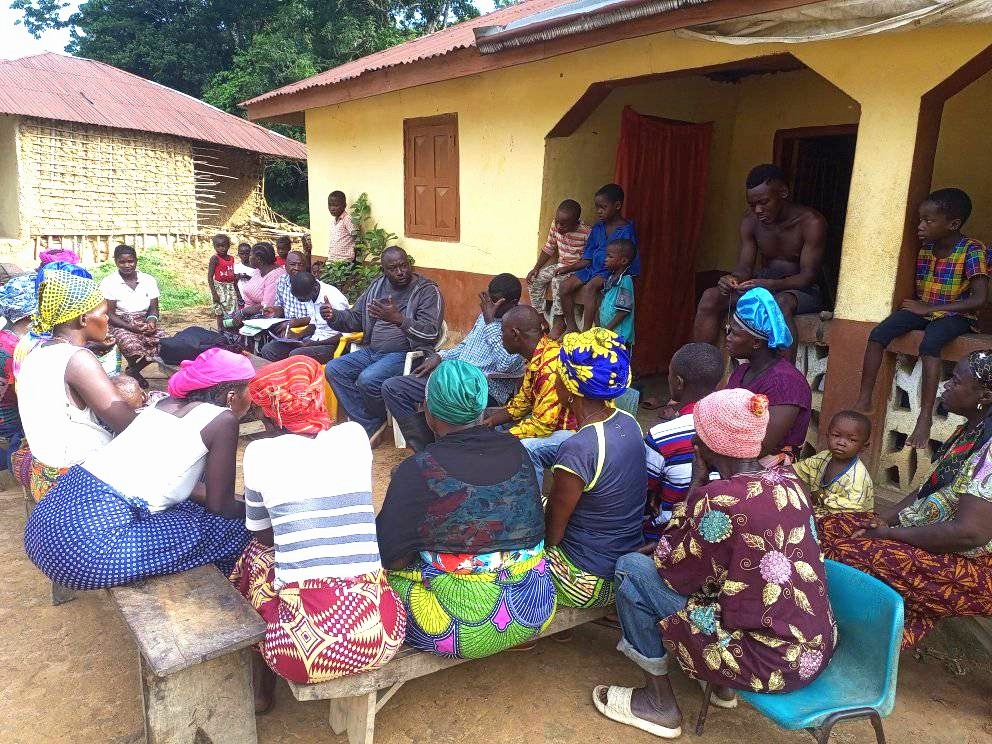
Mustakin, center, explaining Let Them Earn project objectives to Mokomrabai project participants.

Project Management expertise

This results-oriented mindset recently solved a pressing challenge. Climate change is threatening CCET-SL’s 60-acre Orchards for Education with rising dry season temperatures and erratic rainfall. When asked to address this, Mustakin sprang into action.

Within three months, he had:

  • Researched water system solutions, confirming a borehole as cost effective
  • Engaged government advisors for technical design
  • Secured the best borehole contractor
  • Delivered a complete system reaching 220 feet to an aquifer providing plentiful clean water

Today, elevated storage tanks and standpipes cover the 60-acre orchard, ensuring maturing trees have year-round water. Mustakin isn’t an engineer, but he knew how to analyze problems, find technical resources, and execute solutions—exactly the project management skills rural communities desperately need.

Mustakin here supervising installation of a nine-foot water storage tank platform.

Building a Legacy

For Mustakin, this work transcends employment. “I’m here to create my own legacy,” he tells us. His commitment to the people of Bumpeh Chiefdom runs deep, driving him to push through the daily challenges of rural development work. Like getting to project sites on roads, left, he found even his motorbike had trouble passing in the rainy season.

As CCET-SL – and Sherbro Foundation – continue our mission of lifting communities out of poverty, we’re grateful to have a leader who understands sustainable change requires both professional expertise and genuine heart for the people being served.

Thank you, Mustakin, for choosing to invest your talents where they’re needed most—and for showing us what dedicated leadership looks like in action.

— Arlene Golembiewski
   Executive Director
#GivingTuesday: This Year, Change a Sierra Leone Girl’s World

Screenshot (51)

With education, the world opens for a Sierra Leone girl.

You can give the most rural girl from a family living on less than $2 a day the gift of education – and change her world.

She’ll marry later and avoid early pregnancy.  When ready, she’ll have fewer, healthier children and send them to school with the higher earning power her education brings.  She may start a business or become a community leader – or go on to lead her country. The circle of positive impact from education only keeps growing. 

It can start with only $30 for a secondary school scholarship that helps a girl complete high school.

$50 pays a local teacher’s monthly stipend for teaching after-school classes that prepare 9th and 12th graders for their national exams – the entry to senior high and higher education.

$100 pays annual tuition for a student to attend vocational school and advance to a wage-paying job.

$375 pays annual tuition for a college scholarship at the University of Sierra Leone.

This Giving Tuesday, change a Sierra Leone girl’s life. Give her the gift of education.  And you’ll feel great!
www.sherbrofoundation.org/donate

Adult Literacy – what do they really need to know?

It’s estimated that 70% of Sierra Leone’s population lives at the impoverished level of $2 USD/day or less. This is sometimes globally called the bottom billion, the lowest tier on the ladder of the world’s seven billion population.

This is true of rural Bumpeh Chiefdom. As you move into more remote villages, the percent no doubt climbs above 70% to most if not all of these communities.  With this kind of poverty comes lack of education.   

If you want to provide adult literacy education, where do you start? Literally, where should you begin in this kind of environment?

A good place is to know the group you aim to educate.  This is where Rotifunk’s Center for Empowerment and Transformation, a local all-volunteer group of Rotifunk teachers is beginning their work on adult literacy.

Shortly after Prosperity Girls High School Principal, Rosaline Kaimbay came to Rotifunk to begin her work on the school, adults expressed their interest in learning to read and write.  Others had attended school, but had to drop out and wanted to continue and develop skills to join the job market.  Or to help their own children as they progress through school.  The Center for Community Empowerment and Transformation has made adult literacy for these people a cornerstone of the Center’s work.

I asked about a profile of the current adult learners.  All are now women; hopefully the men will follow.  The majority of the women are single heads of household, divorced, separated or widowed.  They are mainly in their mid-30’s, but range from 20 years old and up.  This is the group that would have had their schools abruptly shut or interrupted during Sierra Leone’s civil war when towns and villages were abandoned to rebel fighting.  In the early years of rebuilding following the war, schooling would have either not yet been available, or the cost beyond the reach of rural families.  Girls’ education would traditionally have been given low priority, especially as a girl approached marriageable age.

Women fetching water for their vegetable garden.

Women fetching water for their vegetable garden.

Early primary school learning for these women has long been lost and forgotten.  They moved on with their lives in the footsteps of their mothers and grandmothers, doing the work available in a subsistence agriculture community.  They became small traders and small farmers.

In one way or another, 70% of Sierra Leone’s population is involved in agriculture.  Either they grow things themselves, or they are small traders who buy agricultural products like rice, palm oil and vegetables in quantity from small farms and bring them to resell in larger village and town markets.

Small traders may also buy “general store” items in larger towns to resell in local markets – cooking utensils, plastic buckets and basins, soap, batteries, plastic sandals, cloth and so on.

These are working women, working in what’s called the informal economy.  It’s the economy of small farmers whose schedules are driven by the planting and harvesting seasons, and of small traders who must be available for market days in towns and villages where they sell their wares.  They need knowledge that will help them improve their current lives, and on a flexible schedule.

Women selling fish in Rotifunk's market.

Small trader selling smoked fish in Rotifunk’s market.

Traditional reading and writing is not the first priority for these women.  The typical classroom reading, grammar and writing kind of stuff that you get over twelve years of public education is not of immediate use to them.  Basic arithmetic is a priority.  Vocational skills tailored to their kind of work are another need.

The volunteer teachers at the Center for Community Empowerment and Transformation are embarking on a “functional adult literacy” program. They will teach their adult learners what they need to know to successfully conduct their business and improve their lives.

Traders need to know basic computations to ensure they’re getting the best price for their goods, how to calculate interest for the small loans they invariably take (or maybe give to friends), and skills on how to better market the goods they sell.

Small farmers need to know about applying fertilizer and manure, when and how much, and how to “add value” to their agricultural products by further processing or packaging to get a better price.

They would all like to know more about female reproductive health and social skills to better manage conflicts (known here as palavers), useful when you’re living in the confines of a small village.  And they’re enjoying recreation organized specifically for them – women’s football (soccer) teams.  Where else would a village mother find the time (or give herself the permission) to play sports and release the pent up stress of living in poverty and develop the camaraderie of a group of peer women.

There’s no curriculum for this kind of functional learning, so the Center’s volunteer teachers will develop their own lessons.  Experienced teachers know how to do this, and build as they go.  They understand these things when they lived embedded in the community with their students, and are committed to working with them.

Now, how to give these women the time from their busy lives to take advantage and improve themselves?  Sound familiar? I have no doubt this program will grow and the merits be known by word of mouth from the initial group of students.  Success breeds more success.

The Center for Community Empowerment and Transformation – another bright star

Trying to do good in another country is not always straightforward.  First, you need to find well-defined projects you believe will “do good” in the area you want to serve.  Then you need a trusted partner on the ground who shares your objectives and can effectively deliver the nuts-and-bolts work, and do it with integrity.

The Sherbro Foundation is fortunate to have found such a partner in The Center for Community Empowerment and Transformation.  CCET is a grassroots, all-volunteer nonprofit group of Sierra Leoneans organized for the development of Rotifunk and Bumpeh Chiefdom.

It’s quite a name and tells you right off what the vision of this group is. It’s no less than the empowerment and transformation of their community.

I was fortunate to have had an early and impactful learning from my old days in the Peace Corps that I’ve carried with me all these years.  To make lasting change or improvements, don’t show up with your pre-cooked “solution” and try to give it to people who aren’t sold on – or maybe even aware of – the problem you’ve selected for them. This is generally true anywhere, and even more true when working with a rural community of another culture. 

Still today, I see too many NGOs (nongovernmental organizations) trying to solve the problems of the world with their own “programs”.  They may not spend enough time in the developing country communities they want to serve to jointly set priorities and agree on approaches to use.

It was a stroke of luck that found me back in Rotifunk for my third return trip right as the concept for the Center for Community Empowerment and Transformation was taking shape.  I was visiting more of the chiefdom and better understanding the extent of the needs there.   I arrived already frustrated in not finding existing nonprofit organizations in the U. S. interested in supporting the kind of small community projects I saw needed in Bumpeh Chiefdom.  Grant applications, even if successful, can take months if not a year or more to process. I was already toying with the idea of creating my own nonprofit.

At the same time Prosperity Girls High School had just started their first senior high class, and with that, hired several new teachers.  More competent and committed teachers joined those already at PGHS, ready to serve this rural community.   Within a month of their arrival, several of the new teachers joined up with existing teachers to form the concept for a community based organization.

The Center concept

I asked Mr. Sonnah and Mr. Kamara, PGHS teachers and thought leaders in the Center, how their concept had come about. Both relayed the same story.  Some old university friends of theirs representing an NGO had come to Rotifunk to do a survey.  They challenged them to create their own community-based organization.  Come on, they said.  You’re in this rural place with time on your hands; you have the education and potential to be doing more. 

Mr. Sonnah and his 7th grade class.

Mr. Sonnah and his 7th grade class.

The teachers had already seen how PGHS principal Rosaline Kaimbay was struggling to start adult literacy classes, holding intermittent lessons on the front porch of her house after school let out.  The majority of the adult students were women whose educations were interrupted, or maybe never started, because of the war.

The teachers agreed adult literacy would become the first core program for the Center to take on and they would do it on a volunteer basis.

Mr. Kamara in a moment of relaxing.

Mr. Kamara in a moment of relaxing.

More projects soon followed.  The Center’s current project portfolio includes:

  1. Adult literacy – starting with creating a curriculum of practical skills for small traders and farmers that are illiterate, mainly women.  
  2. Girls Scholarship program – paying school fees to keep teenage girls in Rotifunk’s four secondary schools at a time when drop out rates for girls climb and families have great difficulty paying for the cost of an education.
  3. Tree nursery for trees of economic value – nursing small teak tree and oil palm seedlings and starting citrus and avocado trees from seed to provide to the community at nominal cost.
  4. Computer literacy – building the computer skills of local teachers in preparation for organizing the community computer lab the Sherbro Foundation has facilitated with a donated shipment of fifty computers now on their way to Rotifunk.
  5.  Registration of chiefdom births and deathshelping set up a model process where none now exists in Bumpeh Chiefdom, or most of rural Sierra Leone.
  6.  Adult sports teams for women – organizing women’s football (soccer) teams to give women still traumatized from the war a physical outlet for stress and team building for a peer network.

Within five months of their initial conceptual discussion, the Center volunteers are busy planting trees, teaching computer skills, and developing lessons on basic computations for illiterate market women.

This is what I call empowerment.  They’re getting going on concrete, practical programs that can help transform their community using  the limited resources they have.

The Sherbro Foundation is proud to have helped with start-up costs for the Center.  We have donated money to pay fees for the Center to officially register as a nonprofit with several Sierra Leone ministries, making them eligible for local grant funds.  We have also provided money for classroom furniture to be locally built for the computer lab, and to purchase farming tools and oil palm seedlings for the tree nursery.  We will fund a one-day workshop where people will be taught how to complete the birth/death registrations.

More will follow on each of these projects.

Mr. Sonnah explained the Center’s logo to me and how it symbolizes what they plan to accomplish.  A man and a woman are together holding one torch light.  Light brings about transformation, and men and women are equally balanced in holding one light.  They are surrounded by olive branches depicting them rescuing the chiefdom from its past traumas.  They are transforming the chiefdom to be a better place.  Mr. Kamara said in his quietly confident manner, we are developing our brothers and sisters, and we know with our work today, tomorrow will be a brighter day.  We see our future as bright.

The Sherbro Foundation sees their future as bright, too, and we’re happy to be helping them on their way.

See today’s Sierra Leone by video – Brand Sierra Leone

Freetown beachTo bring business and tourists to Sierra Leone, they need to see the country and what’s going on today.  Brand Sierra Leone aims to do this.
Brand Sierra Leone is a global initiative started by a group made up of diaspora and media experts…, who want to promote a fresh perspective of Sierra Leone by spreading the most important and positive news in the areas of culture, economy and society from all around the country.
In order to do this, Brand Sierra Leone offers via http://brandsierraleone.tv/ a selection of short videos, documentaries, dedicated news and programmes especially focused toward tourism, arts & culture, history, music, fashion, inward investment, business, etc.
Brand Sierra Leone is made up of a team of professionals specialising in communication, marketing and creative applications for digital media such as pre/post-production video, graphic & editorial design, advertising optimisation strategies, etc.
Click through their website for interesting mix of videos about development, history and contemporary Sierra Leone culture.

How you can help

DSCN0359

Donations are great, but there’s other ways to help, too.

  • Like us on Facebook and “share” Sherbro Foundation Facebook news items to your Friends list.
  • Identify organizations interested in supporting girls education, solar energy & agriculture in West Africa.  eg., Churches doing mission & outreach work;  Schools doing public service & educational projects; Foundations & Nonprofits interested in these areas.  Help connect us and advocate for us.
  • Help design a logo for Sherbro Foundation with a .jpeg image.
  • Sponsor a girl for one year in secondary school by paying school fees:
    • $18  for Junior High
    • $22  for Senior High
    • $35  for a school uniform & shoes she’ll wear for two years or more
  • Find used or in-kind donations for schools:
    • Educational videos, tutorials on DVD (eg., math lessons), school supplies, books, computer mouse & mouse pads.
  • Support our current Projects – donate online using the “Donate” button to the right on each page
    • Fifty Laptop computer carrying bags for the new computer lab – about $15 /bag    Current need!
    • Solar Energy System for the Computer Lab
    • Office printer (need 220V equipment)
    • Sponsor a Science teacher for additional teacher training – $250/year
    • Community economic tree nursery – nurse seedlings for local families / create demonstration garden and train on growing
    • Village Cooperative Store – stock household items to sell at cost for a small, subsistence agriculture village; avoid markup costs & provide initial stock for a co-op store

Sherbro Foundation invited to be part of Cincinnati’s Freedom Center event

The Sherbro Foundation was delighted to be invited to participate in an important event for women worldwide May 22 at Cincinnati’s National Underground Railroad Freedom Center.

The free public evening kicked off with a 5:30 p.m. reception and Action Fair. National and local nonprofits – including Sherbro Foundation — offered information about their efforts to uplift women and eliminate oppression and discrimination, both here and abroad, and how you can help.

The event is a follow-up to the recent traveling exhibit at the Freedom Center, “Women Hold Up Half the Sky,’’ based on the bestselling book, “Half the Sky – Turning Oppression into Opportunity for Women Worldwide.” Both serve as wake-up calls to the injustices perpetrated against women worldwide and the ways to effect change.

The program began with a 40-minute version of the PBS Half the Sky documentary.  A short keynote address was presented via live satellite by Half the Sky Executive Producer Mikaela Beardsley and followed by a brief panel discussion with local volunteers and activists.

The evening wrapped up with a longer Action Fair at to give attendees an opportunity to learn more about organizations supporting women locally and globally and how you can get involved and support them through volunteerism, advocacy or giving.

For more information on the Half the Sky movement, visit: www.halftheskymovement.org

Become an Agent of Change - Half the Sky Event Invitation (2)

Rebuilding Bumpeh Chiefdom after Sierra Leone’s civil war

Rebuilding Bumpeh Chiefdom after Sierra Leone’s civil war

Rotifunk, the seat of Bumpeh Chiefdom, was devastated in Sierra Leone’s 11-year civil war.  About 55 miles southeast of the capital, Freetown, Rotifunk was hit hard as rebel soldiers burned and looted their way to the capital.  Every building in the town of about 10,000 was burned except for a church and a mosque, and its people forced to flee. The town abandoned for several years.  The result:  total collapse of the socio-economic fabric, and a once bustling town found itself in abject poverty.

The war ended in 2001. Now a safe, peaceful, country, Sierra Leone is still, however, one where 70% of families struggle to survive in the aftermath of the civil war on $2 a day or less.   This is true for the rural community of Rotifunk and Bumpeh Chiefdom where agriculture is the main livelihood.

Back on its feet, Rotifunk has rebuilt itself to once again serve as the center of trade, education and health care for the area. Rotifunk is known for its lively Saturday market, where farmers and small traders from across the chiefdom come to sell their wares.  Fish from local  rivers are plentiful, as well as locally grown fruit and vegetables.   Rotifunk is preparing for its future by educating its children.  Four secondary schools are now operating, including all-girls and Islamic schools.

August 28, 2014 update: Latest up on Rotifunk’s first computer program.  We are turning a town tragedy into a triumph.  A community computer center is being built as I write this from the ashes of a rebel burned building. http://sherbrofoundation.org/2014/08/25/computing-center-roof-is-up/   This is all going on while the Ebola crisis rages.  Sherbro Foundation is helping Rotifunk and Bumpeh Chiefdom with a community-led Ebola prevention program that reaches down to the small village level.  You can help, too. Read on here.

We work as partners

We work as partners

As a U.S. based all-volunteer nonprofit, we partner with Sierra Leone community organizations to complete projects.  We support locally based groups in achieving their goals to strengthen and develop their communities.

Founder Arlene Golembiewski’s work in Rotifunk and Bumpeh chiefdom started with the Prosperity Girls High School, the first all-girls secondary school in the chiefdom.  PGHS was founded in 2009 and was expanding quickly.  Her aim to encourage girls in secondary education found fertile ground by partnering with PGHS on specific mutually agreed objectives like a scholarship fund for school fees in 2011.

With formation of Sherbro Foundation, this has expanded to a scholarship fund that is eligible to girls from all four secondary schools in Rotifunk.  The Center for Community Empowerment and Development now manages the scholarship fund and other community development projects in Bumpeh Chiefdom.  The PGHS teachers founded this “community based organization” and are volunteering their efforts in the Center to improve the community.  Other competencies they’re working on are adult literacy and computer literacy.

Sherbro Foundation works closely with organizations to first understand community needs, and then define clear and achievable project objectives we can work on together. By partnering with well regarded local organizations to deliver projects, Sherbro Foundation is able to avoid overhead and ensure every dollar we contribute goes directly to grass roots rural development.