The future of education in Bumpeh Chiefdom has been growing by leaps and bounds – with more acres of fruit trees and annual crops flourishing in the Orchards for Education project. With a second Rotary Club Global Grant, our partner CCET-SL’s project has blossomed into 60 acres of orchards and a new vegetable growing effort. Here’s a six-month update.
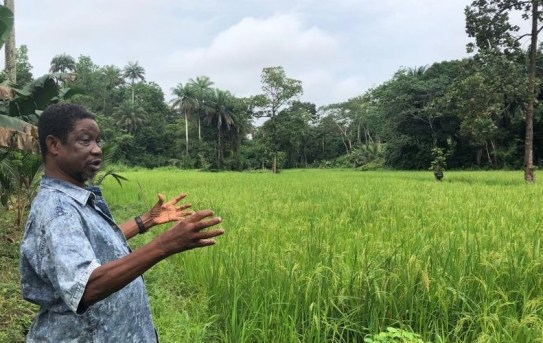
The latest $69,000 phase of Orchards for Education has been completed, with innovative changes along the way, thanks to CCET-SL’s new agriculture manager, Ibrahim Rogers. He saw opportunities to optimize Rotary’s two-year $142,000 investment and generate cash income sooner.
Instead of interplanting vegetable crops in the new orchards and carrying water over tens of acres there, Mr. Rogers advised growing vegetables in raised beds in a swampy area. There, water is plentiful to grow intensively year-round.
A large berm, below, was built around a 7-acre swamp to contain and control water from a stream that naturally floods the area. In the heavy rainy season when 120 inches of rain would wash out raised beds, the project converted to growing rice.

Annual crops will be more productive in an inland valley swamp, or IVS. And that extra money will provide more income to support orchard operations while fruit trees mature.
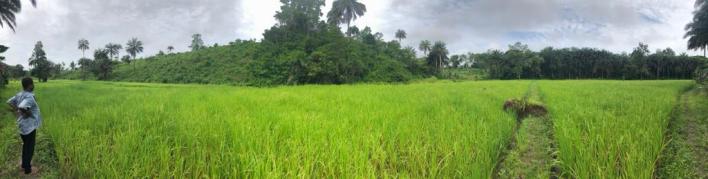
 Seven acres of IVS rice, above, were just harvested in what proved to be a bumper crop.
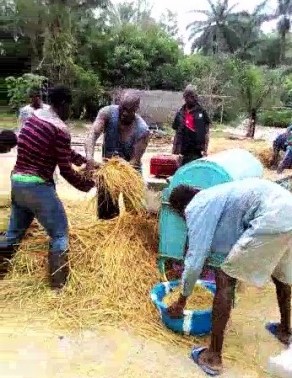
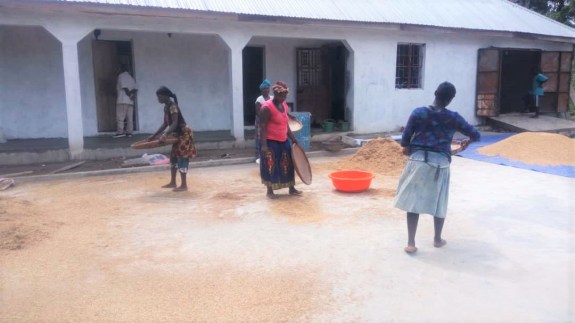
The rice harvest was manually cut into sheaves. A borrowed power thresher, left, cut the time-consuming chore of separating out rice grains. Hand-winnowing, below, is still needed to clean the rice and remove chaff.
The rice will be sold to the Sierra Leone Ministry of Agriculture as seed rice for their program to increase rice growing in the country. Half the rice now consumed in Sierra Leone is imported — the cheapest, least nutritious white rice.
The Ministry will distribute the seed rice to district small farmers to improve their yields and expand their farms so Sierra Leone can feed itself again.
So, our rice project will support both chiefdom education programs and making Sierra Leone self-sufficient in rice-growing!

The IVS is now being converted back to vegetable growing for the dry season. Ten thousand pepper plants grown in seedbeds will soon be transplanted in newly prepared raised beds. Below are last season’s peppers mulched with rice straw. Okra will also soon be growing gangbusters.

The project will start experimenting with other crops, like bell peppers, carrots and watermelons, to see what does well. A strong market is nearby. Freetown with its 1.5 million urban people only 55 miles away depends on rural farmers for fruit and vegetables.
Paramount Chief Charles Caulker donated the IVS land conveniently located next to the fruit tree nursery. To launch this extra project, $9,000 came from Sherbro Foundation donors and Foundation board members.
CCET-SL’s agricultural projects are already paying dividends as a source of employment for the community with rare wage-paying jobs. The project employs 21 full-time orchard workers, 20 part-time women, plus about 100 seasonal workers (men and women). The part-time women, below, tend the vegetable crops in the IVS, leaving them time to work on their own garden plots and double their earnings.

Meanwhile, fruit trees in the project’s orchards have been soaking up five months of the rainy season’s heavy rains and going through another seasonal growth spurt. The year-by-year progress is now clear to see.
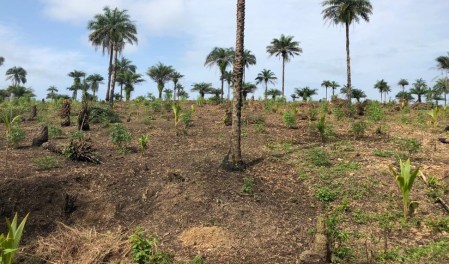 The third, most recent orchard was planted in June-July of this year with coconut saplings on newly cleared ground. These will take five to six years to fully fruit.
Rows of limes and guava that will fruit in three years alternate with coconuts.
 Trees in the second orchard, left, planted in 2018 are strong, sprouting up with two rainy seasons of growth.
Avocados, sour sop and oil palm (a local diet staple) were added to coconuts, together with more guava and lime.
The ground still tries to revert back to bush in Year Two and needs to be regularly whacked back. Cassava were planted among some coconuts as drought resistant short-term crops. Tubers are harvested in two to three years, with plants easily replaced with sticks cut from the parent plant.
 The first orchard planted in 2017 is now in its third year.
Coconut saplings are now trees, many taller than a 6-foot man. Limes and guava are approaching this height.
Old trees and bushes have largely been beaten back and the ground is becoming grassy.
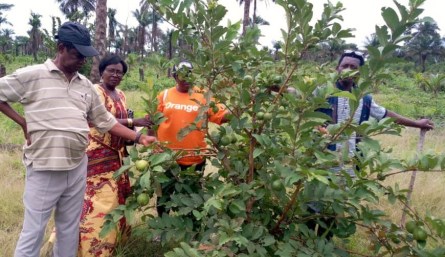 Guava and lime trees planted in 2017 in the first orchard are sporadically fruiting, and will yield a good harvest next year.
The early guava, left, took first place in the country’s annual agriculture fair in October.
Thanks to the Rotary Club grant, much-needed capital investment was made in the project. A storage building and concrete drying floor at the IVS were completed, below, including an office/meeting room and a night guard’s sleeping quarters. A second storehouse is under construction at the orchard.
A simple, portable and flexible approach to watering was purchased — a minitruck equipped with a tank will carry water around the orchards to keep fruit tree saplings watered throughout the dry season. After two or three years, trees no longer need hand watering. The minitruck is available for other uses, like carrying the rice harvest, below.
Note, the new truck driver, Zainab, is a woman, in keeping with the project’s objective to hire women wherever possible. Who said this isn’t women’s work?


Paramount Chief Caulker intends Orchards for Education to be a demonstration ground to show the Sierra Leone government, NGOs and farming neighbors that productive agriculture projects can be community-led and used to reach nonprofit goals.
The Orchards for Education project is set up to fund Bumpeh Chiefdom education programs for the long term. It’s also providing employment and growing seed rice to help local small farmers. Other rural communities can decide how they want to grow their own futures. CCET-SL is showing them it’s all possible.
We send our deep thanks again to Sherbro Foundation donors who generously gave to this Rotary Club grant project with 2018 year-end donations. Your gifts were matched by Rotary International Foundation. You can now see how far your money already has grown on the ground!

 The mini-truck, locally called a keke, is an easy and economical way to carry small loads the short distance from the project fields back into town. Here it’s being loaded with newly harvested rice sheaves.
 Loaded with rice and workers, Zainab carries all back from the fields to town.
 I always anxiously await seeing what happened to individual girls I’ve gotten to know. This picture of Fatmata proudly smiling in her senior high uniform made me smile, then left me teary thinking of her story.


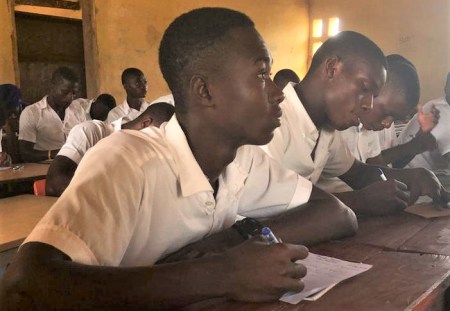 The fact is, they do. And with the scholarship program, the number of girls in Rotifunk secondary schools is catching up to their male peers.
 Student profiles show just how important it is to support boys as well as girls. Mustapha, left, is doing well now in 12th grade with his second scholarship.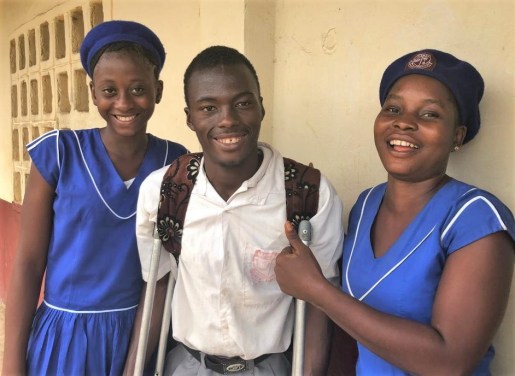
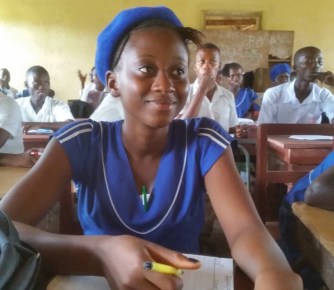


 Aminata, 18, is finishing senior high with her third SFSL scholarship. Her stepmother cares for six children. Her meager earnings as a market trader helped Aminata complete school. They depended on SFSL scholarships to ease the growing cost burden on the struggling family.
 “The tutoring classes improved my studies,” Aminata said.
 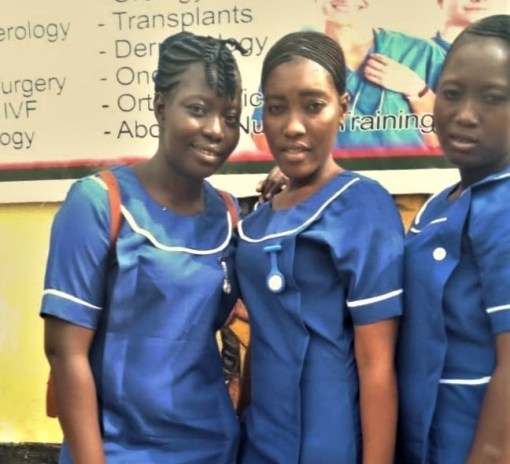 The three Rotifunk graduates are among the first Bumpeh Chiefdom girls to finish high school in more than 20 years since Sierra Leone’s war.
 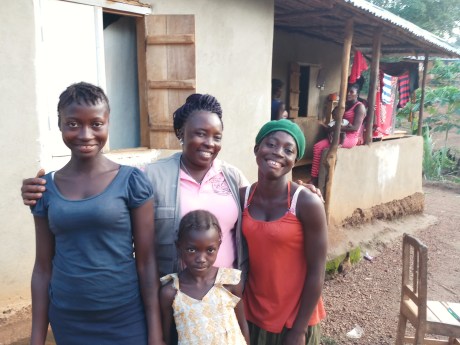 Rotifunk’s education godmother
 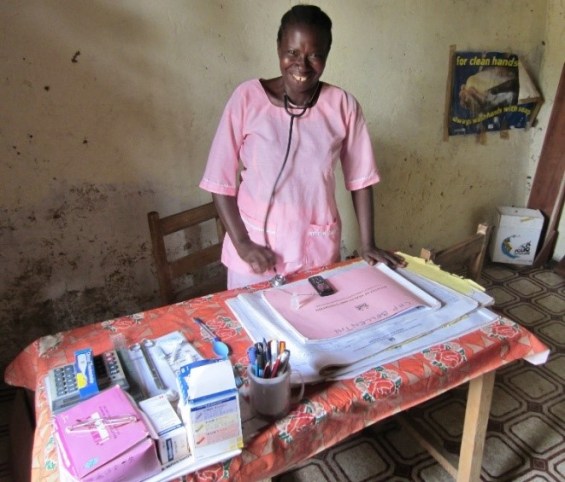 Community health nursing is a great entry point for young women like Fatmata, Umu and Safi. Nurses like Adama, above, run small village-based Public Health Units, where they treat common infectious disease like malaria and dysentery, stitch wounds and perform other first aid. They give women basic pre and post-natal care, serve as midwives at birth and offer well-baby care, including checking infants for stunting.
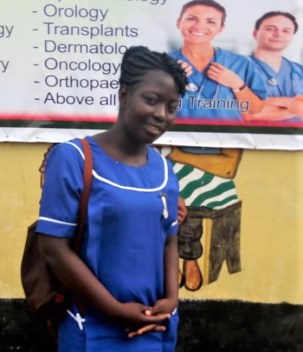

 Safi Bendu comes from a small village “downriver” some distance from Rotifunk. She had to leave home to go to secondary school.
  But we forgot one important barrier to girls regularly attending school.
  Schools at best have a few latrines. Some schools don’t have on-site water – there’s no well or the pump doesn’t work. Forget sinks or wash stations at the latrines.
 Every girl will get a kit in a colorful bag with 2 washable shields, 8 washable pads of an absorbent flannel type material and zip lock bags to hold soiled pads.
 If you have Netflix, you’ll want to see the 2019 Oscar winner for short documentary,
  Through their own fundraising, Schools for Salone offered us a steep discount on the kits. They know Sherbro Foundation has a successful grassroots program that will ensure the kits get to the kind of rural Sierra Leone girls we both work to serve.
 Educating girls is one the highest impact things we can do to lift women and their communities out of poverty.
 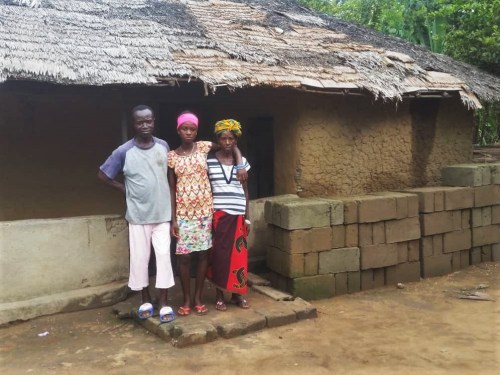 When I first saw Humu’s photo I thought, there’s a tall, slender, poised girl. A 16-year-old often shoots up in height, thin until she fills out. But I found there are other reasons why Humu is so slender.
 Humu attends our partner CCET-SL’s after-school tutoring program, left, also funded by Sherbro Foundation, that prepares girls for their senior high entrance exam.
 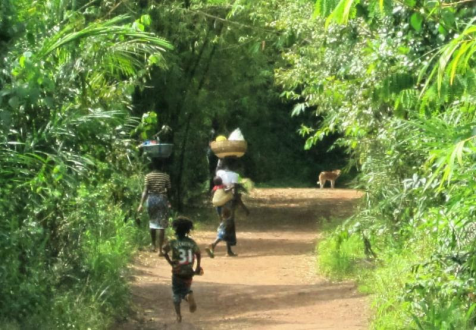 I was concerned for Humu’s safety walking this distance alone in the dark. I was relieved to hear she walks with several other Mokebbie village students.
  Humu wants to move out of the endless cycle of poverty that’s trapped her family for generations. Her grandparents care for ten children in their three-room mud brick house. With a total of sixteen in their household, it’s packed at night with children sleeping on straw floor mats. Subsistence farmers, her family grows most of what they eat and barters much of what’s left. That leaves little cash to pay school expenses. They sent their deep thanks for the scholarships that have enabled Humu to stay in school.
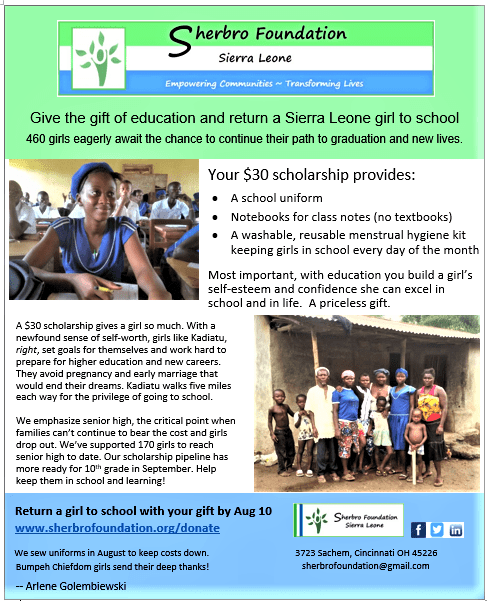
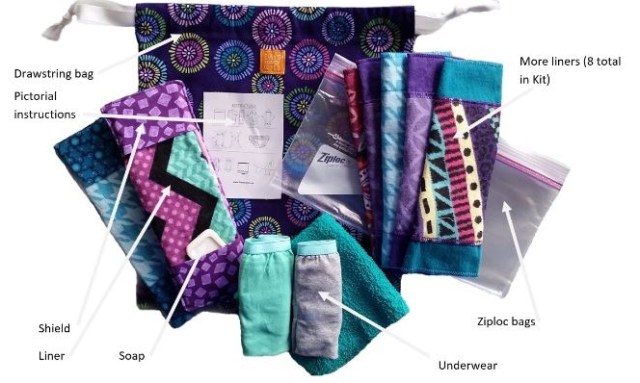 This year’s $30 scholarship package includes a wonderful addition to the school uniform and notebooks we supplied last year. All girls will get a
 Sherbro Foundation knows no one in Auburn, Maine. But someone there had hosted an exchange student from Sierra Leone. During the 2014 Ebola epidemic, they wanted to help at the grassroots level where they felt their money would be put to good use directly helping a rural Sierra Leone community. They found us on a Google search and have been giving ever since.
 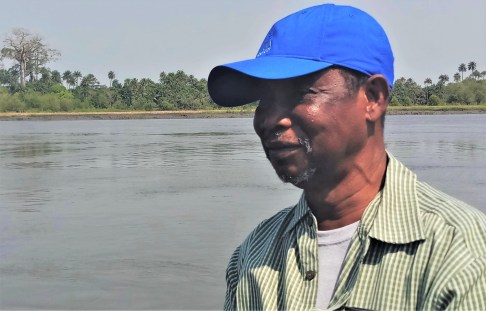 “If we could raise fruit trees on a big enough scale, we could grow our own community’s future.”
 700 coconut trees are flourishing in the first Rotary funded orchard, as well as lime, grapefruit, African plum, avocado, guava, soursop, oil palm and cassava. Most were grown in CCET’s tree nursery from local fruit seed.
 Chief Caulker, center, and Rosaline Kaimbay, CCET Managing Director, right, accept the Rotary Club of Ann Arbor flag from Mary Avrakotos. Dale Smith, Wilmington, NC Rotary Club, left, led fundraising for the medical care component of the grant.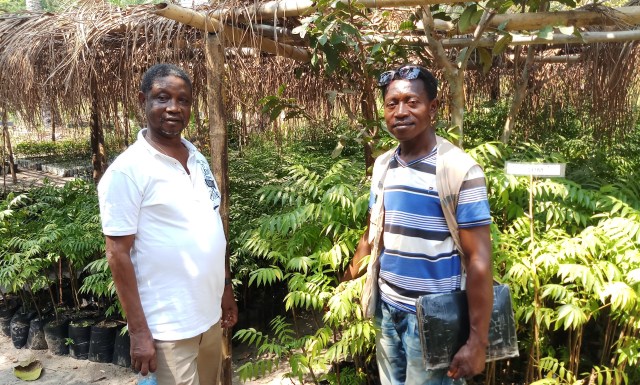
 Full-time orchard workers display their protective gear purchased from the Rotary grant: rain suits for working in the rainy season and thick rubber boots for protection against injury and snakes.
 Local women are hired as part-time workers where heavy labor is not needed. These are planting peanuts in an orchard to generate annual operating income. They’re paid wages equal to those of part-time male workers.
 School sports meets are a huge deal across Sierra Leone, but especially in rural towns like Rotifunk with little to entertain and amuse. Students march onto the sports field in brightly colored T-shirts for their house’s color, while a DJ blasts out music with massive speakers (thanks to a generator for power).
 Announcers calls out the competitors in their various track & field events and give the volleyball play-by-play account. Winners in individual events get certificates. Houses will parade around town with trophies boasting of their overall meet results.
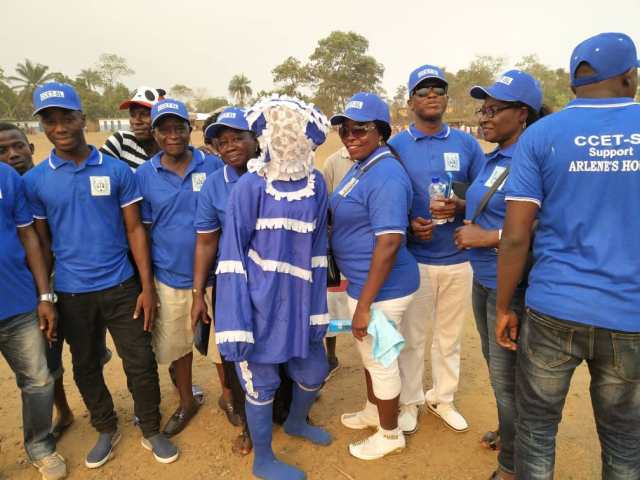 My colleagues from our partner CCET-SL turned out to support Arlene’s house. Each house comes with its own masked “devil,” a nod to their traditional societies. These devils compete in a wildly gyrating dance competition where spectators vote by tossing money in their basket.

 Our goal is for the orchards to produce annual income to run CCET’s education programs. In the meantime, we need annual crops to fund orchard operations until fruit trees mature and begin producing a few years from now.


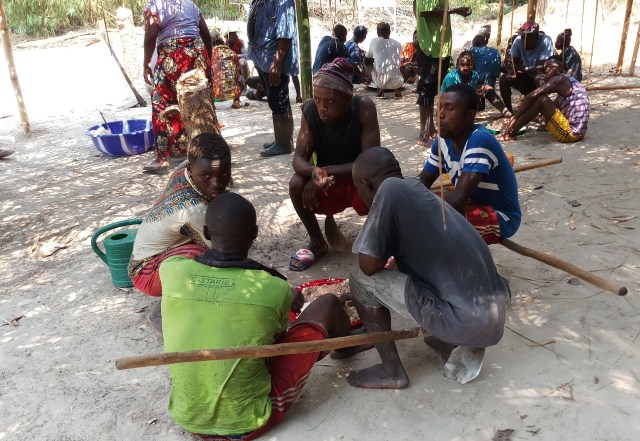
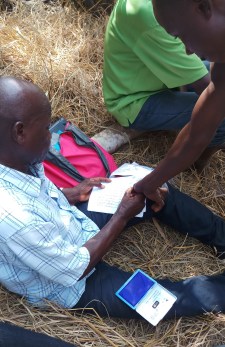

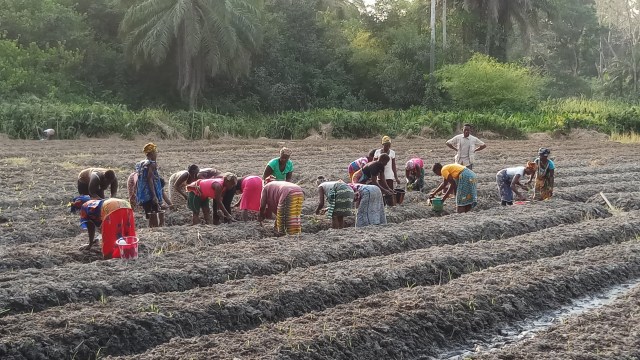

 The women were happy to receive wages for their labor.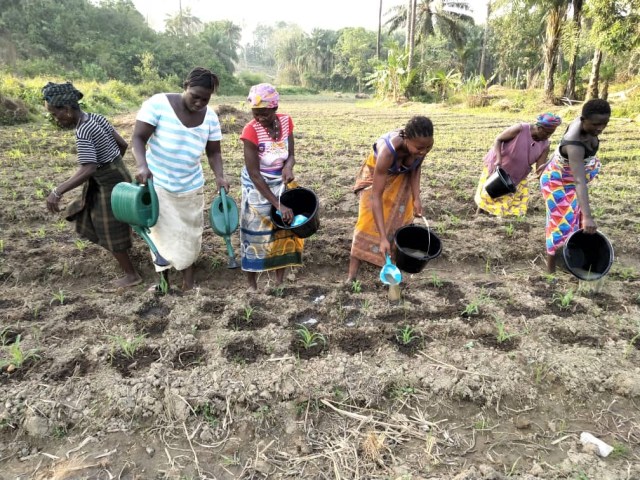

 Sherbro Foundation