
I wrote about Zainab last year in a post called “She is why we do what we do.” She’s now made it through seven years of secondary school against all odds. Her Sherbro Foundation school fee scholarship helped her reach her goal.
Here’s Zainab in July (center, hand on her hip) with a group of Rotifunk girls, all scholarship recipients, leaving for Freetown to take the WASSCE exam – the West African Senior School Certificate Exam. She’s one of a small group that are the first to complete senior high in Rotifunk and sit for this month-long standardized exam. Yes, I said month long.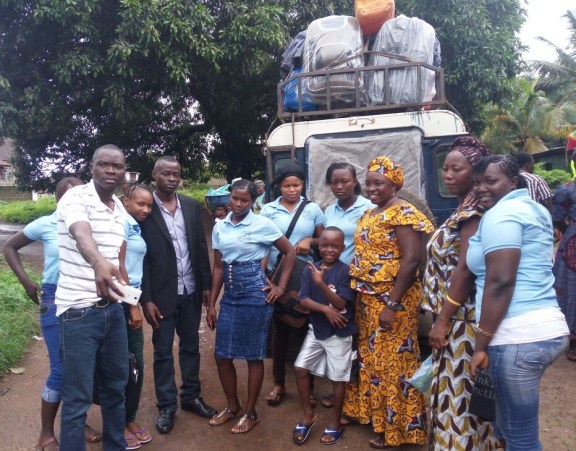
Sherbro Foundation works to get girls like Zainab into secondary school with our Girls’ Scholarship Fund. But our real goal is that they graduate and move on to good careers and productive lives – and leave behind the poverty that has trapped their families for generations.
 Zainab’s story stated out badly. She’s one of many girls faced with poverty and an early arranged marriage when her mother could no longer pay for her to stay in secondary school. Zainab later left this older man, who already had a wife, and she returned to school.
Zainab’s story is all too common in Sierra Leone. But she caught my eye with her determination to complete school and go to college. I was impressed with her maturity when she matter-of-factly asked if Sherbro Foundation would be helping to set-up a science lab for her school needed to complete the senior high science curriculum.
Life had already dealt Zainab a bad hand, but she was determined to pursue science and become a doctor. When I asked her why a doctor, she said, so I can save lives. And that conversation was before Ebola hit.
I was excited to hear Zainab returned to school when it reopened last year after Ebola. I’m now thrilled she is among the first group of girls finishing senior high and taking the completion exam.
Zainab’s story could have ended sadly. When girls reach 15 or 16, it’s too much of a burden for many parents to keep paying for school. An arranged marriage like Zainab’s is an easy solution and eliminates one mouth to feed.
Imagine the strength and determination of Zainab to pursue a new life and realize her obvious potential. I can still see it in her latest picture above. It all starts with getting girls like her into secondary school and keeping them there.
This is why Sherbro Foundation maintains the Girls Scholarship Fund and is pushing it hard this year.
Bumpeh Chiefdom’s Paramount Chief Charles Caulker underlined the importance of reaching this year’s stretch goal to double the program and send 300 girls to school in September.
“Over the past three years we’ve made successful efforts to get girls into secondary school. There were more girls enrolled than ever before when school ended in July.
“But I fear half the girls enrolled are at risk of dropping out this year because their parents just can’t pay their school fees. The economy is that bad now.”
“I’m passionate about this. I want to take the lead in asking all our family and friends to go the extra mile to save these children from dropping out and the abuses so many girls face with teenage marriage and pregnancy. Let’s not let all their efforts to get an education go in vain,” Chief Caulker said.
Sherbro Foundation is determined to keep girls in school. The dollar is strong now and goes further than ever in Sierra Leone. Just $50 will pay school fees for three junior high girls for the whole year.
We need your help: we’re at 75% of goal. We’d love to surpass our goal — hundreds more girls need scholarships!
You can do it now by donating here — send a girl to school.
Thank you!
Arlene Golembiewski
Executive Director, Sherbro Foundation

 Enter any monthly amount you choose. $10 a month is a painless way to ensure you’re sending girls to school throughout the year. In twelve months, you’ll have paid for


 For years, the longtime traditional leader of Bumpeh Chiefdom dreamed of ways life could improve for its 44,000 rural residents.
 “Girls are more serious and work harder. They get better jobs. They take their family responsibilities seriously, and ensure their children and parents are taken care of.
 “Women do 70 percent of the work on the family farm but are not allowed to make decisions on running the farm or selling crops. Their husband controls the money and may carelessly spend it on himself for things like gambling with his friends,” he said frankly.
 “His wife returns late in the day as the sun is going down. She may still need to go buy fresh produce and collect firewood and water before making a fire to cook the family dinner. Her husband will then expect her to have sex that night and she can’t refuse.”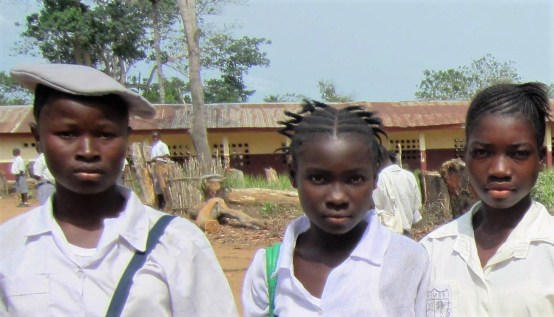

 Sherbro Foundation