I’m proud and humbled to be receiving the National Peace Corps Association’s 2018 Sargent Shriver Award for Distinguished Humanitarian Service.
My early Peace Corps experience in Sierra Leone remains the foundation for everything I’ve done.
This award really goes to Sherbro Foundation’s local community partner, The Center for Community Empowerment & Transformation. CCET’s creative ideas and leadership have achieved so much.
They hope to encourage others on community-led rural development and share their success stories. It’s been my privilege to work with them. https://lnkd.in/eQhgHmJ
— Arlene Golembiewski, Founder & Executive Director
Sherbro Foundation was thrilled to offer our first college scholarship in 2017-18 for a girl graduating in Rotifunk. We’re now delighted seeing how awardee Aminata Kamara’s first year is shaping up at University of Sierra Leone’s Institute of Public Administration & Management where she’s studying Banking and Finance.
Aminata is the youngest of 18 children of now aged parents who no longer work. She was an exceptional high school student, receiving the highest results for a female student on the national completion exam among Moyamba District’s 40 secondary schools.
Moving from a quiet, rural village to the demanding urban environment of the capital Freetown, Aminata has quickly adapted. She shows, given the opportunity, intelligent, eager young people can catch up and perform well. Here’s our recent WhatsApp chat.
Arlene G.: What classes did you take in your first year? How did they go?
Aminata K.: In each year we have two semesters, each with six modules. First semester I took:
Mathematics
English
Elements of Banking
Principals of Accounting
Information and Communication Technology [computer science]
Human Resource Management
In second semester, there are new subjects. The classes are great. I’m doing fine.
AG: I’m glad to see you get an integrated approach with classes with like Human Resources Management from Year One. What are your biggest challenges in starting college?
AK: The high cost of transportation and high Internet cost. I can’t afford a computer laptop and a modem to do the required research.
I had to go to [an internet] café, left, to do some of those things and I pay a huge amount. Most of the tutors just give us topics and ask us to do our own research through Internet.
AG: Did you find anything surprisingly easy?
AK: I met new friends who are very hospitable. Some that are staying within the central area allowed me to stay with them during examination week so that we can study as a group, since I am staying in the far east end of Freetown where we experience a lot of traffic. I sometimes have to come down out of the [public transport] vehicle and hurry up on foot for me not to miss my lectures.
AG: Tell us about the teaching staff at U of Sierra Leone.
AK: We have good lecturers and they teach well. When I started taking lectures, I found it difficult to understand the way of teaching because it is a different way of teaching [lecture and take your own notes] to that of high school [teacher writes notes on board that students copy]. But I am okay with it now as I have just sat to my first semester exams. I am now enjoying the lectures.
AG: Are professors responsive to students and help you succeed?
AK: They will see that the students understand whatever they are teaching and if you do not, they will repeat it again. They counsel students about their education.
AG: I know you lost about a month with classes shut down during the recent presidential election in March-April. How do you catch up?
AK: In the second semester we have only three months. That is why they give us some topics to research on our own. [Over the summer break, I will] keep studying and doing some research.
AG: You have a change of government, with the new president making education his first priority. What are you students hoping to see change with the new administration?
AK: The change in government has not affected us in any way. We are just hoping to see the President fulfill his promise and we want the government to reduce the fees for us.
AG: Any new thoughts about the major you selected? Do you plan to continue with Banking and Finance?
AK: Yes, I want to continue if I am given the opportunity.
AG: What do you like about living in Freetown? Or dislike? It’s a big change from small town Rotifunk.
AK: I dislike the traffic. The thing I like about it is you can get good quality education here in Freetown.
AG: What message do you have for the people in the US who helped you go to college?
AK: On behalf of my old father and my blind mother, please help me extend my heartfelt thanks and appreciation to all those who in diverse ways made it possible for me to be in the university. I am so grateful to the donors and to CCET-SL for letting my dreams come true and putting a smile on my face and that of my parents.
AG: We are so proud of you and excited to see you doing so well in your first year! Best of luck on your exams.
Education in Sierra Leone is on an exciting new track and we’re expanding our 2018 scholarship program, too. Before our annual scholarship campaign kicks off in July, here’s a preview of the changes.
New government, education changes
First, the new Sierra Leone president sworn in April 2018 has made education his first priority. He is doubling the portion of the government’s budget going to education from 10% to 20%.
President Maada Bio’s first big initiative is to make school free for primary and secondary school students.
He also plans to work on teacher standards, training and pay to improve quality of education.
Our scholarship program will still be needed as much as ever. School uniforms cost more than school fees and that expense is another barrier to girls attending school.
Last year with your strong response to the scholarship campaign, we supplied uniforms to two-thirds of girls receiving scholarships.
All girls also received exercise books to take class notes — essential for schools with no textbooks.
For 2018-19, a scholarship will consist of a uniform and exercise books. This will actually cost 40% to 50% more than the past school fee only scholarship – or $25 to $30 for junior and senior high girls. Uniforms will again be sewn by local Rotifunk tailors to keep costs down, as Sierra Leone’s high inflation drives prices up year by year.
We made a major increase in scholarships last year. We’ll target for the same number of scholarships for 2018-19 – but at higher value. Sending 410 girls in one rural community to school is exceptional. Senior-high girls will get priority.
With your help, we’d love to send even more girls to school or add additional supplies for each girl. Or do both!
Time to help disadvantaged boys
We’ve gotten a lot of local feedback for several years about why boys never get scholarships. Following Bumpeh Chiefdom Paramount Chief Caulker’s lead, we’ve focused to date on scholarships for girls as a means of achieving parity between girls and boys attending school.
Enrollment for junior-high girls is approaching that of boys. And there are many disadvantaged boys who experience the same barriers to education as girls.
So, this year we will offer 10% additional scholarships for boys. It’s important for boys to succeed, too. Boys who struggle to go to school need to feel someone is behind them, offering encouragement and support.
Sending two girls to college on scholarship
You made sure we reached our goal of adding a second college scholarship for another graduate in 2018-19!
Big thanks go out to all who responded to our request in March-April to fund college scholarships for two deserving girls.
Aminata Kamara, left, recipient of our first college scholarship is in her first year at the University of Sierra Leone’s Institute for Public Administration and Management in Freetown.
We especially want to thank the former Peace Corps volunteer who stepped up with a matching grant to pay for half of a $1,700 scholarship if we could find new donors for the other half.
We did, and this generous anonymous donor upped his match by another $250 for donations by Cincinnati area Peace Corps people. They responded donating more than double that amount.
So, collectively, the Peace Corps community is sending one girl to college in full! They know the crucial value of education in developing countries.
This means we can maintain the outstanding young woman who started at the University of Sierra Leone for 2017-18 for another year AND start a second student in her college career. The scholarships cover tuition, fees and a living stipend.
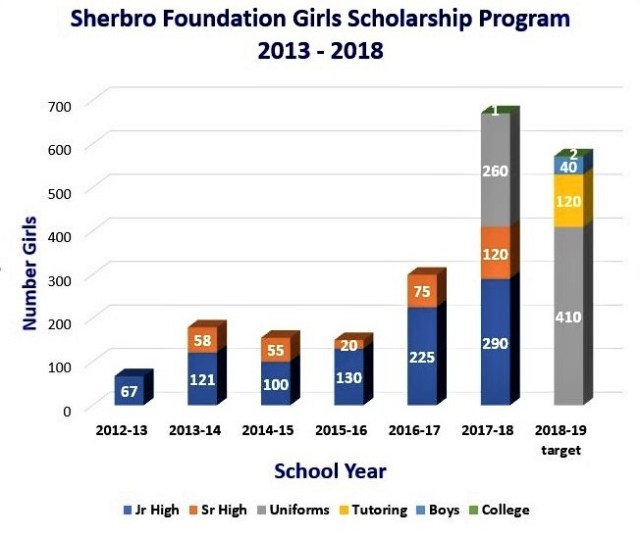
We began five years ago with the modest goal of sending some girls to one secondary school. Your response has been tremendous. The lives of over 600 girls in four schools have been changed by the opportunity to go to school on your scholarships.
And now, two young women will have the opportunity to reach their full potential by attending college.
It definitely took a village to support these girls’ educations — an American “village”.
We’re indebted to all our American villagers for making the dreams of so many girls come true.
We’ll soon kick off the campaign for our sixth year of the Girls Scholarship Program for Bumpeh Chiefdom. We thought you’d like to see what’s been accomplished in the first five years — by the numbers.
Sherbro Foundation was founded in March 2013. We immediately funded scholarships for 67 junior-high girls in the 2012-13 school year already in progress. The numbers have been steadily increasing:
1250 Total number scholarships awarded
Over 600 Number of girls receiving scholarships, some for more than one year
4Number schools participating — 2 Jr/Sr Highs and 2 Jr High only
6X Increase in scholarships given annually — from 67 in 2013 to 410 in 2017
2X Increase in scholarship value in 2017 by adding uniforms for 2/3 of girls
2X Increase in number of girls attending Senior High — from 58 to 120 in 2017
100 Percent of girls wanting to attend Sr. High in 2017 who received scholarships
18 Number of 12th-grade awardees taking National exam (1st in 2016)
3 Number 12th-grade awardees meeting college entry requirements
1 College scholarship added in 2017
Here’s our five-year trend in scholarships:
Only one in three Bumpeh Chiefdom teens have been able to attend secondary school. We started by ensuring more girls made the transition from primary school to junior high.
We focus on the most disadvantaged girls at risk of dropping out of school — orphans or with single parents, low-income families, and students who must leave home villages to attend secondary school in town. Often, a girl meets all the criteria.
The drop-out rate from junior to senior high is typically 50%. Our goal is to advance more girls to senior high and help them graduate. So, we expanded senior-high scholarships, while continuing to increase junior-high enrollment.
The short-term dip in 2015-16 came after the seven-month Ebola crisis, when many students from villages, especially senior high girls, returned to school late or not at all.
With your strong support, we doubled scholarships and the value of the awards (scholarship plus uniform) in each of the last two years.
In 2016, the first three scholarship recipients graduated from senior high.
And in 2017, we reached the ultimate goal by awarding the first college scholarship to one of first girls to meet college entrance requirements.
Now in January 2018, we added extratutoring classes to help ensure 9th and 12th graders pass their junior and senior high national completion exams and advance to their next level of education. We’ll continue this program for the 2018-19 academic year.
Step by step, we’re reaching the goal we set of girls completing secondary school. And now we’re reaching beyond, to help girls advance to college and become leaders in their community and their country.
Below shows why Sherbro Foundation focuses on first and foremost on literacy and education in Sierra Leone. Without literacy, all further development is stymied.
Sierra Leone has a long to go. It ranks 47th out of 52 African countries!
But there’s reason to be optimistic, with many African countries today achieving high rates of literacy. We keep focused on improving literacy in everything we do.
Every day is Earth Day in Bumpeh Chiefdom, as our partner CCET-SL grows fruit trees in their own tree nursery for local planting. CCET-SL grows tens of thousands of fruit tree seedlings every year, year round, to plant in local orchards to fund children’s education. .
They’re showing they can protect the environment, be sustainable using their own resources – AND earn money to send chiefdom children to school.
CCET-SL grows orange, lime, grapefruit, African plum, cashew, avocado, guava and coconuts, all with seed they collect from locally purchased fruit.
Tree seedlings are nearing maturity to transplant in CCET-SL’s “baby orchards” when the rains start in June. These orchards will fund an education savings program for babies, providing money for their future education.
Mission of Hope: Rotifunk volunteer, left, inspects this year’s tree seedlings while visiting their hospital project.
CCET-SL also gives three fruit trees to parents of newborns to plant in their backyard gardens. They are reviving an old tradition of planting a tree when a baby is born.
Today’s new parents are learning they can produce fruit in their own backyards that can pay for their child’s welfare and education.
Tree seedlings that will be soon planted were grown with funds from a 2017 Rotary Club grant led by the Rotary Club of Ann Arbor. Sister club Rotarians, above, from Freetown, Jennifer and Theodora, made a site visit in January to inspect the project, seen here with Paramount Chief Charles Caulker, CCET-SL board chairman.
CCET-SL grows some specialty trees like African plums, left.
They sell tree seedlings to local farmers to earn income to help maintain the tree nursery and make it sustainable long term.
Sherbro Foundation Sierra Leone celebrated our 5th anniversary as a nonprofit on March 14, 2018!
We started with a simple goal: educate girls and improve overall literacy in rural Bumpeh Chiefdom. With literacy, people make better choices, boost their livelihoods and improve their lives and those of their children.
In 2013, our first scholarship program sent 67 7th and 8th grade girls to one secondary school. Today, over 600 girls have advanced their educations at four schools with 1250 Sherbro Foundation scholarships – some receiving scholarships for two or three years.
Help celebrate this 5th year milestone. Join us now in sending the first girls graduating to college.
First college scholarship Last fall, you helped us step up to this next challenge with a big response to our secondary school scholarship campaign. We added a college scholarship.
Meet Aminata Kamara, the first awardee for 2017-18. Her story is one of focus and perseverance against all odds. You’ll see why this exceptional scholar was chosen.
Village beginning Aminata, left, is the youngest of 12 children. Her parents scratched together a living in the Rotifunk area. It’s typical of the chiefdom, with mud houses and where most earn a dollar or two a day as small traders at the weekly market. Her father was a primary school teacher, a low paying job, and her mother a trader. Now, her father is retired and her mother blind.
High ranking scholar Aminata was among the first local girls who made it to senior high.
Then in 2016, she ranked highest of the first three Rotifunk students to pass the national graduation exam at the university requirements level. All three were girls with Sherbro Foundation scholarships. Her scores were Rotifunk’s best in 40 years.
Aminata was also the highest scoring girl in Moyamba district, one of 12 administrative districts in Sierra Leone with 40 secondary schools.
It’s uncommon to get high scores in seven subjects, when most students don’t pass the exam the first time, even in Freetown. This propelled Aminata forward with a college scholarship to study in China.
Happy news ran out The China scholarship fell through when the Sierra Leone government did not prepare her passport in time. She sat out a year pondering her fate at home taking care of her mother.
Although Aminata had no reason in her world to think her education would continue, she persevered, and in October 2017, became our first college scholarship recipient. “Since I started primary school, I have got that intention to go to college. Never mind I don’t have the hope that I will, because we are poor,’’ she said, via text message.
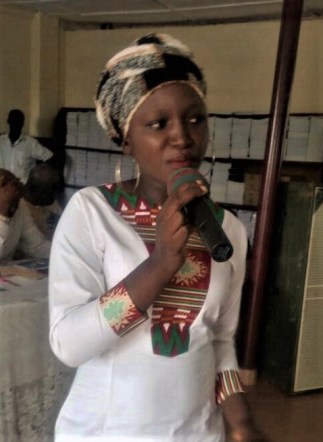
Proud college student Aminata, left, is now a first year student at the Institute of Public Administration and Management at the University of Sierra Leone in Freetown – thanks to Sherbro Foundation’s first college scholarship award of $1700, paying her first year’s tuition, fees, books, transportation and a stipend for living expenses.
She’s good at math and wants to study banking, and eventually become a bank manager. “I kept on studying, hoping one day God will send me a helper in my education.”
She is already dreaming of earning a master’s degree. “I would like to further [my education] overseas with a masters and become a college lecturer,” she said. “And I also want to help my colleagues in the village.”
You need a mentor Aminata’s role model is Rosaline Kaimbay, a dynamic Rotifunk native who returned to start the first girls’ secondary school in Bumpeh Chiefdom. She watched Rosaline as principal and now as managing director of the Center for Community Empowerment and Transformation, our local nonprofit partner, overseeing CCET’s seven programs. Rosaline mentors many girls, and helped the first graduate by making her home a dormitory for senior girls.
“She is a woman, but she does [so much] good and all the people in the community admire her,” Aminata said. Rosaline shows girls a woman born in their chiefdom can get a college degree and take leadership roles usually filled by men.
Aminata, left, is now becoming a role model herself and has advice for younger girls at home watching her successes.
“I want them to forget about their present status; hope [instead] to use their future. Let them forget about material things, about men — these things will pass. Let us focus about education,” she told 460 girls receiving secondary school scholarships at last fall’s award ceremony, left.
“Let us know that our tomorrow will be greater than today.”
You can make Aminata’s tomorrow greater. Help send her to a second year of university.If you’re a new donor, you’ll double your impact. A former Peace Corps Volunteer will match the first $850 from new donors. $1700 will pay Aminata’s second year in full. Pass this on to friends and family who want to see girls succeed.
AND this donor will match $250 from Cincinnati area Returned Peace Corps Volunteers!
More girls in Rotifunk are ready for college. With your help, we’ll also start a second girl on her college journey in 2018-19.
Any excess funds will go to our annual girls’ secondary school campaign planned for this summer. We’re keeping the pipeline full of girls getting an education and ready to change the world.
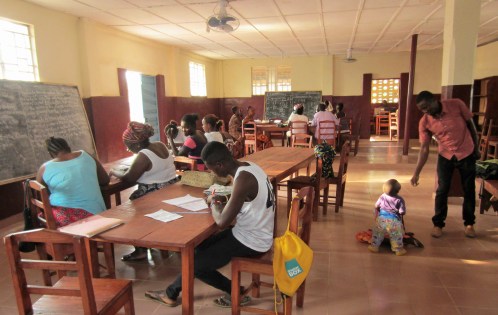
It was a Wednesday night, the first week of school in January, and our partner CCET-SL’s Community Learning Center was thronged with Rotifunk-area kids. Over 80 9th and 12th graders returned to a classroom at night because they’re eager to continue learning.
Come July, they’ll be sitting for their senior high and college entrance exams. They are intent on using their education as a path to a better life. But first, they must pass the West African standardized school completion exams, and they want to pass the first time.
Eighty-three students quickly signed up for CCET-SL’s new Tutoring Program. These 9th and 12th graders attend evening classes three times a week to review the full junior high or senior high curriculum, and make sure they’re prepared for the school completion exams.
Alima, left, is one student who signed up. We introduced Alima last year and the formidable challenges she’s faced to stay in school. When her older parents couldn’t pay for any more schooling, they sent to live with her aunt. She had to walk five miles each way to her Rotifunk school.
With a SFSL-funded scholarship, the bright 14-year-old has progressed to the 9th grade. We were delighted to see she’s joined the tutoring program.
Alima was able to move from her aunt’s village into town this year. She’s determined to go to college and told us here why she comes for extra evening tutoring.
Thanks to a $5,000 Beaman Family Fund grant, the Tutoring Program is being offered free of charge to both girls and boys.
The grant pays for five part-time local teachers, a sixth full-time teacher to coordinate the program for 2017, and teacher and student learning materials.
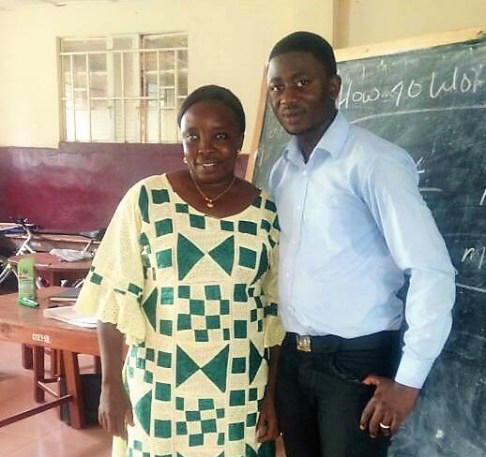
Gibril Bendu, above, the only Science teacher in town, is leading the Tutoring Program for CCET-SL.
Introducing computers — All participating students must also complete an introduction to computers. By the end of term, they will have learned basics of Windows, Word for Windows and Excel.
Paramount Chief Charles Caulker visited the first week and immediately called us in Cincinnati. We heard all the noise in the background of kids getting into the preloaded computer games, as their first effort in learning how to navigate a PC and use the mouse. He said it made him so proud.
“Just think, there are 80 children in my chiefdom now learning how to use a computer!”
Rural education challenges — The unexpected Beaman Family Fund gift is giving rural children the opportunity to succeed in the modern world, just as city kids have.
For over 20 years, no Bumpeh Chiefdom student passed the West African standardized junior high or senior high completion exams, the BECE and WASSCE, or met university entry requirements.
In 2016, the first three candidates (all with Sherbro Foundation scholarships) passed the WASSCE senior high exam with university requirements, and are currently attending college.
More Bumpeh Chiefdom students now are progressing to junior high, many with Sherbro Foundation scholarships. But they face serious limitations in advancing to senior high and beyond. Schools have inexperienced teachers, many unqualified in their subject matter, especially at the senior high level. It’s difficult to get teachers with four-year degrees to live in a rural community.
Students don’t have textbooks and must copy limited notes teachers write on the blackboard.
Poor school policies advance students who fail exams to the next grade, where they don’t catch up. Poor discipline may mean students don’t complete the full curriculum.
When students go home after school, they don’t have a suitable study environment. Most live in crowded conditions with distractions, noise and no lighting. They lack the support and coaching important to reach goals no one around them has achieved.
Filling in the gaps — Kids will never make it to college or vocational school if they don’t first learn what they should in junior high.
Working to fill this gap is CCET-SL’s Tutoring Program, the brainchild of Managing Director Rosaline Kaimbay, left. As a former school principal, she ran year-end study camps where 9th graders had intensive all-day review classes for four weeks. The result was 100% of her students passed the junior high BECE completion exam, uncommon for any school, let alone a rural school.
At CCET-SL, Mrs. Kaimbay is turning her approach into a three-day-a-week evening program open to students from all Bumpeh Chiefdom schools. With the Tutoring Program, kids can achieve the knowledge level needed to be successful in senior high. Dropouts are reduced and the likelihood of advancing to college or vocational school improved. Graduating seniors will get prepped for their college entrance exam.
Pride of the chiefdom — Chief Caulker said the program is already much admired in the chiefdom.
Girls like Adama, left, feel pride that they’re joining a group of chiefdom academic elites, studying with the best local teachers in a first-class environment complete with solar light and computers.
They arrive early and leave talking with their friends in English about what they just learned. Chatting in English doesn’t normally happen in a rural environment, Chief said. It’s strictly Krio, the country’s vernacular.
Parents are overwhelmed by all the efforts being made for their children, he said, and that it’s all free of charge. For a chiefdom with 70% illiteracy, moving 80 kids to academic proficiency at the senior high level is a very big deal. A real source of pride.
More needs — Still, there’s more to do. Some students attending the program live in villages 3-6 miles away, and were valuing their education over even food.
It’s too far for them to walk home from school for their main (and sometimes only) daily meal and return again for evening classes. Some had not eaten since heading to school at 7 a.m.! And it’s too dark for girls to be walking home that distance at 7:30 p.m.
CCET-SL arranged to feed these students in the short term, and teachers taxi them home with CCET-SL motorcycles. Most students are inadequately fed and will perform better with an evening meal to fuel their brains.
Our next goal for these dedicated students is to raise additional funds for a meal program for the whole class and fuel costs to ensure girls are safely taken home at night.
In the meantime, classes are on and it’s a full house.
2017 was a banner year for our projects in Sierra Leone. Our hats off once again to our local Sierra Leone partner, CCET-SL, for all their work making this happen. Here’s what made the year so great – in pictures. —– Arlene Golembiewski, Executive Director
January:Five years in the making, CCET-SL’s new Education & Computer Center was open and buzzing with activity. Three levels of Adult Literacy classes filled the main hall, followed by evening computer training. My favorite group is first level literacy, or the ABC group, where women start by learning the alphabet and how to add. One typical student, Jeriatu, thinks she’s about 35 and is the mother of 12 children, one on her back in class. She grows peanuts and wants to be literate to improve her small business, by counting change correctly and figuring her profit.
February: Visiting small villages participating in our projects, like Village Orchards, is always a trip highlight. Villages have received hundreds of fruit tree seedlings to plant as community orchards. Income will go to children’s education and development projects. I asked Nyandahun village chief, Madam Bendu, above left, how her village would use income from their village orchard. She immediately said, we’ll send our children to school.
March – We started our 3rd group of Women Vegetable Growers, where another 75 women can double their incomes in a few months growing peanuts and vegetables. Emma, above, was in last year’s program. She tells me and Paramount Chief Caulker that with her peanut harvest she paid her children’s school fees and didn’t have to take out a high interest loan. She kept some peanuts as seed to plant this year, too. A success for her, and one of our most successful projects.
April – With a global Rotary Club grant, CCET-SL developed a 15 acre “baby orchard” that will fund children’s education savings accounts. Seven Rotary clubs led by the Ann Arbor club joined the Rotary International Foundation and a Rotary District in a grant that paid to clear overgrown bush and plant over 1100 fruit trees. CCET-SL raised all trees locally from seed, including 450 coconuts and 480 citrus. While the trees mature, annual crops of rice, peanuts, corn and couscous were inter-planted, producing income to pay workers. The $49,500 grant paid for the orchard and several other projects.
May – SFSL won a $12,235 Procter & Gamble Alumni grant, enabling CCET-SL to complete equipping their Education & Computer Center. The Center’s first color printer arrived in May, giving CCET-SL an income generating service with the only public color document and photo printing within a 2-3 hour drive. Students can now get computer training on 17 new laptop computers up-to-date with Windows 10 also funded by the grant.
June – July – CCET-SL updated their chiefdom Birth Registration program that records newborn babies at the small village level. Government registrars can’t reach rural areas, jeopardizing children’s proof of citizenship and birthrights to family land, medical care and other services. The Rotary grant funded training for new chiefdom birth recorders and bicycles to cover their assigned villages. CCET-SL grows their own fruit trees from seed, and gives newborn parents three fruit trees to raise for their child’s welfare and education. The mothers above collected their fruit trees with their babies carried on their backs. See the little feet around their waists.
August – A second group of Women Vegetable Growers got the opportunity to raise peanuts as a cash crop. Subsistence farmers, they use most everything they normally grow to feed their families and barter locally for other needs. They can’t afford a $30 bale of peanut seed to expand their farms and earn more money. This group of 85 women was funded under the Rotary Club grant. They happily line up above with Rosaline Kaimbay of CCET-SL, right, to collect peanut seed, a drying tarp and 100 lb. of rice to feed families before their harvest – worth $80 in all. Within five months they’ll be harvesting. We’ve reached 300 women to date.
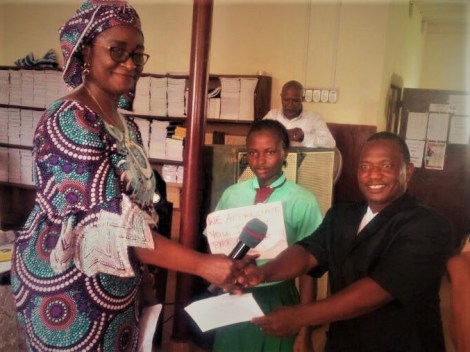
September – 460 girls returned to school with school fee scholarships from Sherbro Foundation. A $17 scholarship keeps them in school for a full year, avoiding early marriage and early pregnancy – and makes for brighter, more productive futures for every year of education they get. Compassionate donors funded uniforms for all 120 senior high and 290 junior high girls, as well. For the first time, 100 girls can study at night with solar study lanterns, and we awarded the first college scholarship. “It’s very impressive. I’ve never seen any organization giving so many awards and paying for so many things,” said Alice Conteh Morgan, managing director of Reliance Insurance Co. in Freetown and Rotifunk native. Above, she presents scholarship awards to Bumpeh Academy principal Rashid Conteh.
October – rice planted in the Baby Orchard was ready to harvest by October. The orchard is really a working plantation with supplies, tree seedlings and acres of harvests to be transported throughout the year. Now a necessity, the SFSL Board made the gift of a used truck, one built to withstand unpaved rural roads. The rice had to be threshed by hand by beating the sheaves to loosen rice grains – using the chief’s palaver house, above, as a workspace. Year by year we’ll make improvements as we can pay for them.
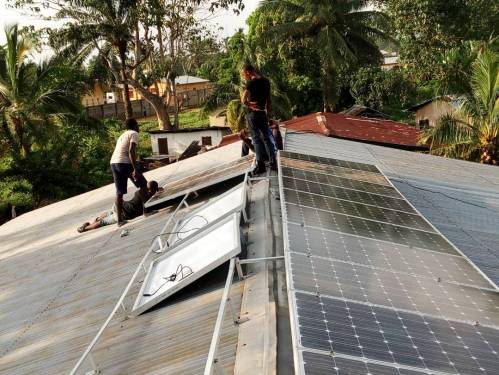
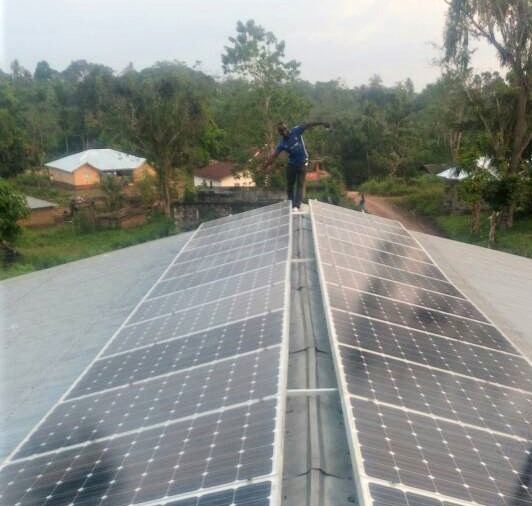
November – Reliable power for CCET-SL’s Center had become a major problem, interrupting classes and jeopardizing income generating services like printing that fund the center operations. Our prayers were answered when the Beaman Family funded a complete 6000 Watt solar power system for the Center. Printing, charging computers and evening classes and meeting space are now available whenever needed. Thank you, Beaman Family!
December – Planning for 2018 is underway. CCET-SL’s Tree Nursery is central to several projects. 12,000 tree seedlings, all started this year from seed, are nearing transplanting stage. They’ll go to planting the next baby orchard, supplying “baby trees” for 2018’s newborns and their parents, and for sale to generate income to keep propagating more trees. 2018 will also be the start of a new local forest reserve system, a first of its kind at the chiefdom level to protect mature forests and sources of village drinking water.
We thought this year’s Girls Scholarship Campaign was highly successful. More than doubling donations over the previous year is definitely a success.
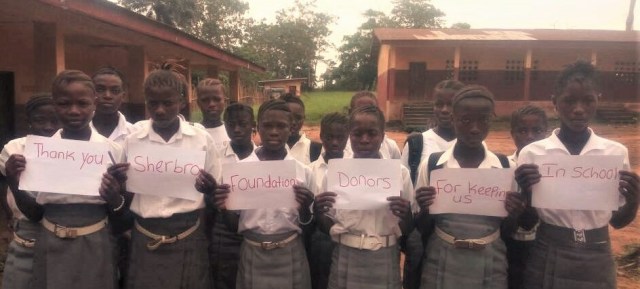
How do the 460 scholarship students and their community see it? They are thrilled.
After the recent Bumpeh Chiefdom scholarship awards ceremony, “parents were singing and dancing with happiness because their girls can stay in school,” reported Rosaline Kaimbay, managing director of our local partner, The Center for Community Empowerment and Transformation – Sierra Leone.
And special guests repeatedly said they’ve never heard of a larger – or more complete – scholarship program anywhere in the country. Ibrahim Coker, left, area supervisor of schools for the Sierra Leone Ministry of Education said: “I’ve never seen such a number of scholarships together with a total package including uniforms, exercise books and solar study lights.”
With $US17,900 from Sherbro Foundation donors, CCET was able to provide 460 school fee scholarships to young women in four secondary schools. And this year, we added 310 uniforms for girls entering junior high and all 120 senior high students.
PLUS, for the first time, 100 students studying for 9th or 12th grade graduation exams received portable solar lights – never seen before – so they can study in Africa’s long dark evenings. AND, we started the first college scholarship.
“It’s very impressive. I’ve never seen any organization giving so many awards and paying for so many things,” said Alice Conteh Morgan, left, managing director of Reliance Insurance Risk Co. in Freetown. Conteh Morgan, a Rotifunk native, attended to encourage the girls: “With your educations, you can achieve everything.”
In comparison, Plan International, a large UK-based charity, awards fewer than 50 scholarships annually in Bumpeh Chiefdom for girls already enrolled in an older program. Most of our awardees don’t qualify. That’s why Sherbro Foundation’s work is so appreciated.
Scholarship money, like any school fee, goes into the schools’ operations and to make school improvements.
“CCET-SL has paid for all (160) girls in our school. We appreciate it so much. May god richly bless you and all the donors,” was the message from Daniel Koroma, vice principal of Bumpeh Academy Secondary School. The school immediately began applying scholarship funds to build classrooms, since many of its classes are held in partial structures with no walls.
The awards ceremony was covered by the Sierra Leone Broadcasting Co., the country’s only TV station and a regional radio station. Paramount Chief Charles Caulker said he continues to receive phone calls congratulating him on Bumpeh Chiefdom’s big news.
Likewise, Rosaline Kaimbay’s phone kept ringing. “It made me so proud to hear from friends around the country saying they saw news of our impressive program.” Above, she presents an Ahmadiyya Islamic school student with her uniform, exercise books and solar study light, together with school principal Mr. Tarawallie.
Just when we thought we were ending a banner year – our best yet – it got even better.
When our partner CCET-SL’s new Community Education Center opened in 2015, we knew we would need solar power to meet the center’s promise of computer and adult literacy classes, chiefdom meetings, NGO-led educational workshops and other services. But we never dreamed this critical chiefdom resource would have its own 24-hour solar power system today.
Then it happened – quickly. All thanks to a donor we have never met! From the very first email contact in early September to final installation of the new solar system in November was only 11 weeks.
The Center can now operate late into the evening, seven days a week as needed, and power all equipment for its growing printing service and computer training.
The gift from the Beaman Family Fund (the actual donor wishes to remain anonymous) was made after another thoughtful donor recommended the work of Sherbro Foundation Sierra Leone and our Bumpeh Chiefdom partner, the Center for Community Empowerment & Transformation (CCET-SL).
The funding installed a 6,000-watt solar power system, including a little extra capacity for the future. We had to carefully plan out all energy use, and still ration hours per day of usage. With solar, you can’t use power faster than you can make and store it.
For perspective on how far 6000 watts will go, a standard women’s hairdryer uses 1875 watts and a basic microwave is 1000 watts. Two simple devices would use half the available power. While solar equipment continues to get cheaper, installing a system to cover all energy needs is still expensive.
With a 6000-watt system, CCET-SL can:
Operate the printing service, with a low-energy duplicator and color printer. The only such public service in Moyamba District of 300,000, it’s expected to keep the center self-supporting.
Light the building with 26 LED bulbs and cool with 16 small ceiling fans and standing fans.
Run computer classes with up to 20 laptops at a time for a maximum four hours a day.
Run equipment for two profit-making services – a small canteen and public cell phone charging.
CCET-SL’s Center started as a burned-out shell of a building destroyed during the rebel war. But it was a central site, and local labor transformed it into a 2,600-square-foot multifunctional space, all built during the Ebola crisis when the chiefdom was under isolation order for months.
Now look at it! The center is not just a bright place for evening classes, to get a photo printed or a copy, hold a meeting or enjoy a cold drink. It’s a model for the entire country on self-supported community education. It’s lighting the way for market women to learn to read and for high school students to use a computer for the first time.
We can’t thank the Beaman Family Fund enough for their generosity in funding the solar power system. Thanks also to all of you who supported us along the way. It’s been a four year journey, but with your help, we’ve reached the finish line.
Sherbro Foundation is delighted to announce that founder and Executive Director Arlene Golembiewski was named Humanitarian of the Year by the worldwide P&G Alumni Network.
The biennial award goes to “the individual who has made a significant contribution to the human condition through their time, effort or expertise, whether this was a single event or a lifetime of work,” according to the organization. “This award is intended to recognize actions that go well beyond efforts in a single community or location and serve mankind as a whole.”
Arlene accepts the award from Ed Tazzia, P&G Alumni Network Chairman.
Arlene received the honor at the recent P&G Alumni Network Global Conference in Cincinnati, Ohio for former P&G employees. Most attendees have gone on to new careers in many industries as CEOs, CFOs, marketing, advertising, finance, manufacturing and HR leaders.
In her acceptance speech, Arlene noted that in its first four years, Sherbro Foundation has funded 1,250 secondary school-fee scholarships for impoverished girls in Bumpeh Chiefdom, Sierra Leone. The Foundation is awarding its first college scholarship this year for a deserving village girl.
“For many, conditions in Sierra Leone can seem hopeless. But I found there were simple and practical things I could do that would have an immediate impact on improving the lives of the some of the world’s poorest and most inaccessible people,” Arlene said.
“These weren’t my ideas, and I couldn’t do any of this on my own living in the US. You need a strong community partner, and we have a remarkable one in the Center for Community Empowerment & Transformation. CCET-Sierra Leone is led by Board Chairman Paramount Chief Charles Caulker and supported by his chiefdom council. The work is all community led – so it’s moved quickly.”
“I share this award with my friends in CCET-Sierra Leone,” Arlene said.
Arlene also thanked the P&G Alumni Foundation for their grant this year of $12,235 for CCET-Sierra Leone’s new education and computer center in Rotifunk. The money went to finish equipping the center, including 17 more laptop computers and a color printer for the first and only printing service in a district of 300,000 people.
Arlene, left, with Chief Charles Caulker and CCET-SL Executive Director Rosaline Kaimbay in their new computer center.
The P&G Alumni Network has 37,000 members in chapters around the world, all former employees of the Cincinnati-based Procter & Gamble Co. Arlene retired from P&G as Associate Director of Global Health, Safety and Environment after a thirty-year career developing HS&E programs around the world and assessing new product introductions for the world’s largest consumer product company.
Imagine if you didn’t exist. No, it’s not a paradox. For millions of children around the world – including in Sierra Leone – their births were never recorded. Technically, they don’t exist. They’re invisible to their own governments.
Sierra Leone is highly rural. Most live in small, hard to access villages, where there is no government birth registration.
Babies are only registered when born in government run hospitals in cities and a few district capital towns.
Most rural babies are born at home, or maybe in a small government health clinic without authority to register births.
Parents can later apply for a birth certificate, but will cost money they don’t have.
Bumpeh Chiefdom is changing this scenario with its own system to record births managed by CCET-SL
Paramount Chief Charles Caulker set up recorders to regularly collect birth and death records in every section of the chiefdom.
Birth rights are important in Sierra Leone where most earn their livelihood by farming. Land is not personally owned. It can’t be bought and sold. It belongs communally to a chiefdom. You receive rights to use family assigned land – if you can prove your place of birth and that of your parents.
Birth registration also establishes citizenship, and access to critical services, like free health care for newborn mothers and children under five.
With no public transportation system, traveling to remote villages was initially a problem for the new birth recorders. Some cover 18 villages miles apart.
Now the recorders ride – thanks to a global grant from the Rotary International Foundation and 7 Rotary Clubs, led by the Ann Arbor Club.
Rotary Clubs funded bicycles for 13 chiefdom recorders and their trainingworkshop. They also paid for printing affidavits signed by the chief for the estimated 1200 babies born in a year. Parents can use this official record to obtain their baby’s legal birth certificate.
The chiefdom cooperates with the government to collect information needed to secure government birth certificates for newborns.
The head government health representative, the Community Health Officer (CHO), helped train the birth and death recorders on required information.
Left, CCET Executive Director Rosaline Kaimbay and CHO Alicious Brewa conducted birth recorder training.
Now the birth recorders can cover the entire chiefdom and newborns are not “lost.” Babies are also enrolled in the chiefdom’s program for families to grow “baby trees” – fruit trees that can help feed the family and earn extra income. More on that in another post.
While we were busy wrapping up this year’s successful Girls Scholarships campaign, CCET-SL’s Rosaline Kaimbay was making the rounds of the four Bumpeh Chiefdom participating secondary schools.
She’s been visiting each school to check their enrollment of girls. And telling girls to tell their friends at home who didn’t report to school to come back. If they can’t pay school fees or buy a uniform, we will help them.
Mrs. Kaimbay is an inspiring role model for these girls, having been born and raised in the chiefdom. We’re fortunate to have her at the helm of CCET-SL.
Mrs. Kaimbay and Bumpeh Academy Secondary School students, left. BASS has both junior and senior high classes and their enrollment of girls is growing.
We doubled our scholarship campaign goal this year!
Our partner, CCET-SL, is now distributing 466 school fee scholarships to the girls that need them most. We added uniforms this year, and have 360 to combine with scholarships.
We expect that every Bumpeh Chiefdom girl who wants to attend senior high will receive a scholarship and a uniform! Helping girls progress through senior high is our goal.
When girls see such a successful woman as Mrs. Kaimbay coming from among their ranks, they think, I can do this, too. And it starts with going to school.
Rotifunk’s Ahmadiyya School, left, is a junior secondary school. Mrs. Kaimbay’s visit is motivating and encourages girls to come to school.
We are excited to announce the results of the Girls’ Scholarship campaign. Thanks to your generosity, the campaign collected $15,800, including the Foundation Board’s $6150 matching funds. Nearly double our original target!
We can help our local partner CCET greatly expand the program. We’ll support more Bumpeh Chiefdom girls – and offer more to make it easier for them to stay in school.
410 girls will receive school fee scholarships for a full year of junior or senior high.
We’re also adding to this year’s awards.
All 410 girls will receive notebooks and pens. In schools without textbooks, students copy notes teachers write on blackboards – another student expense.
260 of these girls will also get a school uniform – those entering 7th grade at new schools and girls in senior high.
We believe we will be able to offer every chiefdom girl who wants to attend senior high a scholarship, a school uniform and notebooks!
One campaign goal is to keep more girls in school and help them advance through senior high. We need to confirm actual enrollment numbers this month at the two participating senior highs. But we’ve targeted for our estimate of covering all 120 senior high girls!
Your gifts effectively more than doubled the number of awards girls will receive compared to last year. Uniforms cost a little more than school fee scholarships, so this doubles the value of the award for 260 girls receiving both scholarships and uniforms. With 150 additional school fee scholarships, that’s equivalent to 670 awards this school year compared to 300 school-fee-only scholarships last year.
Uniforms are being sewn locally.
This keeps costs down. And it keeps money in the local community.
Our local partner CCET engaged Mr. Jalloh, left, a Rotifunk tailor, to sew uniforms production style. He started in August to have them ready when school opens.
There’s more good news. As your donations continued to come in, we recognized we could do still more. There are two other needs we’ve been wanting to address. Now you’ve provided the funding to start filling both.
We just shipped 100 solar lanterns for upper class girls – 9 th and 12 th graders who will study for graduation exams this year. Passing will allow them to enroll in senior high or college, respectively.
Girls informed us of their dilemma of no lighting when I was in Bumpeh Chiefdom last February. The sun goes down quickly by 6:30 p.m. year-round in the tropics. With no electricity in the chiefdom, girls have no lighting to study at night. Constantly replacing batteries for LED lights is a costly burden for students and their families.
I brought some on my last two trips as gifts. Two years later, people report they work great.
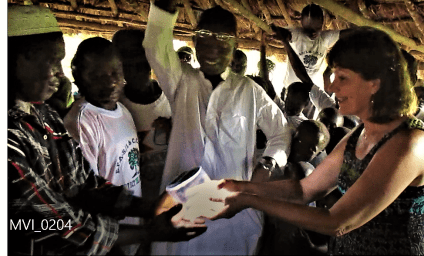
Left, Arlene presents an Imam a solar light for a village mosque.
Here’s perhaps the most exciting news. We are awarding our first college scholarship for a deserving girl!
The first chiefdom girls in the scholarship program are now graduating from high school. After carrying them this far, we want to keep the doors of opportunity open for girls to enter college.
We’re working out the costs for 4-year and 2-year college degrees in Sierra Leone. We plan to award one girl now for her first-year costs for tuition, room, board, books and transportation. This is about $1700 a year for a 4-year university. We have this first year covered, and will add college scholarships as a goal for future campaigns. Look for more on this year’s awardee in a future newsletter.
We can’t thank everyone enough who contributed to make all of this possible. You are amazing!
Donations came literally from across the country. From Alaska to Key Largo, Florida. From Maine to Los Angeles, and many places in-between.
We hope you’ve come to agree that educating a girl is one of the most important things we can do to make this world a better place.
On behalf of the girls of Bumpeh Chiefdom and our local partner The Center for Community Empowerment & Transformation, we all say – Thank you!

 AK: The high cost of transportation and high Internet cost. I can’t afford a computer laptop and a modem to do the required research.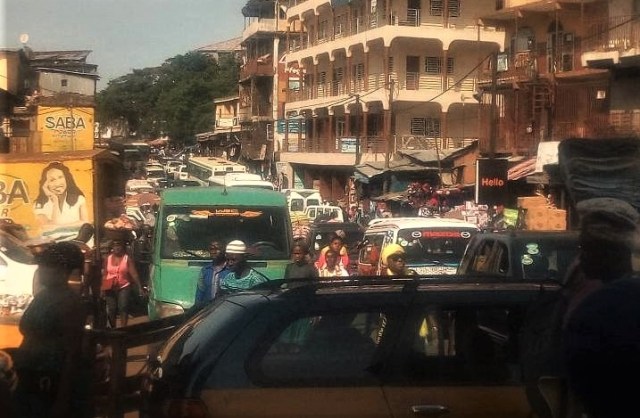
 AG: You have a change of government, with the new president making education his first priority. What are you students hoping to see change with the new administration?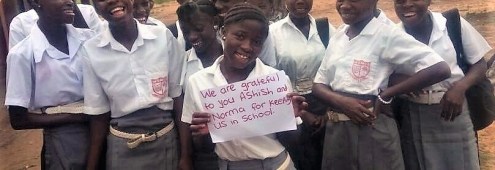


 Aminata Kamara, left, recipient of our first college scholarship is in her first year at the University of Sierra Leone’s Institute for Public Administration and Management in Freetown.


 CCET-SL grows orange, lime, grapefruit, African plum, cashew, avocado, guava and coconuts, all with seed they collect from locally purchased fruit.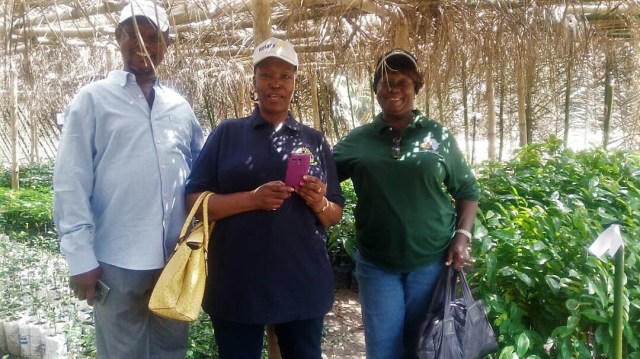
 CCET-SL grows some specialty trees like African plums, left.
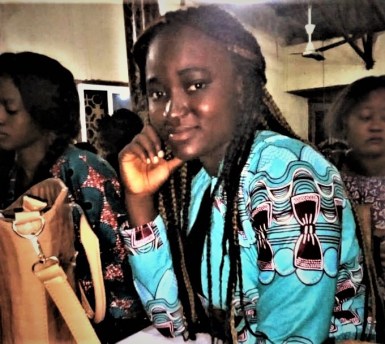 Village beginning Aminata, left, is the youngest of 12 children. Her parents scratched together a living in the Rotifunk area. It’s typical of the chiefdom, with mud houses and where most earn a dollar or two a day as small traders at the weekly market. Her father was a primary school teacher, a low paying job, and her mother a trader. Now, her father is retired and her mother blind.
 Proud college student Aminata, left, is now a first year student at the Institute of Public Administration and Management at the University of Sierra Leone in Freetown – thanks to Sherbro Foundation’s first college scholarship award of $1700, paying her first year’s tuition, fees, books, transportation and a stipend for living expenses.
 “She is a woman, but she does [so much] good and all the people in the community admire her,” Aminata said. Rosaline shows girls a woman born in their chiefdom can get a college degree and take leadership roles usually filled by men.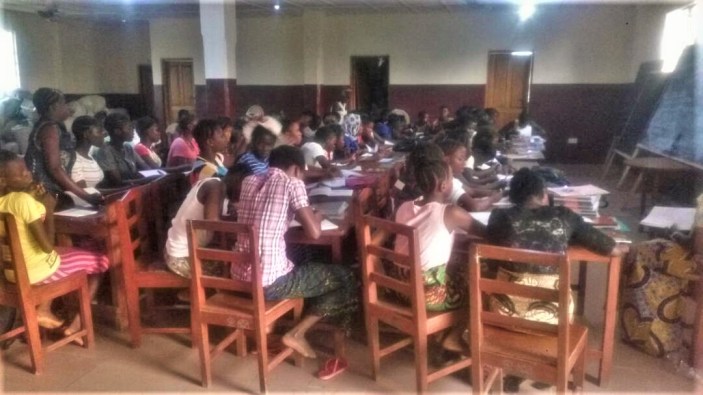
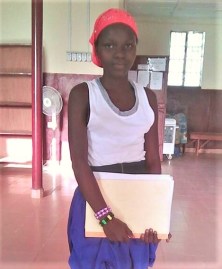 Alima, left, is one student who signed up. We
  Thanks to a $5,000 Beaman Family Fund grant, the Tutoring Program is being offered free of charge to both girls and boys.
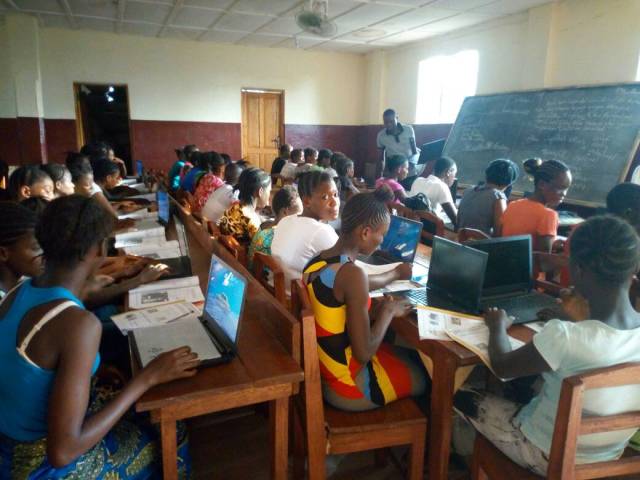 Paramount Chief Charles Caulker visited the first week and immediately called us in Cincinnati. We heard all the noise in the background of kids getting into the preloaded computer games, as their first effort in learning how to navigate a PC and use the mouse. He said it made him so proud.
 Students don’t have textbooks and must copy limited notes teachers write on the blackboard.
 Working to fill this gap is CCET-SL’s Tutoring Program, the brainchild of Managing Director Rosaline Kaimbay, left. As a former school principal, she ran year-end study camps where 9th graders had intensive all-day review classes for four weeks. The result was 100% of her students passed the junior high BECE completion exam, uncommon for any school, let alone a rural school.
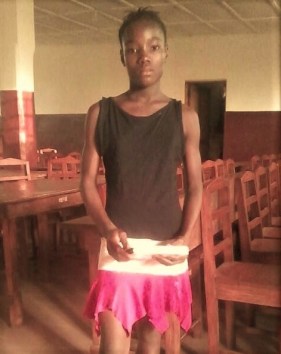 Girls like Adama, left, feel pride that they’re joining a group of chiefdom academic elites, studying with the best local teachers in a first-class environment complete with solar light and computers.
 It’s too far for them to walk home from school for their main (and sometimes only) daily meal and return again for evening classes. Some had not eaten since heading to school at 7 a.m.! And it’s too dark for girls to be walking home that distance at 7:30 p.m.
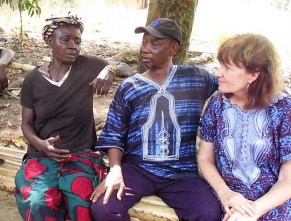






 And special guests repeatedly said they’ve never heard of a larger – or more complete – scholarship program anywhere in the country. Ibrahim Coker, left, area supervisor of schools for the Sierra Leone Ministry of Education said: “I’ve never seen such a number of scholarships together with a total package including uniforms, exercise books and solar study lights.”
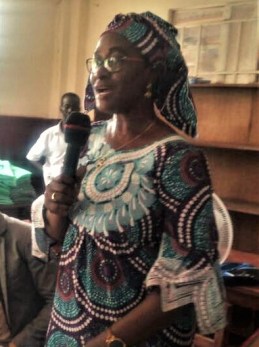 “It’s very impressive. I’ve never seen any organization giving so many awards and paying for so many things,” said Alice Conteh Morgan, left, managing director of Reliance Insurance Risk Co. in Freetown. Conteh Morgan, a Rotifunk native, attended to encourage the girls: “With your educations, you can achieve everything.”
 The awards ceremony was covered by the Sierra Leone Broadcasting Co., the country’s only TV station and a regional radio station. Paramount Chief Charles Caulker said he continues to receive phone calls congratulating him on Bumpeh Chiefdom’s big news.



 The biennial award goes to “the individual who has made a significant contribution to the human condition through their time, effort or expertise, whether this was a single event or a lifetime of work,” according to the organization. “This award is intended to recognize actions that go well beyond efforts in a single community or location and serve mankind as a whole.”
 Arlene also thanked the P&G Alumni Foundation for their grant this year of $12,235 for CCET-Sierra Leone’s new education and computer center in Rotifunk. The money went to finish equipping the center, including 17 more laptop computers and a color printer for the first and only printing service in a district of 300,000 people.
 Sierra Leone is highly rural. Most live in small, hard to access villages, where there is no government birth registration.
 The chiefdom cooperates with the government to collect information needed to secure government birth certificates for newborns.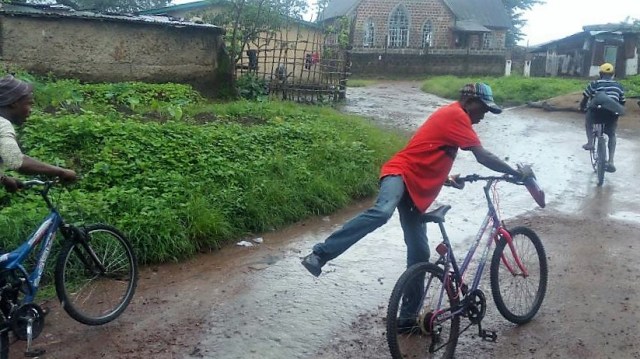


 Uniforms are being sewn locally.
 The solar lights we sent were
  Sherbro Foundation