Fighting Ebola with buckets and bleach

Buckets and bleach.  This is the most basic – and an effective – method to prevent Ebola.  Frequent hand washing is one necessary step in stopping the spread of Ebola.  Here’s the latest pictures on the community-led Ebola prevention work in Rotifunk and Bumpeh Chiefdom by the Center for Community Empowerment & Transformation (CCET).

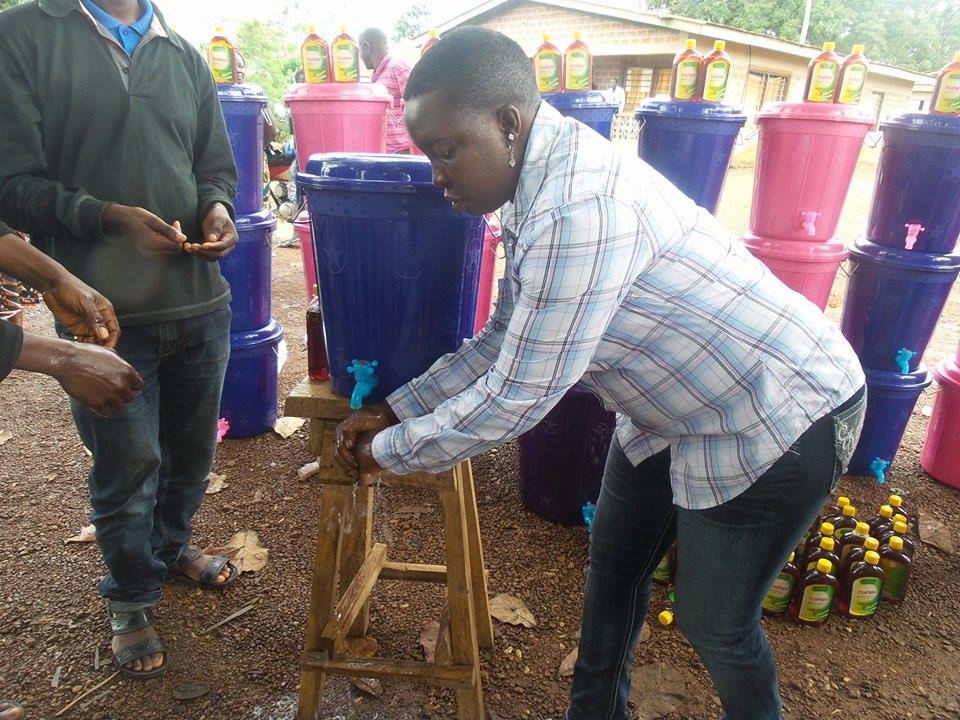
Chief Caulker & CCET Exec Dir, Rosaline Kaimbay show buckets ready to distribute for hand washing

Chief Caulker & CCET Exec Dir, Rosaline Kaimbay show buckets ready to distribute for public hand washing

Hand washing stations are needed in public places to make it easy for people to frequently wash. In the cities in Sierra Leone, it’s become standard practice that you must wash your hands at a portable washing station (aka bucket with spigot) before entering a business or restaurant.  Business owners set these up at the front door and position someone to monitor they’re used.

But rural places with tiny local economies have no money to do this.  Public places like town markets, mosques, churches and public health clinics have not been equipped and are at risk.

Forty public hand washing stations were set up last week  in Rotifunk, seat of Bumpeh Chiefdom with Sherbro Foundation funding. With a second SF donation, CCET is out today in Bumpeh Chiefdom distributing another one hundred buckets and bottles of disinfectant to treat the water used.

2nd batch of 100 buckets for Bumpeh Chiefdom Ebola prevention.

2nd batch of 100 buckets for Bumpeh Chiefdom Ebola prevention.

I caught Paramount Chief Caulker today by phone as he was on the road to deliver the buckets to small villages in the chiefdom.  CCET picked up money Wednesday  in a second wire transfer Sherbro Foundation sent to the capital, Freetown.  They purchased the additional hundred buckets and disinfectant, and Chief Caulker drove them down to Rotifunk on Saturday.

Some were handed out there to complete Rotifunk coverage.  The rest were being driven and personally distributed to villages today, Sunday, by Chief and CCET volunteers. He’ll pick up a boat along the way to deliver buckets to the farther flung small villages along the Bumpeh River that transects his chiefdom.

This is how Chief Caulker and CCET get work done.  They do simple projects that can quickly be implemented and have immediate benefit for poorest people in the chiefdom. They collaborate closely and are personally leading the effort. And it’s finished and having the intended effect – quickly.

10565041_719734634762343_5707628134744572684_nThey are reaching small villages down narrow dirt roads that government designated Ebola “sensitization” trainers and NGO’s never get to.  But these village people travel to town markets to sell their farm goods. They have family and friends that travel down to see them, perhaps now to feel they are escaping the Ebola plague. It’s frequent travel that’s been the vector to spread this ebola outbreak compared to past outbreaks.
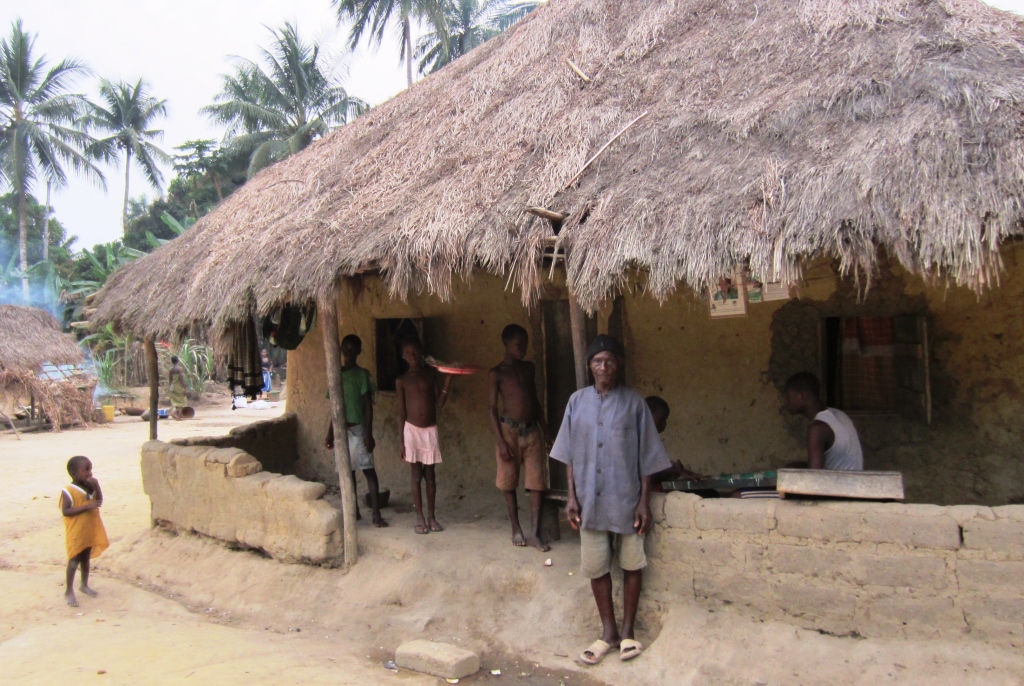
Bellantine town chief Ali Kamara is getting a hand washing station as he receives many visitors at this house.

Bellantine town chief Ali Kamara is getting a hand washing station as he receives many visitors at this house.

These villages need preventive  hand washing, too.  I asked Chief where he put buckets in a small village like this one.  At the public health clinic, the mosque and the town chief’s house, he said, the places where people congregate.

Chief Caulker and CCET are educating people as they go on how Ebola is transmitted and how to prevent transfer, like frequent hand washing. Then they get the hand washing station from Chief or one of their local leaders, and it’s all reinforced for them.

We talked today about the Ebola epidemic resulting in one silver lining with the country-wide blitz training on personal hygiene and spread of disease. Yes, Chief said, it’s a whole new orientation for people.

It’s also energizing people with positive action they can take to fight Ebola. To not feel like victims. They feel their Chief and their country are supporting them when they visibly see action taken they can understand – like a bucket and bleach. When a trusted chief personally explains it and puts it in their hands, it’s more accepted and likely to be used.

I could feel the energy in Chief’s voice today. It was a far cry from our conversation two weeks ago when we first talked of the need to provide preventive action, but none was there.

In recent weeks, Chief Caulker’s been contributing to a number of district level and national strategies to fight Ebola. Today he was doing what he does best; personally inspiring and leading people to action.  He was clearly being energized, too, to continue the Ebola fight.

This Ebola fight will probably go on for six months. We have work in front of us to keep these hand washing stations equipped with disinfectant. You can help by donating to Sherbro Foundation’s Ebola prevention effort.


Rotifunk Leads Unique Community Ebola Prevention Effort

Rotifunk Leads Unique Community Ebola Prevention Effort

Dear Friends,

I thought I would be writing now to ask your support for Sherbro Foundation Sierra Leone’s girls scholarship fund. With the Ebola outbreak in Sierra Leone, school is indefinitely suspended. Instead, I’m asking for your help on getting Ebola prevention supplies to the rural Sierra Leone area we work with.

CCET Exec. Director Rosaline Kaimbay demonstrates the hand washing station.

CCET Executive Dir. Rosaline Kaimbay demonstrates portable hand washing station filled with disinfectant solution.

In the last two weeks, SFSL has had to shift our focus from education to helping Rotifunk and surrounding villages fight the Ebola epidemic.  A second and bigger wave of Ebola is now moving through Sierra Leone.  Neither the Sierra Leone government nor any NGO’s have reached rural areas beyond the outbreak epicenter with Ebola prevention supplies.  Yet, it’s in these kinds of rural places the Ebola outbreak started.

The majority of Ebola cases continue to be in two areas in eastern Sierra Leone. A national state of emergency was declared last week, and these two areas have been blockaded. Everyone is effectively quarantined in place for 21 days, the Ebola incubation period. Only food, water and essential supplies are allowed in.

This is a necessary public health step to control the Ebola outbreak. But the disease had already started spreading around the country.  People who became sick in the hot spot areas feared they would get Ebola if they went to a hospital. Before the blockades went up, sick people ran to the care of relatives in other districts. Some of these sick people had Ebola and transferred it to other parts of the country, including Moyamba district where Rotifunk is.  This district now has four confirmed cases and fifty being tested.  This is how epidemics spread.  A frontline Scots aid worker describes the many direct and indirect effects the epidemic is having on an already fragile country.

10336595_716185338450606_6438555027606916424_n

CCET, our local partner, prepares to deliver hand sanitizing stations.

There’s a misconception that the Ebola outbreak is being managed for the whole country by large nonprofit organizations like Doctors WIthout Borders (MSF). MSF is heroically fighting the battle to save people’s lives already ill with Ebola in the two epicenters, and tracing their contacts for quarantine there. But they are not involved in prevention activities to stop the spread of Ebola in the rest of country. The Sierra Leone Government’s actions have been limited to reactive steps and mainly within their fragile health care system; not preventive steps across the country.

Sherbro Foundation is equipping Rotifunk and surrounding villages with portable hand sanitizing stations.  This deadly disease can surprisingly be killed with soap and water and hand sanitizers.  People are being trained to frequently wash their hands, especially when in public places like markets, churches, mosques and health clinics.

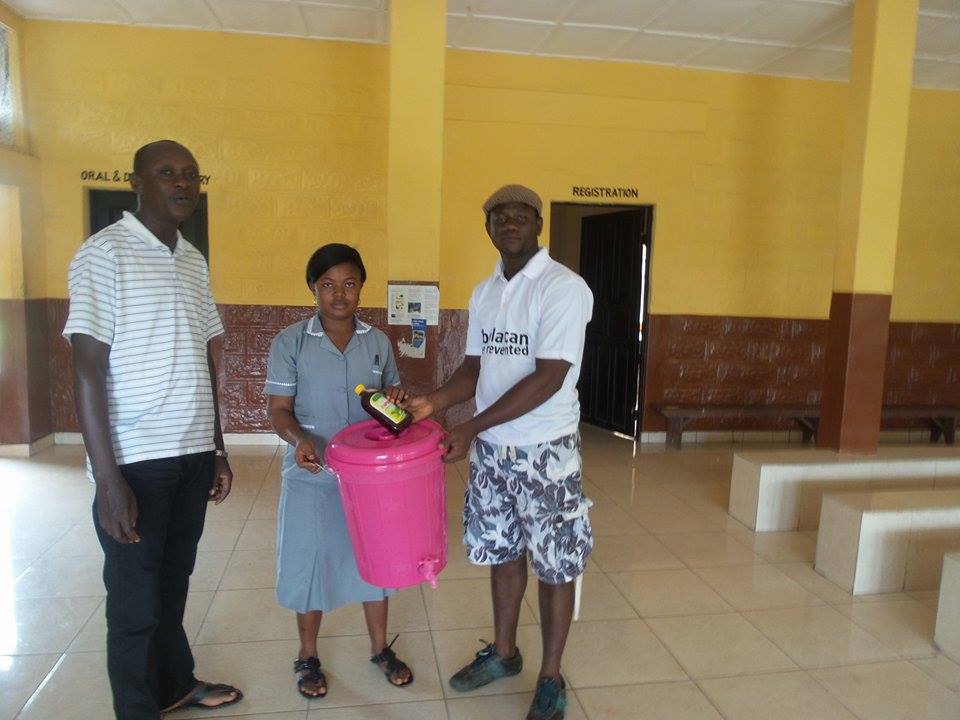
Hand washing station delivered to the health clinic waiting area.

Hand washing station delivered to health clinic waiting area.

Rotifunk, like most of the country, has no running water.  There is nowhere to wash hands.  Preventive steps like hand sanitizing stations in public places are not set up in rural towns and villages outside the two Ebola hot spots.

SFSL sent money last week to set up over forty hand sanitizing stations like this one and a supply of disinfectant. Our Rotifunk local partner, the Center for Community Empowerment & Transformation (CCET)informed us today they need to reach more villages and have more disinfectant to go around. Prices on buying these portable sanitizing stations have gone up 50% in the last week, as goods are in short supply.

CCET Executive Director, Rosaline Kaimbay informed me today they are being seen as unique in Sierra Leone with this kind of grass roots community-led effort on Ebola prevention.  While towns across Sierra Leone are still waiting for Government and NGO assistance, they are taking charge on the fight against Ebola.

It’s understandable that limited resources are first going to the epicenters of the emergency.  But unless towns in the rest of Sierra Leone like Rotifunk are equipped for preventive actions to fight Ebola, the epidemic can continue to spread across the country – and beyond.  More lives will be lost.

Time is of the essence. Can you help stop this tragic epidemic for the cost of a dinner out or one concert ticket? To donate online, just click here: Donate   We accept all major world currencies. To send checks, contact us at sherbrofoundation@gmail.com.

You can help even more by passing this on to a friend.

Thank you!

Arlene Golembiewski
Founder & Executive Director

Sherbro Foundation Funds Ebola Prevention

Sherbro Foundation Funds Ebola Prevention

Sierra Leone and the Ebola crisis are all over the news this week. Everything we read is about the two main outbreak areas in Kailahun and Kenema in the east of the country.  But what’s going on in the rest of the country, you may wonder .

Weeks with the strain of bad news, much uncertainty and no direct support is taking its toll on a small town like Rotifunk. Imagine a country with some of the friendliest people on earth that has stopped shaking hands with friends and colleagues, part of the normal daily ritual of greetings. Everyone is eying each other for signs of illness.

President Koroma declared a national emergency and Monday, August 4 was a national day of prayer and reflection. Everyone was asked to stay home. And they did.  It was eerie to see pictures of the normally jammed streets of Freetown empty without even a pedestrian in sight.

Ebola trainingThis was a chance to complete Ebola sensitization training for all citizens.  We’d call it awareness training. Health care workers could make door to door checks.

Paramount Chief Caulker in Rotifunk, Bumpeh Chiefdom last week gathered all his section chiefs and other chiefdom leaders to personally explain symptoms of Ebola and how to prevent transmission of the virus.

The Ebola training poster is rather graphic.  It needs to be for the many people who cannot read.

Rotifunk is in Moyamba District and they are a long way from the Ebola hot spots.  The District has only had one confirmed Ebola case, fortunately not in Rotifunk.

Rotifunk is a center of local trade with its lively Saturday market.

But with traders coming from many parts of the country for big weekly Luma markets, it wouldn’t be hard for a person just coming down with Ebola to show up in town. These Luma markets have now been banned. Local people are free to buy and sell every day as usual, but “strangers” cannot set up in town to trade.

P. C. Caulker was clearly tired and on edge when I called to check on things. I could hear the strain in his voice of now weeks of the crisis and trying to oversee protection of the people in his chiefdom. It wasn’t the first time he told me no Ebola prevention supplies had made their way to his chiefdom and the other smaller towns across the country.  He felt vulnerable – for the town and for himself.  I’m the chief and I have to receive everyone who comes to my door, he said.  I’m personally at risk.

hand washing stationWe’ve trained people to frequently wash their hands, he said. Yet we have nowhere in public places like the market, mosques, churches and schools to do this.  In a town like Rotifunk with no running water and no public rest rooms, people can’t follow the procedures we just trained them on.

I asked what they need to improvise for hand washing. He described covered buckets fitted with spigots and diluted household bleach solution, now the country protocol. Done. The Sherbro Foundation Board quickly agreed to fund this, and I wired the money on Monday. By end of the week, they should have fifty of these hand sanitizing stations staged around town and a supply of bleach.

Chief’s second problem was harder to address.  Hospitals and clinics may have no personal protective equipment beyond thin disposable gloves and health care workers are afraid to handle people who become sick. Patients might be unattended for several days while waiting for Ebola test results to come back from Kenema. It’s understandable they are afraid. When they do their jobs, nurses and community health officers are at significant risk.

Buckets they can buy in Freetown, but not PPE.  To order and ship from here would be expensive and take a long time, even if we chose the right things.  Sherbro Foundation Director and physician Cheryl Farmer called the Infectious Disease unit at the Ann Arbor hospital where she lives. US hospitals are receiving bulletins on how to handle suspect cases of things like Ebola, including PPE. But the shipping dilemma remained. The whole process can take 6-8 weeks and be expensive.

I raised the concern on the Friends of Sierra Leone Yahoo group. This diverse group of former Peace Corps Volunteers and Sierra Leoneans now in the US has an active dialog group.  Within hours, I got a response from Raphael, working with the Well Body Alliance. This US NGO has sent a large shipment of PPE that should arrive soon and is intended for health care workers upcountry.  The Rotifunk hospital is now in the queue to hopefully receive equipment soon. Thank you, Raphael and Well Body Alliance!

So many times in recent months when I’ve felt the frustration of how I will get something done for Sierra Leone, my prayers are answered.  I’ve learned to be clear and just ask – by email, by phone, by website, by personal contacts.  By blog post.

This is how things are getting done in and for Sierra Leone these days. Often piecemeal and ad hoc.  But thankfully, we’re getting the basics done and making progress.

When I called Chief Caulker to tell him that PPE should be on its way, they had just read CNN news about Liberian Doctor Brantly and his remarkable turnaround from Ebola’s deathbed.  This is the kind of good news people need to hear. Not that it will affect the many people now sick in Sierra Leone. But good news is good news.  That night ended on an upbeat note. For once.

If you would like to help Sherbro Foundation defray the cost of the hand sanitizing stations for Rotifunk (an unplanned expense), your support is most welcome.  You can donate here.

Arlene Golembiewski, Executive Director