It’s July and we’re four months into the Covid pandemic. Sierra Leone and Bumpeh Chiefdom are living the same massive human health experiment we all find ourselves in.
But they’ve fared better than us for the same point in time after the pandemic reached each of our borders. Confirmed cases in Sierra Leone (per 100,000 population) are 50-fold fewer than the US to date, and mostly contained in the capital, Freetown and the surrounding area.
Thanks to your support, Bumpeh Chiefdom used Sherbro Foundation funding to take early and aggressive action. As of July 9, it can still report no confirmed Covid cases.
Following its Ebola experience, most of Sierra Leone’s 1584 confirmed Covid cases to date transferred to government isolation centers for the course of their infection – where they don’t infect more people. Contact tracing led to over 9000 people quarantined, with about 8000 released after 14 days with no infection.
But by the end of May, Covid moved around the country to all but one district beyond the Freetown area. Still, a ban on inter-district travel without a limited essential travel pass managed to keep over 60% of confirmed cases to the Freetown area.
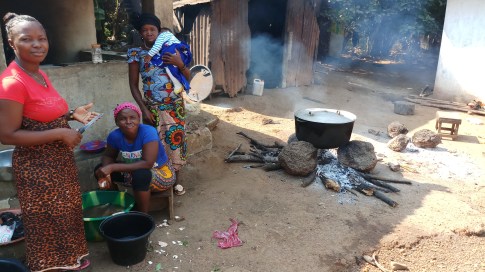 Rural areas like Bumpeh Chiefdom have reported few, if any, cases. Life largely takes place outside where breeze offers natural dilution.
Population density is lower and 60% are young, under twenty-five years of age.
Of course, there’s little access to testing to verify how widely the virus actually spread. We now know youth is no protection, and young people are probably active asymptomatic spreaders of the virus.
Taking early action
Bumpeh Chiefdom’s Paramount Chief Charles Caulker’s didn’t wait to take action. He formed a chiefdom Covid committee in March and reinstated procedures successfully used to quell Ebola, while adding others.
 Chiefdom meetings now take place with distancing and masks.
Checkpoints started monitoring nonresidents trying to enter the chiefdom in midMarch, before even a single case was confirmed in the country. This kept most people from high infection areas out. Local people also wrongly feared being quarantined if they traveled away from home, discouraging movement within the chiefdom.
Chief Caulker passed chiefdom bylaws in May, requiring social distancing and use of face masks in public – before the government took action. But just setting standards doesn’t mean people will follow them, or even hear about them or understand them.
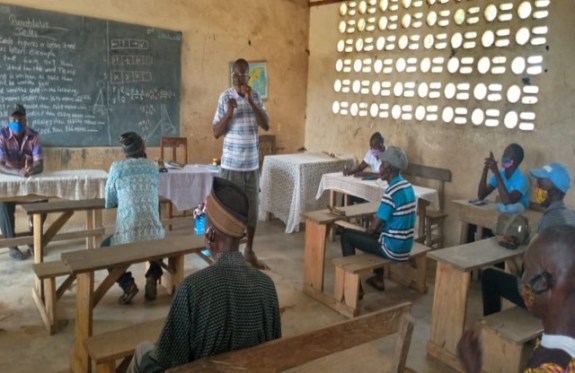
Safety teams for community-led prevention
In early June, 13 safety teams comprised of local leaders from across the chiefdom were trained on their Covid bylaws. Local health professionals and chiefdom Covid committee members went to every part the chiefdom, training 350 local leaders: section and village chiefs, heads of men’s and women’s societies, imams, youth leaders, checkpoint workers and others.
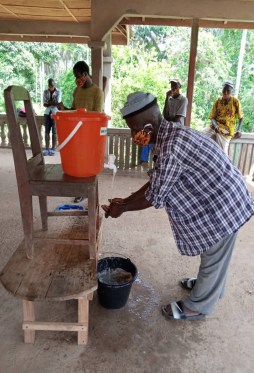 Trainers emphasized practical demonstrations, with participants practicing proper handwashing and mask use.
The safety teams were charged with teaching fellow residents how the Covid virus is transmitted and how social distancing, wearing masks and hand washing protects them.
Teams continue to monitor and enforce Covid procedures.
Taking training to the people in remote villages seldom happens. Rumors and myths about this unknown disease called Covid proliferated without TV, radio, newspapers or internet. Villagers didn’t know how the virus transfers or how to protect themselves.
Using locally known trainers speaking their own language invoked a level of trust. Health care trainers could convey much more understanding that in turn encourages more voluntary compliance.
Trainers explained people have the power to stop the virus through their own behavior. It’s in their hands.
Small group community training made people believers for an epidemic that has largely only been in cities. “Be an example now to your community,” trainers admonished.
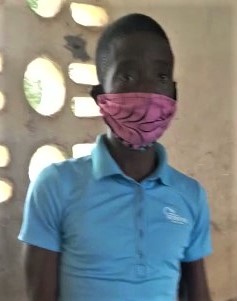

“We learned so much for fighting against Covid-19. Especially about the interior (rural areas),” a youth leader, above left, said. “The interior is a problem with commitment of people. Not all people believe the sickness is in existence. Thank god brought you to communicate and explain how Covid-19 can come right into the interior.”
Asked what she learned, the woman, above right, said, “We learned about social distance and to not encourage ‘strangers’ (nonresidents who could be infected). And to wash our hands with soap and water to protect our families.”
 Over 9000 Sherbro Foundation funded masks were distributed so residents can comply with chiefdom (and now government) requirements.
 195 hand washing stations and soap were also given to village leaders for their public places. With no running water and few wells, this encourages handwashing where people convene.
Chief Caulker extends his “profound thanks” to all Sherbro Foundation donors for funding the program.
 “I am very much delighted for the completion of the training of our section safety teams. I followed the process with keen interest and I am tremendously satisfied with the accomplishments. My section chiefs and their people constantly called me and expressed appreciation for the exercise while it was on.”
“They confessed that the training was the best ever conducted in the Chiefdom and it came out clearly … that participation was enormous and constructive. More importantly, they admitted acquiring the knowledge, skills, and tools to take on Covid ‘one on one’ for self-protection.”

Community-led training brings value, as well as results. 350 local leaders comprising thirteen safety teams for every corner of the chiefdom were trained for less than $600! Trainers gave their time. Costs were mainly for participant and trainer transportation.
Sherbro Foundation encourages the chiefdom to build on the momentum of the safety teams with follow-up sessions. Community-led prevention is a powerful concept not only for Covid, but for prevalent and debilitating disease like malaria. Malaria weakens the immune system making people more susceptible to Covid, especially pregnant women and small children. Future sessions can reinforce Covid practices, and also empower villages to eliminate standing water and sleep under bed nets to avoid malaria.
Reopening the country
Like everywhere, Sierra Leone could only stay shut down so long. The majority of people live day by day, earning a dollar or two today so their families eat tomorrow. The pressure to resume local trading and international traffic is overwhelming. Sierra Leone is “reopening” its economy and borders this month. Increasingly, it gets pulled into the direction all West African countries are taking.
The inter-district travel ban was removed June 24, taking away Bumpeh Chiefdom’s main line of Covid defense. Flights and land borders will be opened shortly. Large outdoor markets and gatherings remain banned, including religious services, much to the objection of mosques and churches.
The back to school question
Sierra Leone now joins countries around the world in the massive experiment of sending school children back to school before the pandemic is stamped out.
School reconvened July 1 for three grades due to now take their national exams needed to move to the next level: 6th graders to junior high; 9th graders to senior high; and 12th graders seeking entry to higher education or to meet employer requirements for school completion exam scores.
 Our partner CCET-SL resumed its special all-day 12th grade school in its education center July 1, preparing Rotifunk’s graduating students for their national exam. Masks and distancing required.
Students will get a few weeks of classes before exams take place over July and August. The West African standard exams must be administered using the West African Examinations Council procedures and schedule – or risk the students losing a whole year until exams are offered again next year.
We’re awaiting word on how and when Sierra Leone schools will fully reopen in the fall.
Stay tuned for the next newsletter on Sherbro Foundation’s direction for the coming school year. You’ll see new things as our partner CCET-SL strives to keep improving the quality of education in the chiefdom. We’ll need your support more than ever.
— Arlene Golembiewski, Executive Director
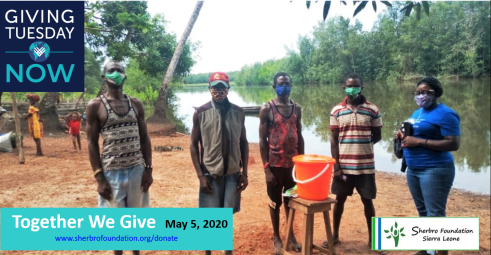
 Sherbro Foundation is paying for small daily stipends for checkpoint volunteers to buy food and water from villagers during their 12 hour shifts away from home.
 Bumpeh Chiefdom, Sierra Leone, took immediate action in April against Covid-19 before any confirmed case reached them — and has kept the virus out so far. But it’s quickly spreading all around them.
 We know Covid-19 is a stealth virus and hard to control. But Bumpeh Chiefdom has a head start, learning from its Ebola ordeal. Covid-19 starts as a traveler’s disease, first carried in by air travelers from infected countries. Sierra Leone has only limited flights and directly quarantined all arriving air passengers in Freetown throughout March; starting in February, for passengers originating in China.
 But the April 17 report shows nearly a doubling of cases from 15 to 26. Most new cases are reported linked to the second case; they worked at the same hospital. But the doctor’s husband rightfully said it’s time to concentrate on community transmission. She appears to have been infected by community transfer. Her family, housekeepers and close hospital work associates have tested negative, while hospital nurses with little to no contact with her tested positive this week. They could have been community-exposed as the doctor was. As was the lab technician.
 The government’s control program now limits travel to within each of its 16 districts, set a 9 pm to 6 am curfew, limits public-sector business hours (the largest employer) and stresses staying at home wherever possible. Hand washing and social distancing are emphasized. They continue contact tracing and quarantines, but that will soon outstrip capacity to handle new cases.
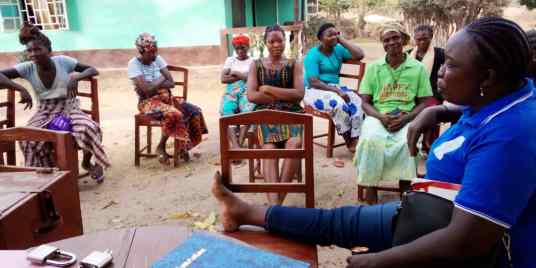 Social distancing is initially hard to get used to. The weekly women’s small grant meeting, above, spread out, but not quite six feet. Chief not only stopped gatherings, but leads by example, applying the six-foot rule in his own interactions. Our partner CCET-SL leaders do the same. Hand-washing stations are set up in public places, and people urged to wash hands at home.

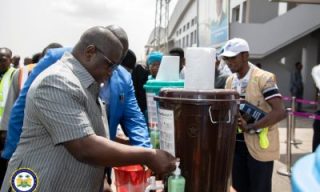

 Outside traders bring in fish, the main protein source for most.
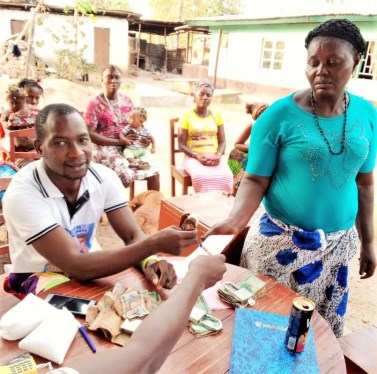 They also become part of the savings plan of the new Women’s Small Grant Program, where women deposit part of each week’s earnings, left.
 Sherbro Foundation