What a girl must do to go to school

What a girl must do to go to school

Alima just finished 8th grade. She’s a spirited 13-year-old who speaks right up, but she’s small for her age. It was only after I asked in our second conversation that she told me she walks to school from her village six miles away.
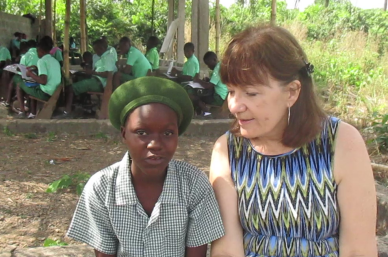
That’s 12 miles a day to and fro, every day. But Alima has a scholarship and is happy to be in school. I could tell she’s bright, which her vice principal confirmed.

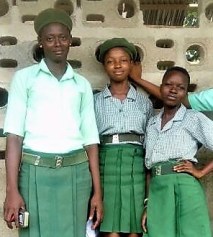
13-year-old Alima, left, student at Bumpeh Academy with Arlene Golembiewski, SFSL

Girls must grow up early when they decide to go to secondary school in Bumpeh Chiefdom, Sierra Leone.

They have huge hurdles to pass for the basic education westerners take for granted.

It starts with getting to a school.

Alima is not alone in walking a long way to school. It’s common for village girls to walk 4, 5, 6, even 7 miles each way to Rotifunk schools every day. Leaving when dawn is just breaking, kids begin their long trek, often on an empty stomach. Their return trip is under the hot tropical sun.
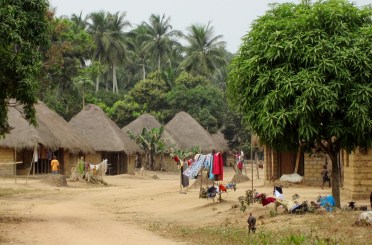
Bumpeh Chiefdom is made up of 200 small villages of 200 to 400 people, sprinkled throughout the chiefdom. Most are too small to support a primary school, let alone a junior high or high school. Girls must go to Rotifunk, the chiefdom seat, to attend one of four secondary schools of different types and faiths. A new junior high recently opened in a larger village. It’s struggling with funding and getting teachers who have training beyond high school themselves.

Only a couple rickety, well-used mini-vans travel the dirt back roads as public transportation, and only a few times a week, usually for market days. They’re not out in the early dawn hours to reach school for 8 o’clock assembly.

Kids like Alima can’t afford to pay for daily transportation anyway. They walk every day. Many miles.

Village girls have to leave home to board with a family in Rotifunk or a nearby village.
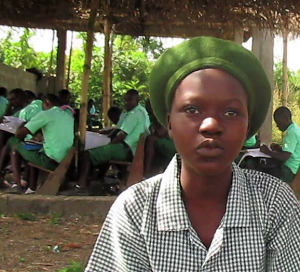
Alima lives with her aunt in Mokebi village. She’s typical of girls who must leave their parents and home at an early age to go to school. If they’re fortunate like Alima, they board with a family member who can offer housing and some level of family life. If better off, the relative may even pay the child’s school fees.

Split families are common in Sierra Leone. Husbands and wives work in different places. Alima’s parents are older and couldn’t pay for any more schooling, so they sent her to her aunt. Single parents and poor families often can no longer afford to feed teenage children, and send them to relatives. Family members are left to take in orphans.
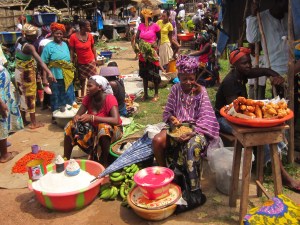
When asked who girls live with, the answer so often is, my aunt. Rotifunk is a local trading center with a large weekly market, smaller daily markets and other places to sell, like school lunch stands. Market trading and cooking and selling food are the domain of women. They’re often single heads of households, their men gone or looking for jobs in larger towns and cities. Little money finds its way back home. But women keep taking in children and find ways to stretch their tiny incomes.

Isatu B. was recently orphaned. “I no longer have any strong relative who will help me go through schooling,” she said. Relatives strapped for money and with children of their own may offer girls little more than a place to sleep. Teens away from home for the first time can get little supervision. At 15 and 16 years of age, many are making their own way.

Girls work for a living while going to school.
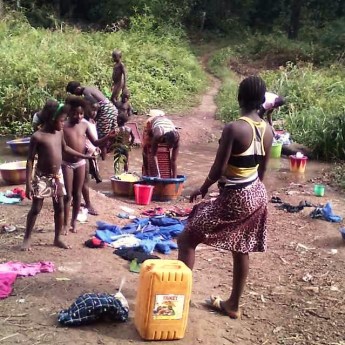
After a day at school and walking 12 miles, Alima helps her farmer aunt planting and weeding the cassava, yams and okra they grow. This is their livelihood and pays for their food and her school uniform.

Girls take on many physical chores after school. They’re cooking on wood fires, doing laundry by hand, carrying water and fetching firewood. They work on family farms, and may be selling its produce or other goods in the local market after school.
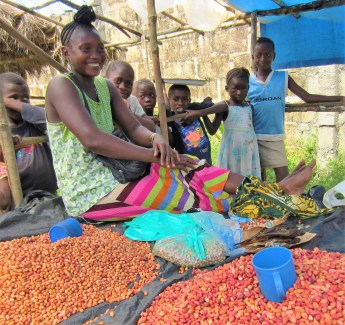
If girls can’t rely on a guardian for money, they have to earn the money for their daily food and school expenses (school fees, uniform and school supplies).

Their family or guardian may advance them $10 to sell things in the market. They buy elsewhere and resell in Rotifunk at a higher price. Or they make fried doughnuts or cakes to sell, or bring produce from the family farm. It’s painstaking work, clearing cents on the dollar.

Girls spend their school vacations working to clear enough profit to buy a $15 school uniform they’ll wear for the year.

When these girls leave home and work to earn money for school, it’s not unlike young adults in the US going to college. But these girls may start at the age of 12. They’ll work their way through six years of school before they can think about vocational training or college – which costs even more.
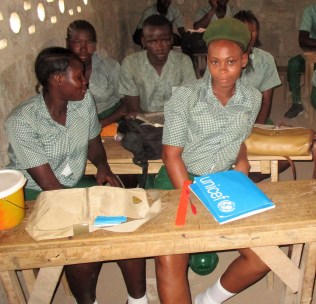
When a girl receives a scholarship and a school uniform, it frees her to focus on her studies. Isatu K. lives with her grandmother and said she no longer has the fear of being asked out of class to go home for school fees. It gives her a sense of security.

Schools depend on school fees for operating costs. During the school year, students who can’t pay the term’s fees have to leave and try to come up with the money. It’s humiliating and children feel rejected at this young age. With no money, they may have to drop out of school and repeat the grade next year.

A scholarship and a paid school uniform don’t just give a girl the chance to progress through school. They give her the self-esteem to be a success.

She’ll work less. And get back her childhood.

Staying in school, she has a future.

For $17, you can keep a girl like Alima in school for the whole year with a scholarship. $35 pays for a scholarship and a school uniform.

Open up her world. Click here: I want to send a girl to school.


Open up her world. Give a girl a scholarship.

Campaign 7-25-17 (2)

Isatu is a remarkable girl.  She’s an orphan determined to stay in school.  With help from Sherbro Foundation scholarships, she has made it to her senior year!

Each day is a challenge in Bumpeh Chiefdom, Sierra Leone. Isatu lost both her parents as a young girl. She lives with her aunt, a farmer, in their small village of mud houses outside Rotifunk. There’s no public transportation. Isatu and her friends get up before dawn and walk six miles to school.

After school, Isatu walks six miles again home, and then helps her aunt in the field, tending cassava, rice and greens. They grow their own food, but have little left to sell for income for school fees. Darkness comes by 6:30 year-round near the equator. Isatu can’t afford a lamp to study in the evening.

Yet Isatu has big plans. She wants to become a lawyer. She learned in Civics class that lawyers use the law to protect people. “I want to fight for my colleagues and people in the village against violence” and for better conditions, she says.  If Isatu hadn’t received a Sherbro Foundation scholarship, she wouldn’t be in school, and wouldn’t be learning about a world of jobs and careers.
Bumpeh Academy students – Isatu, left, Hellen and Alima

More Bumpeh Chiefdom girls than ever are in school. Nearly 900 girls were enrolled in the area’s five secondary schools at this term’s end.

But hundreds more want to go to school and don’t have $17 to pay the annual fee! Their families are struggling to earn $1 per day to put food on the table. Sierra Leone’s economy went into freefall after Ebola and has not recovered. Families can’t continue to support teenage girls, and many are pushed to marry at 16 and 17. They get pregnant too early. The cycle of poverty continues. Teen pregnancy keeps Sierra Leone’s maternal and infant mortality rates among the world’s highest.

In four years, Sherbro Foundation’s scholarship program has helped 450 girls enter – and stay – in school.

Girls with scholarships work harder in school in order to keep them. They know there’s competition. They now have bigger goals, and pregnancies are reduced to only a few.

Some graduates will go on to vocational training. Some like Isatu are determined to go to college. They want to become the nurses, doctors, teachers, accountants, policewomen and lawyers their country desperately needs. With education, they all can move beyond the cycle of subsistence life that has long trapped their families.

But our scholarships have only helped a third of the girls enrolled. Even more want to go to school.

Now is a crucial time. With the new school year starting soon, you can give more of these girls the gift of attending school. You can:

  • Ensure 350 girls have the chance to go to school this year with a $17 scholarship.
  • Help girls progress into senior high and bring new 7th graders into junior high.
  • Provide a new uniform for 7th graders and 10th graders starting in new schools.

With a strong U.S. dollar, giving is a great bargain. Your $50 will sponsor three junior-high students to make the important leap to secondary school. Or ensure that three older girls can focus on graduation.

$35 will send a girl to school for an entire year AND outfit her with a school uniform. Where else can $35 do as much good as educating a girl?

More good news:  Our Board pledges to match each gift. You’ll help twice as many girls!

It’s easy to donate online: Click here. We welcome checks sent to: Sherbro Foundation, 3723 Sachem Ave., Cincinnati, OH 45226.

Bumpeh Chiefdom’s girls tell us: “We’re ready to learn.”

You’ll open up their world to new possibilities by giving girls a scholarship.

Thank you!

Arlene Golembiewski, Chris Golembiewski, Cheryl Farmer and Steve Papelian

— The Sherbro Foundation Board of Directors

P.S. Isatu and her fellow students are so grateful to you for expanding their world. Won’t you help a few more of her friends? If you do so now, they can be ready for school in September!


So how do you grow a coconut?

How do you grow a coconut? What’s the seed?

vlcsnap-error366As a biologist myself, I had to stop and think, it’s the same as with any other fruit. In nature fruit drops from a tree and will start growing where it falls.

That’s true for coconuts, too. In a fertile place, they will grow where they fall –  shell, husk and all.

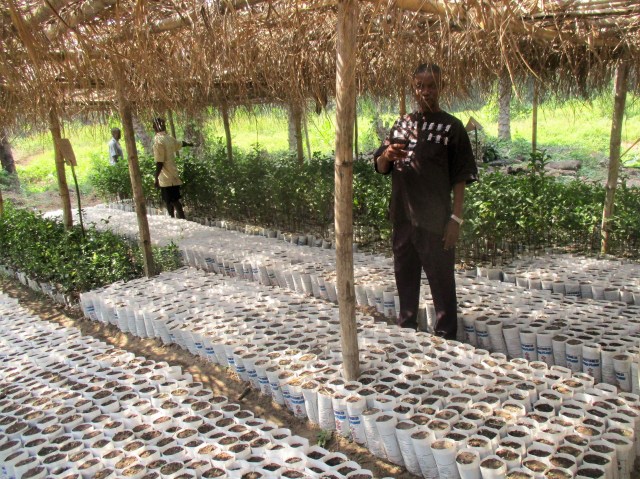
IMG_1988Bumpeh Chiefdom is lowland tropical rainforest, perfect for growing coconuts.  The Center for Community Empowerment & Transformation (CCET) is growing them commercially by the hundreds in a coconut nursery.
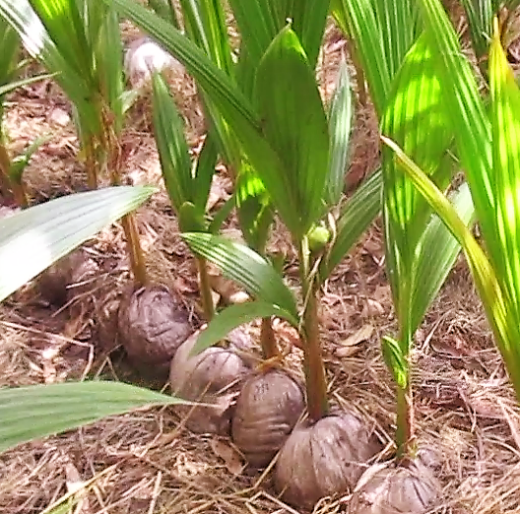
Coconut seedlings will go to their own nonprofit project orchards and some to sell to private growers. Private sales help pay for ongoing nursery operation and fund growing all the fruit trees they raise for village orchards and baby orchards.

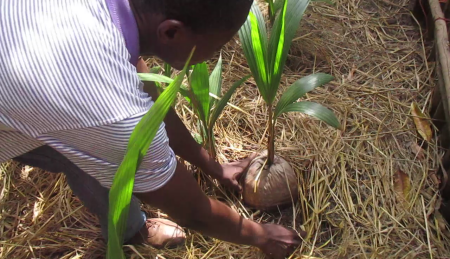
vlcsnap-error787 (2) Coconuts, shell and all, are planted about a third of the way into loose soil and covered with straw mulch.
Two or three months later, they’re sprouting. By six months, they are ready to transplant.

A mature coconut tree will fetch $30 in fruit income. And CCET just planted 450 of these in the new Baby Orchard!

IMG_1993CCET’s nursery manager, Pa Willie, grows project coconuts in a protected nursery to keep thieves from stealing them. It’s a fenced in and locked pen right behind his house he keeps an eye on.
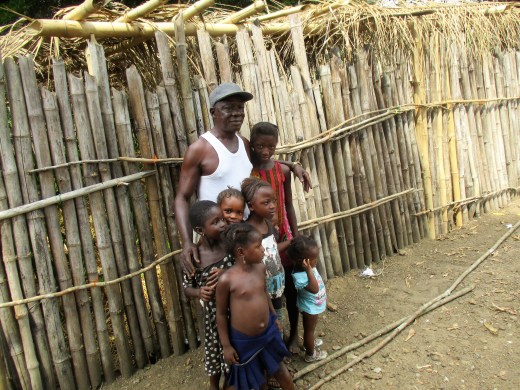
Pa Willie developed his growing skills when he worked for a Liberian rubber plantation  near the border with Sierra Leone before the rebel war. He had to flee for his life with only the shirt on his back when rebels infiltrated the plantation. Thankfully today. he can tend to the nursery from the peace of his own backyard.

Trivia question – where did the rubber for making tires come from when Henry Ford started making cars a hundred years ago, and before the days of petroleum based synthetic rubber? Ford funded plantations in Liberia growing natural rubber trees. Some are still growing today.


Starting an orchard the traditional African way

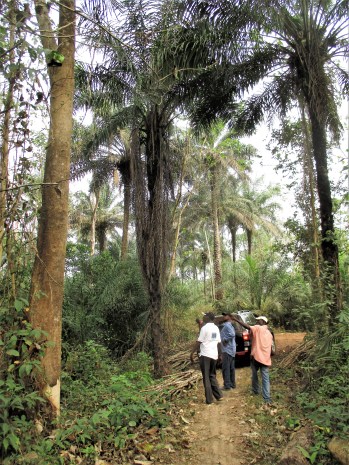
Starting a new 15-acre orchard is big job anywhere. Starting an orchard this size the traditional way– reclaiming overgrown tropical bush with only manual labor — is huge.

The first priority for the Rotary grant is planting a new 15-acre “Baby Orchard.” This forward-thinking project will ensure Bumpeh Chiefdom children go to secondary school for years to come, with orchard income funding newborn baby education savings accounts. Hence the name, Baby Orchard.

IMG_2412.JPGWork is underway and on a tight schedule, as the annual rains started in May. Here’s the step by step process.
First, suitable land was acquired in February. You can’t purchase and own land outright in Sierra Leone. It belongs collectively to the people of a chiefdom. You get rights to rent land from the family who has traditional rights to using it.

Paramount Chief Caulker, left blue shirt, negotiated the land for the new orchard shown here from a family in the tiny village of Roponga, just outside Rotifunk.

It will be easily accessible and serve as a demonstration orchard for visitors. Chief said this extended family did a lot of work for his father fifty years ago. They’ll now be rewarded with rental income for the land and jobs working in the orchard for years to come.

The Roponga orchard land has been part of shifting agriculture, where land is farmed for two or three years, then left fallow when fertility drops. This land hasn’t been used for some years, and is considered “strong bush.” To not waste its fertility and to produce short-term income, annual crops of rice and peanuts were inter-planted with fruit trees seedlings.  With fruit trees spaced 25-30 feet apart for their eventual mature size, there’s plenty of room to raise other crops between them.

March 14 first Roponga clearing     vlcsnap-error685

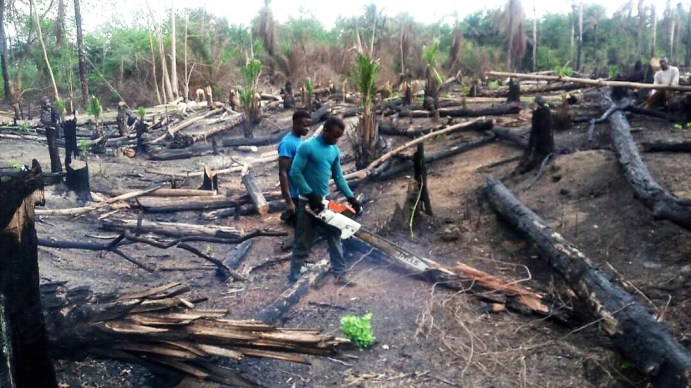
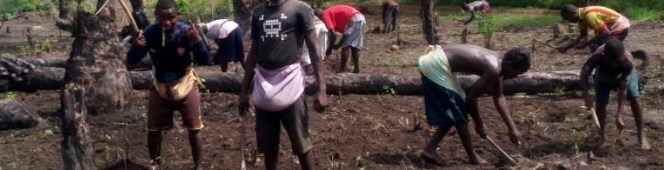
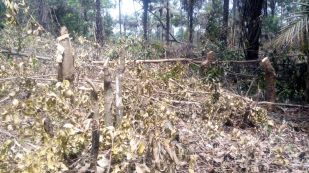
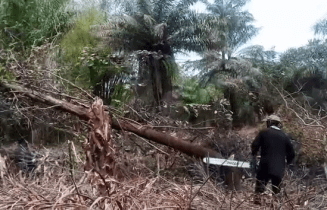
The land was first manually “brushed” in March, the dry season. Dozens of men spent two weeks cutting back all the small trees, bushes and weeds they could with machetes. A guy with a chain saw followed, cutting down medium-sized trees. All was left to dry for 4 weeks.

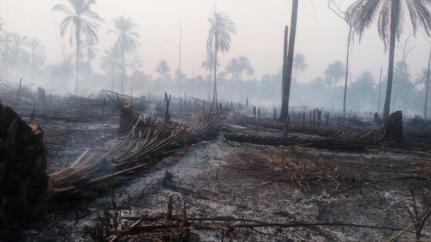
Burning Mar 30 '17With no mechanized equipment to clear the land, it must be burned. This land dried well for a “good burn” in April. If farmers brush too late, or rain comes too early, they are not so lucky.
Chief sighed on the phone when I said people here will object to burning. “We’d be here for the rest of the year with a small army trying to remove all the trees and brush from 15 acres if we couldn’t burn,” he said. At least, for an orchard, it will only be burned once. Fruit trees once planted will be maintained for the next 25 years or more.

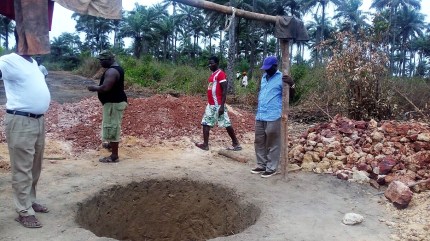
Mar 22 Mike's Orchard water well project 2A well was dug in April to reach the lowest dry season water level.  If you dig after the rains start, you won’t get deep enough, and will run out of water come next dry season. This well was dug by hand 7 or 8 meters deep — over 20 feet. A guy is down in the hole filling buckets with dirt and stones hoisted up with a chain over the strong bamboo frame. The well will be lined with concrete so it won’t collapse, and a hand pump installed to keep young tree seedlings watered during coming dry seasons.

IMG-20170430-WA0002Men cleared the orchard land again, using a chain saw to cut remaining small trees and tree limbs that didn’t burn.

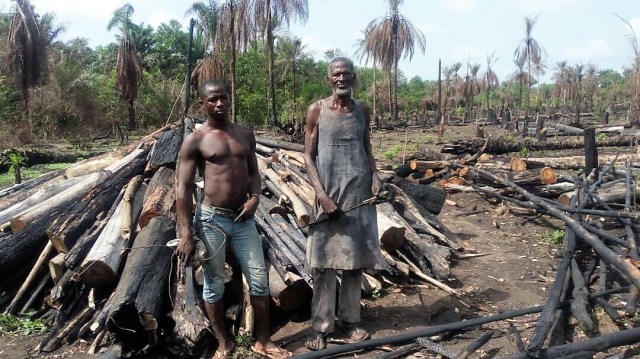
Roponga orchard making charcoal 5-11-17Little goes to waste in Bumpeh Chiefdom. To make extra income for the orchard, these cut trees were collected to make charcoal. It’s an in-demand product in a country where the great majority of people still cook outside on wood or charcoal, even in cities. They produced 1,000 bags of charcoal that will offset costs to start the orchard.
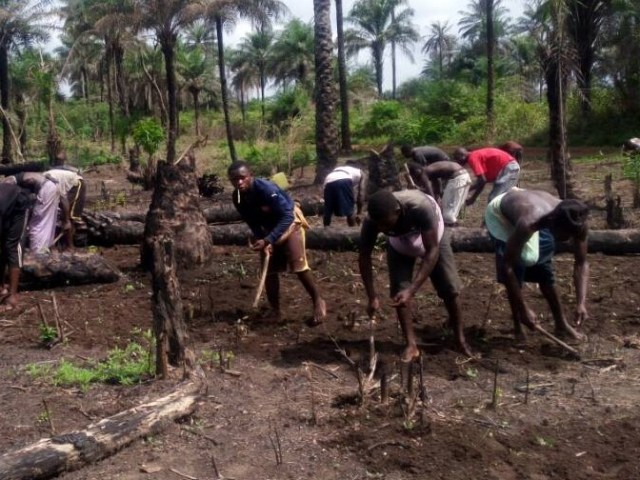
Roponga orchard planting groundnuts 5-11-17 7 (2)

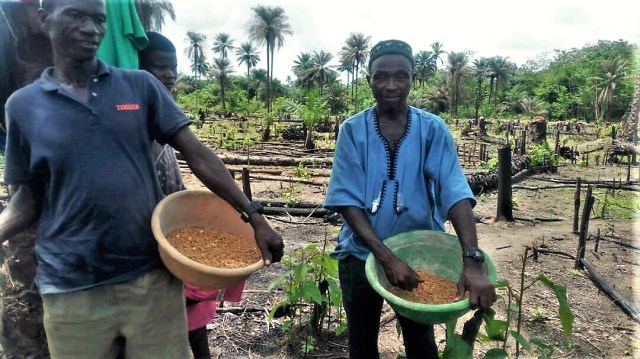
By mid-May, the orchard was finally ready to plant. Five acres of peanuts and five acres of rice were planted. This is back- breaking work, where the now bare soil is broken with small hand hoes. Peanut seed held in makeshift waist pouches is dropped in the soil and covered again as they go.

Planting rice May 24, '17 (2)

Upland rice followed, planted the same way.  The yield is less than rice planted in swamp water, but grows nonetheless in the area’s heavy monsoon rains peaking in July – August.

Within ten days, the peanuts and rice were germinating.  In five months, they’ll be ready to harvest.

june-14-4-2.jpgJune is tree planting time and coconut and fruit tree seedlings went in. 450 coconuts and 700 citrus and guava raised by the project from seed were planted.

The land is “pegged” with posts driven into the ground every 25 – 30 feet to space trees for their future mature canopies.

This is lowland tropical rainforest, where coconuts grow at their best. Within 5 years, they’ll be producing a bounty of coconuts.

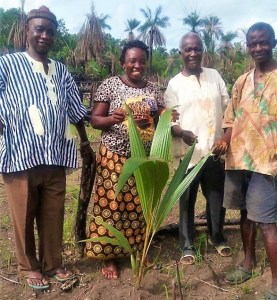
L-R, Chief Caulker, CCET Managing Director Rosaline Kaimbay, Stalin Caulker and Kalilu Sannoh admire one of 450 coconuts just planted.

IMG_2225

Trees raised from seed in the nearby project tree nursery. Chief Caulker, above, stands among 5,000 orange seedlings planted for next year. Other trees like cashew and avocado will be added to the orchard, as well as banana and plantain.

Guava is like a large bush and fast growing. It will be producing fruit within 18 months of planting, and fruits twice a year. Banana and plantain will produce a year after planting, and keep sending out offshoots for year-round fruit. More short term income for the project.

Chief Caulker plans to use the program for demonstration, showing visitors how they, too, can start low-cost community-led projects. And grow their own way to a new future.


Save

Growing a Community’s Future benefits thousands

Growing a Community’s Future benefits thousands

Many will directly benefit from Growing a Community’s Future within the two-year Rotary grant period. But the real beauty of the program is its long-term and enduring benefits. It’s designed to enable the chiefdom to use its own resources and capabilities to grow a self-reliant future.

More than 3,000 people will be positively impacted through the Rotary Global Grant. The project will continue to generate results for years to come and improve many more lives.

In a chiefdom now 70% illiterate, educating children and moving to literacy is a major goal underpinning the entire project.

Roponga pegging orchard 6-13-17 (3)A Baby Orchard will fund newborn education savings accounts for 500 children annually. These accounts will grow to pay secondary school educations.

A variety of 1,200 fruit trees is being planted on 15 acres. In five years, the orchard will produce sustainable income, all going towards educating children.  Short-term crops — peanuts, rice and bananas — are also being planted for annual income while trees mature.

The orchard will keep producing fruit income for 20 years and more.

IMG_2562 (2)
Village Orchards
  Three villages averaging 300 people each, 900 people total, will grow commercial size community orchards.

These orchards will make villages self-reliant in funding their children’s educations and development projects that improve their quality of life. They can dig wells for clean drinking water, improve roads, build primary schools, etc. Orchards can in five years produce $12,000 in annual income year after year.

IMG-20170402-WA0001Women’s Vegetable Growing 170 women can double their incomes growing peanuts in 2017-18 and take steps to becoming small commercial growers. With families averaging five members, 850 people will be positively impacted with expanded income.

Women like Emma Sesay, in last year’s program, was able to stop taking high-interest loans to send her children to school and save seed to grow more peanuts this year.

IMG_2192Job Creation The grant creates 14 full-time jobs maintaining two baby orchards, a tree nursery and supervising all agriculture programs. These are the only wage- paying jobs in subsistence agriculture villages. With families of at least five, 70 lives will be significantly improved with steady income year round.

To sustain these jobs, orchards are growing short-term crops like rice, peanuts and pineapples for annual income. The tree nursery grows more than 15,000 fruit tree seedlings each year and sells some to private farmers to pay workers and grow next year’s seedlings.

DSC04587Birth Registration About 1,200 newborns will have their births registered each year and receive chiefdom affidavits.

This ensures their access to government services for documented citizens, including immunizations and free health care for children under five. It also provides chiefdom birthrights, like access to land. Outside of government hospitals in a few cities, there’s no other system to register births.

In addition, the program gives newborn parents three fruit tree seedlings to grow for income to fund their child’s education. The popular program renews an old tradition with a new goal, teaching parents they can save for their child’s future.

IMG_2394

Chiefdom Forest Reserves Seven forest reserves will be created ensuring chiefdom natural resources of land, drinking water and wildlife are protected today and flourish for future generations.

These will be the first locally protected reserves created in the country. Eventually 23 forest reserves will be created and protected through chiefdom by-laws.

Villages throughout the chiefdom will benefit from streams that maintain clean water and don’t dry up in the dry season, wildlife stock that expands and hardwood trees with economic value protected for future generations.

CCET also recognizes by planting and protecting trees – large tropical trees – they are doing their part to reduce global warming and fight climate change.


Save

Save

Rotary Clubs make “Growing a Community’s Future” reality

Rotary Clubs make “Growing a Community’s Future” reality

Paramount Chief Charles Caulker toiled for years to develop community-led agriculture programs that would help eliminate poverty in his chiefdom and make people self-reliant.

Now, seven cooperating Rotary Clubs are providing the critical boost — the “fertilizer” — to expand and firmly root “Growing a Community’s Future,”  his innovative programs in Bumpeh Chiefdom.

Thanks to Rotary Club of Ann Arbor leadership, a multifaceted Rotary Global Grant totaling $49,500 will improve the lives of thousands.

IMG_4887 (2)

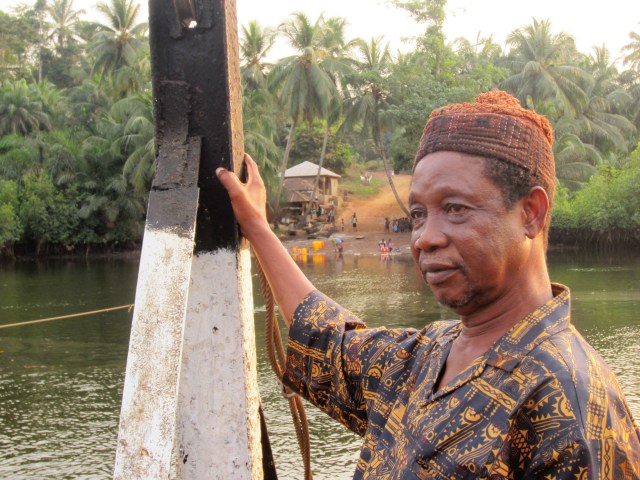
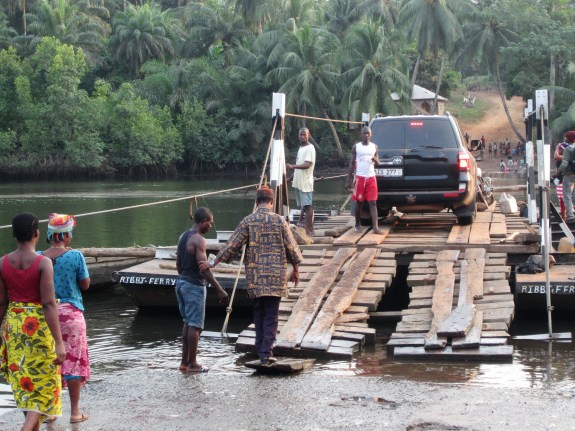
Paramount Chief Charles Caulker on the hand-pulled ferry crossing that’s the gateway to his chiefdom. 

Helping a struggling community transform its economy
The Rotary-funded project called “Growing a Community’s Future” will do just that using the only things Bumpeh Chiefdom has in abundance to bolster its economy — fertile land, plentiful water and agriculture traditions.

For isolated Bumpeh Chiefdom, one of the poorest places in the world, the opportunity is huge. “This grant will ensure we can fully implement our program to grow our community’s own future.  We’ll be able to fund children’s education, community development and protect the environment,” explained Chief Caulker.

Sherbro Foundation helped connect the seven Rotary Clubs with our chiefdom partner, the nonprofit Center for Community Empowerment and Transformation, CCET, which will carry out the project.

“Little did I know, a chance meeting with Ann Arbor Rotarians would lead to a grant of this size that will have such major development impact on the chiefdom of 40,000,” said Arlene Golembiewski, executive director of Sherbro Foundation

Motobang 5 (2)

Chief Caulker, right, talks with residents of Motobon village.

International partnerships make it happen
The Ann Arbor Rotary Club contributed $10,000 and coordinated grant contributions from six other Rotary Clubs: Ann Arbor North, Dexter and Ypsilanti in Michigan; plus Cincinnati, Wilmington, N.C. and Pune, India. Rotary District #6380 and the Rotary International Foundation provided matching funds for this two-year global grant.

Rotary grant kick-off Hawa Samai, Chief May '17 (2)A partnership between Ann Arbor Rotary and the Freetown Rotary Club in Sierra Leone will oversee the project’s progress.

Hawa Samai of Freetown Rotary Club, right, visits Rotifunk to kick off the project with CCET and Chief Caulker, left.

“It is a privilege to support the efforts of an extraordinary leader like Paramount Chief Charles Caulker who is working tirelessly to help his Chiefdom recover from an 11-year civil war and the recent Ebola epidemic,” said Mary Avrakotos, Ann Arbor Rotary Club lead for the Sierra Leone project.

“His expansive goals for long-term economic development and to assure that every child in his chiefdom receives a secondary education are exemplary of visionary leadership.”

Multifaceted grant
Rural villages will now be able to develop large fruit orchards on a commercial scale, earmarking income for children’s education and village development, like digging wells and building schools. Also, a women’s vegetable growing program is teaching subsistence rice farmers they can earn more money by diversifying crops and adding fast-growing peanuts and vegetables.

Grant funds will expand the chiefdom’s first birth registration program. And parents of newborns will receive fruit trees to grow for income they can save for their child’s education, reviving an old tradition with a modern goal.

A unique provision of the grant is creation of seven forest preserves to protect drinking water sources, wildlife and trees to benefit of future generations. These will be the first locally organized preserves in Sierra Leone, as Bumpeh Chiefdom strives to protect its all-important natural environment and counteract climate change.

Ashish Sarkar of the Rotary Club of Ann Arbor emphasized, “Projects with the greatest potential are ones like this where the vision is local and our role is simply one of empowerment.”

Save

The Embrace of Sierra Leone

The Embrace of Sierra Leone

Sierra Leone doesn’t just say hello. It embraces you in a rush of sights, sounds, crush of people, heat, humidity, smells, women’s clothes the colors of tropical birds, drumming, music, throngs of kids with smiles from ear to ear. Life spills out onto the street and the village front porch. Here’s some of my images and impressions in returning to Salone after 14 months.

img_1918.jpg
In Freetown, you invariably find yourself on Siaka Stevens St., the center of town, in a crush of traffic with the famous 200-year old cotton tree in front of you. The winter’s harmattan dust was hanging in the air, making it hazy all day, but much of that haze is now diesel exhaust pollution.

USD cash exchangeI have two visual barometers for the Salone economy. Freetown’s beaches were empty. No tourists, which adds to unemployment. People can’t afford to go to their own gorgeous beaches.
The other is how big a pile of leones you get when exchanging dollars. 5,000 and 10,000 denominations are used, and so devaluated, they’re only worth $0.70 and $1.40 each. 

The leone devalued about 25% during 2016. Petrol prices soared. People say the economy is at its worst in years.

IMG_4885
Leaving the highway for small feeder roads to Rotifunk is entering another world. The Ribbi ferry is virtually unchanged since I used it 40 years ago as a Peace Corps Volunteer; a platform on pontoons and you’re manually pulled across. A crowd of small children collect on the other side chanting, Ah-bey, ah-bey, ah-bey — Temne for chief. They know Paramount Chief Caulker is coming bringing them sweets. He started this during Ebola and continues it with every crossing. “I can’t do much to really improve their lives, but I can at least make them smile for a couple hours.”

IMG_5115
Our first week included a trip down the beautiful Bumpeh River to Mamu village to celebrate the opening of new primary school. Taking a big boat with the Paramount Chief, front right, for an official visit is not an everyday activity. So, it’s a party on a boat. Gliding down this unspoiled river, pure joy.

IMG_5140
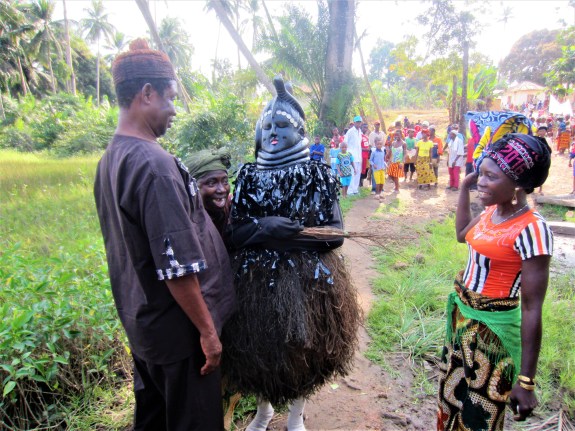
Bundu devils from the women’s society join drummers and singers to welcome the chief to Mamu village. Traditions in a small village like Mamu are very much alive and well. Opening a new school is a happy day, this school built with donations from young Norwegians.

IMG_2788  IMG_2769
Back in Rotifunk, there’s simple pleasures of seeing friends again and meeting new friends.

IMG_2105
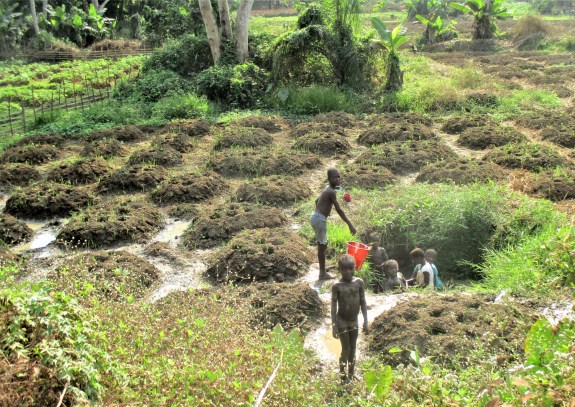
Early evening is a favorite time of day to stroll down the hill to see vegetable gardens being planted and tended in the rich flood plain of the Bumpeh River. Raised beds of various leafy greens, a diet staple, and peppers were coming to life. Kids “fished” in a field well, bringing up salamanders from the mud. They’re probably added to the pot for dinner.

IMG_4972
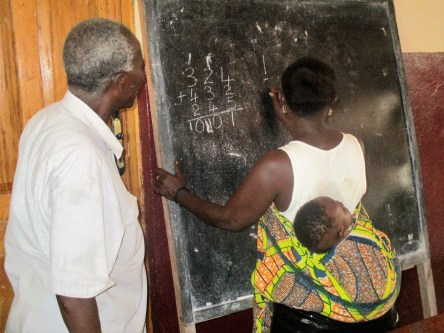
Another moment of joy was walking into our partner CCET’s new education center at 5 p.m. when it was abuzz with activity. Three adult literacy classes and the first regular high school computer class, all going on in the main hall. Most adult literacy students are single parents. Babies are welcome.

IMG_2109This mother of twelve shows us it’s never too late to learn your ABCs for the first time, and how to “carry over” when adding three digit numbers.

Women have graduated from Adult Literacy and entered other vocational training as primary school teachers, nurse aides, a policewoman and one ready to start as a surveyor’s assistant.


IMG_2372 (2)
Computer training classes for Bumpeh Chiefdom students and adults was a dream five and a half years in the making. It grew from offering classes in one school to a full education center in its own 2,600-square-foot building built during Ebola. I learned to dream big; then it happens.

vlcsnap-error383   IMG_2036For Bumpeh Academy, one of the Chiefdom’s newer schools, progress happens in small steps. Very small steps. Senior high classes, previously run “second shift” in a primary school, moved to the main school addition, still in progress as funds are available. In 2015, a concrete slab was poured for three classrooms. In 2016, a zinc roof and partial walls between rooms were added, and classes started. I was happy to hear from Vice Principal Koroma, above, SFSL funded part of the addition with the school fee scholarships we paid for girls. They used the money to buy bags of concrete. Still, children at Bumpeh Academy are in school learning. 98% of Academy students taking the 2016 senior high entrance exam passed! And they have a new Peace Corps teacher, Ethan Davies, above, right corner.  

MVI_2603_Moment
Visiting Bumpeh Chiefdom’s small villages is always a trip highlight. Nyandahun, one of the oldest and smallest villages with 25 houses is the birthplace of Chief Caulker’s grandmother. It has a long tradition of women village chiefs. Chief Lupe Bendu, above left, definitely has a chiefly demeanor. By tradition, she’s considered the queen of Nyandahun. Asked how their village orchard will help them, she immediately replied, “It will help our children and we’ll use it for their education.” 

IMG_2625 (2)
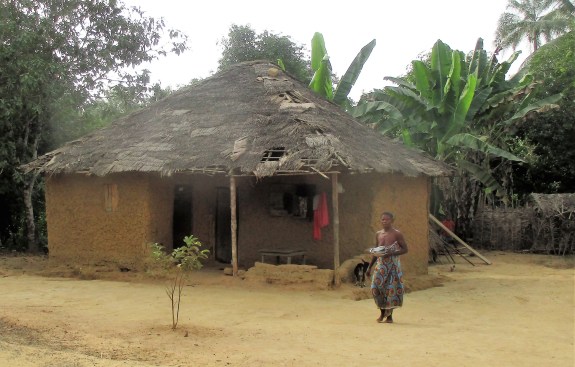
Passing village homes like this one, I’m reminded why our Women’s Vegetables Growing and Village Orchard programs are so important. They’re simple to implement, following local agriculture traditions, income can be earned quickly, and it goes directly to families that need it the most.  With cash income, their children can go on to secondary school in Rotifunk.

IMG_2296
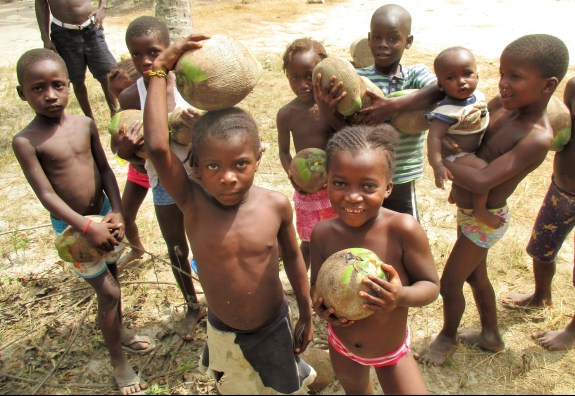
There’s little for a village child to look forward to without education. But we don’t want them to be leaving their villages. We want to teach schoolchildren and their parents they could be earning a good living growing coconuts like these, and guava and cashews. Make agriculture a small business.

IMG_2538
Developing the local village economy includes having cash to set up a small front porch shop for neighbors. A dilemma is not losing your small profits to transportation costs of going to Rotifunk or Freetown to buy cheaper goods to sell. There’s little public transportation from a village like Mosundu.

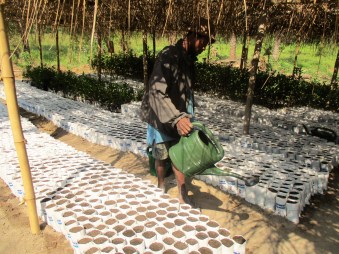
IMG_2190  IMG_2168In full swing, CCET’s fruit tree nursery grows a variety of trees from seed: orange, grapefruit, lime, avocado, guava, cashew, mango. Three workers plant seeds collected from local fruit, and water and nurse them for a year+ until ready to plant in the Village Orchard program. Some go to newborn parents, restoring the tradition of “baby trees.” Some will be sold for income to continue to operate the nursery. Abdul learned to write and make signs in Adult Literacy class.

IMG_1992  IMG_1988Bumpeh Chiefdom is a prime coconut growing area. Pa Willie personally raises coconut seedlings in a closed pen behind his house to keep out thieves. The coconut, husk, shell and all, is embedded in soil until it sprouts. It’s a longer-term venture taking two years, but they’re worth more. Pa Willie’s tree-growing skills date back to working in a Liberian rubber plantation before the war.
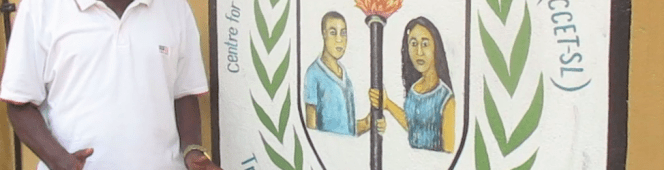


Sherbro Foundation wins P&G Alumni grant to expand the Computer Center

Sherbro Foundation wins P&G Alumni grant to expand the Computer Center

Sherbro Foundation is awarded a P&G Alumni Foundation 2016 grant

vlcsnap-error310


The $12,235 grant is awarded on behalf of our Sierra Leone partner, the Center for Community Empowerment & Transformation (CCET), and will help expand their computer center.

Left, Oliver Bernard, CCET volunteer facility manager at the Center


pg_logo

Former Procter & Gamble employees fund their alumni foundation with the mission of economically empowering those in need.

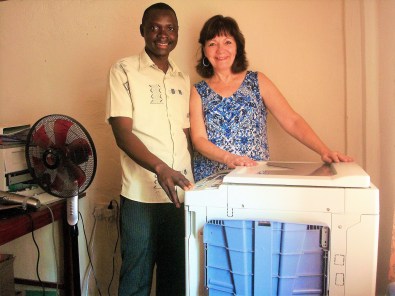
DSC04545Sherbro Foundation Executive Director and P&G Alumna Arlene Golembiewski, left with Sulaiman Timbo, submitted the proposal. She said, “CCET’s new Center offers practical education programs, before unavailable in this community, that improve student earning potential, like computer training and adult literacy.
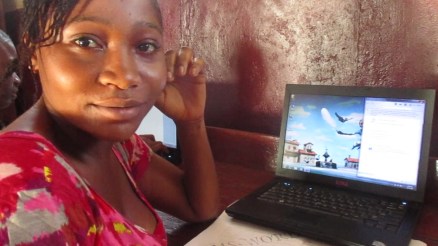
They are preparing impoverished people to find wage-paying jobs in the formal economy. And providing skills to develop small businesses.”

The Computer Center has a slate of education programs and community services that satisfied all three Alumni Foundation objectives for the grant. 

MVI_2758_MomentHigh school students like Zainab, left, get practical job skill training on computers. 
She wants to become an accountant and knows she must be able to use a computer to get a job.

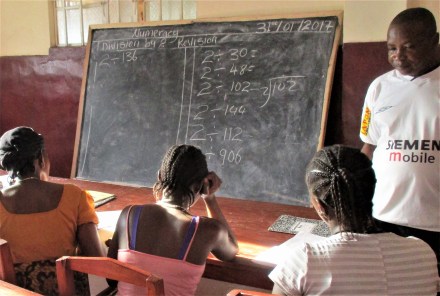
IMG_2031 (2)Adults develop small business skills. Left, Francis Senesie teaches petty market traders and farmers math and business basics like computing profit.

Adult computer students apply their own small-business examples with instructors available to guide them.  

MVI_2260_Moment(7)The Center itself is a new entrepreneurial venture, offering previously unavailable services like copy & printing that fund its nonprofit education programs.

The grant will pay for adding new computers to the Center and a color printer for the new printing service. CCET will buy remaining equipment the Center needs, like a generator to back-up their solar power service and a chest freezer to expand a canteen service.

The grant will also be used to pay initial operating costs while the new Center develops its customer base for copy and printing and other Center services.

The Computer Center is bringing the first and only IT technology access and training to rural Bumpeh Chiefdom’s 40,000 people. It’s the only place in Moyamba District with 300,000 people to get an IT certificate covering all Microsoft Office software programs.

The grant required a P&G alum to participate in the project. Arlene Golembiewski, Sherbro Foundation founder and Executive Director, was a 30-year P&G employee and is a member of the global Alumni Network.

How a small, rural nonprofit becomes self-reliant

How a small, rural nonprofit becomes self-reliant

MVI_2260_Moment(5)Mr. Bendu, a primary school head-teacher, came into the new printing service at the Center for Community Empowerment & Transformation (CCET) to get some UN Children’s Feeding Program forms printed. He walked out of the new Community Computer Center 20 minutes later with his copies.

It was effortless. It would have taken less time if I hadn’t stopped to interview him. Four months ago, it could have been a 2-day trip.

IMG_2795CCET’s new printing service in Rotifunk is scoring a home run for their customers and for themselves.

CCET’s mission is to help community members become self-reliant. But they can’t keep assisting residents unless they themselves become self-reliant.

Left, CCET staff Oliver Bernard, Sulaiman Timbo, Rosaline Kaimbay

The first few years in the life of a small nonprofit are tricky. You’re getting projects off the ground, and need a little cash to fall back on when the unexpected happens. Donors are just learning who you are. Grant applications are often a year-long process before you see any funding – IF you’re approved.

Grant givers ask for your sustainability plan, which can feel like wishful thinking. How can you ensure the future success of your programs when you’ve just started to deliver something using donor money?

vlcsnap-error688It takes a paradigm shift.  You can help people while you earn income offering needed services that fit your nonprofit mission.

Left, CCET Managing Director Rosaline Kaimbay at CCET’s new Center

Our Sierra Leone community partner, the Center for Community Empowerment & Transformation, laid early groundwork for self-sufficiency with new, much needed community services that earn income to fund their nonprofit programs.

IMG_4244Only four months earlier, to get anything printed Mr. Bendu faced an all-day or an overnight trip to the capital, crammed into a minivan bus or on the back of a motorcycle taxi on treacherous roads. His transportation costs alone would have been 10 to 20 times the cost of the printing. The time wasted is just accepted, a common inefficiency holding back developing countries like Sierra Leone.
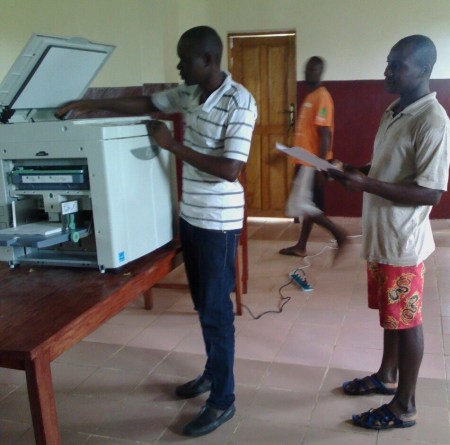
Today, there’s a win-win in Rotifunk. Mr. Bendu and other Bumpeh Chiefdom customers no longer waste their time and money. Instead CCET provides local printing and other services people need. And CCET is making money to fund their nonprofit programs like computer training and adult literacy.

The Rotary Club of Ann Arbor, the Procter & Gamble Alumni Network and Sherbro Foundation funded CCET to start their new services.

img-20160820-wa0000-1These three grant makers were happy to invest in projects giving this rural community services they never had before, knowing income goes to support nonprofit programs.

CCET’s printing service can make simple photocopies or print 500 school report cards or church memorial service programs.

IMG_4916 (3)Sulaiman Timbo, left, and below left, is printing service and IT manager

Sulaiman can prepare custom layouts and type up forms and documents for customers, and then immediately print them.

A color printer is on its way that will expand the business, offering full-color election posters and event flyers, and color photos. More business opportunities.

No one else in their district of 300,000 people provides a printing service like this.

IMG_2018Cell phones are now a way of life, and this means daily charging in a rural town with no electricity.

CCET charges phones in a secure drop-off service seven days a week. People may now bring a battery pack to charge as well.

NGO training session Mar 2017The CCET Center rents meeting and workshop space for NGO and government programs during the day, when no classes are in session. It’s the only place in town and for miles around with a facility to hold professional meetings for 20 to 100 people.

The building’s solar power lets participants use their computers. And they can print meeting materials right there. It’s also a good venue for wedding receptions and other special parties.

IMG_2016.JPGNext on the list to introduce is a small canteen for cold drinks, snacks and catered meals. The room next to the main hall, left, is ready.

Across the street is the only small hospital within a two-hour drive. Staff and visitors want meals and refreshments in a comfortable sit-down space — as well as market day visitors, teachers and NGO workers.  A refrigerator is coming soon to kick off this service.

IMG_2248There’s also a growing need for internet service. People may not own their own computer, but they want to be connected to the world around them by email and Facebook.

The local professional community of teachers, religious leaders, chiefdom authorities, nurses and health care technicians, and NGO reps needs to communicate with organizations around the country and beyond.

CCET plans to start a small pilot internet service and grow from there, based on demand.

So, when a small, rural nonprofit wonders how to become self-reliant, leaders should ask who are their customers, and what do they need?

More girls in school than ever, but more want to go

More girls in school than ever, but more want to go

I was excited to see enrollment of girls was up when I visited Bumpeh Chiefdom’s secondary schools in February. Girls, in fact, were now equal in numbers to boys enrolled. This is a big step forward in Bumpeh Chiefdom, where poverty forces most girls to drop out by junior high.

But I soon found still more girls want to go to secondary school and can’t afford to.

The Sherbro Foundation Girls Scholarship program is changing this. We set a goal last summer of doubling the number of scholarships from 150 to 300 girls.

Thanks to your support, we met that goal and sent 300 girls to secondary school last September.

A small donation of $25 meant a Bumpeh Chiefdom girl could attend school for a full year.

Hear from some of the girls I recently met,  what it means for them to get a scholarship and how hard they work to stay in school:

vlcsnap-error123Some like Alima Kanu, left, JSS II (8th grade), are the oldest and first child in their family to go to secondary school.  She comes from a small village where her parents are rice farmers. Her scholarship to Bumpeh Academy made the difference in her continuing in secondary school.
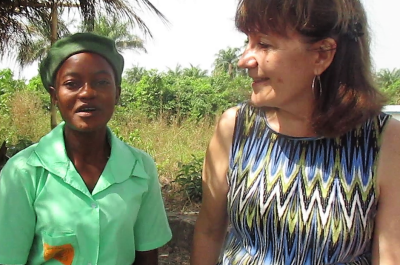
Alima told me, “This scholarship helps me and my family is happy when I have this scholarship because they don’t have money to pay for school fees. Me too, I’m happy. I thank all the people that give me the scholarship.”

The purpose of SFSL’s scholarship program is to not only get girls into secondary school, but to support them in finishing high school.

With her scholarship, Isatu Kargbo, left, completed JSS III (9th grade) and got the highest result of 127 students taking the senior high entrance exam.
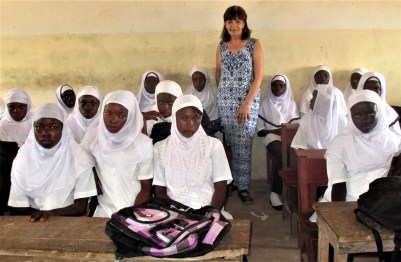
Now in SSS I (10th grade) at Bumpeh Academy, she said, “My father couldn’t pay my school fees. CCET help us and give me a uniform. I’m very happy to be in school and give thanks.” CCET, the Center for Community Empowerment & Transformation, is our local community partner that administers the scholarship program.

Like many girls, Aminata, SSS IV said, “Thank you for donating your funds to enable me to continue my schooling. I appreciate it so much. Honestly, had it not been for your support, I have to stop going to school because my parents are poor and therefore cannot pay my school fees.”

Emilia, JSS III, wrote in a thank-you, “I am happy and delighted when I got this scholarship which every girl wish to have this opportunity. If not the intervention of you I would have been a drop-out because my parents find it difficult to pay my school fees. Through the help of Sherbro Foundation I am continuing my schooling.”

“I have been out of school for many years…You are now my light to see in the world.”  — Thuma, SSS III, on her scholarship

Sherbro Foundation supports five Bumpeh Chiefdom secondary schools of all faiths with scholarships. I met with the 50 girls at Ahmadiyya Islamic Secondary School receiving scholarships this academic year.
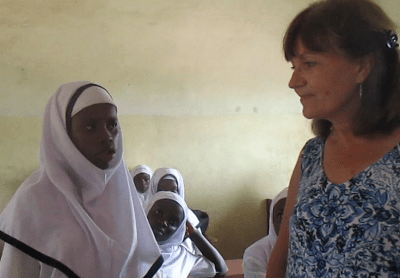
Fatmata, left below, said, “On behalf of the girls in the school, we express our thanks and appreciation for the scholarships. Also, last year for the uniform scholarship.”

vlcsnap-error362She went on to talk about the challenges the girls face in going to school. There are 208 villages in the chiefdom and only five secondary schools. Many girls must walk 4 or 5 miles or more each way to reach one of schools, often making them late for class. And the tropical sun is hot walking home on an empty stomach to get their one meal of the day.

Some just drop out after primary school. Other girls may get rides to school from motorcycle taxi drivers common on the rural roads, who may then coerce them into sex. A number have become pregnant.

vlcsnap-error133 (2)Kadiatu, left, told me most girls have no lights at home and have difficulty studying at night. By the time they get home and do chores, it’s dark. At the equator, it’s dark by 7 p.m. year-round.

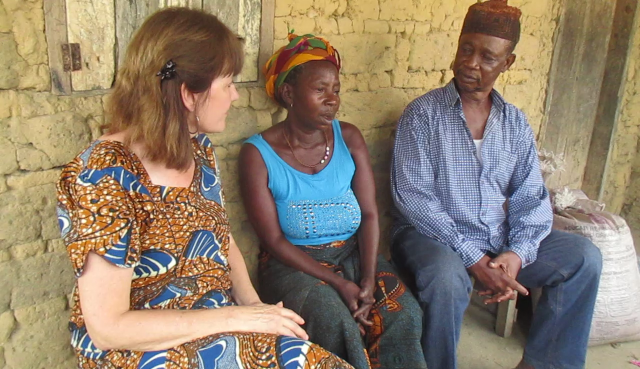
Rechargeable solar lights are one possible solution the program can evaluate. Another girl added that they would like to have a library where they could study after school.

These are problems girls face in all Bumpeh Chiefdom secondary schools.

But the most poignant message was from a girl in the back of the room who stood to speak as our meeting was ending.

vlcsnap-error946 (2)“Please add more scholarships so we are all able to go to school. There are girls at home waiting for this same opportunity. I am fortunate, but there are others who can benefit and want to become educated and literate.”

With girls waiting for their chance to go to school, we want to set our sights higher and grow beyond 300 scholarships in the next school year.

Stay tuned for more in the coming months on Sherbro Foundation’s 2017-18 Girls Scholarship campaign.

Breaking the cycle of poverty takes only peanuts

Breaking the cycle of poverty takes only peanuts

Emma Sesay used to take out a loan at a high interest rate to send her children to school. Emma is the mother of six children. Six survive of the eight she gave birth to. Getting six children through school is tough for a poor rice farmer in Mobainda village.

vlcsnap-error035
Arlene Golembiewski, SFSL, Emma Sesay, Bumpeh Chiefdom Paramount Chief Charles Caulker

Emma was part of Sherbro Foundation’s Women’s Vegetable Growing project last year that helped her grow peanuts. Asked how the project helped her, she said, “I usually need to take loans. I no longer need a loan at high interest to pay for my children to go to school. I sold my peanuts when I needed to pay the school fees.”

Sherbro Foundation just funded a third group of women vegetable growers for the spring 2017 growing season with money raised in our year-end fundraising.

Rice farming is traditional in Mobainda village. It’s a labor intensive, taking 10 months of back breaking toil, but you make little money.

Rice farmers are often forced to take a loan from a local lender at interest rates of 50% and more to send their children to school. These informal village lenders can charge this much because villagers usually have no other option for a loan.

Lenders collect as soon as a farmer harvests. To pay off the loan, farmers are forced to sell their rice at low prices when the market is flooded with lots of other newly harvested rice.

The family then eats what’s left of the rice harvest as their staple food in the coming months, leaving little to nothing as seed for the next crop. They often run out of rice before the next harvest. It’s called the “hungry time.”

Junior high is when most children drop out of school. By this age, eating must take priority over paying for a child to continue in school.

The family may need to take out another loan just to buy rice seed to plant their next crop. And so the cycle of debt and poverty continues.

The Women’s Vegetable Growing project is starting to break this cycle of poverty.

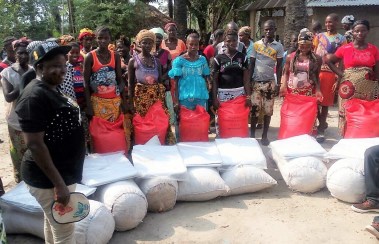
This year’s project again supplied 75 women with 2 bushels of peanut seed, 100 lb. of rice as food before the harvest, and a drying tarp to improve their crop yield. With these supplies worth about $80 each, women are producing income double and triple what they make in rice farming. And they can continue to grow rice and fish in local rivers and streams.

Emma harvested twelve bushels of peanuts from her two bushels of seed last year.  She saved a bushel as seed to plant this year. She is still doing her normal rice farming, so she could wait until the price of peanuts went up after the harvest, and then sold hers to pay her children’s school fees.

Asked how they spent money earned growing peanuts, each woman in the program immediately said, I can pay for my children’s education.

Yata Williams, left, shows the two bushels of peanuts she saved for seed from her ten bushel harvest. She said, “The project helped with many things. It solved our problem of paying school fees. There was money left to buy a market.” Yatta buys things she sells as a small front porch business or neighborhood “market.” Soft drinks, sweets, soap, cigarettes – small luxuries you’d have to travel to a bigger town to buy. The family now has a another income source.

Fula Musu Mansaray, below, in Nyundahun village joined the 2016 project and had a good harvest. She and husband, Musa, also sold peanuts to pay for their children’s education.

L to R, Lupe Bendu, village chief, Fula Musu, Chief Caulker, Musa, Arlene

They are making the most of Fula Musu’s participation in the Women’s Vegetable Growing program. They saved eight bushels of peanut seed from their harvest. They will plant four times as many peanuts in 2017 as she received last year, and grow their small business.

Fula Musa was one of eight women in the project from this small village of 25 houses.
The project will expand to cover another 20 families this spring. So every family in Nyundahun will benefit, a huge economic boost for a tiny village like this.


The Women’s Vegetable Growing project is teaching villages they can diversify their farming by adding peanuts and make more money.

Last year was a bad year for growing rice with prolonged drought and grasshoppers eating crops. Families could fall back on their peanut harvest and have some money to spare.

Before the Vegetable Growing project, a $30 bale of peanut seed was out of the reach of these women.

Now, they’re showing what they can do with this small investment and taking their first steps to self-sufficiency. It only took peanuts.

Do Twice the Good. Feel Twice as Good.

img_0433-copy-2Bumpeh Chiefdom women work hard to make little money.
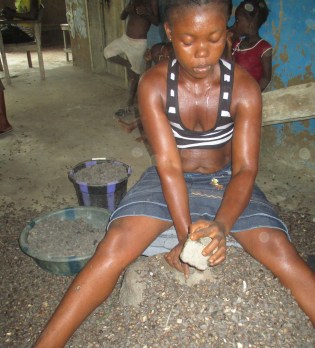
This women is cracking palm kernel nuts with a rock. One by one. Oil is extracted from the nut.

Laborious work with only a small yield.

You can do more good for these women than you can imagine.

Give to the Women’s Vegetable Growing project and help women grow peanuts and vegetables in a half acre garden.

They can double their incomes and more – and still have time for traditional farming & fishing. They can finally start to get ahead in life.

Give to the WOMEN’S VEGETABLE GROWING PROJECT now and we DOUBLE your GIFT.

You’ll do twice the good. She gets twice the help.

Now – imagine how good that feels. For both of you.

Do More Good Than You Can Imagine

branchandbulb1‘Tis the Season
Give for Good!


Do more good than you can imagine – all year round.

women-veg-grow-nov-16-c

300 women are waiting.

You can give them their chance.

All donations welcome!

Read more: Women’s Vegetable Growing project

We’ll even double your gift. Twice the good!

Now how good does that feel?

Thank you!  Happy Holidays,

Letterhead


Giving Tues – Put a Woman on Path to Self Sufficiency

Giving Tues – Put a Woman on Path to Self Sufficiency

givingtuesday-16Give for Good
Nov. 29
We’ll double your gift =
Twice the Good!


women-veg-grow-nov-16-c

Read more about the Women’s Vegetable Growing Project.

We ran out of funding for more women. Any donation welcome!

Give HERE   Thank You!


Giving Tuesday – Put Women on a Path to Self-Sufficiency

In 2015 after Ebola clobbered the economy and people were hungry, Sherbro Foundation wanted to help the most vulnerable. We could help stop hunger by helping women farmers quickly regain lost income.

For GIVING TUESDAY, you can, too. We’ll even match your gift and double your impact.

rosaline-and-veg-farmerWe learned that just $75 can put a family on the path to self-sufficiency by planting fast-growing vegetables as cash crops.

We started the Women’s Vegetable Growing Project, providing peanut and vegetable seeds and a 100-pound bag of rice to 30 small farmers. They had no cash to buy any seed to restart crops. With the rice, they could feed their families with this diet staple before their harvest.

A small start, but the first harvest results were immediate and spectacular. By raising peanuts, these rice farmers within four months grew crops worth three times their normal profit in one-third the time.
veg-project-women-breaking-ground-5-15

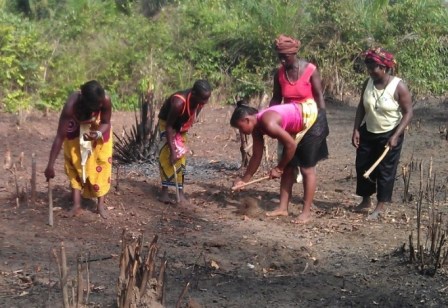
By growing peanuts and produce like cucumbers, peppers and corn in half-acre gardens, the growers could earn $200. Yes, that’s three times their regular profit from 10 months of back-breaking hand-planting and harvesting rice!

We called them “millionaires” because this was worth millions in Sierra Leone’s deeply devalued currency. It’s only gotten worse since the Ebola virus decimated the country. In the last year, the economy lost over 20 percent of its value.

For small growers, this is disastrous. The cost of food and other daily necessities continue to soar. The government just cut their budget by 30 percent as an austerity move, and now removed fuel subsidies, doubling the price of fuel. It means food and necessities will be more expensive than ever.

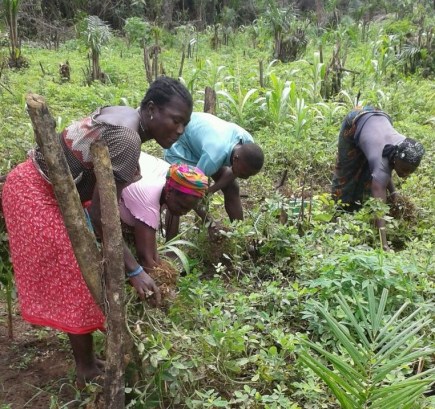
veg-groundnut-harvesting3Growing peanuts and other vegetables helps diversify crops and reduces risk for these subsistence farmers.
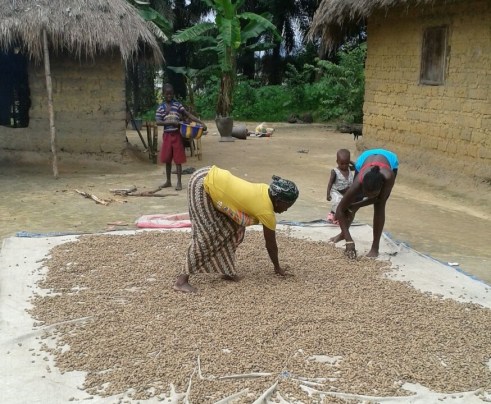
They usually have nothing left over to sell, after feeding their children one or two meals a day. Nothing left to send them to school.

They can’t get ahead when they can’t invest even $20 in seed, fertilizer or tools.

Less than a third of Sierra Leone teens attend school. That’s often because a family’s entire annual cash income won’t pay for junior/senior high school fees and uniforms costing $50.

Some families go into debt to send a child to secondary school. That’s like having a mortgage. It takes years to pay off the loan with high interest rates, making the cost 20 to 30 times the original amount.

The Women’s Vegetable Growing Project is intended as a three-year program for 450 women wanting to participate.  Sherbro Foundation funded another successful group of 75 women farmers in early 2016.

But we then ran out of money for the project.

So, nearly 400 eager women are waiting to take part to ensure food for their families throughout the year and get their children educated.

Veg - drying groundnutsResearch around the world has shown that women spend most of their income locally, helping build the local economy and small businesses. This strengthens their communities.

With your help, we can make more Bumpeh Chiefdom families productive in 2017.


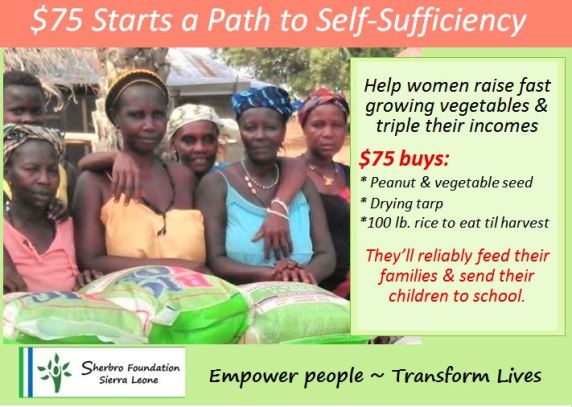
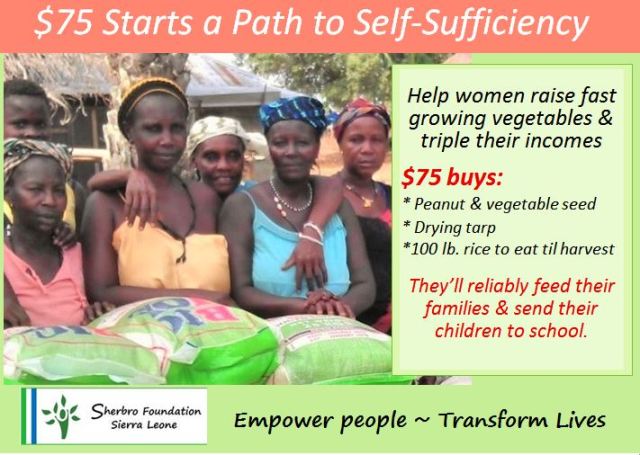
Just $75 will supply one woman vegetable farmer with peanut and vegetable seed for a half-acre garden, a drying tarp to preserve their yield and 100 pounds of rice.

Any donation will help put more families on the path to self-sufficiency.   You can donate HERE.

For the next month, we’ll even match your donation, doubling the impact of your gift!

Thank you!