It takes money to make money. This could not be more true than with the plight of subsistence farmers in Bumpeh Chiefdom.
When you only net $50 to $100 a year in cash from your farming, you don’t have enough to eat and live on. There’s nothing extra to send your children to school; pay unexpected heath care expenses; fix your leaky roof.
You definitely don’t have money to put into expanding your farming so you can grow more and earn more.
We are going to start changing that with the support of The Procter & Gamble Alumni Foundation. We are beyond grateful to start the Let Them Earn Project with a $24,000 grant from the P&G Alumni Foundation Fund of the Greater Cincinnati Foundation.

Subsistence farmers are limited by what they can grow with manual labor. Most harvests are for household food; some is bartered for local goods. That leaves little to nothing to sell for cash.
There are two things I’ve been wanting to do for some time. First, is take our work to the villages beyond Rotifunk, Bumpeh Chiefdom’s headquarters town. 75% of the chiefdom’s population lives in small, hard-to-access villages that the government and NGOs never reach. But with Paramount Chief Charles Caulker and our partner CCET-SL, we can.
Secondly, I’ve long wanted to help village women. Chief Caulker describes women as beasts of burden. They’re constantly working — farming, caring for their house and their children, cooking, lugging water and firewood. They walk miles taking a small amount of produce to market in a basin on their heads. They’ll be lucky to earn a dollar. They do all the work, and their male partners and relatives take control of the money they make.

| Chief Caulker, lower left, screened villages for the project with a series town hall meetings. He looked for industriousness (eg., backyard gardens) and willingness to comply with project terms. |
The Let Them Earn Project combines microfinance farm loans in five villages with specialized training on growing and marketing to ensure participant success. 70% of participants targeted are women.
Let Them Earn will teach small farmers to raise quick-growing vegetables as cash crops and market them in bigger city markets where prices are higher and they can earn more money. The project will help protect their earnings so they can quickly invest in expanding and growing second and third crops. This will help assure they pay back their loans and make the funding available to a new group the next year.
Typical microfinance loans charge 30% interest. That eats up the small profit farmers earn, leaving them where they started. Let Them Earn will charge zero interest. We want all earnings in their pockets, not ours. We’re commercializing CCET-SL’s tree seedling nursery to finance administrative costs when the grant ends.

Practical training
We’ve hired a professional agriculture manager with a Bachelor of Science degree in Agriculture Economics. Chief Caulker and I are impressed with Tommy Sankoh’s knowledge and the practical advice he offers on managing agriculture in a traditional rural setting.
Tommy will provide guidance on the best crops for local growing conditions. Uneducated farmers need training. But not in a classroom. To boost their success rate, he will train small farmers in demonstration gardens at their level of literacy and monitor progress of their individual farms. Training this extensive for illiterate farmers has never reached the village level.
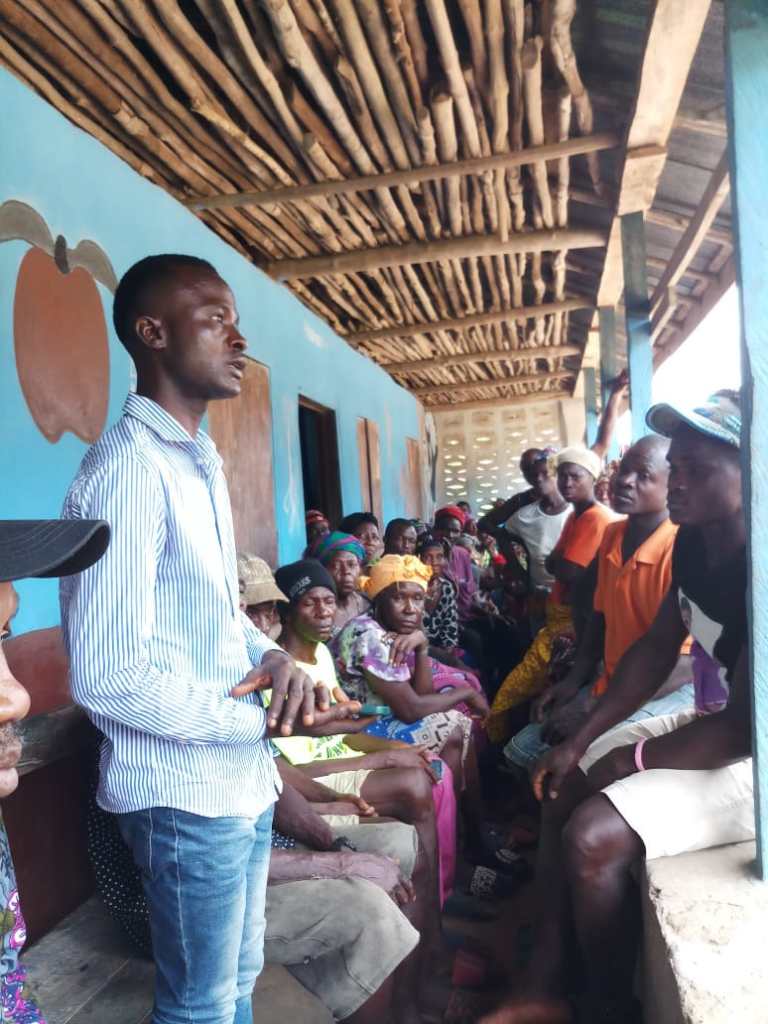
Left, at a village meeting, Tommy is well-spoken, understands project management and is hard working. Born and raised in a Bumpeh Chiefdom village, he was glad to come home after his degree and accepted Chief’s job offer.
Tommy treats the illiterate project participants with respect and quickly developed rapport. They are like his home village family and neighbors. We’re excited to think of the impact he’ll have as CCET-SL’s agriculture manager and in helping subsistence farmers develop successful small businesses.
Changing village cultural practices
Paramount Chief Caulker is using the project to change two long-held cultural practices that hold back overall development.
Chief is a tireless advocate of women. But village women traditionally don’t make decisions on use of family land independent of husbands and male relatives and embark on business development. Yet, they shoulder the responsibility to feed and care for children and elderly relatives.
Laws were enacted giving them these legal rights. But remote villages are the last to hear of laws and change comes slowly in traditional societies.
Chief Caulker will be a visible champion of Let Them Earn and use it to create women entrepreneur role models at the village level.
This will not be a simple or quick change. But Chief is skillful in using strategic carrots to change behaviors that influence longer term cultural change.
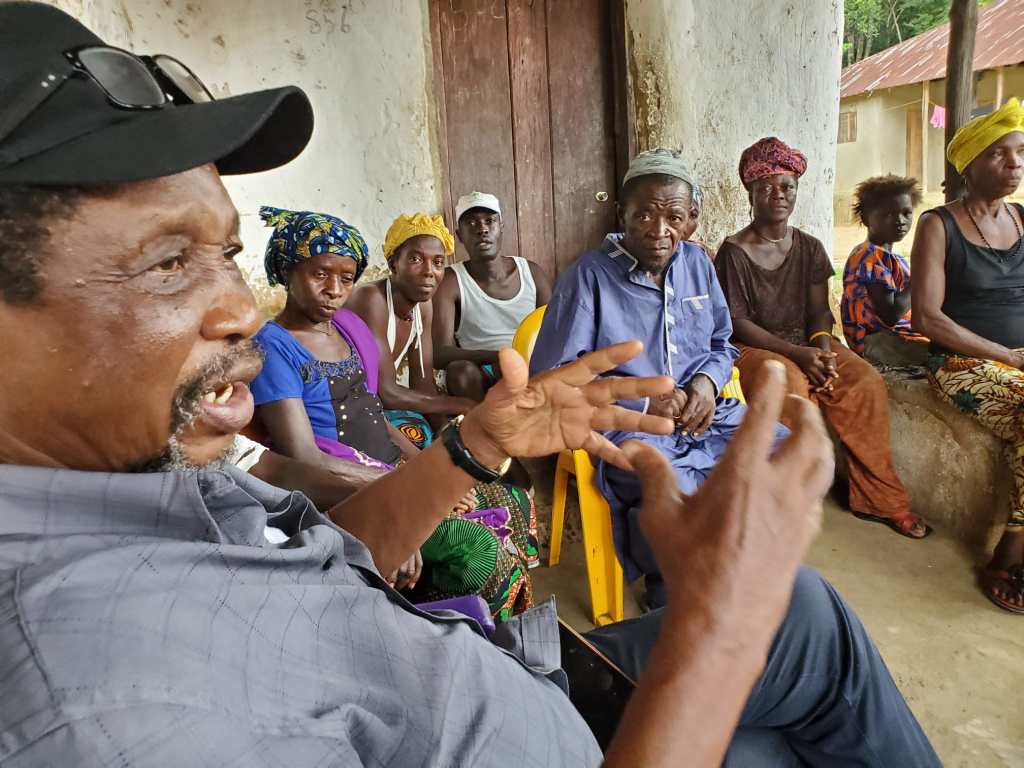
Chief Caulker, above, explained his project vision in each village and expectation for majority of women as participants. Most villages welcomed the opportunity for their women. A couple needed calibration.

Project manager Tommy Sankoh, left, interviews each candidate to verify they meet project criteria and are credit worthy for a small loan of $225.
Fatu Kallon, right, of Mobinchi village is typical of most village women with six children. Two are grown, but she cares for the others with no husband.
The project will help Fatu earn more to better sustain her family. Sending children to school is a priority for mothers. This means sending them away for secondary school to a town like Rotifunk, an expense many, if not most, families cannot afford.
It’s common that women care for 7, 8 and more children, including those of other family members, like deceased or disabled siblings.
The other practice Chief Caulker wants to eliminate is using children as farm labor. It’s common for children 8 and 10 years old to leave school and work as free labor on family farms. Once out of school, they’re unlikely to return.
A condition of being in the project is no children 15 years of age and under can be used as labor during school hours. It will be strictly enforced, with participants kicked out for violating the rule.
Project launch
I returned last week from a six-week trip to Bumpeh Chiefdom where I helped launch the project. We were excited in seeing its potential and got off to an auspicious start.

Women rejoiced in song and dance as they thanked their paramount chief for bringing them this opportunity.
Their traditional Sherbro song says, “Hold yourselves tight. Keep the family together.”
We decided to expand right away from three villages in the grant with 35 participants, to five villages and an additional 15 participants. Fifty village farmers will now get opportunities they’ve never had before.
I decided to fund the additional 15 positions. When you see how great the need is, I felt there’s no time to waste in improving the lives of village farmers. Year by year, we want to expand to cover more families in the initial villages and add on more villages.
We can’t thank the P&G Alumni Foundation enough for getting Let Them Earn off the ground. You’re helping us make an important intervention that will have generational impact! A loan of just $225 for a village farmer is life changing.
We’re feeling grateful for a successful 2023. Our partner CCET-SL delivered the best education program results yet to date. Thanks so much to all of you for helping make this happen. Because of you, children from primary school to the university level got new or improved education opportunities!
We’re looking forward to all 2024 will bring.
Sherbro Foundation wishes you and yours very Happy Holidays, Merry Christmas and Happy (belated) Hanukkah.
— Arlene Golembiewski,
Executive Director
 Sherbro Foundation